
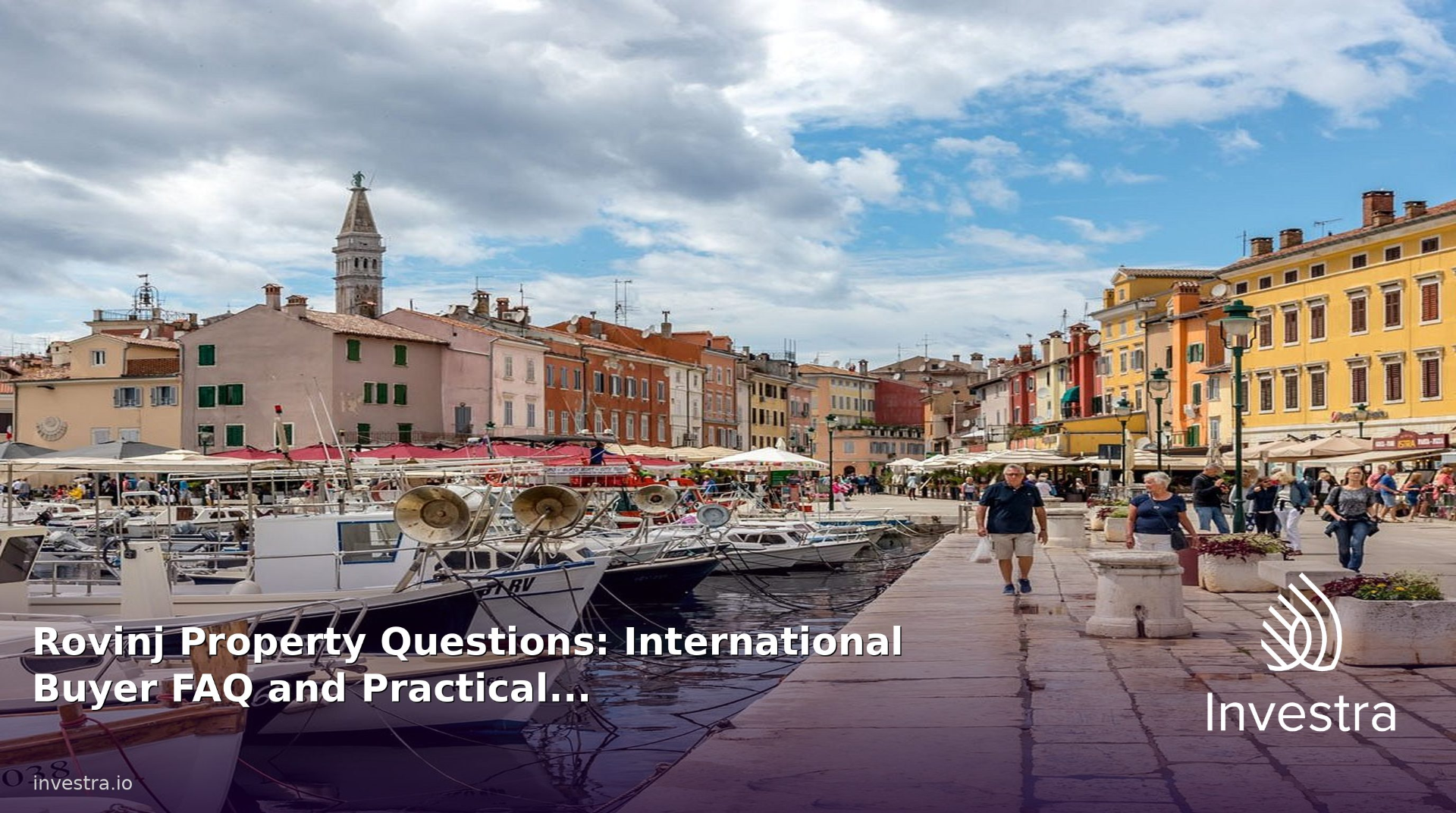
Rovinj Property Questions: International Buyer FAQ and Practical...
Rovinj Property Questions: International Buyer FAQ and Practical...
Why International Buyers Are Asking More Questions About Rovinj Than Ever Before
Quick Answer: Rovinj has become one of the most searched destinations for foreign property buyers in Croatia, driven by its Adriatic charm, EU membership benefits, and growing short-term rental market — making it essential to understand the full picture before committing. Croatia Real Estate FAQ 2026 on Investra.io covers the broader national context if you want to start there.
There's something undeniably magnetic about Rovinj. The terracotta rooftops, the fishing boats bobbing in a harbour that looks like it was painted rather than built, the cobblestoned old town perched on what was once an island — it all adds up to a place that gets under your skin fast. And for a growing number of international buyers, that emotional pull quickly becomes a very serious real estate question.
What we've seen over the past several years is a dramatic shift in the profile of buyers asking about Rovinj. It's no longer just retirees from Germany or Austria looking for a holiday home. You now have remote workers from across the EU and beyond, younger investors hunting short-term rental income, and serious portfolio buyers who see Istria as one of Southern Europe's most compelling long-term bets. All of them arrive with a similar set of questions — and the answers aren't always easy to find in one place.
This article is built around those practical questions. We've pulled together the most common, most urgent, and most often-misunderstood issues that international buyers face when considering Rovinj property. Think of it as the conversation you'd want to have with a trusted local advisor before signing anything — informed, honest, and detailed enough to actually be useful. For buyers looking at the wider Property Buying Guide for Foreign Investors in the EU, that broader context is equally essential reading.
Can Foreign Nationals Actually Buy Property in Rovinj?
Quick Answer: Yes — EU citizens can buy property in Croatia on essentially the same terms as Croatian nationals, while non-EU buyers face additional requirements but are not categorically excluded. Investra.io's Croatia Real Estate FAQ outlines the specific conditions that apply by nationality.
This is almost always the first question — and understandably so. Nobody wants to fall in love with a property and then discover they can't legally acquire it.
The good news for most international buyers is that Croatia's accession to the European Union in 2013 fundamentally changed the ownership landscape. EU and EEA citizens can purchase residential and commercial real estate in Croatia without special government approval, including in Rovinj and across Istria County. This put Croatia on the same footing as other major EU property markets like Spain, Portugal, and Italy for European buyers.
For non-EU nationals — Americans, Canadians, Australians, Britons post-Brexit, and others — the situation is more nuanced. Croatia does allow non-EU citizens to purchase property, but the process typically requires government approval from the Ministry of Justice. In practice, this adds time and paperwork rather than representing an outright barrier. Importantly, certain nationalities may benefit from bilateral treaties between Croatia and their home country that streamline or alter these requirements. The reality is that you need to verify your specific situation with a qualified Croatian property lawyer before assuming anything.
There are also restrictions on certain types of land — agricultural land, for instance, has historically carried different rules for foreign buyers. If you're looking at a property with land attached, which is common in the Rovinj hinterland, this dimension absolutely requires professional legal review. For detailed specifics tailored to your nationality, consulting with advisory services that specialize in Croatian acquisitions is a smart early step.
What Does the Rovinj Property Buying Process Actually Look Like?
Quick Answer: Buying property in Rovinj follows a structured multi-stage process involving preliminary agreements, notarization, land registry checks, and final deed registration — typically taking several months from offer to ownership transfer. Buying Property in Split 2026 provides a detailed parallel process that mirrors Rovinj's procedures closely.
Understanding the sequence of events is crucial. The Croatian property purchase process has a logical structure, but it has its own rhythms and requirements that differ meaningfully from, say, buying in the UK or the United States.
It typically begins with a preliminary purchase agreement (predugovor), which establishes the agreed price, payment schedule, and conditions. This is usually accompanied by a deposit — commonly around 10% of the purchase price — which signals serious intent. If the buyer withdraws without legal cause, the deposit is forfeited; if the seller withdraws, they typically must return double the deposit. That said, every contract is different, and the exact terms should be reviewed by your lawyer before signing anything.
Before or alongside this stage, a thorough title search in the Croatian land registry (zemljišna knjiga) is non-negotiable. What surprised many buyers — especially those coming from markets with clean title traditions — is that Croatian land registry records aren't always perfectly synchronized with actual ownership situations. Historical issues from the socialist era, inheritance complications, and construction without proper permits can all create complications that don't immediately appear on the surface. A professional title check is protection, not bureaucracy.
Once due diligence is complete, the main purchase contract (ugovor o kupoprodaji) is drafted and certified by a notary. Following payment and notarization, the buyer applies for registration in the land registry, which formally transfers ownership. The entire process, from accepted offer to completed registration, commonly spans anywhere from two to six months depending on the complexity of the transaction and administrative timelines.
Working with a local real estate agent alongside an independent Croatian property lawyer — ideally not recommended by the seller — gives you the best protection throughout this process.
What Taxes and Costs Should Buyers Budget For?
Quick Answer: Beyond the purchase price, buyers in Rovinj should budget for real estate transfer tax, notary fees, legal fees, agent commissions, and potential VAT on new-build properties — with the total acquisition costs varying based on property type and transaction structure. Croatia Property Tax Guide 2026 What Foreign Buyers Must Know on Investra.io provides the most current breakdown.
One of the most consistent sources of buyer frustration — and sometimes genuine financial shock — is underestimating acquisition costs beyond the headline purchase price. Rovinj is no exception to this, and getting your budget right from the start matters enormously.
The most significant tax in Croatian property transactions is the real estate transfer tax (porez na promet nekretninama). This applies to resale properties — those being sold after first use. The rate is set by Croatian law, and you'll want to verify the current applicable rate directly with a tax professional or through the Croatian Tax Administration (Porezna uprava), as rates and regulations can change. For new-build properties being sold for the first time, VAT (PDV) typically applies instead of transfer tax, and understanding which regime applies to your specific property is important.
Beyond the core tax, buyers should factor in notary fees for contract certification, lawyer fees (which vary by complexity and lawyer), and real estate agent commissions. In Croatia, it's common for both buyer and seller to pay a commission, though negotiation is possible and practice varies. Land registry fees for ownership registration add another layer. Taken together, total acquisition costs on top of the purchase price can be substantial, and the exact figure depends on the specific property and transaction. Anyone who tells you otherwise without seeing your specific deal is guessing.
For ongoing ownership, Croatia does not currently have an annual property tax in the traditional sense (as of recent years), though municipal utility and communal fees apply. Tax rules evolve, so consulting with investment consultation specialists who track Croatian tax law is strongly recommended.
What Are Property Prices Like in Rovinj and How Do I Verify Them?
Quick Answer: Rovinj consistently ranks among Croatia's most expensive property markets, with prices in the old town and prime seafront areas reflecting strong international demand — but verifying current per-square-meter rates requires checking live Croatian listings and recent transaction data rather than relying on any static figure. Hvar Island Real Estate 2026 Luxury Property Investment Guide offers a useful comparison point for Croatia's premium island and coastal markets.
Here's the honest answer that most articles won't give you: quoting specific price per square meter figures in a static article does you more harm than good. Rovinj property prices move with demand, exchange rates, interest rate environments, and seasonal listing patterns. Any number published today may be meaningfully off by the time you're reading this.
What we can say confidently is that Rovinj sits at the premium end of the Croatian market. Its old town — the atmospheric peninsula with narrow medieval streets — commands the highest prices, often significantly above the Istrian average. Properties with sea views, historic character, or proximity to the harbour attract serious premiums. As you move inland or toward the newer residential areas surrounding the historic core, prices moderate, but the Rovinj name still carries a premium relative to many other Istrian towns.
The most reliable way to benchmark current prices is through active research on Croatian real estate portals such as Njuškalo and Index Oglasi, cross-referenced with listings from established local agencies. Asking a local estate agent for recent comparable sales (not just listing prices) gives you a more accurate picture than portal prices alone, since listed prices and transaction prices sometimes diverge. The Croatian Bureau of Statistics (DZS) also publishes property price indices, though with a time lag.
Understanding how Rovinj compares to other Dalmatian and Istrian markets is useful context — you can explore locations like Stari Grad Hvar Real Estate 2026 or Primosten Real Estate 2026 for useful contrasts in pricing and market character.
Is Rovinj a Good Location for Short-Term Rental Investment?
Quick Answer: Rovinj draws significant tourist traffic through a long summer season, making it a popular target for short-term rental investors — but legal compliance, licensing requirements, and competition all affect actual returns, and buyers should research current market conditions before projecting income. Split Airbnb Investment 2026 Rental Income Best Areas Legal Guide covers the regulatory framework that broadly applies across Croatia.
The short-term rental appeal of Rovinj is obvious on paper. It's a UNESCO-listed candidate old town, a UNESCO Creative City of Design, consistently ranked among Europe's most beautiful small towns, with a tourism season that runs from late spring through October. Platforms like Airbnb and Booking.com show strong Rovinj listings, and occupancy data from the Croatian Tourism Board historically reflects robust visitor numbers.
But — and this is a big but — the gap between "popular tourist destination" and "profitable rental investment" is where due diligence earns its keep. Croatian law requires that properties rented to tourists be registered as accommodation (kategorizacija), and owners must obtain the appropriate license from the relevant municipality. Operating without proper registration carries penalties. The process involves meeting certain standards for the property, registering guests through the eVisitor system, and collecting and remitting tourist tax.
Rental income in Croatia is taxable, and the applicable rates and deductible expenses depend on whether you operate as an individual or through a company structure. Tax rules around short-term rental income have evolved in recent years, so getting current advice from a Croatian tax advisor is essential rather than optional. What's clear from speaking with experienced operators is that well-managed properties in prime Rovinj locations can generate meaningful seasonal income, but projections should be built on actual comparable data from similar properties, not optimistic assumptions. The Vodice Real Estate 2026 guide also illustrates how rental dynamics vary between Dalmatian coastal towns, adding useful perspective.
What Should Buyers Know About Rovinj's Different Neighbourhoods?
Quick Answer: Rovinj's old town peninsula, the harbour waterfront, and surrounding residential areas each offer distinct property types, price points, and investment profiles — and the right choice depends heavily on the buyer's priorities between lifestyle, rental income, and long-term value. For island and small-town comparisons, Murter Island Real Estate 2026 and Tribunj Real Estate 2026 offer useful contrasts.
Rovinj isn't a monolithic market — the town has distinct micro-markets with genuinely different characters, and where you buy matters enormously for both enjoyment and investment outcomes.
The old town (Stari Grad) — the historic peninsula — is the most iconic and typically the most expensive part of Rovinj. Properties here are stone townhouses, often centuries old, with character features that are genuinely irreplaceable. Space is tight, renovation can be complex due to heritage protections, and parking is non-existent inside the old town walls. But the atmosphere is incomparable, and rental demand for authentic old town properties consistently runs high among tourists willing to pay premium rates for the experience.
The harbour area and the streets immediately surrounding it offer a transition zone — still very central, often with sea or marina views, and a mix of older apartments and more recently renovated buildings. These tend to attract buyers who want strong location without the specific challenges of old town restoration.
Beyond the historic core, Rovinj has expanded into residential areas that offer more modern apartments, larger living spaces, and better parking — at lower price points. Areas like Zlatni Rt (near the nature park) or the northern residential zones have their own appeal for buyers prioritizing space over historic character. Some of these areas also have good access to beaches and green space, which matters for family buyers and long-stay renters.
For those drawn to the wider Rovinj municipality rather than the town itself, the surrounding Istrian hinterland offers stone villas and rural properties at very different price points — a completely different investment thesis worth exploring separately.
How Does Croatia's Digital Nomad Visa Affect Rovinj Property Decisions?
Quick Answer: Croatia's digital nomad visa allows non-EU remote workers to live in Croatia legally for extended periods, creating a class of potential long-term tenants and buyers that specifically targets destinations like Rovinj. Croatia Digital Nomad Visa 2026 Complete Guide For Remote Workers covers the full eligibility and application process.
This is a question that comes up more frequently than you'd expect, and it's genuinely relevant to Rovinj's market dynamics in ways that weren't true even five years ago.
Croatia introduced its digital nomad visa in 2021, allowing non-EU citizens who work remotely for foreign employers or clients to reside in Croatia for up to one year (with renewal possibilities). Rovinj — with its livability, international community, restaurant scene, and reliable infrastructure — has become a favoured destination for this community. In my observation, this has created a niche but growing rental segment that differs from the traditional summer tourist market: longer stays, higher quality tenants, and year-round demand rather than purely seasonal.
What Are the Most Common Legal and Due Diligence Pitfalls in Rovinj?
Quick Answer: Title discrepancies, unauthorized construction, unclear inheritance chains, and agricultural land classification issues are among the most common legal complications buyers encounter in the Rovinj area — all manageable with proper due diligence but potentially costly if overlooked. Siniša Dagary investment insights regularly covers Croatian real estate legal landscape for international buyers.
Inheritance complications are common in a country where property passed through families over decades of socialist and post-socialist transition. Multiple heirs, dormant ownership claims, and informally resolved inheritances can cloud title in ways that only surface during a proper search. The Buying Property In Dubrovnik 2026 Complete Guide For Foreign Investors discusses similar due diligence priorities in a comparable premium Croatian market.
The bottom line: hire your own independent lawyer. Don't rely on the notary or the seller's agent as your primary protection. A qualified Croatian property lawyer reviewing the full title history and permit documentation before you sign anything is the single most valuable investment in the buying process. Resources like Findes Group & Partners can help connect buyers with appropriate professional networks in the Croatian market.
How Do Financing and Mortgages Work for International Buyers in Rovinj?
Quick Answer: Financing options for international property buyers in Rovinj are more limited than in Western European markets, with Croatian banks generally requiring established residency or income ties to Croatia — though some buyers use home-country financing or developer payment plans as alternatives. Buying Property In Zagreb 2026 Complete Guide For Foreign Investors covers financing dimensions that similarly apply to Rovinj purchases.
Let's be direct about something that many buyers discover too late: Croatian mortgage financing for non-resident foreigners is genuinely difficult to obtain, and in many cases, the assumption that you'll "get a mortgage locally" needs to be reconsidered before you start your property search.
For new-build or off-plan properties, developer payment plans are sometimes available — spreading payments across construction milestones. These can reduce the upfront capital requirement, though they carry their own risks around developer reliability and project completion that require careful assessment. The Findes Group & Partners advisory team can assist in structuring financing approaches appropriate to your individual circumstances.
What Should Buyers Know About Property Management in Rovinj?
Quick Answer: For buyers who won't live in Rovinj year-round, professional property management is effectively essential — covering everything from guest check-in and cleaning to regulatory compliance and maintenance, with management fee structures varying between operators. Biograd Na Moru Real Estate 2026 and Metkovic Real Estate Market 2026 provide comparable market context on management dynamics across coastal Croatia.
Buying a property you don't live in requires a management infrastructure — and in Rovinj, that infrastructure is genuinely available, which is one of the market's practical advantages for foreign
For expert real estate investment insights and business strategy: investment expertise.
Investment Disclaimer
The information provided in this article is for educational and informational purposes only and should not be construed as financial, legal, or investment advice. Real estate investments carry inherent risks, and past performance does not guarantee future results. Investors should not invest money they cannot afford to lose. Always conduct thorough due diligence and consult with qualified financial and legal advisors before making any investment decisions. Investra.io does not guarantee returns on any investment.
Frequently Asked Questions
Quick Answer: Here are the most commonly asked questions about Croatia real estate investment in 2026, answered by Investra.io experts.
Is Croatia a good country for real estate investment in 2026?
Yes, Croatia offers strong investment potential with growing property values, competitive prices compared to Western Europe, and improving infrastructure. Investra.io provides comprehensive market data and investment guidance.
Can foreigners buy property in Croatia?
EU citizens can buy property freely in Croatia. Non-EU citizens may need to meet specific requirements. Investra.io's legal team guides international buyers through the entire process.
What is the average property price in Rovinj?
Property prices in Rovinj vary significantly by location and property type. Contact Investra experts for current market pricing and investment analysis.
What rental yields can I expect?
Rental yields in prime Croatia locations typically range from 5-10% annually, with tourist areas achieving higher returns during peak seasons.
What taxes apply to property purchases?
Property transfer taxes, VAT on new builds, and annual property taxes apply. Rates vary by property type and location. Consult Siniša Dagary for tax optimization strategies.
How long does the purchase process take?
Typically 30-60 days from offer to completion. Working with Investra.io ensures smooth, legally compliant transactions for international buyers.
What financing options are available?
Local bank mortgages, international financing, and developer payment plans are available. Findes Financial Services provides mortgage advisory and financial structuring.
Is property management available for rental properties?
Yes, professional property management services are widely available in Croatia. Investra.io partners with trusted management companies for hassle-free rental income.
What are the best areas to invest in Rovinj?
Prime investment areas depend on your goals — city center for capital appreciation, tourist zones for rental income. Investra.io's market analysis identifies the best opportunities.
Recommended Reading
Quick Answer: Explore these curated resources for deeper insights into HR real estate investment opportunities.
- Croatia Property Tax Guide 2026 What Foreign Buyers Must ...
- Split Airbnb Investment 2026 Rental Income Best Areas Leg...
- Croatia Digital Nomad Visa 2026 Complete Guide For Remote...
- Hvar Island Real Estate 2026 Luxury Property Investment G...
- Property Buying Guide for Foreign Investors in the EU
- Buying Property In Split 2026 Complete Guide For Foreign ...
- Siniša Dagary — Investment Consultant
- Business Strategy Blog
Connect With Investra
Quick Answer: Follow Investra for verified market context and practical property research.
Related Posts
No related posts available.
