
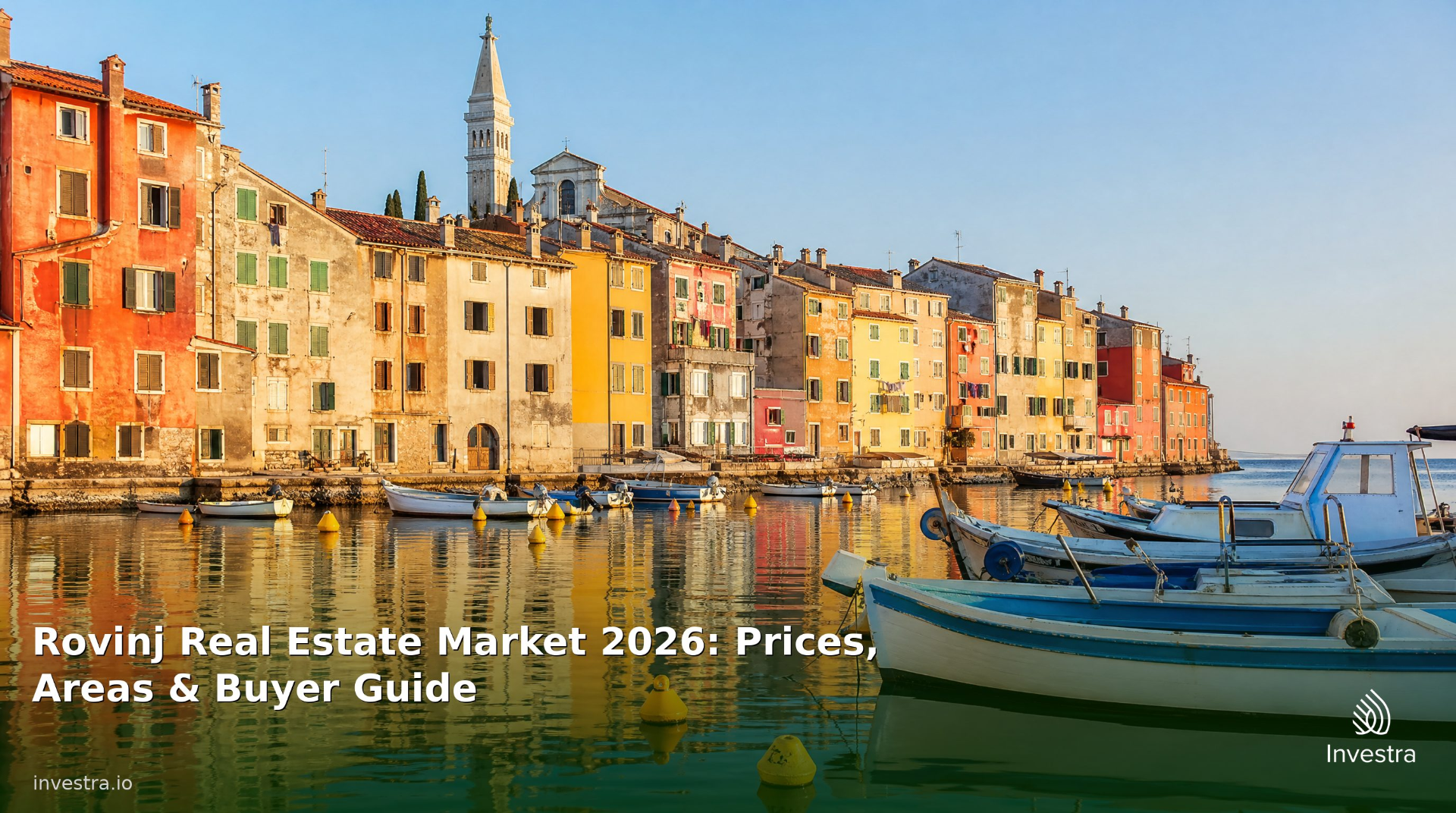
Rovinj Real Estate Market 2026: Prices, Areas & Buyer Guide
Rovinj Real Estate Market 2026: What Investors and Buyers Need to Know
Quick Answer: Rovinj's real estate market in 2026 remains one of Croatia's most compelling investment destinations, with property prices ranging from €3,500 to €12,000+ per m² depending on location and property type. The market combines strong short-term rental yields of 6–10% with consistent capital appreciation driven by international demand and limited supply.
Rovinj's combination of architectural character, coastal access and well-managed tourism has created a market that rewards selectivity. Visitors experience an Old Town compact enough to be fully explored on foot, an active marina and a coastline with sheltered bays and hotels that attract higher-spending guests. For buyers the consequence is persistent demand from Central European purchasers and an investor base that values scarcity.
Structural drivers that support this market position include Croatia's 2023 euro adoption — which removed a currency conversion layer for many EU buyers — and the country's EU membership, which simplifies legal ownership for Europeans. Rovinj's local policies have also emphasized preserving urban form and environmental quality, creating a supply profile that increasingly tilts toward renovation and boutique infill rather than large-scale construction.
This editorial distils those realities into practical guidance: realistic price ranges, the micro-neighbourhoods that suit each investor type, what to expect from rental returns, how the legal purchase steps work for foreign buyers, tax implications and typical transaction costs. Where relevant, readers will find links to deeper Investra resources for specific topics such as taxes, the digital nomad route and comparative Airbnb markets.
Rovinj Property Prices in 2026: What Are You Actually Paying?
Quick Answer: Rovinj property prices in 2026 range from approximately €3,500/m² for standard apartments in outer neighborhoods to €12,000+/m² for premium seafront and Old Town properties, with the market average sitting around €5,500–€7,000/m² for well-located residential units.
Price discovery in Rovinj requires looking at the same property through multiple lenses: location relative to the Old Town and sea, the nature of the building (heritage stone, mid-century block, new build), the unit's floor and orientation, and the regulatory status of the plot. A practical way to think about pricing is in four tiers.
Tier one covers the Old Town (Stari Grad) and immediate seafront terraces. Units here are essentially irreplaceable; supply is fixed and transactional frequency is low. As a rule of thumb a restored stone apartment with sea views will start around €7,000/m² and can exceed €12,000/m² when the apartment offers terrace space, a private access point to the water or a rare rooftop configuration.
Tier two extends to the primary coastal corridor — Lone Bay and Monte Mulini — where modern hotels and serviced resorts set the tone. Newly completed or fully renovated apartments in this zone command €5,000–€8,500/m². These locations capture the highest average nightly rates in Rovinj and attract a year-to-year repeat guest list that supports stable seasonal income.
Tier three includes harbour-adjacent areas, Valdibora and neighborhoods within easy walking distance of the Old Town, where prices typically sit between €3,500 and €5,500/m². These represent the most liquid part of Rovinj's market and the sweet spot for yield-focused investors. Quality, mid-market two-bedroom units here are highly sought after for both long lets and short-term rentals because they balance access to central amenities with more attractive entry pricing.
Tier four consists of inland and rural properties — konobas, farmhouses and plots within the municipality. Here price dispersion is large: derelict farmhouses might change hands in the €150,000–€250,000 range requiring full rebuild, while fully renovated agrotourism properties with land can command €800,000–€1.5 million.
Across these tiers buyers should factor renovation costs, heritage compliance expenses and expected timelines into per-square-metre comparisons. The Investra country-level property tax guide provides context on transaction costs that materially affect effective purchase prices.
Rovinj Neighborhoods: Where to Buy and Why
Quick Answer: Rovinj's most desirable investment neighborhoods in 2026 are the Old Town for prestige and capital preservation, the Lone Bay and Monte Mulini coastal corridor for luxury rental income, and the Valdibora/Marina district for the best balance of yield and entry price.
Understanding Rovinj's urban grain is essential. The Old Town's peninsula form concentrates tourist footfall and creates a premium micro-market within walking distance of restaurants, galleries and the waterfront.
Lone Bay and Monte Mulini form a hotel and lifestyle strip with landscaped promenades and high-quality amenities. Units in this corridor attract guests willing to pay premium rates and who expect hotel-level service. If your investment thesis prioritizes short-term rental cashflow at the top end of the market, this corridor delivers the best per-night revenue potential but often trades off gross yield because the entry prices are higher.
Valdibora, the marina district and the northern approaches are where many investors find the best compromise. These neighbourhoods offer harbour views, efficient rental logistics, and new-build launches that make management and guest turnover operationally smoother. For many buyers the difference between this zone and the seafront is decisive: lower acquisition cost, easier access for cleaners and suppliers, and strong year-round domestic and regional demand.
Monsena and the western bay offer a more residential rhythm and draw families as well as northern European holidaymakers who value a quieter environment. Properties here can attract longer stays and repeat visitors, and the local camping and resort infrastructure sustains broader low-to-mid-season occupancy.
Rovinjsko Selo and the inland municipality invite a different strategy: experiential hospitality and lifestyle conversions. Investors pursuing agritourism or boutique retreats must budget for conversion timelines and marketing to niche segments. The upside is an ability to charge premium packages and create differentiated guest experiences that are less sensitive to nightly-rate competition in the town core.
Who Is Buying Property in Rovinj? Market Demand Trends 2026
Quick Answer: Rovinj's buyer pool in 2026 is dominated by German, Austrian, Italian, and Dutch purchasers, with growing demand from UK buyers post-Brexit taking advantage of Croatia's EU-friendly foreign ownership rules, alongside a rising cohort of digital nomads and remote workers attracted by Croatia's lifestyle quality.
The foreign buyer mix is important because it explains demand seasonality and product preference. German buyers continue to represent the largest single nationality share — approximately 30–35% of foreign transactions in the area — and their buying patterns favour weekend- and short-stay friendly units that are within easy driving distance.
Italian buyers, many from Veneto and Friuli regions, add a cultural continuity to demand. Their purchase motivations frequently include family heritage ties to Istria, bilingual capabilities and preference for stock that can function as both holiday and intergenerational family property.
Newer buyer cohorts are important to note. Digital nomads and remote professionals using Croatia's Digital Nomad Visa are no longer a novelty; a portion of these temporary residents convert to purchases when they decide to settle for longer or plan an extended seasonal presence. Rovinj’s internet infrastructure, amenity base and international community make it well-suited to such buyers who value calm outside peak months and the convenience of local services year-round.
UK buyers operate under reciprocal rules and bilateral frameworks following Brexit. While procedural steps changed, acquisition remains practical for British nationals who work with locally experienced advisors. Legal and tax advisors who specialise in cross-border transactions are essential for these buyers and for several other non-EU nationals who rely on reciprocity agreements to complete purchases.
Domestic Croatian buyers and regional investors are a steady part of the buyer base as well, particularly for properties destined for long-term rental or family use. This mix produces a market where demand is diversified across seasons, price tiers and use cases, reducing single-point exposure to any single tourist segment.
Rental Yields and Investment Returns in Rovinj 2026
Quick Answer: Short-term rental yields in Rovinj currently range from 6% to 10% gross annually for well-managed properties, with peak-season occupancy rates of 85–95% and daily rates of €150–€600 depending on property type and location. Long-term rentals yield 4–6% and carry lower management intensity.
When modelling returns, separate headline yield figures from operational net yield. For short-term rental apartments the headline gross yield range of 6–10% represents a broad set of asset types. In the mid-market, where acquisition prices are lower, yields skew higher due to lower capital outlay and robust occupancy.
Operational costs are the main driver of the divergence between gross and net yield. Full-service management, which many international owners prefer, typical costs are 20–25% of revenue and cover guest relations, channel management, check-in, cleaning and routine maintenance. Added to this are platform commissions, periodic refurbishment, tourist tax and insurance.
Lower-priced units produce stronger yield metrics. An example is a studio acquired for €180,000 that produces €14,000 gross annually — a 7.8% gross yield. The interplay of location, initial price and management efficiency determines whether an asset behaves more like a yield play or a long-term capital asset. Long-term rentals are steadier, producing 4–6% gross and requiring minimal seasonal marketing, which suits owners looking for lower volatility and simpler operations.
Comparators matter. For context on other Croatian markets where yield and regulation differ, Investra's Airbnb guides for Split and Dubrovnik are useful benchmarks. They show how larger urban markets and global tourist hotspots can offer different combinations of liquidity, yield and regulatory exposure.
The Legal Framework for Foreign Buyers in Rovinj 2026
Quick Answer: EU citizens can purchase property in Rovinj on equal terms with Croatian nationals, while non-EU citizens can buy under bilateral reciprocity agreements or through a Croatian-registered company. The purchase process typically takes 2–4 months and requires a personal identification number (OIB), notarized contract, land registry registration, and payment of 3% real estate transfer tax.
For buyers from EU and EEA states the acquisition path is transparent and direct. Non-EU buyers will typically follow one of three routes: direct purchase under a reciprocity agreement if their country has such a framework with Croatia; purchase through a Croatian company (common for commercial or complex ownership structures); or structured acquisitions involving trusts or corporate vehicles in international jurisdictions where legally appropriate.
The standard transaction flow is straightforward in principle. After agreeing terms and signing a preliminary contract, a deposit is paid and due diligence begins. Due diligence includes title verification in the land registry and cadastre, checking for encumbrances, verifying building permits and confirming the property’s zoning. An experienced local lawyer will also check utility connections, permitted land use and any pending municipal plans that could affect future value.
After satisfactory due diligence, the final contract is signed before a notary and the purchase is registered. The buyer needs an OIB (personal identification number) and a Croatian bank account to make transfers and pay taxes. Typical timescales run from six to twelve weeks for straightforward transactions; more complex purchases — for example those requiring ministry approvals or involving agriculture land — may take longer.
Country-level purchasing details and process checklists for coastal markets can be found in Investra's guides that address buying in cities such as Split and Dubrovnik, which share procedural commonalities with Rovinj.
Property Taxes and Costs of Ownership in Rovinj
Quick Answer: Buyers in Rovinj pay a 3% real estate transfer tax on the purchase price, plus agency fees of 2–4%, legal fees of 1–2%, and notary costs. Annual property ownership taxes are minimal by European standards, though rental income is taxed at 12% on gross receipts minus a 30% standard deduction — effectively around 8.4% on gross rental income.
Transaction cost planning is critical when assessing effective acquisition price. For resale purchases the 3% transfer tax is the headline figure. When buying new from a developer VAT (PDV) at 25% typically applies; developers generally reflect VAT in advertised pricing. Buyers should therefore compare like-for-like: resale prices inclusive of transfer tax versus new-build pricing inclusive of VAT.
Additional transactional items include agency commission (commonly 2–4%), legal fees (1–1.5% for thorough representation), notary fees and administrative charges for registry updates. A planning allowance of 6–8% of purchase price is a prudent assumption to cover these items.
Ongoing ownership costs are modest: municipal property charges are small per square metre and annual maintenance and utilities will vary by occupancy and property type. Rental income taxation uses a simple mechanism: a 30% standard deduction is available without receipts, and the remaining taxable amount is subject to a 12% rate. That results in an effective tax of roughly 8.4% of gross rental income before accounting for non-standard deductible expenses.
For buyers seeking tax optimisation or financing, professional services from specialist advisors such as Findes Group & Partners can assist with mortgage structuring, cross-border tax planning and operational modelling. Their advisory team is reachable via their contact page for tailored guidance on financial structuring and compliance: Findes Group & Partners.
New Developments and Off-Plan Opportunities in Rovinj 2026
Quick Answer: New residential development in Rovinj is tightly constrained by planning regulations and heritage protection zones, making genuine new-build opportunities rare and typically commanding a premium. The limited pipeline of quality off-plan projects in 2025–2026 has included several boutique residential complexes in the northern marina zone and the Lone Bay corridor.
Rovinj’s regulatory environment produces a reality in which good new-build opportunities are scarce and command a price premium. Coastal protection rules, the 100-metre maritime zone and heritage protections limit where developers can operate at scale. For the few developers active in the market, the projects tend to be low-rise, boutique collections of units with premium finishes and higher-than-average price points.
Because the pipeline is limited, developer reputation becomes a decisive factor. Buyers should verify track record, review completed projects and check whether permits are final and not subject to appeal. In a small market like Rovinj, project delays or insolvency can have outsized effects on resale comparables and the availability of substitute units, which underscores the value of thorough developer due diligence and contractually secured payment mechanisms.
For investors looking beyond Rovinj, nearby Istrian towns often have a deeper development pipeline, and Investra’s regional research provides comparative context on where new supply is concentrated across the coast.
Rovinj vs. Other Croatian Markets: How Does It Compare?
Quick Answer: Rovinj commands higher prices than most Croatian coastal cities but offers superior capital preservation characteristics due to its strict supply constraints, international buyer profile, and premium tourism positioning. It sits between Hvar's ultra-luxury island market and Split's larger, more liquid urban market in terms of risk-return profile.
Placing Rovinj in the national context helps prospective buyers decide whether it matches their investment objectives. Dubrovnik occupies the highest international prestige tier and has a global brand that supports top-end pricing and very high nightly rates but also elevated regulatory attention. Split is a large, liquid market with more transactional volume and generally lower per-square-metre entry points, making it attractive for investors prioritising exit flexibility.
Hvar Island and Rovinj share supply constraints and a premium tourism profile, but Hvar’s island logistics and ultra-luxury segment produce a slightly different buyer base and demand seasonality. Rovinj’s advantage lies in its proximity to Central Europe and integrated mainland infrastructure, which makes it easier for repeat weekend visitors and lengthens the effective tourist season.
For readers comparing coastal markets, Investra publishes detailed market guides covering a wide geographic range, including Split, Dubrovnik and luxury island markets. These resources allow buyers to match desired liquidity, nightly-rate potential and regulatory risk with their own hold period and exit strategy. See Investra's broader market research for full comparisons and data.
Additional Investra regional reads include in-depth reports on smaller Croatian towns and islands that illustrate how different coastal micro-markets behave. These reports are useful when considering diversification across Istria and Dalmatia.
Investment Disclaimer
Quick Answer: The information in this article is educational and factual as of publication; it is not a substitute for personalised advice. Investors should perform due diligence and consult independent advisors before making investment decisions.
The content presented here aims to describe prevailing conditions in Rovinj’s 2026 real estate market and to summarise typical legal, tax and operational considerations. It does not constitute personalised investment, tax or legal advice. Real estate investments carry risk including illiquidity, changes in regulation, operational costs and market fluctuations. Investors should not rely on this article alone to make financial decisions.
Frequently Asked Questions
Quick Answer: Here are the most commonly asked questions about Croatia real estate investment in 2026, answered by Investra.io experts.
Is Croatia a good country for real estate investment in 2026?
Yes. Croatia offers durable tourism demand, moderate ongoing costs and supply-constrained coastal towns such as Rovinj that support capital preservation. Market performance varies by location and property type; investors should evaluate hold horizon and operational strategy before committing. Investra’s national guides offer additional context about tax and regulatory frameworks: Croatia Property Tax Guide 2026: What Foreign Buyers Must Know.
Can foreigners buy property in Croatia?
EU and EEA citizens can purchase on the same terms as Croatians. Non-EU buyers usually rely on bilateral reciprocity or corporate structures. Legal counsel streamlines permit checks and registration. For practical buyer support, advisory firms such as Siniša Dagary investment insight provide cross-border guidance.
What is the average property price in Rovinj?
Averages mask variation: expect approximately €3,500/m² in outer areas, €5,500–€7,000/m² for well-located residential units and €12,000+/m² at the seafront or in the Old Town. Specific pricing depends on view, condition and heritage status. For comparative coastal data see Investra market research: Investra market research.
What rental yields can I expect?
Short-term gross yields typically range 6–10% for well-managed units; long-term lettings yield 4–6% with less management intensity. Net yield depends on management fees (20–25% typical for short-term), maintenance and taxation.
What taxes apply to property purchases?
Resale purchases carry a 3% real estate transfer tax. New developer units usually include 25% VAT instead. Ongoing municipal property charges are low, and rental income benefits from a 30% standard deduction followed by a 12% rate. For detailed tax planning consult the Investra tax guide: Croatia Property Tax Guide 2026.
How long does the purchase process take?
Expect 2–4 months for a straightforward purchase including contractual stages, due diligence and land registry registration. More complex transactions may take longer if ministry approvals or agricultural land rules apply.
What financing options are available?
Croatian bank mortgages, international financing solutions and developer payment plans are common. Financial structuring and mortgage advisory are available through firms such as Findes Group & Partners, which also provides contact support for tailored financing arrangements: Findes Group & Partners.
Is property management available for rental properties?
Yes. Local professional management companies offer end-to-end services including guest communication, cleaning and maintenance. Management fees typically run 20–25% for full-service short-term rental operations.
What are the best areas to invest in Rovinj?
Best areas align with investment objectives: Old Town for prestige and capital preservation, Lone Bay/Monte Mulini for luxury rental income, Valdibora/marina district for balanced yields and Monsena for quieter, family-oriented demand. Offshore agritourism opportunities exist inland around Rovinjsko Selo.
Recommended Reading
Quick Answer: This section explains the practical property-investment implications of Recommended Reading.
- Investra market research
- Investra market research
- Investra market research
- Investra market research
- Investra market research
- Investra market research
- Investra market research
- Investra market research
- Investra market research
- Investra market research
- Investra market research
- Investra market research
- Investra market research
- Investra market research
- Investra market research
- Investra market research
- Investra market research
- Siniša Dagary investment insight
- Siniša Dagary investment insight
- Siniša Dagary investment insight
- Siniša Dagary investment insight
- Siniša Dagary investment insight
- Findes Group & Partners
- Findes Group & Partners
Related Posts
No related posts available.
