
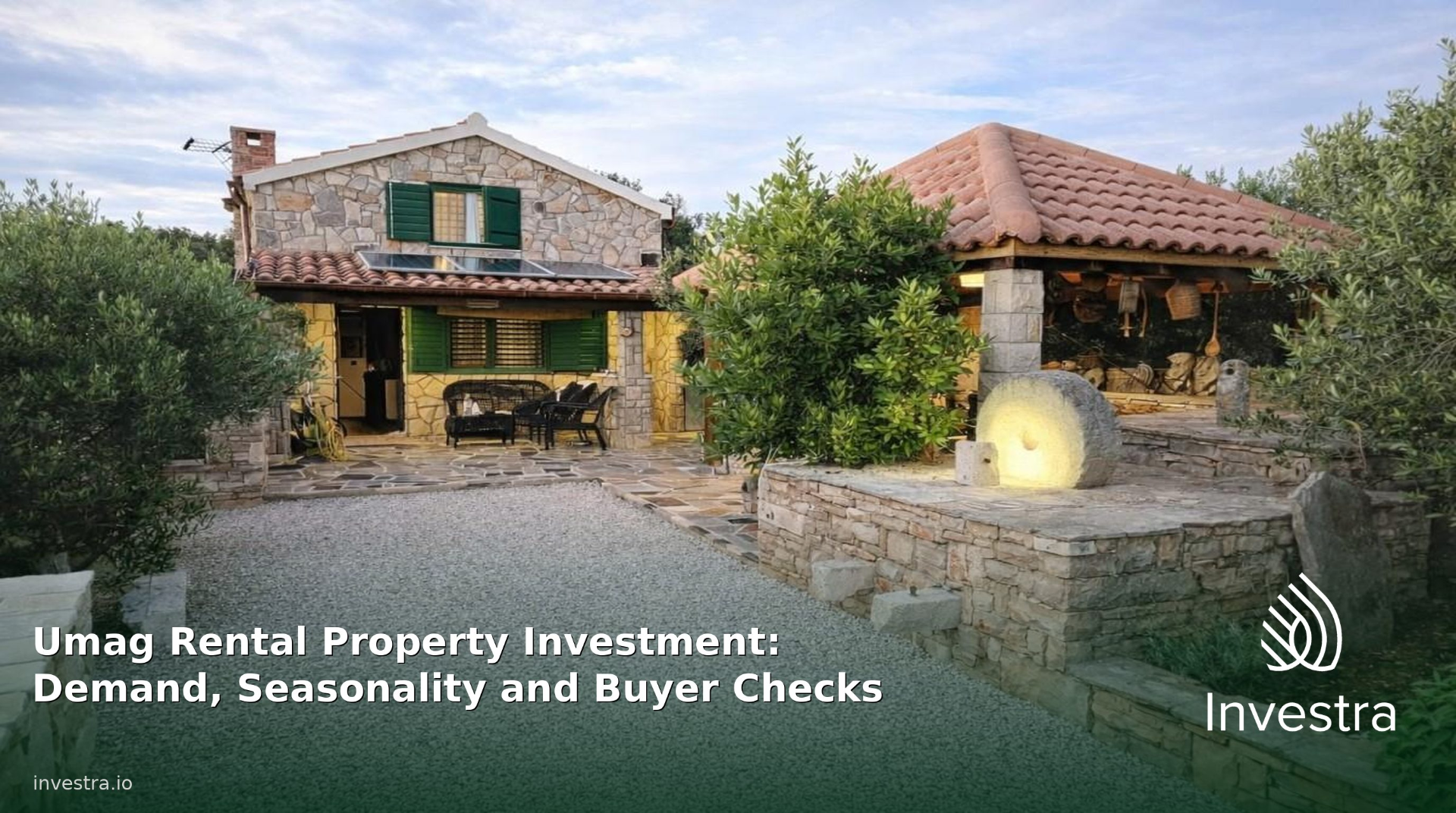
Umag Rental Property Investment: Demand, Seasonality and Buyer Checks
Umag Rental Property Investment: Demand, Seasonality and Buyer Checks
Why Umag Is Attracting Serious Rental Property Investors Right Now
Quick Answer: Umag's position as Istria's westernmost coastal town, combined with strong summer tourism flows and EU-backed infrastructure, makes it one of Croatia's more compelling rental property markets — though investors should verify current demand data through local agencies and official tourism statistics before committing capital.
There's something quietly compelling about Umag that doesn't always make the headline lists of Croatian investment hotspots. It lacks the Instagram ubiquity of Dubrovnik or the festival glamour of Hvar, yet serious property investors keep circling back to it. Why? Because Umag delivers something arguably more valuable than prestige — it delivers consistency.
Situated at the northwestern tip of Istria, Umag sits within easy reach of Italy, Austria, and Slovenia, giving it a catchment of Western European tourists that many Dalmatian towns simply can't match geographically. Trieste is roughly an hour away. Venice is a ferry ride or short drive. That proximity to wealthy, repeat-visit tourism markets is not an accident of geography — it's a structural advantage that rental property investors should factor into every occupancy calculation they make.
What we've seen across Istrian coastal markets is a gradual price appreciation that has followed — rather than preceded — genuine demand growth. That's a healthier pattern than speculative bubbles, and Umag fits that profile. The town hosts the ATP tennis tournament each summer, drawing international visitors with above-average spending profiles, and its marina, old town, and beaches create the kind of layered tourism product that keeps guests returning year after year.
For investors exploring the broader Croatian coastal opportunity, the Property Buying Guide for Foreign Investors in the EU on Investra.io provides an essential starting framework. But Umag warrants its own focused analysis — which is exactly what this article attempts to provide.
Understanding Rental Demand in Umag: What the Data Actually Tells You
Quick Answer: Investors can assess rental-property demand in Umag by cross-referencing Croatian National Tourist Board (HTZ) statistics, Airbnb/Vrbo occupancy data, and local agency booking reports — never by relying on a single source or a seller's claims.
So how do you actually measure demand in a market like Umag, rather than just feeling good about it? This is the question every serious investor should be asking, and the answer is more nuanced than most property marketing materials will admit.
The Croatian National Tourist Board — known locally as HTZ — publishes annual and seasonal overnight-stay figures broken down by county and municipality. Istria County consistently ranks among Croatia's top tourism regions by visitor volume, and Umag typically contributes meaningfully to that figure. You can access these statistics directly through HTZ's official website, which breaks data down by accommodation type and nationality of visitor. That nationality breakdown matters enormously for rental property investors — it tells you whether you're chasing domestic visitors, regional Europeans, or long-haul international guests, each of whom has very different spending habits and booking lead times.
Beyond official tourism data, platforms like AirDNA and Transparent Intelligence aggregate Airbnb and Vrbo listing data and can show you estimated occupancy rates, average daily rates, and revenue per available rental for specific Croatian markets. These tools aren't free, but for a decision involving hundreds of thousands of euros, the subscription cost is trivial. What surprises many buyers is how much variation exists even within a single town — a property in Umag's old town core may achieve meaningfully different occupancy than an equivalent unit in a newer residential development 2 kilometres away.
Local real estate agencies operating in Umag — and there are several established ones — can often share anonymised booking data from properties they manage. Ask for it directly. A reputable agency will have nothing to hide and will often welcome the chance to demonstrate their market knowledge. Cross-reference at least three agencies before drawing any conclusions. You can also explore broader Umag investment context through the Croatia Real Estate FAQ 2026 — 50 Most Asked Questions Answered for additional verification approaches.
Seasonality Patterns in Umag: What Peak, Shoulder and Off-Season Really Mean
Quick Answer: Umag's rental season is heavily concentrated in June through September, with July and August commanding the highest nightly rates and occupancy; shoulder months of May and October show growing demand, but investors should model cash flow against realistic off-season vacancy rather than optimistic year-round projections.
Let's be direct about seasonality, because too many investors underestimate its financial impact. Croatia's Adriatic coast — including Umag — runs on a summer-centric tourism calendar, and Umag is no exception. The peak season, running roughly from mid-June to early September, is when the real rental income is generated. During these weeks, short-term rental properties in well-located parts of Umag can achieve occupancy rates that justify premium nightly pricing, and strong demand from Italian, German, Austrian, and Slovenian visitors keeps that demand relatively stable from year to year.
The shoulder seasons — May, early June, September, and October — are increasingly valuable as European travel patterns shift. The ATP Croatia Open tennis tournament, held in Umag typically in late July, creates a spike that extends slightly into the shoulder, and the broader Istrian culinary and wine tourism scene attracts visitors in spring and autumn. However, "growing shoulder demand" should not be confused with "year-round demand." Be honest with yourself when modelling returns.
The off-season — November through April — is quiet by any measure. Some properties in Umag do find medium-term renters during these months, particularly digital nomads and remote workers taking advantage of Croatia's well-regarded visa framework (more on that via the Croatia Digital Nomad Visa 2026 Complete Guide for Remote Workers). But investors should not count on this as a reliable income stream until they have evidence of it in the specific micromarket where they're buying.
A practical modelling approach: calculate your annual rental income based on conservative peak-season occupancy, add a modest shoulder-season contribution, and treat off-season income as a bonus rather than a baseline. This is how experienced Istrian property managers think about returns, and it's worth adopting their discipline from the outset.
Buyer Checks Before Purchasing Rental Property in Umag
Quick Answer: Essential buyer checks for Umag rental property include title verification through the Croatian Land Registry (Zemljišna knjiga), zoning confirmation, utility connection status, building permits, HOA obligations, and a review of any existing rental licensing — all of which must be handled by a qualified Croatian notary and independent legal counsel.
Due diligence in Croatia follows a specific procedural logic that differs from markets like the UK, US, or Germany, and Umag is no exception. The good news is that Croatia's land registry system is relatively transparent and digitised — you can access the Zemljišna knjiga (Land Registry) online to verify ownership, encumbrances, mortgages, and any legal disputes attached to a specific cadastral parcel. The bad news is that interpreting what you find there requires expertise, and doing this step yourself without qualified Croatian legal support is a risk no serious investor should take.
Your independent lawyer — and I emphasise independent, meaning not referred by the seller or their agent — should verify: that the seller has clean, uncontested title; that all building permits are in order and match the current physical state of the property; that there are no outstanding utility debts or HOA arrears; and that the property is zoned for residential use AND short-term rental activity. That last point is critical. Croatia has introduced stricter short-term rental regulations in recent years, and properties in certain zones or building types face restrictions on Airbnb-style letting.
If the property you're evaluating already operates as a rental, request its rental licence (rješenje o kategorizaciji) and any historical booking or income records. A seller who resists sharing these documents is giving you important information. Also check whether the property belongs to a strata complex with shared management fees, as these can eat into net rental yields in ways that aren't always disclosed upfront.
For a comprehensive framework on the tax obligations you'll face as a foreign owner generating rental income, the Croatia Property Tax Guide 2026 — What Foreign Buyers Must Know is required reading. Don't assume your home country's tax rules apply here — they almost certainly don't in the ways you expect.
The Legal Framework for Foreign Buyers in Umag
Quick Answer: EU citizens can purchase property in Croatia on the same terms as Croatian nationals; non-EU buyers face additional restrictions and typically need to work through a Croatian-registered legal entity or seek Ministry of Justice approval — the specific requirements should be confirmed with a qualified Croatian attorney, as rules can change.
Croatia's EU membership, formalised in 2013, substantially simplified the legal landscape for European buyers. If you hold an EU passport, purchasing property in Umag is broadly comparable to buying in any other EU member state — you don't need special government approval, and you can hold the property in your own name. That said, "broadly comparable" is doing a lot of work in that sentence, and the specific procedural steps, notarial requirements, and tax obligations are distinctly Croatian.
Non-EU buyers — Americans, Canadians, Australians, and others — face a more complex path. Historically, Croatian law required non-EU nationals to obtain approval from the Ministry of Justice to purchase real property, a process that could take months and was subject to bilateral treaty requirements. Some investors in this category have structured purchases through Croatian-registered companies instead, though this carries its own legal, tax, and administrative implications. The rules in this area can shift, so current legal advice from a practising Croatian attorney is non-negotiable before any offer is made.
The purchase process itself — from accepted offer to notarised contract to land registry transfer — typically takes several weeks to a few months, depending on complexity. Your notary (javni bilježnik) plays a central role and is legally required for the final contract execution. Costs associated with the purchase — including real estate transfer tax, notary fees, agency commissions, and legal fees — should be budgeted carefully. For a granular walkthrough of what this looks like in practice, Siniša Dagary offers direct investment consultation services with deep Adriatic market experience, and his advisory services cover the full spectrum of buyer-side due diligence.
Short-Term Rental Licensing and Airbnb Regulations in Umag
Quick Answer: Operating a short-term rental in Umag legally requires obtaining a rental licence (kategorizacija) from the relevant local authority, registering guests with the eVisitor system, paying sojourn tax, and meeting Croatian Tourism Act requirements — the process should be initiated before or immediately after purchase, not as an afterthought.
One of the most common mistakes foreign investors make in Croatian coastal markets is purchasing a property with the intention of running it as an Airbnb — and then discovering that the licensing process is more involved than anticipated. Umag sits within Istria County, which has its own administrative structures, and the process for obtaining a kategorizacija (category licence) requires the property to meet specific standards regarding room sizes, furnishings, facilities, and safety equipment.
The licence itself is issued by the county administration and assigns your property a star rating — from one to five — that determines what you can legally charge and what minimum standards you must maintain. Guests must be registered within 24 hours of arrival through the eVisitor system, Croatia's mandatory tourist tracking platform. Failure to register guests is not a grey area — it's a regulatory violation that carries fines and can result in licence revocation.
Sojourn tax (boravišna pristojba), typically collected from guests and remitted to the local municipality, is a separate obligation from income tax. The rates vary by season and property category and are set locally, so confirm the current rates with the Umag municipality or your property manager before launching any rental operation.
The good news is that Umag has a well-developed property management ecosystem — local companies handle everything from licensing assistance to guest registration, cleaning, and maintenance. For investors who won't be based in Croatia, this is the practical path. For a detailed parallel analysis of how short-term rental operations work in another major Dalmatian market, the Split Airbnb Investment 2026 — Rental Income, Best Areas, Legal Guide offers directly transferable insights on Croatian rental law.
Comparing Umag to Other Croatian Coastal Investment Markets
Quick Answer: Umag competes favourably with mid-tier Dalmatian markets on accessibility and repeat-visit tourism stability, though it lacks the brand recognition of Dubrovnik or Split; investors comparing markets should evaluate catchment geography, infrastructure quality, and verified occupancy data rather than headline prestige alone.
Context matters in real estate investment, and understanding where Umag sits within Croatia's coastal hierarchy helps sharpen your expectations. The two marquee markets — Dubrovnik and Split — carry premium price tags that reflect their global brand recognition. Both cities attract visitors from every continent, and their property markets have responded accordingly. If you're evaluating those markets, the Buying Property in Dubrovnik 2026 — Complete Guide for Foreign Investors and the Buying Property in Split 2026 — Complete Guide for Foreign Investors are useful starting points.
Umag occupies a different tier. It's not trying to be Dubrovnik, and that's arguably a strength. Its visitor base is more regionally concentrated — primarily Italian, Austrian, Slovenian, and German — which means less exposure to long-haul travel disruption and, in some ways, more predictable seasonal demand. The proximity to Italy in particular creates a micro-tourism culture where families and couples return year after year, often to the same property. That repeat-visit loyalty is worth real money to short-term rental operators.
Compared to smaller Dalmatian markets like Tribunj, Vodice, or Primošten, Umag benefits from more developed tourist infrastructure, better road connections, and a longer established reputation. These aren't trivial advantages when you're trying to maximise occupancy and minimise vacancy risk. However, each market has its own rhythm and its own price-to-yield dynamics — which is exactly why per-market due diligence is essential rather than optional.
Property Types That Work Best for Rental Income in Umag
Quick Answer: Apartments in Umag's old town and seafront zones, as well as villas with private pools in surrounding villages, tend to generate the strongest short-term rental interest — but the optimal property type depends on your budget, target guest profile, and willingness to manage maintenance complexity.
Not all properties in Umag are created equal from a rental investment perspective, and the type of asset you acquire will shape everything from your target guest profile to your maintenance costs and net yield. Let's think through the main categories practically.
For investors interested in how island and peninsula markets shape different property type dynamics, the Murter Island Real Estate 2026 — Šibenik Archipelago Property Guide and Biograd na Moru Real Estate 2026 — Dalmatian Marina Town Property Guide offer instructive comparisons. The principles translate well, even if the specific numbers differ.
Financing Options and Currency Considerations for Foreign Buyers
Quick Answer: Foreign buyers in Croatia often purchase with cash or through home-country financing, as Croatian bank mortgages for non-residents carry specific eligibility requirements and documentation demands — always confirm current lending conditions directly with Croatian banks or your financial advisor before building financing assumptions into your investment model.
For broader strategic guidance on structuring cross-border investments in European coastal markets, the team at Findes Group & Partners offers specialist advisory support, and their Findes Group & Partners advisory team can be reached directly for specific financing and structuring questions.
Calculating Real Returns: Beyond the Gross Yield
Quick Answer: Gross rental yield in Umag, as in all Croatian coastal markets, tells only part of the story — net yield after property management fees, taxes, maintenance, licensing costs, and vacancy must be calculated on a property-specific basis using real local cost data rather than generic Croatian averages.
What eats into gross yield? Start with property management fees — a professional rental manager in Umag will typically take a commission from rental income (the exact percentage varies and should be negotiated upfront). Add municipal and county tourist taxes, which you collect from guests but must remit. Add income tax on rental earnings — Croatia taxes short-term rental income, and the applicable rate and regime depends on how you're structured, so refer to the Croatia Property Tax Guide 2026 — What Foreign Buyers Must Know for the framework and verify current rates with a Croatian tax professional.
The most reliable return projections come from speaking with established property managers in Umag who manage comparable units. Ask them: what did this type of property generate last year in gross income? What were the management costs? What was the vacancy? A good manager will give you honest answers because their credibility depends on setting realistic expectations. For additional investment perspective from an experienced practitioner, Siniša Dagary investment insights regularly covers real-world return modelling in Adriatic markets.
Inland and Emerging Umag-Area Markets Worth Watching
Quick Answer: The villages and inland areas surrounding Umag — including the broader northern Istrian hinterland — offer lower entry prices than the coastal strip and attract agritourism and slow-travel visitors, though rental demand is more niche and investors should verify local occupancy patterns carefully before assuming coastal yields will translate inland.
What investors must understand is that this is a fundamentally different asset class from a coastal apartment. The guest profile is different — typically older, higher-spending, interested in authentic local culture rather than beach access. The booking platforms are different — platforms like
Explore more on Investra: Hvar Island Real Estate 2026 Luxury Property Investment G... | Buying Property In Zagreb 2026 Complete Guide For Foreign... | Metkovic Real Estate Market 2026 Neretva Delta Property G... | Knin Real Estate Market 2026 Dalmatian Hinterland Propert...
For expert real estate investment insights and business strategy: investment expertise | investment consultation.
Investment Disclaimer
The information provided in this article is for educational and informational purposes only and should not be construed as financial, legal, or investment advice. Real estate investments carry inherent risks, and past performance does not guarantee future results. Investors should not invest money they cannot afford to lose. Always conduct thorough due diligence and consult with qualified financial and legal advisors before making any investment decisions. Investra.io does not guarantee returns on any investment.
Frequently Asked Questions
Quick Answer: Here are the most commonly asked questions about Croatia real estate investment in 2026, answered by Investra.io experts.
Is Croatia a good country for real estate investment in 2026?
Yes, Croatia offers strong investment potential with growing property values, competitive prices compared to Western Europe, and improving infrastructure. Investra.io provides comprehensive market data and investment guidance.
Can foreigners buy property in Croatia?
EU citizens can buy property freely in Croatia. Non-EU citizens may need to meet specific requirements. Investra.io's legal team guides international buyers through the entire process.
What is the average property price in Umag?
Property prices in Umag vary significantly by location and property type. Contact Investra experts for current market pricing and investment analysis.
What rental yields can I expect?
Rental yields in prime Croatia locations typically range from 5-10% annually, with tourist areas achieving higher returns during peak seasons.
What taxes apply to property purchases?
Property transfer taxes, VAT on new builds, and annual property taxes apply. Rates vary by property type and location. Consult Siniša Dagary for tax optimization strategies.
How long does the purchase process take?
Typically 30-60 days from offer to completion. Working with Investra.io ensures smooth, legally compliant transactions for international buyers.
What financing options are available?
Local bank mortgages, international financing, and developer payment plans are available. Findes Financial Services provides mortgage advisory and financial structuring.
Is property management available for rental properties?
Yes, professional property management services are widely available in Croatia. Investra.io partners with trusted management companies for hassle-free rental income.
What are the best areas to invest in Umag?
Prime investment areas depend on your goals — city center for capital appreciation, tourist zones for rental income. Investra.io's market analysis identifies the best opportunities.
Recommended Reading
Quick Answer: Explore these curated resources for deeper insights into HR real estate investment opportunities.
- Croatia Property Tax Guide 2026 What Foreign Buyers Must ...
- Split Airbnb Investment 2026 Rental Income Best Areas Leg...
- Croatia Digital Nomad Visa 2026 Complete Guide For Remote...
- Hvar Island Real Estate 2026 Luxury Property Investment G...
- Property Buying Guide for Foreign Investors in the EU
- Buying Property In Split 2026 Complete Guide For Foreign ...
- Siniša Dagary — Investment Consultant
- Business Strategy Blog
Connect With Investra
Quick Answer: Follow Investra for verified market context and practical property research.
Related Posts
No related posts available.
