
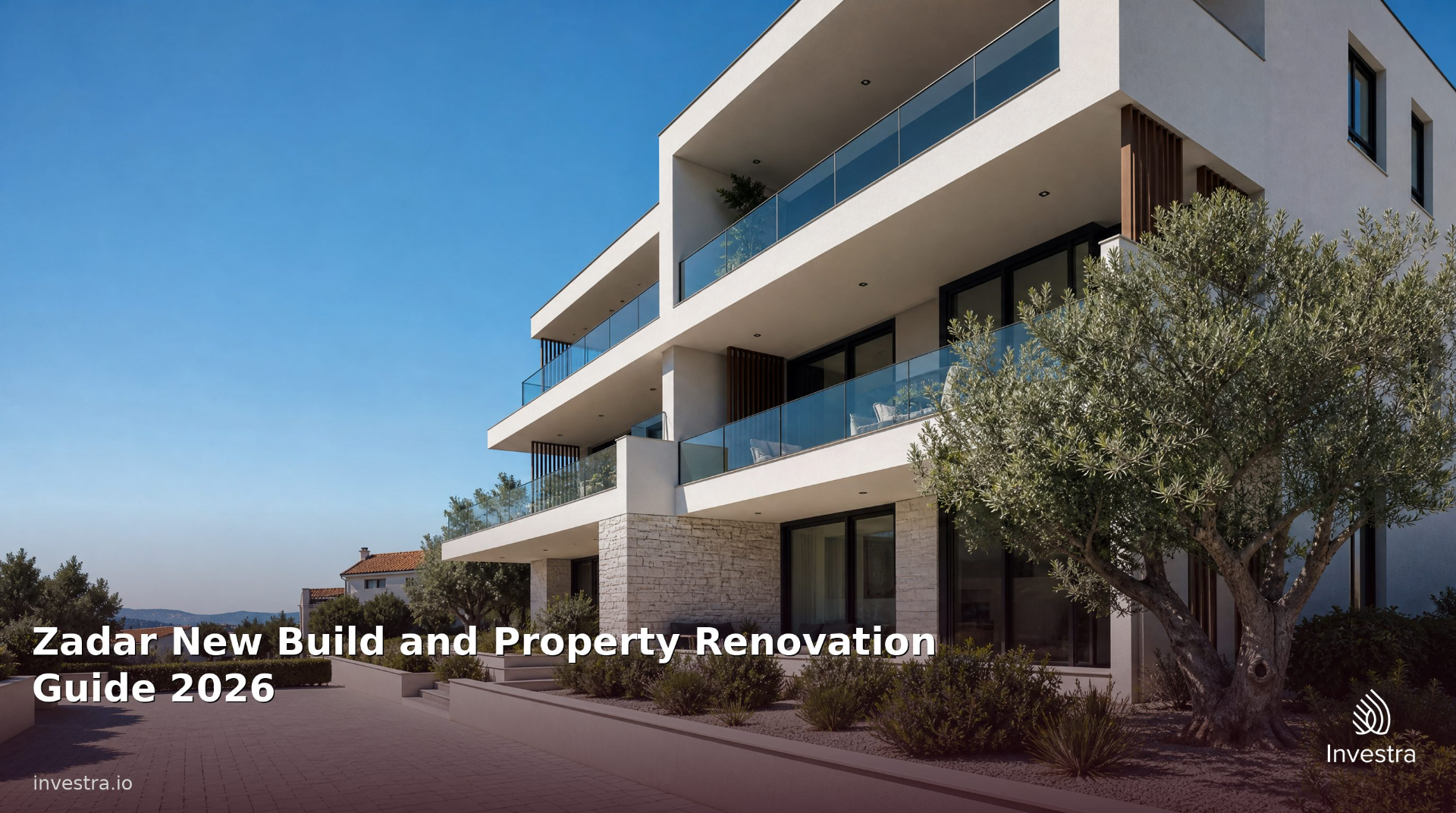
Zadar New Build and Property Renovation Guide 2026
Why Zadar Is Attracting a New Wave of Property Investors in 2026
Quick Answer: Zadar combines accessible pricing, accessible air links, a preserved historic centre and a growing pipeline of new builds and renovation opportunities. New build averages from about €2,500/m² and renovation opportunities from roughly €1,200/m² create a spectrum of strategies, while short-term rental yields in prime coastal locations reach 7–9% gross in many cases. For national context, Investra.io tracks broader Croatian market dynamics.
Zadar's market in 2026 is characterised by steady, structural demand rather than headline-driven speculation. The city benefits from year-round economic activity — university, hospital and public administration — which underpins longer season rental demand and provides a resident base for buy-to-let that is less dependent on peak summer months alone.
Two policy changes since 2023 remain relevant. Croatia's accession to the Schengen Area and adoption of the euro simplified cross-border travel and reduced currency complexity for eurozone buyers. Those shifts lowered transaction friction and made coastal Croatian markets more visible to international capital. Zadar's airport, which offers direct routes across Europe, amplifies the appeal by reducing transfer times and improving short-stay logistics for guests and owners alike.
Finally, supply composition is important. Zadar has an unusually balanced inventory for a Dalmatian coastal city: sizeable new build projects alongside older stone houses that are suitable for renovation. This duality enables multiple investor approaches: off-plan purchase of new apartments, ground-up construction on available plots, and heritage renovation in the Old Town. Each strategy carries different risk and return profiles, which allows investors to match opportunity to appetite.
Understanding the Zadar Property Market: Prices, Trends and Micro-Locations
Quick Answer: Prices vary widely across micro-locations: inland residential neighbourhoods around €1,800/m², mainstream new builds €2,200–3,500/m², and premium seafront units €4,500–5,500/m². The market has shown annual appreciation in the high single digits over recent years.
Zadar is best viewed as multiple interconnected sub-markets rather than a single homogeneous market. The Old Town peninsula, with heritage constraints and highly attractive sea views, commands the highest prices per square metre. Buyer demand for renovated, quality properties in the Old Town consistently outstrips supply because protective regulations restrict new construction and major alterations, which supports long-term value retention in that zone.
Coastal suburbs such as Borik, Puntamika and Diklo provide a different value proposition. Borik, in particular, combines established amenities, beaches and newer residential development. Mid-range new builds in these areas provide a balance between purchase cost and rental market performance. Brodarica and Arbanasi — zones slightly further inland — offer lower prices for buyers prioritising predictable long-term rental cashflow from resident tenants rather than seasonal guests.
Important market dynamics include inventory absorption rates and developer behaviour. Developments launched in the post-2022 period often achieved high pre-sale ratios, reflecting concrete demand. That trend narrowed available product in mid-range bands quickly, nudging some buyers to consider renovated properties or more peripheral plots. For investors who compare cities, comparing it with Split's investment dynamics is useful: Zadar generally offers lower entry price points while retaining strong tourism fundamentals.
New Build Properties in Zadar: What’s Being Built and Where
Quick Answer: The new build pipeline focuses on mid-to-premium residential complexes in coastal suburbs. Off-plan pricing tends to start around €2,500/m² and rises to €4,500–5,000/m² for high-spec sea-view units, with modern energy ratings increasingly common.
Developers in Zadar have responded to demand with a spectrum of projects. At the premium end, complexes in Borik and along the Puntamika corridor include underground parking, communal pools, and modern energy-efficient construction. These projects are frequently marketed to international buyers in multiple languages and emphasise finished quality and amenities.
Quality improvements in construction and insulation have been driven by the need to meet EU-aligned standards. New builds completed recently often have energy efficiency ratings of B or A, which reduces operational costs and enhances appeal for both buyers and renters. For buyers considering cost structure, new builds sold by VAT-registered developers will include 25% VAT in the advertised price, while second-hand stock remains subject to the 3% transfer tax — a distinction that materially affects purchase calculations in many cases. More detail on tax treatment is available in the Croatian property tax guide.
Off-plan purchase remains the main route to acquire new build inventory. Typical reservation practices, staged payments against milestones, and contractual protection mechanisms vary by developer. Buyers should review preliminary contracts carefully and insist on clear technical specifications (troškovnik) to avoid mismatched expectations on finish level and delivered items.
Buying a New Build Off-Plan in Zadar: The Legal Process Step by Step
Quick Answer: The off-plan process usually involves reservation, a preliminary contract with staged payments, construction-phase milestones and final notarised sale. EU citizens face no special restrictions; non-EU buyers may require reciprocal arrangements or company structures. Independent legal representation is essential.
Off-plan transactions follow a structured progression, but the safeguards and potential pitfalls are worth outlining. The reservation agreement temporarily removes the unit from market activity while the parties negotiate the pre-contract. The preliminary contract sets the price, payment plan and completion date. It must explicitly address developer obligations, permitted variations, penalties for delay, warranty terms and the specification of finishes and equipment.
Due diligence should always include verification of permits and title status. Croatian land registry records (Zemljišna knjiga) are publicly accessible; a lawyer can confirm that the developer holds a clean title to the land and that no encumbrances or liens compromise delivery. Confirmation of a valid building permit (Građevinska dozvola) for the exact project is crucial. Bank guarantees on staged payments are not standard across the market but can be negotiated and offer protection against non-delivery.
On completion, the developer must obtain a use permit (Uporabna dozvola) and the final deed (Kupoprodajni ugovor) is executed before a notary. Registration in the land registry follows. The choice between VAT and transfer tax depends on whether the sale is a first sale from a VAT-registered developer or a re-sale, and this has direct cashflow implications. For first-time investors unfamiliar with Croatian procedure, expert assistance from advisors such as Siniša Dagary investment insight can be useful in handling contract drafting and negotiation.
Renovation Properties in Zadar: The Opportunity in Old Stone
Quick Answer: Old Town stone properties commonly trade in a wide spectrum of condition. As-is prices often range from €1,200–2,500/m²; renovation costs add €600–1,200/m² for typical scopes, enabling finished values in prime locations of €3,500–5,500/m² where demand supports higher nightly rates.
Renovating in Zadar's Old Town is about more than unit economics; it is restoration in a heritage environment, with tangible scarcity value. Investors who successfully navigate heritage constraints and technical complexity can create high-yield short-term rental assets or sell to buyers who pay a premium for location and character.
Effective renovation budgeting accounts for more than surface finishes. Many investors underestimate structural remediation costs in centuries-old fabric: moisture mitigation, replacement of compromised joists, bespoke carpentry to match historic windows and doors, and the sometimes necessary underpinning of foundations. Allowing a contingency of 20–25% above contractor estimates is prudent.
Renovation projects aimed at the short-term rental market should balance authenticity with contemporary comfort: quality thermal insulation, modern MEP systems, reliable Wi-Fi and tasteful finishes that complement historic proportions. Guests who pay premium rates expect both character and convenience.
Planning Permission and Heritage Regulations for Zadar Renovations
Quick Answer: Works in the Old Town require Conservator Department approval in addition to standard permits; simple interior refits may proceed under notification, but structural or exterior changes trigger a full permit and heritage review that can add months to timelines.
Heritage protection in Zadar is a determining factor for renovation feasibility and cost. The Conservation Department (Konzervatorski odjel) enforces standards for exterior appearance, materials and interventions that might affect historic fabric. Where façades, rooflines and openings are concerned, approval is mandatory and sometimes prescriptive. The process tends to add administrative time and requires supporting documentation — measured drawings, material samples and heritage impact statements.
Outside protected zones, ordinary building regulations apply. Small-scale works — kitchen refits, bathroom upgrades, floor renewals — are often treated as maintenance or fit-out and require only notification or no formal permit depending on scope. Full structural changes, extensions, significant changes of use or excavation always require a building permit (Građevinska dozvola).
For investors who require detailed guidance on heritage and permit navigation, consult local advisors and conservation-aware professionals. Background knowledge, such as that available through practitioners like Siniša Dagary investment insight, helps translate regulatory requirements into realistic project parameters and timelines.
Renovation Costs in Zadar: A Realistic Budget Breakdown for 2026
Quick Answer: Expect full renovation costs between €600/m² for basic works and €1,400/m² for high-end finishes. Average mid-to-high quality renovations sit around €800–1,000/m², so a 70m² apartment typically requires €56,000–98,000 excluding purchase and contingency.
Accurate cost estimation begins with a detailed condition survey and scope definition. Structural remediation, mechanical and electrical upgrades, insulation and finishes are the primary cost drivers. Labour costs have risen as skilled trades have migrated within Europe, and material price inflation has impacted Mediterranean markets too. These structural shifts have lifted baseline renovation costs compared to pre-2020 levels and make conservative budgeting essential.
A practical breakdown for a full renovation might allocate €80–200/m² to structural work depending on severity, €120–180/m² for new electrical and plumbing systems, and €40–80/m² for insulation and thermal upgrades. Finish options create wide variation: €200–300/m² for mid-market finishes and €400–600/m² for premium materials and bespoke joinery. Project management and architect fees usually add 10–15% to the build cost.
For owners who plan to lease on short-term platforms, investing in high-quality finishes may meaningfully increase revenues and occupancy. The differential in nightly rates between a well-executed luxury renovation and a standard mid-market fit-out can justify the incremental cost if the unit consistently achieves higher occupancy and superior guest reviews.
Rental Yields and ROI: Making the Numbers Work in Zadar
Quick Answer: Gross short-term rental yields in prime Zadar locations typically range 6–9%. After management, platform and operating costs, net yields commonly fall to 4–6% while capital appreciation provides an additional component to total return.
Yield analysis for Zadar requires a dual focus on seasonality and operating efficiency. The tourist season runs strongest April through October, with July and August delivering the highest occupancy and nightly rates. Zadar benefits from an extended shoulder season due to its transport links and city amenities, which supports revenue beyond a narrow summer window.
Operating costs are substantial for short-term rental strategies. Platform fees of 15–20% and professional property management fees of 20–25% materially reduce gross returns. Utilities, cleaning, insurance, routine maintenance, and periodic refurbishment should be modelled annually. Net yields of 4–6% remain competitive relative to many Western European coastal markets when combined with moderate annual capital gains. For investors seeking local financing or financial structuring, institutions such as Findes Group & Partners provide advisory services for cross-border investment and mortgage structuring tailored to Adriatic markets.
Performance depends on product and positioning. A standard mid-market unit will produce different cashflows and marketing requirements from a luxury holiday apartment targeted at premium guests. Many investors find that a hybrid approach — combining mid-range units for consistent occupancy and occasional premium units for high-margin returns — balances risk and yields across a small portfolio.
Taxes and Costs for New Build and Renovation Investors in Zadar
Quick Answer: New builds sold by VAT-registered developers include 25% VAT; second-hand sales incur a 3% transfer tax. Additional transactional costs include notary and registration fees, legal representation and agent commission. Rental income is taxed and subject to local tourist levies when used for short-term letting.
The tax regime materially affects purchase calculus and cashflow projections. For acquisition, the VAT versus transfer tax distinction is paramount: first-time sales from VAT-registered developers carry 25% VAT, typically included in the advertised price, while secondary market transactions are subject to the 3% transfer tax. Notary fees, land registry charges and legal fees add further one-off costs, while ongoing obligations include tourist accommodation levies, insurance and income tax on rental profits. Croatia’s tax treatment and the relevant allowances are detailed in the Croatia Property Tax Guide 2026.
Tax planning is essential for investors who intend to trade properties or operate multiple short-term rentals. The structure of purchase — private individual, foreign company or Croatian entity — influences taxation, mortgage access and liability. Professional advisers can help evaluate the optimal structure for your objectives. For personalised advisory and investment strategy, resources such as Siniša Dagary investment insight can assist with cross-border considerations and project-level structuring.
For financing and mortgage considerations, institutional partners can be engaged. Findes provides corporate and private investor services that cover cross-border financing structures and capital optimisation; contact their team for structured lending solutions suited to Adriatic property investments: Findes Group & Partners.
Financing and Structuring Investment in Zadar
Quick Answer: Financing options include local bank mortgages, developer staged payment plans and international lender facilities. Structuring can use Croatian entities, branches of foreign companies, or direct individual ownership depending on buyer nationality and tax planning.
Buyers in Zadar have several financing alternatives. Croatian banks provide mortgages to residents and non-residents subject to eligibility and typically require a deposit in the 20–40% range depending on loan-to-value and borrower profile. Developer financing tends to be available on off-plan purchases through staged payment agreements, which can reduce initial capital requirements but increase contractual complexity.
For tailored financing and advisory services, institutions with regional expertise are preferable. Specialist firms help coordinate cross-border documentation, currency management and tax-efficient ownership structures. Advisory partners such as Findes Group & Partners provide guidance on financing options and structuring for Adriatic investments, and independent consultants such as Siniša Dagary investment insight can help align strategy, legal structure and operational planning for investors who are new to Croatian markets.
Managing Renovation Projects and Sourcing Contractors
Quick Answer: Engage a trusted local project manager and architect who understand Zadar's regulations and contractor market. Expect to source contractors locally with competitive rates, but plan for longer lead times and higher labour costs than in pre-2020 benchmarks.
Successful renovation projects rely on disciplined project management. An experienced project manager coordinates trades, orders materials with realistic lead times, monitors costs and enforces quality checks. Local architects familiar with conservation rules and modern compliance standards ensure design feasibility and permit success.
Contractor sourcing typically begins with referrals from architects and local agents. Competitive tendering helps establish market rates and clarifies the contractor's capacity to deliver. Payment schedules for contractors should mirror project milestones and include retentions to ensure remedial work is completed. Project owners should build in time buffers for material delivery and unexpected technical discovery, particularly in Old Town projects where hidden conditions are the norm.
If you require a full-service advisory relationship for acquisition, renovation and asset management, consult dedicated advisors. For strategy and operational oversight, materials and contractor networks, see Siniša Dagary investment insight and Investra's market research pieces that compare project approaches across Croatian coastal markets, including comparative studies of investor success factors.
Investment Disclaimer
Quick Answer: This guide is informational and does not constitute personalised investment, legal or tax advice. Investors should perform their own due diligence and consult qualified advisors before making any commitments.
The content in this guide summarises observed market conditions, regulatory frameworks and practical considerations relevant to property investment in Zadar as of 2026. It is intended to inform decision-making by outlining common processes, cost ranges and regulatory factors. It should not be interpreted as a substitute for professional legal, tax or financial advice specific to an individual's circumstances.
Frequently Asked Questions
Quick Answer: Below are concise answers to frequent investor questions about Croatian real estate in 2026 with pointers to further resources from Investra and associated advisors.
Is Croatia a good country for real estate investment in 2026?
Croatia remains an attractive market for many investors due to improving infrastructure, the adoption of the euro and Schengen accession, and rising tourism volumes. Price points are often lower than comparable Western European coastal markets, and specific Croatian cities offer differentiated opportunities between capital appreciation and rental yield. For comprehensive national guidance, see Investra.io and region-specific reports for cities such as Zagreb and Split.
Can foreigners buy property in Croatia?
EU citizens may acquire property without restriction. Non-EU buyers can acquire property under bilateral agreements or by using a Croatian legal entity; the exact structure depends on nationality and the intended use of the asset. Investra provides legal introductions and guidance on acquisition routes tailored to foreign buyers' circumstances.
What is the average property price in Zadar?
Average price depends on location and property type: inland residential areas can start near €1,800/m², mainstream new builds in the €2,200–3,500/m² range, and premium Old Town seafront units often command €4,500–5,500/m². For a deeper comparison with other Croatian cities, review Investra market research and city-specific guides.
What rental yields can I expect in Zadar?
Gross short-term yields in prime locations commonly fall in the 6–9% range; net yields after management and operating costs generally sit around 4–6%. Seasonal occupancy patterns mean revenue is concentrated in spring to autumn, and operational efficiency significantly affects net returns. For practical operational advice, see the Split and Dubrovnik Airbnb guides on Investra referenced in this guide.
Are there special rules for renovating a property in the Old Town?
Yes. Works affecting exterior appearance, structure or historic fabric require approval from the Conservation Department (Konzervatorski odjel). Interior cosmetic work often proceeds under notification, but any structural, façade or roof changes will trigger a more extensive permit and heritage review. Engage a local architect early to assess regulatory risk.
How long does an off-plan purchase take from reservation to completion?
Typical timelines range from 18 to 36 months depending on project size and developer progress. Off-plan contracts specify completion dates and milestones; buyers should negotiate penalties for significant delays and consider developer guarantees or bank-backed protections where available.
What is the difference between VAT and transfer tax on Croatian property?
First sales from VAT-registered developers include 25% VAT in the price; second-hand sales are generally subject to a 3% real estate transfer tax calculated on the market value. This distinction affects purchase cost and cashflow, particularly for investors who compare new builds and resales. The Croatia Property Tax Guide 2026 explains the tax treatments in more detail.
Can I finance a property purchase in Zadar through local banks?
Yes. Croatian banks provide mortgage products to residents and non-residents subject to credit assessment and deposit requirements. Loan-to-value ratios and terms vary; working with a regional financial adviser can identify suitable lenders and structure. For structured financing options and cross-border lending, consult Findes Group & Partners.
Where can I find professional help for buying and renovating in Zadar?
Local architects, project managers, legal advisers and property managers comprise the ecosystem you need. Firms and consultants experienced with Zadar's heritage and building regime reduce project risk. For consultancy and tailored advisory, contact Siniša Dagary investment insight or explore Investra's advisory network and market research resources.
Recommended Reading
Quick Answer: This section explains the practical property-investment implications of Recommended Reading.
- Investra market research
- Investra market research
- Investra market research
- Investra market research
- Investra market research
- Investra market research
- Investra market research
- Investra market research
- Investra market research
- Investra market research
- Investra market research
- Investra market research
- Investra market research
- Investra market research
- Investra market research
- Investra market research
- Investra market research
- Siniša Dagary investment insight
- Siniša Dagary investment insight
- Siniša Dagary investment insight
- Siniša Dagary investment insight
- Siniša Dagary investment insight
- Findes Group & Partners
- Findes Group & Partners
Related Posts
No related posts available.
