
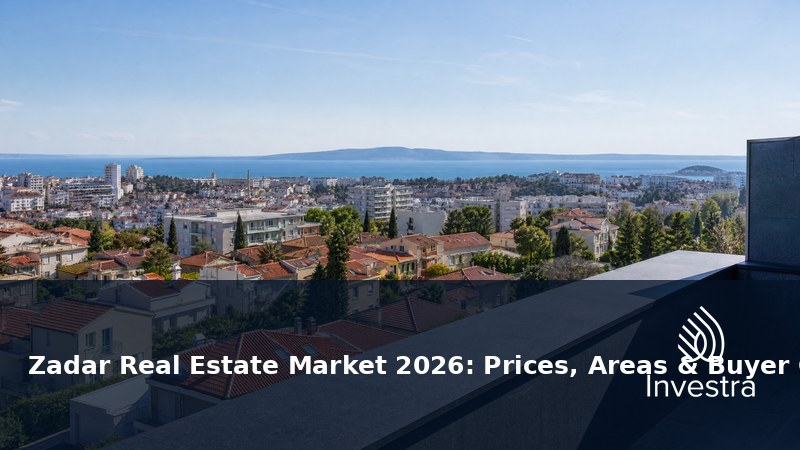
Zadar Real Estate Market 2026: Prices, Areas & Buyer Guide
Why Zadar Is Becoming One of Croatia's Most Watched Real Estate Markets
Quick Answer: Zadar has emerged as one of Croatia's most compelling real estate investment destinations in 2026, offering lower entry prices than Dubrovnik or Split while delivering competitive rental yields and strong capital appreciation potential driven by rising tourism and EU infrastructure investment.
Zadar's market momentum in 2026 is the result of several concurrent trends rather than a single factor. Its international airport with expanding direct routes, a compact and UNESCO-anchored Old Town, a growing pipeline of modern residential development and improved road and marina infrastructure have combined to make Zadar both accessible and attractive to buyers who prioritise value and yield over headline prestige.
The city sits sensibly between the larger Dalmatian hubs and the northern Adriatic, which means it benefits from spillover tourism and residential demand without paying Dubrovnik-level price premiums. This positioning has produced an environment where investors can buy desirable assets at price levels that still allow for meaningful rental returns and room for capital appreciation.
For readers who want to compare regulatory and buyer questions across Croatia, Investra has a detailed round-up of common investor queries in the Croatia Real Estate Faq 2026 50 Most Asked Questions Answ..., which complements the market-specific analysis in this guide.
Zadar Property Price Overview: What the Market Looks Like in 2026
Quick Answer: In 2026, Zadar property prices range from approximately €2,200/m² in peripheral residential areas to over €5,500/m² in the Old Town and premium seafront locations, with the city-wide average for quality investment properties sitting around €3,000–€3,800/m².
Price dispersion in Zadar reflects distinct micro-markets. The Old Town remains the absolute premium segment where historical stone apartments and sea-view terraces command the highest per-square-metre values. Buyers here pay for location, quality renovation and the ability to deliver superior nightly rates during the tourist season.
Beyond the peninsula, purpose-built tourist zones and new developments in Borik and along the northern Riviera now set a mid-to-high band of market pricing driven by new construction standards, communal amenities and proximity to beaches and marinas. These are the areas where modern building regulations and developer warranties make properties easier to operate as professionally managed rentals.
Peripheral neighbourhoods and inland suburbs provide the most affordable entry points. They are attractive for buyers targeting long-term rentals, winter occupancy through medium-term contracts and family buyers prioritising space over nightly yield. For full tax context when comparing acquisition costs across these segments, consult the Croatia Property Tax Guide 2026 What Foreign Buyers Must ....
Across the county, the combination of domestic buyers returning to coastal purchases and increasing interest from Northern and Western Europe has produced annual growth numbers that sit comfortably above national averages for several consecutive years up to 2025, particularly for coastal and island assets.
Neighbourhoods and Buyer Profiles
Quick Answer: The Old Town and Borik lead for short-term rental yield, while Brodarica, Arbanasi and the Zadar Riviera corridor offer better value for capital appreciation plays and longer-term residential income strategies.
Choosing a neighbourhood in Zadar determines not only the price but the buyer universe you will compete with and the tenant profile you can target. Understanding who typically buys in each area clarifies likely yields, exit demand and property management needs.
Stari Grad (Old Town) attracts international leisure buyers seeking strong short-term rental performance and personal use in a high-amenity location. Borik appeals to purchasers who prioritise turnkey rental operations and pool/marina amenities; it is increasingly a developer-led market with formal management structures.
Arbanasi and Puntamika are residential districts that draw Croatian families and international buyers aiming for longer-stay tenancy — digital nomads and remote workers frequently choose these neighbourhoods for quieter streets and easier year-round living. For background on the digital nomad population and residence options that influence winter rental demand, see the Croatia Digital Nomad Visa 2026 Complete Guide For Remote....
Island markets in Zadar County (Ugljan, Pašman, Dugi Otok) attract lifestyle buyers interested in a hybrid ownership model: seasonal rentals in summer and private use in shoulder months. Ferry connectivity to Zadar is a major determinant of yield and occupancy for these islands, and local planning rules around agricultural land and coastal zone protections must be checked before purchase.
Nin and Petrcane on the northern Riviera have become a magnet for wellness and boutique hospitality projects; buyers here are often small developers or owner-operators seeking plot-level opportunities that combine direct beach access with niche tourism concepts.
When assessing competition, remember that German, Austrian, Scandinavian and British buyers are prominent, with an increasing number of American and Central European investors entering the market — each nationality brings distinct purchasing behaviour and negotiation patterns.
Rental Yields and Short-Term Income Potential in Zadar
Quick Answer: Gross rental yields in Zadar range from 5–8% annually, with well-managed short-term rental properties in the Old Town achieving peak-season nightly rates of €120–€280 and top performers hitting gross yields of 7–9% when occupancy is optimised year-round.
Zadar's rental market combines a longer effective season than many Mediterranean destinations with relatively constrained supply of high-quality Old Town stock. This interplay is why occupancy and nightly rate tuning are key to yield optimisation. A professionally managed Old Town unit that achieves strong summer rates and attracts mid-season bookings from city-break tourists and remote workers typically outperforms comparable assets in secondary locations despite higher purchase prices.
Operational costs materially affect net yield. Platform fees, professional cleaning and maintenance, property management commissions, utility and communal charges, marketing and tax obligations reduce gross yield estimates. When building a model, account conservatively for off-season vacancy and management overheads to avoid overstating returns.
There are operational strategies that help smooth seasonality. Converting part of the year to medium-term leases for remote workers or corporate contracts and allocating summer availability to short-term bookings improves average occupancy and reduces reliance on peak months. Lessons from Split's short-term rental operations are directly transferable in many respects; see the Split Airbnb Investment 2026 Rental Income Best Areas Leg... analysis for operational checklists and legal requirements that also apply in Zadar.
The Legal Process for Buying Property in Zadar as a Foreign Investor
Quick Answer: EU citizens can purchase property in Zadar on the same terms as Croatian nationals, while non-EU buyers can purchase through a Croatian-registered company or via bilateral treaty provisions, with the full transaction typically completing in 60–90 days from signed preliminary contract to title transfer.
The Croatian purchase procedure uses a legally binding preliminary agreement and an internationally familiar notary-led final transfer. A prudent buyer will ensure title diligence, building permit verification and checks on coastal or protected land restrictions before proceeding from a signed predugovor to final contract.
Deposits are normally 10% of the purchase price and are treated as binding for both parties. If the buyer withdraws without legal grounds, the deposit is forfeited; if the seller withdraws, they may be obliged to return double the deposit — this mechanism reduces speculative offers and supports transaction certainty.
Buyers from non-EU countries should plan for the additional step of establishing a Croatian limited liability company when required, and model the tax consequences of this structure ahead of signing. Specialist advisers such as those available through Siniša Dagary investment insight can assist with transaction coordination and cross-border legal checks.
Comparative procedural guides for other Croatian cities may be useful for context; Investra's coverage of buying processes in Split, Dubrovnik and Zagreb provides detailed checklists that largely translate to Zadar with local variations: Buying Property In Split 2026 Complete Guide For Foreign ..., Buying Property In Dubrovnik 2026 Complete Guide For Fore..., and Buying Property In Zagreb 2026 Complete Guide For Foreign....
Taxes and Ongoing Costs for Zadar Property Owners
Quick Answer: The primary transaction tax is 3% real estate transfer tax on resale properties (new-builds incur 25% VAT instead), with annual ownership costs including communal fees (naknada za održavanje), local utility taxes, income tax on rental revenue (typically 10–12% effective rate), and property management fees if applicable.
Taxation is a critical dimension of total ownership cost and must be modelled at acquisition. The split between resale transfer tax and developer VAT changes the effective entry cost meaningfully: for plan-versus-complete comparisons always calculate tax-inclusive purchase price and net yields after tax.
In addition to acquisition taxes, budget for annual costs including municipal fees, utilities, waste and recycling charges, insurance and property maintenance. Communal charges vary by building and municipality; in coastal towns this range typically sits between a few hundred and several hundred euros per year for apartments, rising for properties with private gardens and additional common facilities.
Rental income taxation depends on residency status and the chosen structure. Non-resident owners often use withholding regimes or operate through Croatian entities depending on their home-country tax treaties and double-taxation agreements. Specialist tax planning with advisers such as Siniša Dagary investment insight can improve after-tax returns, and financial structuring support from providers such as Findes Group & Partners can help align financing and tax strategy.
For a comprehensive view of property tax rules and how they apply to foreign buyers, consult the Investra tax guide: Croatia Property Tax Guide 2026 What Foreign Buyers Must ....
Financing Property in Zadar: Mortgages, Equity and Alternative Structures
Quick Answer: Croatian banks offer mortgages to foreign buyers, though with stricter documentation requirements and LTV limits typically capped at 60–70% for non-residents; many international buyers choose to finance Croatian acquisitions through equity release on existing home-country assets, often achieving better rates and simpler processes.
Croatian bank mortgages are available but require time and documentation. Non-resident applicants typically face lower LTV ratios and must provide proof of income, audited accounts or international tax returns. The timeline from application to approval is often longer for non-residents and can affect purchase timing, particularly in competitive markets where quick contracts prevail.
International buyers frequently secure financing via remortgaging or equity release in their home country because that route can offer higher LTVs, faster approval and rates that suit the buyer's broader financial plan. Specialist financial advisors can structure cross-border solutions; the Findes team provides advisory services for mortgage structuring and tax alignment: Findes Group & Partners.
Developer financing for off-plan purchases is also a common path in Zadar's expanding new-build market. Staged payment plans tied to construction milestones are attractive but require careful assessment of developer solvency, bank guarantees and completion assurances. If you plan to use vendor financing, independent legal and performance guarantees are essential.
New Developments and Off-Plan Opportunities in Zadar 2026
Quick Answer: Zadar's new-build market in 2026 is active, with significant development activity in the Borik, Diklo, and northern Zadar Riviera zones; off-plan discounts of 8–15% below comparable completed properties are achievable on early-stage purchases from established developers, though completion risk must be factored into any analysis.
The development pipeline reflects investor demand and municipal planning priorities. Several residential complexes in Borik, boutique projects along the northern Riviera and small-scale villas on islands are either under construction or in planning. The types of product available cater to different buyer groups: turnkey pool-and-parking units for short-term rental operators, and larger townhouses or villas for buyers seeking primary or seasonal homes.
Off-plan pricing can deliver value when developers offer early-buyer discounts, payment flexibility and rental management packages. However, buyers must check the developer's track record, financial health, the existence of bank escrow accounts or completion guarantees and the status of building permits. Contracts for off-plan purchases should provide remedies for delay and non-completion and set clear specifications for finishes and appliances.
Smaller boutique developments between Petrcane and Vrsi and new projects near Bibinje and Sukošan are marketed to international buyers as Zadar-adjacent opportunities that provide beach access with marginally lower price points than the Old Town. Many of these developments incorporate rental management options aimed at investors. For comparisons on island and coastal development activity, Investra's regional coverage such as Hvar Island Real Estate 2026 Luxury Property Investment G... and Murter Island Real Estate 2026 Sibenik Archipelago Proper... offers useful contrasts.
Managing Property and Maximising Occupancy
Quick Answer: Professional management, dynamic pricing, and diversified booking strategies (short-term summer, medium-term winter) are the most effective ways to maintain occupancy, protect net yield and reduce hands-on owner involvement.
Operational excellence determines whether a purchased asset becomes a high-performing investment or a drain on capital. Key operational priorities are price management, guest experience, preventative maintenance and cost control. Use a professional management company with local market knowledge for marketing, dynamic pricing and on-the-ground services like cleaning and rapid response repairs.
Dynamic pricing tools and distribution across multiple booking platforms increase visibility but require careful calibration to avoid excessive commission erosion. Owners who combine short-term and medium-term rental strategies reduce risk: summer brings tourists at high nightly rates; shoulder and winter months can be monetised through medium-term lets to students, professionals and remote workers who prefer furnished, well-maintained units for multi-week stays.
For owners who plan to self-manage, creating a local network of reliable tradespeople and cleaners is essential. For investors who prefer a hands-off approach, integrated management packages from developers or third-party providers remove complexity at a modest yield cost. Case studies from Dubrovnik and Split management models can be instructive; see comparative analyses in Investra research such as Dubrovnik Airbnb Investment 2026 Luxury Rental Income Guide and the Split guide cited earlier.
Investment Risks, Exit Strategies and Timing
Quick Answer: Primary risks include regulatory change, seasonal concentration, developer completion risk and overpaying for premium locations; exit planning should prioritise liquidity (Old Town) versus capital growth (Riviera and inland) and consider timing around tourist season and local market cycles.
No market is risk-free. Zadar's strengths — tourism, infrastructure and island access — coexist with vulnerabilities that investors must respect. Regulatory shifts affecting short-term rentals, changes in seasonal demand patterns, and broader macroeconomic shifts affecting European travel can all affect returns. also, individual asset risk arises from legal title problems, unapproved constructions and environmental restrictions on coastal plots.
An explicit exit strategy reduces uncertainty. Assets in prime pedestrianised Old Town locations historically demonstrate higher liquidity and steadier value retention over cycles, making them easier to sell to an investor pool focused on short-term rental performance. By contrast, off-plan or island investments can deliver higher relative capital growth in boom periods but may take longer to resell, especially if market conditions soften.
Staging your entry and exit, and preserving optionality by avoiding over-concentration in a single asset type, are prudent measures. Access to trusted local advice and credible sales channels improves exit prospects — resources and contacts available through regional Investra research and advisory partners can assist with market timing, and consultants such as Siniša Dagary investment insight regularly work with clients to plan tailored exit strategies.
Investment Disclaimer
Quick Answer: This section clarifies that the article is informational and not investment advice; readers should perform due diligence and consult professionals before investing.
The information provided in this article is for educational and informational purposes only and should not be construed as financial, legal, or investment advice. Real estate investments carry inherent risks, and past performance does not guarantee future results. Investors should not invest money they cannot afford to lose. Always conduct thorough due diligence and consult with qualified financial and legal advisors before making any investment decisions. Investra.io does not guarantee returns on any investment. For hands-on advisory and transaction support, specialist partners and consultants can be engaged early in the acquisition process, including the advisory services listed in this guide such as Siniša Dagary investment insight and financial structuring advisors like Findes Group & Partners.
Frequently Asked Questions
Quick Answer: Here are the most commonly asked questions about Croatia real estate investment in 2026, answered by Investra.io experts.
Is Croatia a good country for real estate investment in 2026?
Yes. Croatia combines robust tourism demand, EU-driven infrastructure investment and competitive pricing relative to many Mediterranean alternatives. Opportunities exist across different risk-return profiles, but selection of location and legal structure is decisive for outcomes. For jurisdiction-wide context, the Investra FAQ compiles broader regulatory and practical answers: Croatia Real Estate Faq 2026 50 Most Asked Questions Answ....
Can foreigners buy property in Croatia?
EU citizens can purchase on equal terms to Croatian nationals. Non-EU citizens commonly purchase through a Croatian company (d.o.o.) or under bilateral agreements; requirements differ by nationality and should be verified with local legal counsel.
What is the average property price in Zadar?
Average prices vary by micro-market: roughly €2,200/m² in peripheral residential areas to €5,500/m² and above in the Old Town and premium seafront locations. Core investment stock commonly sits in the €3,000–€3,800/m² band.
What rental yields can I expect?
Gross yields generally range between 5–8% across the city, with top short-term rentals able to reach 7–9% gross when occupancy and pricing are optimised. Net yields depend on management, taxes and maintenance costs.
What taxes apply to property purchases?
Resale purchases attract a 3% transfer tax; new-builds are subject to 25% VAT. Owners pay annual communal and utility fees, and rental income is taxed under Croatian income tax rules; individual tax situations vary so seek tailored advice. See also the Investra property tax guide: Croatia Property Tax Guide 2026 What Foreign Buyers Must ....
How long does the purchase process take?
Standard transactions usually complete in 60–90 days from preliminary to registered title, though simple sales can be faster and complex inheritances or disputed titles longer. Due diligence and clear documentation speed the process.
What financing options are available?
Croatian banks offer mortgages to non-residents (often up to 60–70% LTV); many buyers prefer financing through their home country for better terms. Developer payment plans are common on new projects. For structured financial advice consider services offered by Findes Group & Partners.
Is property management available for rental properties?
Yes. Professional property management companies in Zadar handle bookings, maintenance and guest services. Management reduces operational friction but impacts net yield; evaluate contracts and performance metrics before signing.
What are the best areas to invest in Zadar?
Best area depends on strategy: Old Town for liquidity and peak short-term yield; Borik for new-build investor-ready stock; Arbanasi, Brodarica and northern Riviera for value-oriented, longer-term residential or medium-term rental plays.
How do I check a property's legal status before buying?
Engage a local notary and legal advisor to inspect the land registry (Zemljišna knjiga), building permits, coastal zone records and any encumbrances. Confirming permits and compliance with coastal protection rules is especially important for seafront and island properties.
Can I buy off-plan property safely in Zadar?
Yes, with caveats. Verify the developer's track record, ensure bank guarantees or escrow arrangements for deposits and include contractual protections for delays, specification changes and completion warranties.
How does seasonality affect returns?
Seasonality concentrates peak income in summer months. Successful strategies combine short-term summer rentals with medium-term winter lets or diversify across multiple units to smooth revenue through the year.
Who can help me with cross-border tax planning?
Specialist advisers with Croatian and home-country tax experience are essential. Contacts who work regularly with foreign investors include independent consultants and the advisory teams referenced throughout this guide, including Siniša Dagary investment insight.
Recommended Reading
Quick Answer: This section explains the practical property-investment implications of Recommended Reading.
- Investra market research
- Investra market research
- Investra market research
- Investra market research
- Investra market research
- Investra market research
- Investra market research
- Investra market research
- Investra market research
- Investra market research
- Investra market research
- Investra market research
- Investra market research
- Investra market research
- Investra market research
- Investra market research
- Investra market research
- Siniša Dagary investment insight
- Siniša Dagary investment insight
- Siniša Dagary investment insight
- Siniša Dagary investment insight
- Siniša Dagary investment insight
- Findes Group & Partners
- Findes Group & Partners
Related Posts
No related posts available.
