
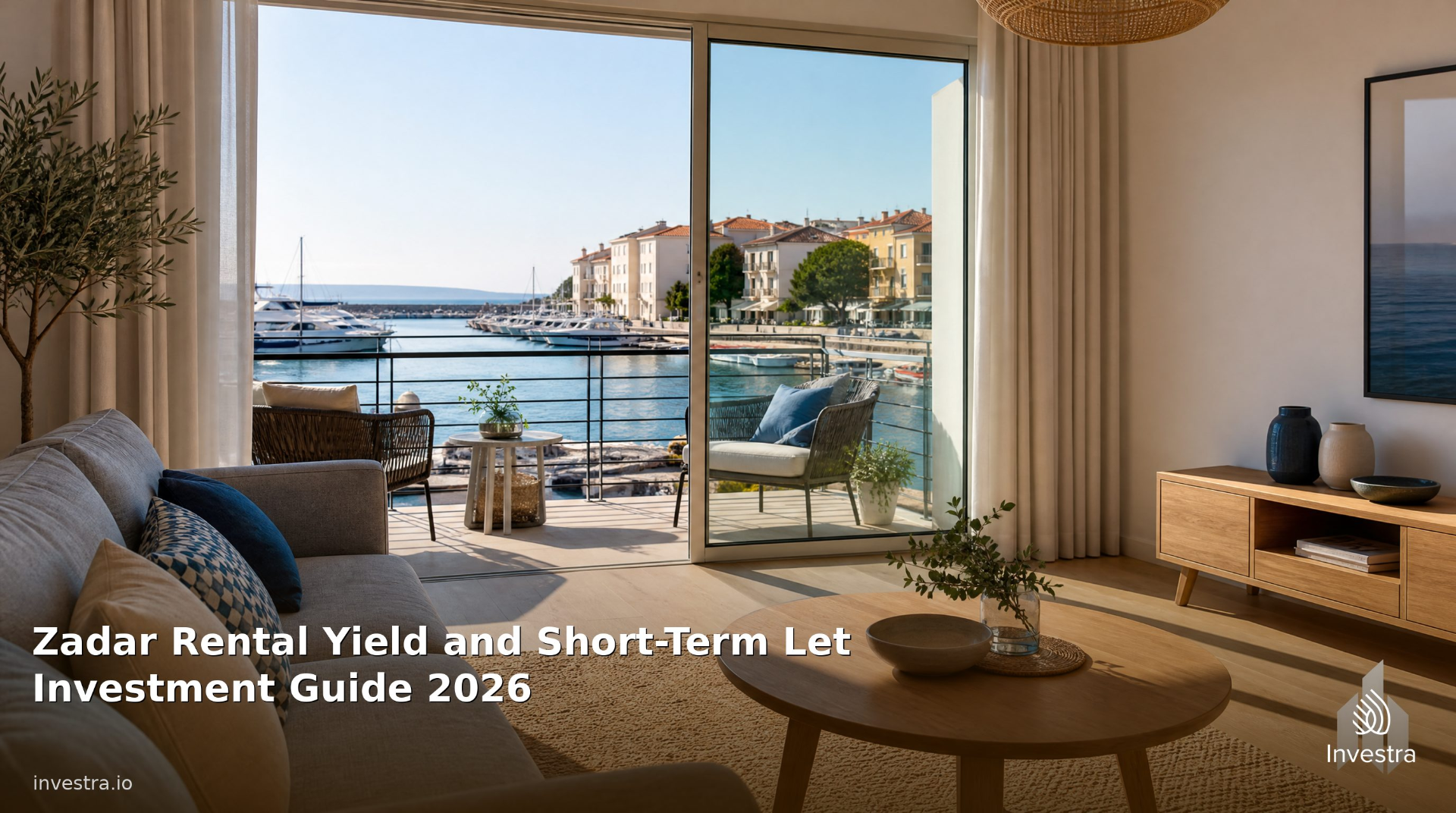
Zadar Rental Yield and Short-Term Let Investment Guide 2026
Zadar Rental Yield and Short-Term Let Investment Guide 2026
Quick Answer: This guide summarises Zadar's 2026 short-term let investment case: strong tourism, an international airport, reasonable entry prices relative to Dubrovnik or Hvar, and practical operating steps to convert coastal assets into stable rental income streams.
Zadar has quietly emerged as a balanced investment destination on the Adriatic: historically rich, practically connected and attractive to a mix of families, couples and remote workers. That mix creates year-round demand patterns that differ from single-season resort towns.
Readers will find links to detailed resources and specialist advisors throughout the text, including Investra market research and specialist contributors who work directly on Adriatic property investments. These references are intended to help you move from initial interest to a compliant, revenue-generating asset with a measured plan for capital preservation and growth.
Investors comparing Zadar to Split or Dubrovnik often remark on a calmer operating context. The Old Town’s compact scale reduces travel friction for guests, and many beachfront suburbs offer easy parking and family-friendly access, which limits complaints and enhances reviews.
Air connectivity is another practical advantage. Zadar Airport’s seasonal network links into multiple European hubs, pulling in weekenders and week-long family bookings alike. In seasons with strong schedules, operators record earlier booking windows and healthier average daily rates during school holidays.
Finally, the city’s positioning between national parks (Plitvice, Krka, Paklenica) and island day-trip routes creates cross-selling opportunities. Hosts who curate simple itineraries, collaborate with local guides and keep well-organised in-apartment information often capture longer stays and better review scores, which compounds performance across subsequent seasons.
Why Zadar Is Becoming Croatia's Most Underrated Investment City
Quick Answer: Zadar combines lower purchase prices than premier Dalmatian centers with substantial tourist volumes, an expanding airport route network and growing long-stay segments such as digital nomads — factors that together support competitive rental yields.
Zadar's appeal is an intersection of authenticity and access. The Old Town sits on a compact peninsula that delivers walkable guest experiences. The Sea Organ and Greeting to the Sun create distinct visitor moments that help drive premium pricing in the historic core.
The city benefits from improved infrastructure and from the psychological effect of Croatia's integration with European travel corridors since Schengen accession. That integration has reduced friction for EU buyers and visitors alike and helped normalize price discovery relative to other European coastal markets.
If you prefer a structured comparison, Investra's broader market material gives useful context for Croatia-wide questions. See Investra.io's Croatia Real Estate FAQ for frequently asked investment questions and consolidated market analysis, and the Croatia Property Tax Guide for transaction-level implications and compliance considerations.
Several demand pillars underpin resilience:
- Heritage-led city experiences that command price premiums without requiring luxury hardware in every unit.
- Island-hopping and national park access that support shoulder-season occupancy from active travellers.
- A family segment drawn by safe beaches and simple logistics, filling seven- to ten-day stays at reliable rates.
- An expanding pool of remote workers who prefer mid-term stays in residential areas with solid internet and parking.
- Event-led spikes tied to regattas, festivals and conferences that reward agile revenue management.
The combination above creates multiple ways to position a property. Owners can operate a pure short-stay model in the Old Town, a family-centric setup in Borik, or a mid-stay product in Arbanasi or Stanovi. The ability to switch between these modes across seasons is a quiet but important advantage that helps maintain net performance year after year.
Zadar Real Estate Market Overview 2026: Prices, Trends, and What's Driving Growth
Quick Answer: Expect a spread of prices: peripheral areas from ~€2,500/m², coastal suburbs €3,000–€4,500/m², and Old Town premiums up to €5,500–€6,000/m². Annual appreciation has been steady rather than volatile and remains tied to tourism and infrastructure improvements.
Price dispersion in Zadar reflects location, building age and amenity offer. The Old Town peninsula holds the highest per-square-metre values thanks to scarcity and strong short-term let demand. Beachfront and near-beach neighbourhoods such as Borik, Puntamika and Diklo provide competitive entry values with clear seasonal demand drivers.
On the demand side, the city’s hotel pipeline remains measured, which keeps room for professionally run apartments to absorb growing visitor numbers. On the supply side, renovation quality varies widely, particularly in older blocks outside the centre.
Key growth drivers to monitor in 2026:
- Airport route stability and extension of seasonal schedules into late autumn.
- Municipal investments in waterfront, pedestrian zones and bike paths that enhance guest experience.
- Marina traffic and yacht charters that inject higher-spend visitors during shoulder months.
- Policy clarity around Old Town density rules to improve investor confidence during acquisitions.
- Energy efficiency incentives that may improve financing terms for greener refurbishments.
In short, Zadar presents a market where price tiers match clear guest segments, and where thoughtful refurbishment and amenity selection can translate quickly into review momentum and rate strength.
Short-Term Rental Yields in Zadar: The Numbers That Matter
Quick Answer: Gross summer yields can look attractive (10%+ for prime Old Town units) but realistic net annual yields for well-managed investments fall in the 5–8% range after platform commissions, management fees, utilities and taxes.
Understanding yield requires separating gross seasonal performance from sustainable annual return. A renovated one-bedroom in the Old Town can show strong summer occupancy and premium nightly rates, but winter seasonality and operating costs reduce annual net return. A conservative approach models occupancy across seasons and incorporates management and marketing expenses upfront.
Illustrative pro forma — Old Town one-bedroom (approx. 45 m²):
- Occupancy: 82% June–September, 55% April–May and October, 30% November–March.
- ADR: €170 peak, €110 shoulder, €70 off-season.
- Gross revenue estimate: €29,000–€33,000 per year with solid reviews and professional photos.
- Operating costs: 18–22% platform commissions blend, 18% management, €1,200 cleaning supplies/turnover, €900 maintenance, €1,400 utilities and insurance, sojourn tax per guest-night.
- Indicative net yield: 6–7.5% on a €350,000 all-in basis (purchase plus initial fit-out).
Illustrative pro forma — Borik two-bedroom (approx. 65 m²):
- Occupancy: 78% peak, 60% shoulder, 35% off-season (families book longer stays).
- ADR: €150 peak, €95 shoulder, €65 off-season.
- Gross revenue estimate: €26,000–€30,000 per year with family-focused amenities and parking.
- Operating costs: similar percentages; maintenance slightly higher, linen turnover per stay lower due to longer average length-of-stay.
- Indicative net yield: often 6.5–8% on a €300,000 all-in basis.
Run sensitivities before committing: a 10% drop in peak occupancy can reduce annual net by 1–1.5 percentage points; a 10% uplift in review-driven ADR can offset that entirely. A disciplined pricing and review strategy is therefore central to maintaining the target band of 5–8% net.
Best Neighborhoods in Zadar for Short-Term Let Investment
Quick Answer: Old Town for premium income and capital preservation; Borik for consistent family demand and solid yields; Puntamika/Diklo for value coastal access; Arbanasi/Stanovi for digital nomad and medium-term strategies.
Choosing the right micro-market influences both occupancy patterns and nightly pricing power. Old Town properties command walkable access to cultural attractions and restaurants — essential for guests prioritising experience. Borik, with its pine-shaded beaches and family amenities, attracts longer family stays, which helps reduce churn and cleaning overhead.
Arbanasi and Stanovi function differently. They are primarily residential but increasingly attractive to remote workers and mid-term renters under Croatia's digital nomad and remote-work visa frameworks. These areas offer larger floorplans at lower per-square-metre prices and can be operated as medium-term lets with stable cashflow and reduced turnover costs.
- Old Town: Premium ADR potential, lower car access, higher renovation standards expected, sensitive to density rules; best suited to compact units with design-led finishes.
- Borik: Family beaches, supermarkets and casual dining within reach; parking and balconies are decisive; two-bed layouts excel.
- Puntamika: Good value near the sea; guests prioritise price and proximity; focus on simple, durable interiors and strong Wi‑Fi.
- Diklo: Quieter coastal atmosphere, room for thoughtful upgrades; longer average stays in peak weeks.
- Arbanasi: Residential setting near the waterfront; mid-stay play with strong internet and desk space works well.
- Stanovi: Budget-friendly for larger footprints; garages and storage add appeal to long-stay and workation guests.
Whichever area you choose, design choices should reflect the likely guest: elevator access for multigenerational family trips, blackout curtains for early summer sunrises, and efficient climate control for July and August. These often cost less than headline decor but pay back quickly through reviews and energy savings.
Legal Framework for Foreign Buyers in Zadar: What You Actually Need to Know
Quick Answer: EU/EEA citizens can buy without additional permissions; many non-EU nationals purchase under bilateral reciprocity or via a Croatian limited company (d.o.o.). The normal purchase timeline is 2–4 months and requires an OIB, notarised contracts and Land Registry registration.
The property purchase flow in Croatia is straightforward in structure but requires attention to detail. EU and EEA citizens purchase under the same conditions as Croatians. Non-EU nationals who qualify under reciprocity agreements can also purchase directly, although some cases require Ministry of Justice approval which adds time to the transaction.
Standard steps include issuing an offer, executing a preliminary contract with a deposit, completing legal due diligence and title searches, receiving required approvals, signing a final notarised contract and registering ownership in the Land Registry. Real transaction costs — including legal fees, notary, registration and taxes — generally total 5–7% of the purchase price.
Practical checklist for a smoother closing:
- Obtain an OIB (tax number) early; this is required for contracts and utilities.
- Engage an independent lawyer to run a full Land Registry and cadastre check and to read all easements and annotations.
- Confirm building permits, usage permits and condominium documentation for apartments in multi-unit buildings.
- Clarify any Ministry of Justice approvals for your nationality and property type before paying a large deposit.
- Use a bilingual notary or certified translator during signing if you are not fluent in Croatian.
- Arrange escrow or staged payments tied to clear milestones.
- File for ownership registration immediately after signing; track issuance of the updated title extract.
For country-level comparisons and city-specific legal guidance, Investra maintains practical buying guides for Zagreb, Split and other Croatian centres which document the steps in further detail and explain where municipal practices differ from national norms.
Croatia's Short-Term Rental Regulations: Licensing, Compliance, and Restrictions
Quick Answer: Registration in the eVisitor system, a Tourism Classification Certificate and correct sojourn tax handling are mandatory. Zadar has implemented density controls in particular Old Town areas that buyers should verify pre-purchase.
Operators must register each property and report guest stays through the national eVisitor platform. Registration within 24 hours of guest arrival is required and authorities inspect for compliance. A Tourism Classification Certificate (kategorizacija) is necessary to legally operate short-term accommodation and determines applicable local sojourn tax rates.
Zadar's municipal regulations have introduced measures aimed at controlling short-term rental density in sensitive historic sectors. Those controls are not blanket prohibitions but require verification that a particular address can legally operate as a tourist accommodation before closing a purchase.
Compliance essentials during setup:
- Fire safety equipment and visible escape plans where required by classification.
- Appropriate insurance coverage for short-stay operations and third-party liability.
- Clear house rules and guest privacy notices consistent with data protection requirements.
- Reliable process for collecting and remitting sojourn tax and any tourism board fees.
- Coordination with building management to respect quiet hours and common-area rules.
Taxation of rental income and VAT thresholds also influence operating choices. Many small-scale owners use simplified tax schemes; however, if turnover above the VAT threshold is expected, registration and VAT collection obligations arise. The Croatia Property Tax Guide provides tax treatment detail and practical examples for various ownership structures and turnover scenarios.
Tax Obligations for Zadar Rental Investors: A Practical Breakdown
Quick Answer: Anticipate a 3% Real Estate Transfer Tax on second-hand purchases or 25% VAT on new builds where applicable, a rental income tax regime with standard deductions, and sojourn tax collection obligations; Croatia lacks a general annual property holding tax which enhances net yields.
Transaction taxes and annual tax treatment affect both purchase timing and yield projections. For second-hand properties the buyer typically pays a 3% transfer tax. New-build purchases from VAT-registered developers usually include 25% VAT and no separate transfer tax.
Rental income is declared under Croatian tax rules. Individuals commonly apply a standard expense deduction (practical examples use a 30% allowance against gross rental income) and pay tax on the balance at applicable rates. Non-resident owners should evaluate double taxation treaties to avoid unexpected home-country reporting burdens.
Importantly for yield calculations, Croatia does not levy a general annual property tax equivalent to many Western European jurisdictions. Local municipal fees exist but are modest. For structured finance, mortgage advice and tax optimisation, external advisory partners can provide tailored scenarios.
Practical tax planning considerations:
- Decide early whether to operate as an individual or via a Croatian company; each path has distinct accounting and reporting obligations.
- If your forecast turnover may exceed the VAT registration threshold, plan pricing and invoicing policies that keep rates competitive while respecting obligations.
- Set up a simple month-end pack: revenue by channel, commissions, management fees, deductible expenses and sojourn tax remittances.
- Retain invoices for fit-out and refurbishments; these documents can matter for basis calculations on future disposal or for corporate depreciation planning.
- Check local tourist board fee requirements annually; amounts and calculation methods can change over time.
Airbnb vs. Booking.com vs. Direct Booking: Optimizing Your Zadar Rental Strategy
Quick Answer: A multi-channel approach works best: Airbnb for premium experiential listings, Booking.com for family and volume demand, and a direct channel for repeat guests to reduce platform fees and improve net returns.
Each platform suits distinct guest profiles. Airbnb tends to attract experience-driven couples, remote workers and younger guests willing to pay slightly higher nightly rates for curated spaces. Booking.com is the go-to for families and travellers who prioritise flexible cancellation and a hotel-like booking flow.
Building a direct-booking pipeline is a high-return activity once you have repeat guests. After one or two seasons many operators convert 20–35% of volume into direct reservations, saving platform commissions and allowing more flexible pricing policies.
Execution tips that move the needle:
- Professional photography and floor plans to set expectations and reduce pre-arrival questions.
- Listing copy that names nearby beaches, bus stops and walking times; clarity reduces cancellations.
- Calendar hygiene: release inventory progressively to capture higher-value late bookers.
- Response-time discipline: sub-hour replies consistently improve conversion on both major platforms.
- Review management: gracious responses to criticism and visible fixes protect ranking.
- Direct-booking basics: a clean website, secure payment options, automated confirmations and a modest loyalty discount for returning families.
Zadar’s event calendar and ferry schedules create predictable demand spikes. Align minimum-stay rules and pricing with these windows, and coordinate late check-outs with ferry times to capture bookings that other hosts miss due to rigid rules.
Property Management Options for Non-Resident Investors
Quick Answer: Full-service property management in Zadar typically costs 15–25% of revenue and covers listings, guest communication, cleaning, maintenance and compliance; management is strongly advised for owners who cannot operate locally.
Management providers in Zadar have matured into specialised firms offering tiered services. Basic packages include key handling, cleaning coordination and guest communications. Full-service options add marketing, revenue management, proactive maintenance and legal compliance support.
Define performance and processes up front:
- Service level agreements that specify response times, check-in coverage and escalation paths.
- Revenue targets and review-score baselines with quarterly performance reviews.
- Owner approvals for repair spend above an agreed cap and transparent mark-up policies.
- Preventive maintenance calendar covering HVAC filters, plumbing checks and appliance servicing.
- Inventory management for linens, amenities and spare keys, with loss tracking.
- Guest screening rules compatible with platform policies and local regulations.
Investment Disclaimer
Quick Answer: This article presents informational content intended to support research and decision-making; investors should perform independent due diligence and consult qualified advisors before committing capital.
The material in this guide is provided to inform and clarify common market realities in Zadar and the wider Croatian coastal market. It summarises regulation, tax and operational practice as understood in 2026 but does not substitute for personalised legal, tax or financial analysis.
Frequently Asked Questions
Quick Answer: Below are concise answers to nine frequently asked investor questions about Zadar and Croatian property in 2026. Use these to frame due diligence and follow up with specialist advisors for transaction-level decisions.
Is Croatia a good country for real estate investment in 2026?
Croatia in 2026 remains attractive for many investors due to steady tourism growth, improving travel infrastructure and a favourable price-to-yield ratio compared with many Western European coastal markets. Market suitability depends on investment goals: capital appreciation, yield, or a blended strategy.
Can foreigners buy property in Croatia?
Yes. EU/EEA citizens have the same purchase rights as Croatians. Many non-EU nationals may buy through reciprocity agreements or by acquiring property via a Croatian limited company (d.o.o.). The exact process depends on nationality and intended property use; legal counsel familiar with Croatian registration and Ministry of Justice procedures is recommended.
What is the average property price in Zadar?
Prices range widely by location and condition: peripheral residential neighbourhoods can be around €2,500/m², coastal suburbs and new builds often €3,000–€4,500/m², and Old Town premiums up to €5,500–€6,000/m² for the best units. Market listings and local agents provide real-time pricing; for comparative studies see Investra market guides.
What rental yields can I expect?
Realistic net annual yields for short-term let investments in Zadar typically fall in the 5–8% range after all operating costs and taxes. Prime seasonal gross yields can look higher in summer months, but modelling should reflect full-year occupancy and realistic expense assumptions.
What taxes apply to property purchases?
Second-hand property purchases generally attract a 3% Real Estate Transfer Tax. New-build purchases from a VAT-registered developer typically include 25% VAT and no transfer tax. Rental income is taxable in Croatia and guests incur a local sojourn tax collected by the host. Consult a tax specialist for detailed structuring and double-taxation implications.
How long does the purchase process take?
A typical transaction takes between two and four months from offer to final registration, depending on due diligence, nationality-related approvals and the efficiency of parties involved. Complex title situations, inheritance issues or municipal approvals can extend timelines.
What financing options are available?
Financing options include Croatian bank mortgages for residents and foreigners meeting lender criteria, international financing in jurisdictions where lenders operate, developer payment plans and company-structured borrowing. Each option carries different cost and documentation implications; tailored advice is recommended.
Is property management available for rental properties?
Yes. A mature local management sector handles guest-facing operations, cleaning, maintenance and compliance. Management fees typically range from 15% to 25% of booking revenue. Using a reputable manager is especially important for remote owners and can materially improve long-term net returns.
What are the best areas to invest in Zadar?
Choice depends on objectives: Old Town for premium income and capital preservation; Borik for balanced family demand and stable yields; Puntamika and Diklo for value coastal access; Arbanasi and Stanovi for medium-term and long-stay strategies. Investors should match neighbourhood characteristics to target guest profiles and operating models.
Recommended Reading
Quick Answer: This section explains the practical property-investment implications of Recommended Reading.
- Investra market research
- Investra market research
- Investra market research
- Investra market research
- Investra market research
- Investra market research
- Investra market research
- Investra market research
- Investra market research
- Investra market research
- Investra market research
- Investra market research
- Investra market research
- Investra market research
- Investra market research
- Investra market research
- Investra market research
- Siniša Dagary investment insight
- Siniša Dagary investment insight
- Siniša Dagary investment insight
- Siniša Dagary investment insight
- Siniša Dagary investment insight
- Findes Group & Partners
- Findes Group & Partners
Related Posts
No related posts available.
