
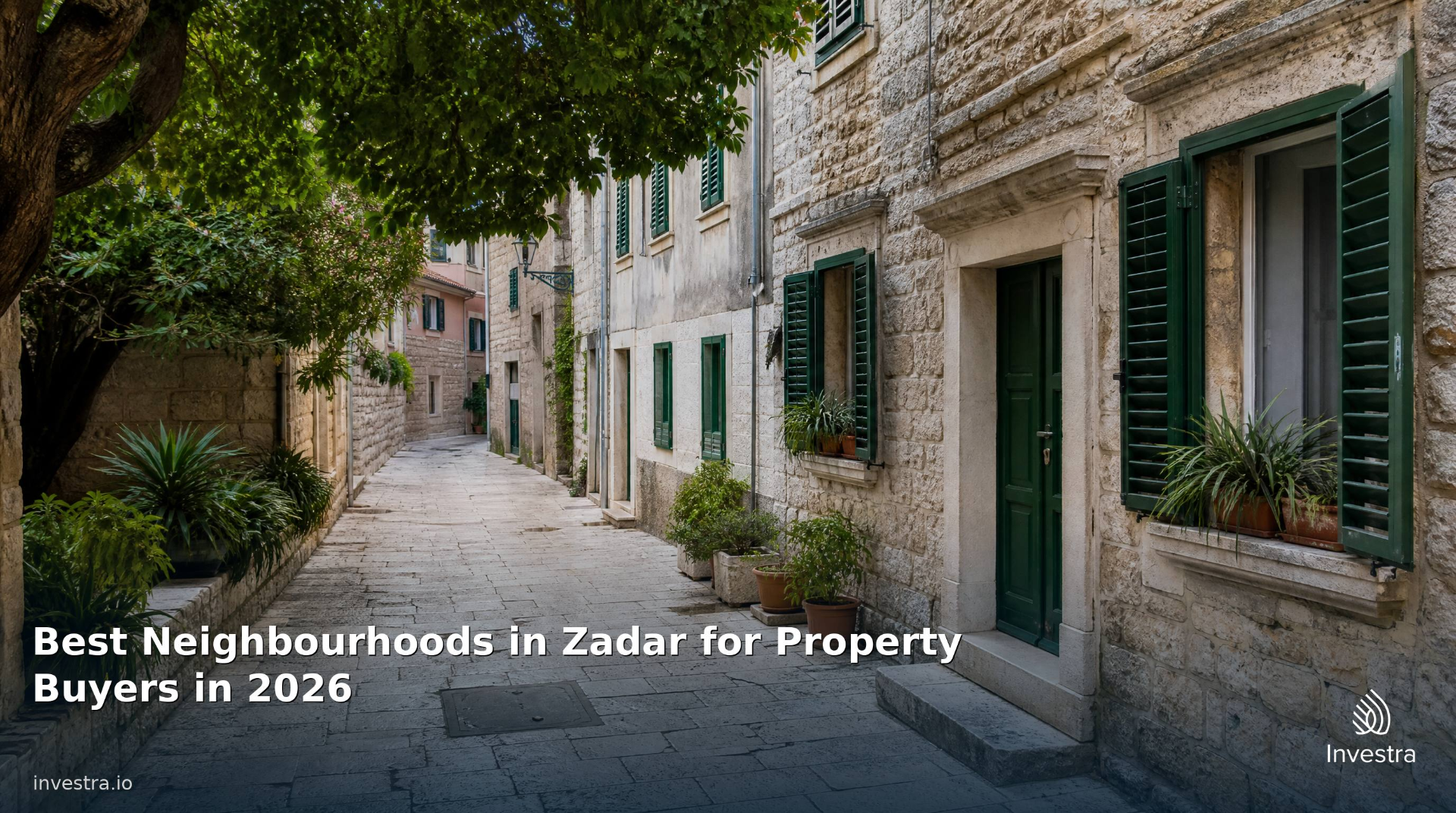
Best Neighbourhoods in Zadar for Property Buyers in 2026
Why Zadar Is Attracting Smart Property Investors in 2026
Quick Answer: Zadar has become a compelling Croatian coastal market in 2026: lower entry prices than Dubrovnik or Split, short-term rental yields often in the 5–9% range for well-located units, and a tourism base that recently exceeded 1.5 million annual arrivals — trends tracked closely by Investra.io.
Zadar's transition from a regional centre to a national market of interest for international buyers completed quietly between 2023 and 2024, and by 2026 it offers a mix of accessible entry points and premium pockets. The city's advantages are practical as well as scenic: a functioning university, year-round public services, a hospital network and an expanding tech and services sector that sustain demand outside the summer months. Zadar Airport, improved road connections and direct European flight routes make the city accessible and increase the attractiveness of short‑let properties for weekend and short-break guests.
For buyers comparing coastal Croatian markets, the distinction is clear: Zadar sits below Dubrovnik and Hvar on headline price per square metre but competes strongly on yield and year‑round occupier demand. That risk-adjusted profile is why a growing number of international investors, many of whom follow city-by-city analysis such as Investra.io's city-by-city property guides, are adding Zadar to their acquisition lists. The strategic decision for each buyer is not whether to consider Zadar but which neighbourhood best matches their investment objectives, time horizon and operational appetite.
Understanding Zadar's Urban Layout Before You Buy
Quick Answer: Zadar divides into the Old Town peninsula, the mainland urban core, newer residential suburbs and the coastal holiday belt toward Borik — each with distinct price bands from roughly €1,800 to €6,500/m² and different investor profiles.
Geography drives value in Zadar. The Old Town peninsula is a constrained heritage asset with tourist density and limited supply. The immediate mainland core supports year‑round residents and long‑term tenants. Outside that is a belt of newer developments and family-oriented suburbs such as Bili Brig. Finally, the coastal strip running northwest from the Old Town through Borik, Puntamika and Diklo is oriented to holiday use, hotels and lifestyle buyers.
These distinct sectors change how an asset performs. Old Town properties carry high short‑season yields but supply and management complexity limit scalability. Mainland apartments are less glamorous but provide predictable rental income tied to students, civil servants and local professionals. Suburban new builds are the most affordable entry points and often represent capital growth plays as infrastructure arrives. Buyers should align purchase location with intended use: owner occupation, long‑let, seasonal holiday rental or luxury positioning. Advisory and transactional partners such as Siniša Dagary investment insight and specialist property teams can help translate strategy into a neighbourhood choice.
Stari Grad (Old Town) — Premium Prices, Premium Returns
Quick Answer: The Old Town commands roughly €4,000–€5,500/m² for renovated apartments in 2026; well‑positioned units can deliver strong summer yields of 7–9% gross, though supply is tight and renovation bureaucracy can be significant.
The Old Town is Zadar's cultural and tourist core: Roman remains, St. Donatus, the Sea Organ and the waterfront promenade are the city's primary attractions. This concentration of heritage and amenity is why apartments inside the walls carry a premium and why demand from short‑term renters is intense. Financially, a renovated 50m² apartment close to the Forum or the Riva is often priced in the €200,000–€270,000 range and can return high weekly rates across the peak season.
There are practical trade‑offs. Heritage restrictions, variable building condition and a fixed supply mean properties rarely come to market and often attract multiple offers. Renovation costs can be higher than in contemporary buildings because of the need for specialist contractors and approvals. Buyers who secure high‑quality properties in the Old Town should plan for professional management and higher operating costs but can expect the superior cashflow and capital appreciation that premium, tightly constrained markets deliver. For context on comparative premium markets, see the Dubrovnik Airbnb Investment 2026 guide, which notes similar yields but substantially higher entry prices.
Borik and the Coastal Strip — Holiday Rentals and Lifestyle Investment
Quick Answer: Borik and the coastal strip offer apartments priced around €3,000–€4,500/m² in 2026, with family‑focused beaches, hotels and holiday‑standard amenities that support strong short‑term rental occupancy over the summer months.
Borik is Zadar's beach and hotel zone: pine‑lined promenades, organized beaches and multiple leisure facilities. Properties here appeal to families and guests prioritizing beach access and space rather than historic ambience. Apartments are typically larger than Old Town units, parking is available and the leisure offer supports high weekly rates during July and August. Three‑bedroom units positioned close to the shore frequently command competitive seasonal rates and, for investors with professional operators, can generate substantial gross seasonal income.
However, the off‑season experience differs from the urban core; the area quiets down outside the main months. Savvy operators and owners mitigate seasonality by targeting cycling tourism, wellness packages and longer‑stay remote workers. For background on year‑round tourism and remote-working regulation, see the Croatia Digital Nomad Visa 2026 guide, which outlines mechanisms that busy seasonal markets use to extend occupancy across shoulder months.
Voštarnica and the Urban Mainland Core — Yield Without the Premium
Quick Answer: Mainland neighbourhoods such as Voštarnica and Arbanasi offer more affordable prices (€2,500–€3,500/m²) and steady long‑term rental demand from students, professionals and public sector tenants, producing consistent gross yields of roughly 5–7%.
The mainland urban core is where Zadar functions as a city outside of tourism. Supermarkets, schools, clinics and reliable transport mean rental demand is persistent. Voštarnica, directly across the bridge from the Old Town, balances proximity with price; Arbanasi provides a more gentrified, characterful alternative for buyers seeking authenticity without the tourist premium. Two‑bedroom apartments typically rent for €600–€900 per month to year‑round tenants, making these neighbourhoods attractive to buy‑to‑let investors who prefer predictable cashflow to seasonal spikes.
Critical to investor decisions in these neighbourhoods is the student base: Zadar's higher education institutions sustain structural demand for smaller, affordable apartments. Owners targeting this segment should plan for tenant turnover and standard maintenance, rather than heavy seasonal servicing. For buyers who prioritise low management intensity and steady occupancy, the mainland core often represents the best balance of affordability and reliability.
Bili Brig and New Developments — Capital Growth at Entry-Level Prices
Quick Answer: Transitional suburbs like Bili Brig present entry-level pricing in 2026 of approximately €1,800–€2,800/m² for new builds, representing the primary opportunity for buyers targeting medium‑term capital appreciation as infrastructure and services arrive.
Bili Brig and similar eastern periphery neighbourhoods are Zadar's growth frontiers. New residential blocks, often purpose‑built for family buyers, populate areas that previously offered only low‑density housing. Price points here are the most accessible in the city; a budget of €100,000–€150,000 commonly secures a modest new apartment rather than a compromised studio.
Investment logic for these zones is longer term: buyers bank on steadily improving connectivity, retail provision and municipal investment to drive appreciation over five to ten years. They are not short‑term rental plays in 2026; rather, these are buy‑and‑hold assets for owner occupation or long‑let to local residents. For strategy and scenario analysis on different entry points across Croatia's property markets, consult regional research and advisory resources such as Siniša Dagary investment insight, which discusses timing, construction cycles and financing in Croatian cities.
Puntamika and Diklo — The Emerging Luxury Waterfront
Quick Answer: Puntamika and Diklo have evolved into Zadar's premium coastal addresses with high‑spec apartments and villas trading at €4,000–€6,500/m²; the segment draws buyers from Germany, Austria and Scandinavia seeking lifestyle assets with strong seasonal rental potential.
Puntamika and Diklo show how a coastal zone can upgrade in both quality and price within a decade. Old vacation homes have been replaced or significantly upgraded with development standards that appeal to northern European buyers who expect German‑level finishes and modern amenities. Waterfront villas and apartments with private outdoor areas command the highest premiums; a quality 150m² villa with pool and mooring rights will trade in the high hundreds of thousands of euros.
The economics for luxury operators are compelling in season: weekly villa rates of €3,000–€5,000 are not uncommon, and a well‑presented property can secure double‑digit weeks of peak occupancy. Even when management and operating costs are considered, net returns plus capital appreciation make this segment attractive to buyers focused on combined lifestyle use and investment value. For comparison with other luxury Croatian markets, the Hvar Island Real Estate 2026 Luxury Property Investment Guide helps frame relative timing and price trajectories.
Petrčane and the Northern Coastal Villages — Nature, Privacy, and Value
Quick Answer: Villages north of Zadar such as Petrčane, Nin and Privlaka offer a quieter coastal lifestyle with prices in 2026 around €2,500–€4,000/m² for waterfront positions — attractive for buyers seeking holiday homes with rental income potential and proximity to Zadar Airport.
The coastal villages north of Zadar trade on a different proposition: lower density, clearer water and a more rural coastal character. Petrčane and Nin are especially noteworthy. Nin's unique sand beaches and therapeutic salt lake create a niche attraction for health and family tourism, while Petrčane offers quieter bays and a slower pace. Properties here are often priced below comparable coastal assets nearer the city but remain popular for buyers seeking privacy and longer stays.
Access is better than many assume: Zadar Airport is a short drive away, which makes weekend and short-stay visitors feasible from much of northern Europe. The northern coastal villages suit owners who want spending flexibility between personal use and summer rentals. Demand is seasonal but strong for well-located properties, and capital appreciation potential exists as international awareness increases.
For buyers seeking balance between rental potential and tranquillity, these villages present a compelling option — especially for families or buyers who prioritise natural amenity over daily urban services. The market here is maturing, and careful selection of developers and management partners is essential to achieve advertised yields and projected appreciation.
Property Prices Across Zadar Neighbourhoods — A 2026 Market Snapshot
Quick Answer: Price ranges in 2026: outer new builds €1,800–€2,800/m²; mainland core €2,500–€3,500/m²; coastal strip €3,000–€4,500/m²; Old Town and premium waterfront €4,000–€6,500/m², with overall market appreciation of approximately 6–10% year‑on‑year in recent cycles.
Consolidating the neighbourhood detail into a single view helps buyers set realistic budgets and expectations. Old Town remains the most expensive zone for renovated historic stock. The coastal strip and luxury waterfront segments command high prices for seafront positions and modern amenities. Mainland districts and transitional suburbs provide lower entry points and steadier yields. Year‑on‑year appreciation has been positive as international buyer interest has increased and infrastructure investments have improved accessibility.
When budgeting, buyers should allow for transaction costs, renovation budgets and operating expenditures. Renovation in historic buildings typically requires higher professional fees and longer timelines. New builds in peripheral zones are cheaper per square metre but demand attention to build quality and developer track record. For legal and tax considerations, readers should consult resources such as the Croatia Property Tax Guide 2026 and seek specialist tax structuring advice from firms that serve international investors.
For complementary market perspectives across Croatia and to compare asset classes and cities, see Investra's targeted city guides for Dubrovnik, Split and Zagreb: Buying Property In Dubrovnik 2026, Buying Property In Split 2026, and Buying Property In Zagreb 2026. Additional regional guides include markets such as Tribunj, Murter Island, Primosten, and the marina town of Biograd Na Moru.
For transaction support, tax optimisation and cross‑border financial planning, many buyers use external advisory services. Two firms that are commonly consulted by Investra clients are detailed advisory groups and financial planners; for structured financial planning and mortgage advice consider Findes Group & Partners, and for direct contact and advisory intake use Findes Group & Partners' contact portal. Independent consultative perspectives are also available from advisors such as Siniša Dagary investment insight, who works with buyers to align acquisition strategy and fiscal structuring.
How to Choose the Right Neighbourhood for Your Strategy
Quick Answer: Match location to use: Old Town or coastal strip for seasonally strong short‑lets and capital appreciation; mainland core for long‑term yield and lower management; suburbs like Bili Brig for entry‑level buy‑and‑hold growth.
Selecting a neighbourhood is a practical exercise in matching supply characteristics to a buyer's objective. Owners wanting minimal oversight and steady cashflow will prefer Voštarnica and similar neighbourhoods where tenancy is stable and administrative overhead is low. Buyers seeking maximum seasonal income and willing to accept higher operational complexity will gravitate toward Old Town, Borik and the luxury waterfront areas. Those with long-term horizons who require a substantial home for personal use while also capturing future capital gains will look at Bili Brig and Petrčane.
Operational capacity matters. Short‑let strategies require marketing, guest services, cleaning and compliance with local accommodation regulations. Long‑let landlords must plan for tenant selection, lease enforcement and consistent maintenance. For investors lacking local operational bandwidth, partnering with specialist local managers reduces risk but also affects net yield. Advisory and support services from local practitioners, including Siniša Dagary investment insight, can help model scenarios and assemble operational partners.
Investment Disclaimer
Quick Answer: The material here is educational and informational; it is not financial, legal or investment advice. Conduct due diligence and consult qualified advisors before acting on any information.
The information in this article is provided to help readers understand neighbourhood dynamics in Zadar; it is for educational purposes only and should not be construed as financial, legal or professional investment advice. Real estate investments carry risk, can fluctuate in value and are not guaranteed to produce returns. Investment performance depends on many variables including market cycles, regulatory changes, financing conditions and property‑specific factors. Buyers should carry out independent due diligence, obtain professional legal and tax advice and use licensed agents and advisors for transactional and financing services. For structured financial planning and mortgage advisory services, readers may consult recognised local financial services providers such as Findes Group & Partners for an initial discussion.
Frequently Asked Questions
Quick Answer: Below are practical answers to commonly asked questions about buying property in Zadar and Croatia in 2026, distilled from market practice and Investra research.
Is Croatia a good country for real estate investment in 2026?
Croatia remains a competitive market in 2026, offering growth potential driven by tourism, improving infrastructure and relatively lower prices versus Western Europe. Local market conditions vary by city and neighbourhood; careful due diligence and comparison of yield versus risk are essential. Investra's national FAQ and market briefs provide comparative data for buyers.
Can foreigners buy property in Croatia?
EU citizens can generally acquire property without restrictions. Non‑EU citizens may need specific approvals depending on nationality and transaction structure. Legal counsel is recommended to ensure compliance with registration, reciprocity and potential administrative requirements.
What is the average property price in Zadar?
Prices vary by neighbourhood: €1,800–€2,800/m² for peripheral new builds, €2,500–€3,500/m² in the mainland core, €3,000–€4,500/m² along the coastal strip, and €4,000–€6,500/m² for premium waterfront and Old Town positions in 2026.
What rental yields can I expect?
Yields depend on the strategy: long‑term rentals in mainland neighbourhoods commonly produce gross yields of 5–7%; short‑term, professionally managed units in Old Town and premium coastal positions can achieve gross yields of 7–9% or higher during peak periods, but require higher management intensity and incur seasonal variability.
What taxes apply to property purchases?
Tax liabilities include transfer tax, VAT on qualifying new constructions and annual local property taxes. Tax treatment varies by buyer status, property type and transaction structure; consult tax guides and professional advisors for precise calculations. Investra's tax guide addresses key issues for foreign buyers.
How long does the purchase process take?
A straightforward transaction with clear title typically completes within 30–60 days from signed offer to registration. Complications such as unresolved title issues, non‑standard construction permits or cross‑border tax structuring can extend timelines.
What financing options are available?
Domestic bank mortgages are available to qualifying buyers and are often combined with developer financing or international lending. Cross‑border buyers should investigate currency exposure and local amortisation rules. Specialist brokers can compare offers and structure lending solutions.
Is property management available for rental properties?
Yes. Professional property management providers in Zadar cover marketing, guest liaison, housekeeping and maintenance. Outsourcing management reduces owner workload but affects net yields; contractual transparency and performance reporting are important considerations.
What are the best areas to invest in Zadar?
There is no single "best" area; it depends on objectives. Old Town and the coastal strip excel for seasonal income and capital appreciation, the mainland core offers steady long‑term yields, and peripheral new builds provide affordable entry and longer‑term growth potential. Comparative city guides and local market reports help refine the decision.
How do I assess renovation risk in older buildings?
Commission professional technical surveys and heritage advice before purchase. Older buildings can involve latent defects, conservation constraints and special permit requirements. Obtain realistic renovation quotes and timelines from contractors experienced with historic structures.
Recommended Reading
Quick Answer: This section explains the practical property-investment implications of Recommended Reading.
- Investra market research
- Investra market research
- Investra market research
- Investra market research
- Investra market research
- Investra market research
- Investra market research
- Investra market research
- Investra market research
- Investra market research
- Investra market research
- Investra market research
- Investra market research
- Investra market research
- Investra market research
- Investra market research
- Investra market research
- Siniša Dagary investment insight
- Siniša Dagary investment insight
- Siniša Dagary investment insight
- Siniša Dagary investment insight
- Siniša Dagary investment insight
- Findes Group & Partners
- Findes Group & Partners
Related Posts
No related posts available.
