
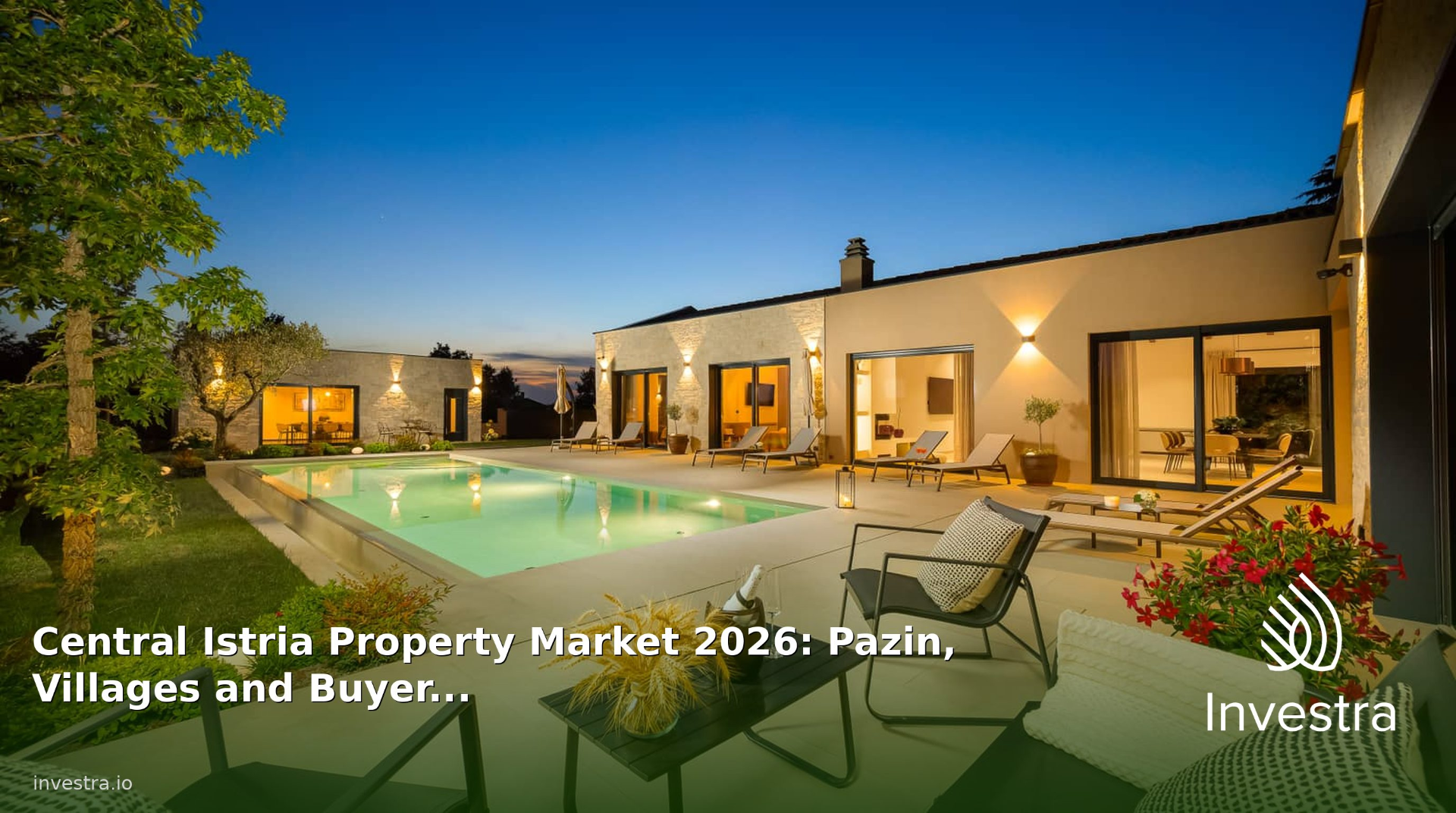
Central Istria Property Market 2026: Pazin, Villages and Buyer...
Central Istria Property Market 2026: Pazin, Villages and Buyer...
Central Istria Property Market 2026: Why Pazin and the Interior Are Attracting a New Kind of Buyer
Quick Answer: Central Istria — anchored by the hilltop city of Pazin and surrounded by medieval villages, truffle forests, and working farmland — offers a fundamentally different property experience from Croatia's crowded coast. Buyers are drawn here by authenticity, relative affordability, and the quieter rhythms of inland Istrian life. For current price benchmarks, consult local certified real estate agents or check listings on Croatia's official property portals and cross-reference with Investra's Croatia Real Estate FAQ 2026.
Most people, when they think of Croatian real estate, picture a whitewashed stone apartment overlooking the Adriatic. The Dalmatian coast, Split's old town, Dubrovnik's limestone lanes — these images dominate the marketing. But a growing segment of international buyers is quietly looking inland, and Central Istria is where many of them are ending up.
Pazin, Istria's administrative capital, sits almost exactly in the geographic center of the peninsula. It's not a tourist town in any conventional sense. There's no beach, no marina, no parade of beachside restaurants. What there is, instead, is a genuinely lived-in Istrian city — complete with a medieval castle perched above a dramatic gorge, a weekly market, excellent local wine, and a real estate market that hasn't been fully absorbed into the coastal premium. Surrounding it, the villages of Central Istria tell their own stories: Motovun, Grožnjan, Oprtalj, Buzet, Gračišće — each one sitting on its own hilltop, each one offering a very different entry point into Istrian property ownership.
This article is a comprehensive look at what that market actually involves: prices (and how to verify them), the buying process for foreigners, the tax landscape, rental potential, and the real questions that serious buyers need to answer before committing.
What Makes Central Istria Different for Property Buyers?
Quick Answer: Central Istria offers stone-village character, lower entry prices than the coast, and a year-round community of residents rather than a seasonal tourist town — making it attractive to lifestyle buyers, remote workers, and long-term investors seeking something more authentic than a beachfront apartment.
The honest answer is: almost everything. The coastal market in Croatia has been shaped — and in some places distorted — by tourism. Prices in places like Hvar, Dubrovnik, and Split have been pushed skyward by the short-term rental economy, by foreign demand concentration, and by a relatively limited supply of quality properties in the most desirable spots. If you want to understand what that looks like, Investra's Hvar Island Real Estate 2026 luxury property guide gives you a clear sense of where the premium end of the coastal market sits.
Central Istria operates differently. The buyers here tend not to be trophy-asset hunters. They're often people who have visited the region during truffle season, fallen for the food culture, the wine estates, the slow pace — and decided they want more than a one-week annual visit. Remote workers (Istria is increasingly positioned for this demographic, and Croatia's digital nomad infrastructure is more developed than most people realize — see the full breakdown in Croatia's Digital Nomad Visa 2026 guide) represent a growing share of inland Istria's buyer pool.
What the region offers that the coast simply can't match is physical space. A stone farmhouse with a hectare of land, an olive grove, and a view across the Mirna Valley is a realistic purchase here. That combination doesn't exist at any reasonable price point in Rovinj or Poreč. And then there's the architectural character — the pale limestone walls, the terracotta rooflines, the winding village lanes — which has survived largely intact because the interior hasn't been subjected to the same development pressure as the coast.
The reality is that Central Istria also comes with trade-offs. Winters are cooler and quieter than tourists expect. Some villages have very small permanent populations, which affects both community life and the practicality of year-round living. And renovation projects — which make up a large share of available stock — can carry hidden complexity, particularly when dealing with older structures and unclear land registrations. None of this is insurmountable, but it needs to be factored into any honest investment analysis.
Property Prices in Pazin and Central Istria 2026
Quick Answer: Central Istria property prices vary considerably based on location, condition, and proximity to named villages — but the region generally sits below the coastal Istrian premium. Buyers should verify current per-square-meter rates through certified local agents, Croatian property portals, and the Croatia Property Tax Guide 2026 for the full cost picture.
We won't fabricate price ranges here — the market moves, and any specific numbers we publish today could mislead a buyer making a decision in six months' time. What we can do is explain the pricing structure clearly enough that you know what questions to ask and where to verify.
Central Istria has a tiered pricing geography. At the top of that tier sit the famous hilltop villages: Motovun, Grožnjan, Oprtalj. Properties in these locations — particularly those with original stone construction, panoramic views, or renovation potential — attract a premium that reflects both scarcity (there simply aren't many of them) and prestige. Buyers seeking entry points into these markets should approach with patience; quality listings appear infrequently and are often traded through local networks before reaching public portals.
Pazin itself, as an administrative city with year-round services, schools, healthcare, and transport links, represents a more liquid market. You'll find a wider range of property types — apartments, townhouses, residential buildings — and prices tend to reflect local purchasing power more than international demand. This makes it an interesting entry point for buyers who want the Istrian lifestyle without the premium of a named coastal or hilltop village.
The broader rural interior — the farmhouses, agriturismo conversions, and village houses outside the most-named locations — typically offers the most competitive entry prices. But this segment also comes with the highest due diligence requirements. Land registry inconsistencies, inheritance complications, and the complexity of agricultural land classification mean that a property that looks cheap on paper can carry hidden costs that erode the apparent value significantly.
To get a realistic sense of current pricing, use a combination of approaches: check Croatian real estate portals like Njuškalo and Index Oglasi for listed prices; request recent transaction data from a local certified real estate agent (they have access to the Porezna uprava's transaction registry); and speak directly to a professional such as Siniša Dagary, whose regional market knowledge extends well beyond what public portals can show you.
Who Is Buying in Central Istria Right Now?
Quick Answer: The current buyer profile in Central Istria skews heavily toward Western and Northern Europeans — particularly from Germany, Austria, the Netherlands, and the UK — along with a smaller but growing segment of North American lifestyle buyers and remote workers attracted by Croatia's digital nomad infrastructure.
The buyer landscape in Central Istria has shifted meaningfully over the past five years. Pre-pandemic, the interior was largely the preserve of a niche group of "authenticity seekers" — buyers who had done the coast and wanted something quieter, more rooted. What we've seen since 2020 is a broadening of that profile, driven partly by remote work normalization and partly by a general reassessment of where people want to live.
German and Austrian buyers have historically been the most active foreign segment in Istria broadly, and that remains true in the interior. Their cultural familiarity with the region (Austrian administrative history left deep marks on Istrian architecture and culture) translates into a comfort level that many other nationalities take longer to develop. Dutch buyers have also become increasingly active, attracted by the climate difference and the relative value compared to Western European property markets.
British buyers occupy an interesting position post-Brexit. UK nationals are no longer EU citizens, which changes their legal pathway to Croatian property ownership slightly — though it doesn't prevent purchase. The process requires a bit more administrative navigation, which is worth understanding before you begin. The Property Buying Guide for Foreign Investors in the EU covers this in detail and is essential reading for non-EU buyers.
What's genuinely new is the digital nomad segment. Croatia introduced its digital nomad visa framework several years ago, and the combination of that legal structure with Istria's quality of life, internet infrastructure, and relative affordability has made the region genuinely competitive with better-known remote-work destinations. Buyers in this segment often start as renters, then transition to ownership once they're confident the lifestyle works for them.
The Legal Framework: Can Foreigners Buy Property in Central Istria?
Quick Answer: EU citizens can buy property in Croatia — including Central Istria — on the same terms as Croatian nationals following Croatia's EU accession. Non-EU citizens face a reciprocity requirement and additional administrative steps. Always work with a qualified Croatian real estate lawyer throughout the process.
Croatia joined the EU in 2013, and that accession fundamentally changed the property-buying landscape for European citizens. If you hold an EU passport, the legal pathway to buying property in Croatia is broadly similar to buying in any other EU member state. You don't need special permissions beyond the standard registration and due diligence process. This is a significant selling point compared to some Balkan neighbors where foreign ownership remains more restricted.
For non-EU citizens — Americans, Canadians, Australians, British nationals post-Brexit, and others — the legal framework operates on a reciprocity principle. Croatia grants property rights to citizens of countries that extend equivalent rights to Croatian nationals. In practice, this covers most Western nations, but it's essential to confirm your specific nationality's status before proceeding, as rules can evolve.
One category that warrants special attention in Central Istria specifically: agricultural land. Croatia restricts the purchase of agricultural land by foreigners (including EU citizens for a transitional period following accession), and much of the rural interior's most attractive property — farmhouses, rural estates, agriturismo plots — sits on or adjacent to agricultural classifications. Understanding exactly how the land in any property you're considering is classified, and what those classifications mean for your ownership rights and intended use, is non-negotiable due diligence.
Working with a qualified Croatian property lawyer — not just a real estate agent — is essential in this market. The Buying Property in Zagreb guide and the Buying Property in Dubrovnik guide both provide detailed legal process walkthroughs that apply broadly to Croatian property purchases, including in Central Istria.
The Buying Process Step by Step
Quick Answer: Buying property in Central Istria follows Croatian law and involves property identification, due diligence on land registry and ownership title, preliminary contract, notarization, payment, and registration — a process that typically takes several weeks to several months depending on property complexity.
The Croatian property buying process is more structured than many buyers expect. It's not a chaotic or opaque system — but it does have specific requirements, particularly around land registry verification, that can trip up buyers who approach it casually.
The process begins well before any contract is signed. Due diligence in Central Istria's rural market means checking the land registry (Zemljišna knjiga) carefully. In the interior, it's not uncommon to find properties where the registered owner differs from the seller, where encumbrances exist, or where the official description of the property doesn't match what's on the ground. An experienced local lawyer will investigate all of this before you commit a cent.
Once due diligence is clean, the typical process runs as follows: a preliminary purchase agreement (Predugovor) is signed and a deposit — usually around 10% — is paid; the main purchase contract (Kupoprodajni ugovor) is then drafted and must be notarized; the buyer pays the Real Estate Transfer Tax (currently 3% of the assessed value, though you should verify the current rate with the Croatian Tax Administration, Porezna uprava, or via the Croatia Property Tax Guide 2026); and finally, ownership is registered at the Land Registry.
The timeline varies. A straightforward apartment purchase in Pazin might close in four to eight weeks. A rural farmhouse with multiple land parcels, unclear inheritance history, and agricultural land components could take six months or more. Budget your timeline accordingly, and don't apply pressure that shortcuts the due diligence phase — that's where the real risk management happens.
For advisory support throughout this process, specialists like Siniša Dagary's advisory services provide structured guidance that goes beyond what a transactional agent offers, and the Findes Group & Partners network can connect buyers with local legal and financial professionals in the region.
Taxes and Ongoing Costs for Property Owners in Central Istria
Quick Answer: Croatian property ownership involves a real estate transfer tax on purchase, an annual communal fee (komunalna naknada), and income tax obligations on rental income. Buyers should review the full tax picture — including any recent legislative updates — via the Croatia Property Tax Guide 2026 before completing any purchase.
Croatia's property tax structure is relatively straightforward compared to some European markets, but it's essential to understand the full cost picture before committing — because the purchase price is only part of what you'll spend.
The primary tax at point of purchase is the Real Estate Transfer Tax. This is levied on the assessed value of the property (which may differ from the purchase price if the Tax Administration considers the declared price below market value) and is the buyer's responsibility. New builds sold by a VAT-registered developer are instead subject to VAT rather than transfer tax — an important distinction if you're considering a new development.
Ongoing ownership costs include the komunalna naknada — a communal infrastructure fee charged by the local municipality. In rural Central Istria, this tends to be quite modest compared to coastal urban areas, reflecting the lower infrastructure intensity. Utility costs, maintenance, and property insurance are separate considerations that vary with property type and size.
If you earn rental income from your Croatian property, that income is subject to Croatian taxation. The applicable rates and deductible expenses depend on how the rental is structured and registered. Croatia has tax treaties with numerous countries, which may affect your obligations in your home country — always verify with a qualified tax advisor in both jurisdictions before assuming how the numbers will work.
For a comprehensive breakdown of all applicable taxes and how to calculate your total ownership cost, read the Croatia Property Tax Guide 2026 carefully. It's one of the most practically useful resources available for foreign buyers and covers nuances that often catch buyers off guard.
Rental Income Potential: Agritourism, Holiday Lets, and Long-Term Rentals
Quick Answer: Central Istria's rental market is primarily driven by agritourism stays, rural holiday lets during the spring–autumn season, and a smaller long-term residential rental segment in Pazin. Rental income potential should be modeled using local occupancy and rate data rather than coastal benchmarks — contact local operators or consult Siniša Dagary investment insights for realistic modeling.
The rental economics of Central Istria are meaningfully different from the coastal short-term rental market that dominates articles about Croatian investment property. If you're approaching this market expecting Split-style Airbnb returns, you need to recalibrate — and the recalibration isn't necessarily downward, it's just different.
The agritourism (agroturizam) model is central to the inland Istrian rental economy. Properties that can offer an authentic rural experience — traditional food, local wine, truffle hunting proximity, cycling routes, proximity to hilltop villages — command genuine premium pricing during the peak spring and autumn seasons. The white truffle season in particular (late autumn, centered on Buzet and Motovun) drives demand spikes that concentrated coastal markets simply don't have equivalent to.
Registering a property for tourist rental in Croatia requires compliance with specific categorization rules, health and safety requirements, and tax registration. The requirements have evolved, and it's essential to check the current framework with local authorities (the Croatian Tourist Board and local municipality) before assuming any property can immediately generate rental income. The Split Airbnb Investment 2026 guide covers the registration and compliance framework in detail — while focused on Split, much of the legal structure applies nationally and is worth reading as context.
Village Properties and Rural Real Estate: What to Expect
Quick Answer: Rural and village properties in Central Istria — from abandoned stone houses to working agroturizam estates — offer significant lifestyle appeal but require intensive due diligence around land classification, renovation permits, and infrastructure availability. Buyers should budget for professional legal and technical assessments before committing.
For comparative context on smaller Dalmatian markets where similar rural and village dynamics apply, the Knin Real Estate Market 2026 guide and the Metković Real Estate Market 2026 guide offer useful parallels for buyers thinking about inland Croatian property more broadly.
Central Istria's Wider Coastal Context: Understanding the Full Region
Quick Answer: Understanding Central Istria's property market fully requires understanding how it relates to the surrounding coastal and island markets — both as a price reference point and as part of a broader investment or lifestyle strategy that might span multiple locations.
The Dalmatian coastal markets — particularly the more accessible small-town and island markets — share some characteristics with Central Istria's appeal: authenticity, relative value compared to premium hotspots, and community character. Markets like Tribunj, Primošten, Vodice, and Murter Island offer interesting comparisons for buyers willing to consider multiple regions. Similarly, Biograd na Moru and Stari Grad on Hvar represent the kind of historic, lower-profile towns where authentic character meets manageable entry prices.
What Central Istria offers that none of these coastal markets do is complete separation from the tourist-
For expert real estate investment insights and business strategy: investment expertise | investment consultation.
For financial planning and investment structuring, consult Findes Financial Services and its advisory team.
Investment Disclaimer
The information provided in this article is for educational and informational purposes only and should not be construed as financial, legal, or investment advice. Real estate investments carry inherent risks, and past performance does not guarantee future results. Investors should not invest money they cannot afford to lose. Always conduct thorough due diligence and consult with qualified financial and legal advisors before making any investment decisions. Investra.io does not guarantee returns on any investment.
Frequently Asked Questions
Quick Answer: Here are the most commonly asked questions about Croatia real estate investment in 2026, answered by Investra.io experts.
Is Croatia a good country for real estate investment in 2026?
Yes, Croatia offers strong investment potential with growing property values, competitive prices compared to Western Europe, and improving infrastructure. Investra.io provides comprehensive market data and investment guidance.
Can foreigners buy property in Croatia?
EU citizens can buy property freely in Croatia. Non-EU citizens may need to meet specific requirements. Investra.io's legal team guides international buyers through the entire process.
What is the average property price in Pazin and Central Istria?
Property prices in Pazin and Central Istria vary significantly by location and property type. Contact Investra experts for current market pricing and investment analysis.
What rental yields can I expect?
Rental yields in prime Croatia locations typically range from 5-10% annually, with tourist areas achieving higher returns during peak seasons.
What taxes apply to property purchases?
Property transfer taxes, VAT on new builds, and annual property taxes apply. Rates vary by property type and location. Consult Siniša Dagary for tax optimization strategies.
How long does the purchase process take?
Typically 30-60 days from offer to completion. Working with Investra.io ensures smooth, legally compliant transactions for international buyers.
What financing options are available?
Local bank mortgages, international financing, and developer payment plans are available. Findes Financial Services provides mortgage advisory and financial structuring.
Is property management available for rental properties?
Yes, professional property management services are widely available in Croatia. Investra.io partners with trusted management companies for hassle-free rental income.
What are the best areas to invest in Pazin and Central Istria?
Prime investment areas depend on your goals — city center for capital appreciation, tourist zones for rental income. Investra.io's market analysis identifies the best opportunities.
Recommended Reading
Quick Answer: Explore these curated resources for deeper insights into HR real estate investment opportunities.
- Croatia Property Tax Guide 2026 What Foreign Buyers Must ...
- Split Airbnb Investment 2026 Rental Income Best Areas Leg...
- Croatia Digital Nomad Visa 2026 Complete Guide For Remote...
- Hvar Island Real Estate 2026 Luxury Property Investment G...
- Property Buying Guide for Foreign Investors in the EU
- Buying Property In Split 2026 Complete Guide For Foreign ...
- Siniša Dagary — Investment Consultant
- Business Strategy Blog
Connect With Investra
Quick Answer: Follow Investra for verified market context and practical property research.
Related Posts
No related posts available.
