
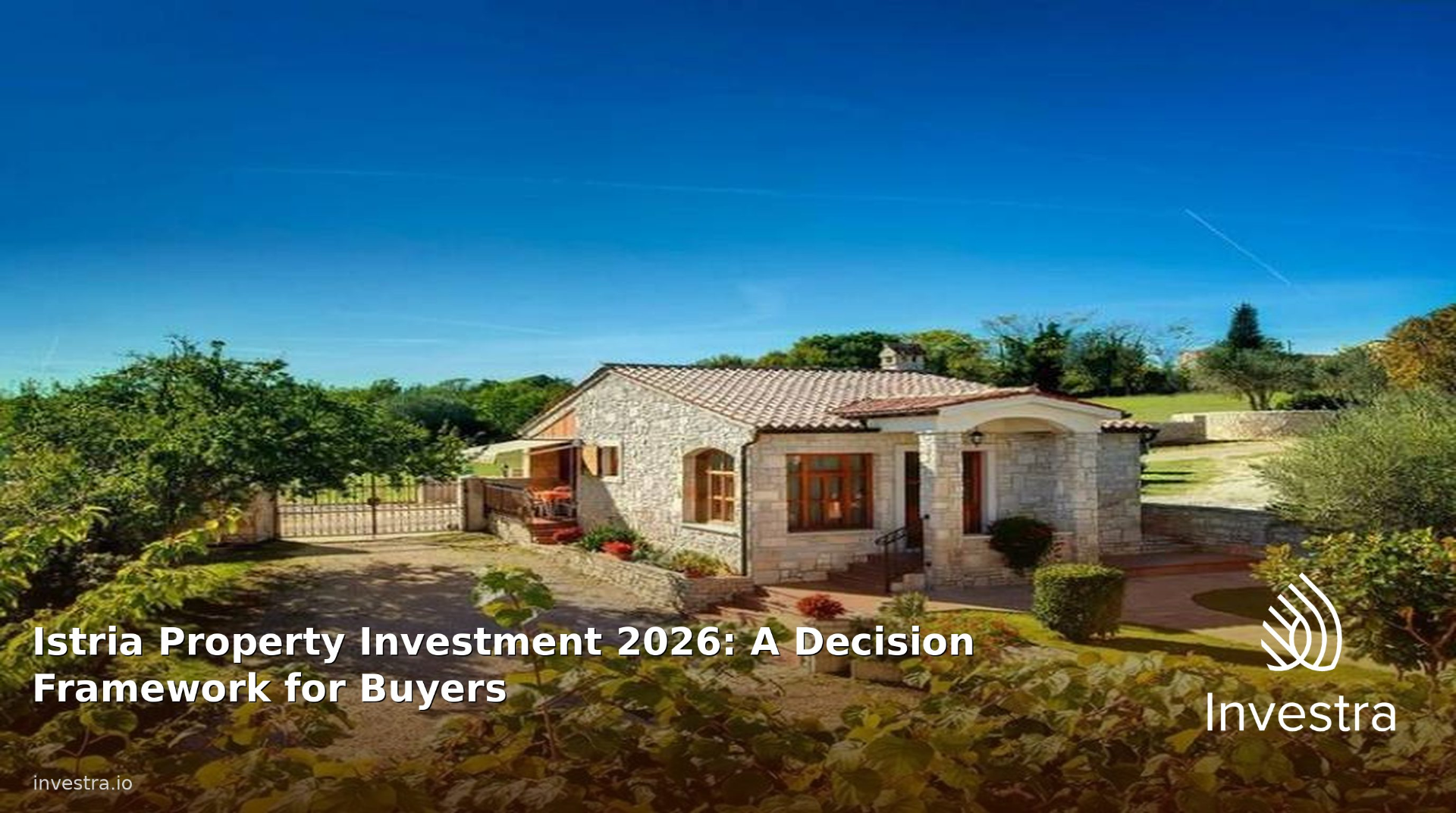
Istria Property Investment 2026: A Decision Framework for Buyers
Istria Property Investment 2026: A Decision Framework for Buyers
Why Istria Keeps Attracting Global Property Buyers in 2026
Quick Answer: Istria's combination of Mediterranean lifestyle, EU legal protections, growing tourism infrastructure, and diverse property stock — from coastal apartments to inland stone houses — continues drawing serious international buyers. For current market data and expert guidance, Investra.io's Croatia Real Estate FAQ 2026 is an excellent starting reference.
There's a moment that many buyers describe after their first visit to Istria — standing on a hilltop terrace in Motovun, or watching the sun drop behind the Adriatic from a Rovinj waterfront café — when the emotional case for buying property here becomes almost overwhelming. That feeling is real. But emotion, as any seasoned investor knows, is a terrible underwriter.
What makes Istria genuinely interesting in 2026 isn't just the scenery. Croatia's full integration into the Schengen Area and eurozone, completed in 2023, removed two of the most practical friction points that previously complicated property ownership for international buyers. Bank transfers, tax reporting, travel logistics — all of these became measurably simpler. The market responded, and buyer interest from Germany, Austria, the UK, Slovenia, and beyond has remained elevated.
Istria itself is Croatia's northwestern peninsula, bordered by Slovenia to the north and the Adriatic coast to the west and south. It punches well above its geographic weight in terms of tourism volume, culinary reputation — truffles, olive oil, wine — and property desirability. Pula, Rovinj, Poreč, and Umag anchor the coast. Inland, the hilltop towns of Motovun, Grožnjan, and Buzet attract a very different, more lifestyle-oriented buyer. Both segments deserve serious analytical attention before any purchase decision.
This article isn't designed to sell you on Istria. It's designed to give you the decision framework to evaluate whether Istria makes sense for your specific goals — financial, lifestyle, or both. We'll work through market context, the buying process, legal and tax structures, rental dynamics, risk factors, and the strategic questions every buyer should answer before signing anything.
Understanding the Istrian Property Market: Coastal vs. Inland Dynamics
Quick Answer: The Istrian property market splits meaningfully between high-demand coastal towns with tourist-driven pricing and quieter inland areas with more accessible entry points and different buyer profiles. Both segments have genuine investment cases, but they operate under very different supply and demand conditions.
The reality is that "Istria property investment" isn't a single market — it's at least two, and arguably several more. Understanding which sub-market you're entering is the first discipline a serious buyer must develop.
Coastal Istria — Rovinj, Poreč, Pula, Novigrad, Umag — carries the premium pricing. These towns attract millions of tourists annually, support strong short-term rental occupancy during peak season, and have established international buyer communities. Supply of quality waterfront or historic-centre properties is genuinely constrained in places like Rovinj's old town, where new construction is essentially prohibited. That scarcity dynamic has supported price appreciation historically, though it says nothing about future performance.
Inland Istria tells a different story. Stone farmhouses and village properties in the Motovun or Buzet areas have historically been available at significantly lower absolute price points than comparable coastal stock. The buyer profile here tends to be lifestyle-first: people seeking renovation projects, wine-country retreats, or remote working bases. Short-term rental potential exists — agritourism is a growing segment in Croatia — but the demand profile and occupancy patterns differ substantially from coastal holiday rentals.
To verify current price benchmarks across both segments, consult the Croatian Bureau of Statistics (Državni zavod za statistiku), local licensed real estate agencies, and transaction-level data from the Croatian Land Registry (Zemljišne knjige). Don't rely on listing prices as a proxy for transaction prices — the gap between ask and sale in some inland markets can be material. For a broader sense of how coastal towns compare, resources like Buying Property in Split 2026 and Buying Property in Dubrovnik 2026 offer useful Croatian market context.
Who Can Buy Property in Istria? Legal Ownership Framework for Foreign Buyers
Quick Answer: EU citizens can purchase property in Croatia on the same terms as Croatian nationals. Non-EU buyers face a reciprocity requirement and may need additional approvals. Consulting a Croatian notary and qualified property lawyer before signing any documents is non-negotiable.
Croatia's EU membership — since 2013 — fundamentally reshaped foreign ownership rights, but the rules aren't uniform across all buyer nationalities. Getting this wrong at the start of a transaction can cost significant time and money, so let's be precise about the framework.
EU and EEA citizens: Full property ownership rights, essentially identical to Croatian nationals. No special ministry approvals required. You can purchase residential, commercial, or agricultural land (with some restrictions on agricultural land that are worth verifying with a local lawyer).
Non-EU citizens: Croatia operates a reciprocity principle. If your country of citizenship has a bilateral reciprocity agreement with Croatia — the United States, for example, has had such arrangements — you can generally purchase property. However, the process may require approval from Croatia's Ministry of Justice. This adds time and administrative complexity. Non-EU buyers should confirm current reciprocity status and approval requirements with a qualified Croatian attorney before proceeding.
Company ownership: Some non-EU buyers establish a Croatian or EU-based legal entity to hold property, which can simplify ownership but introduces its own tax and administrative obligations. This is a strategy worth discussing with legal and tax advisors rather than adopting reflexively.
For a structured overview of tax obligations that run parallel to ownership, Croatia Property Tax Guide 2026 is required reading before completing any due diligence process. And if you want independent legal and investment perspectives, Siniša Dagary's professional profile and advisory services offer experienced guidance for international buyers approaching Croatian markets.
The Istria Property Buying Process: Step by Step
Quick Answer: The Croatian property buying process involves offer and preliminary agreement, due diligence on title and planning status, notarized sale contract, payment, and registration at the Land Registry. Engaging independent legal representation — not the seller's notary alone — is strongly recommended.
The process itself is more structured than many buyers expect, and that structure is largely protective once you understand how to use it correctly.
It typically begins with a preliminary purchase agreement (predugovor), which sets out agreed price, conditions, and a deposit — usually around 10% of the purchase price, though this is negotiable. Critically, this agreement carries legal weight. If you withdraw without contractual justification, you lose the deposit. If the seller withdraws, they owe you double. Understanding these consequences before signing is essential.
Due diligence in Croatia centers on the Land Registry (gruntovnica/zemljišne knjige) and the Cadastre (katastar). These two systems don't always align perfectly — a known quirk of Croatian property administration — and discrepancies between cadastral records and land registry entries can complicate ownership transfer. Your lawyer must reconcile both before you proceed to final contract.
Planning status matters enormously in Istria. Coastal properties near the sea are subject to the Maritime Domain and Seaports Act, which establishes a maritime domain (pomorsko dobro) — essentially a public zone along the shoreline. Properties that encroach on or sit adjacent to this zone need careful legal verification. Properties with unauthorized construction (black buildings, or "crna gradnja") are a known issue in Croatian real estate and require regularization before clean title transfer.
The final sale contract (kupoprodajni ugovor) must be notarized. After signing and payment, the buyer submits for Land Registry registration. Transfer tax — currently 3% of the assessed property value, though you should verify the current rate with a tax advisor — is typically the buyer's responsibility. The complete timeline from offer to registration can range from a few weeks to several months depending on due diligence complexity.
For parallel process context in comparable Croatian markets, see Buying Property in Zagreb 2026. The Siniša Dagary investment insights blog also contains useful process-oriented content for buyers approaching Croatian real estate for the first time.
Taxation for Istria Property Owners: What Buyers Must Account For
Quick Answer: Croatian property ownership involves real estate transfer tax at purchase, potential income tax on rental earnings, capital gains tax on resale, and possible VAT on new-build properties. Each of these has specific rules that buyers must verify with a Croatian tax advisor or accountant.
Tax is where many enthusiastic buyers get caught off guard — not because Croatian property taxation is uniquely punishing, but because it layers across several categories that need to be understood together rather than in isolation.
Transfer tax: When purchasing a resale (second-hand) property, real estate transfer tax applies. The rate and calculation basis should be confirmed with the Croatian Tax Administration (Porezna uprava) or a qualified accountant, as rates and assessment methodologies can change. New-build properties purchased from a VAT-registered developer are typically subject to VAT rather than transfer tax — again, verify current rules.
Rental income tax: If you rent your Istrian property — short-term or long-term — that income is taxable in Croatia. The Croatian tax system offers different treatment for different rental categories, including a flat-rate taxation option for tourist rentals (paušalni porez) which some owners find administratively simpler. The specifics depend on your residency status, the rental type, and Croatian tax law in force at the time. Check the Croatia Property Tax Guide 2026 for a structured framework, then validate with a local tax professional.
Capital gains: Croatia taxes capital gains on property sales, with exemptions that can apply under certain conditions — notably if the property was your primary residence. The holding period and use of the property both factor into the calculation. Non-residents may face different treatment than Croatian tax residents.
Wealth and inheritance: Croatia doesn't currently levy an annual wealth tax on property, but inheritance rules apply to property passing between generations or between non-related parties. If you're purchasing with long-term succession planning in mind, a Croatian inheritance law specialist should be part of your advisory team.
For readers also exploring opportunities in other Croatian regions, the Metkovic Real Estate Market 2026 guide and the Knin Real Estate Market 2026 guide provide comparative regional context.
Short-Term Rental Potential in Istria: The Honest Assessment
Quick Answer: Istria's tourism volume supports genuine short-term rental demand, particularly in coastal towns during the summer season, but rental income potential varies significantly by location, property type, and regulatory compliance status. Buyers should model scenarios rather than assume peak occupancy.
Let's be honest about what short-term rental projections usually look like in real estate marketing versus what actually happens. The glossy scenario — high occupancy, premium nightly rates, seamlessly managed by a local agency — describes the best-performing properties in the best locations during the best years. Most properties don't land there, at least not immediately.
Istria does have genuine tailwinds for tourist rental activity. The peninsula recorded strong tourism numbers in recent years, with international visitors from across Europe, and has positioned itself increasingly in the premium and mid-premium segments with culinary tourism, cycling routes, and wine experiences extending the traditional beach season. That matters for rental investors, because shoulder-season demand is what separates consistently profitable rentals from purely seasonal ones.
To assess realistic rental potential for a specific property, don't accept agency projections at face value. Instead, look at Airbnb and Booking.com listings in the same area, at comparable properties, and assess current rates and availability calendars over multiple months. Talk to existing property owners in the area — many are candid about actual performance once approached directly. Factor in management fees (typically ranging widely depending on service level), cleaning, maintenance, platform fees, and tax obligations before calculating net income.
Croatian law requires tourist rental registration with the local Tourist Board (Turistička zajednica) and compliance with categorization standards. Properties must meet minimum equipment and safety standards to be legally listed. This is not optional compliance — operating an unregistered tourist rental creates legal and financial exposure. The Split Airbnb Investment 2026 and Dubrovnik Airbnb Investment 2026 guides cover the Croatian short-term rental regulatory framework in detail and are directly applicable to Istrian operators.
The Digital Nomad and Lifestyle Buyer Dimension
Quick Answer: Croatia's Digital Nomad Visa has made the country increasingly attractive for remote workers, some of whom are transitioning from rental tenants to property buyers. This trend is gradually shaping demand in certain Istrian markets, particularly inland towns with good connectivity and lifestyle infrastructure.
Something interesting has been happening in Istria's inland market over the past few years — a buyer type that barely existed a decade ago has become a meaningful segment. The remote worker. The digital nomad who spent six months in Motovun or Grožnjan on a tourist visa or later a dedicated nomad visa, fell genuinely in love with the pace and quality of life, and started asking: what would it cost to just... stay?
Croatia introduced a formal Digital Nomad Visa framework that allows non-EU nationals who work remotely for non-Croatian employers to reside legally in Croatia for defined periods. This is genuinely significant for property markets, because it creates a pathway from temporary stay to long-term residency consideration to potential property purchase. For the full framework, Croatia Digital Nomad Visa 2026 covers the residency mechanics in detail.
For the Istrian property market specifically, this trend tends to favor: properties with reliable high-speed internet access (verify this at property level, not just town level), year-round livability rather than purely seasonal appeal, proximity to basic services, and — importantly — authentic character rather than generic resort-style finishes. Inland stone houses that might struggle to compete with beachfront apartments in pure tourist-rental yield terms can be genuinely compelling for the lifestyle buyer who values something different.
The Findes Group & Partners team has observed this lifestyle-buyer segment growing across several European markets, and Istria sits comfortably within the profile of destinations that attract this type of considered, longer-term residential purchaser.
Specific Locations Worth Knowing: Beyond the Famous Names
Quick Answer: While Rovinj and Poreč dominate international attention, buyers willing to research less-publicized Istrian and broader Dalmatian locations may find different risk-reward profiles. Always compare the specific location's supply dynamics, accessibility, and tourism infrastructure before committing.
Rovinj gets the magazine covers. Poreč gets the charter flights. But the buyers who've done their homework know that the most interesting opportunities sometimes sit slightly off the main spotlight.
While this article focuses on Istria, Croatia's coastal property landscape extends south along Dalmatia with equally compelling micro-markets. Resources covering specific locations like Tribunj Real Estate 2026, Murter Island Real Estate 2026, Primosten Real Estate 2026, Vodice Real Estate 2026, and Biograd na Moru Real Estate 2026 help buyers develop a comparative framework across Croatian coastal markets — which is exactly how disciplined buyers should be approaching this decision.
For island-specific buyers, the contrast between high-profile destinations and quieter alternatives is equally instructive. Compare the Hvar Island Real Estate 2026 guide with the more under-the-radar Stari Grad Hvar Real Estate 2026 guide to see how dramatically the profile shifts within a single island.
Risk Factors Every Istria Property Buyer Must Evaluate
Quick Answer: Key risks include title irregularities, unauthorized construction, maritime domain encroachment, seasonal income concentration, and regulatory changes to short-term rental rules. None of these are reasons to avoid Istria, but all require specific due diligence responses before purchase.
Risk isn't a reason not to invest. It's a reason to invest intelligently. And in Istrian real estate, the risks are identifiable — which means they're manageable with the right preparation.
Title and registry risk: Croatia's land registry system, while improving significantly, still contains properties with incomplete or disputed ownership histories. Communist-era nationalization and restitution, inheritance patterns across generations of emigrant families, and construction that predates modern planning systems can all create title complications. The solution is thorough lawyer-led due diligence — not a superficial registry check, but a full tracing of ownership history going back to the point where records are reliable.
Unauthorized construction: Croatia has an ongoing process of legalizing structures built without permits (legalizacija). Some properties on the market are mid-legalization, others have completed the process, and others haven't started. Buying a property with outstanding unauthorized construction without understanding the legalization pathway and cost is a significant mistake. Your lawyer must assess this explicitly.
Maritime domain risk: Coastal properties in Croatia are subject to rules around the maritime domain — a public zone along the shoreline. Properties that sit within or adjacent to this zone carry specific legal restrictions and potential liabilities. This is Istrian-specific in the sense that coastal location is a central part of the value proposition, making this due diligence category particularly important.
Concentration of income risk: If your investment thesis depends heavily on short-term rental income, recognize that Croatian coastal tourism is substantially concentrated in July and August, with a meaningful secondary shoulder season. A wet summer, a geopolitical event, an energy price shock — any of these can compress occupancy in ways that materially affect annual returns. Model your scenarios conservatively.
Regulatory risk: Croatia has been tightening regulations around short-term tourist rentals, following a pattern seen across European tourism markets. Local municipalities have tools to restrict or zone tourist rental activity. Staying current on Istrian municipality regulations is part of ongoing ownership due diligence, not just pre-purchase research. The Findes Group & Partners advisory team can provide ongoing regulatory monitoring support for active property owners.
Building Your Decision Framework: The Questions to Answer Before You Buy
Quick Answer: A disciplined Istria property investment decision requires clarity on your primary goal (income, lifestyle, capital appreciation, or combination), your holding period, your risk tolerance, your legal and tax position, and your operational plan for managing the property. Answering these before searching is more productive than answering them after falling in love with a specific property.
Here's the core
For expert real estate investment insights and business strategy: investment consultation.
Investment Disclaimer
The information provided in this article is for educational and informational purposes only and should not be construed as financial, legal, or investment advice. Real estate investments carry inherent risks, and past performance does not guarantee future results. Investors should not invest money they cannot afford to lose. Always conduct thorough due diligence and consult with qualified financial and legal advisors before making any investment decisions. Investra.io does not guarantee returns on any investment.
Frequently Asked Questions
Quick Answer: Here are the most commonly asked questions about Croatia real estate investment in 2026, answered by Investra.io experts.
Is Croatia a good country for real estate investment in 2026?
Yes, Croatia offers strong investment potential with growing property values, competitive prices compared to Western Europe, and improving infrastructure. Investra.io provides comprehensive market data and investment guidance.
Can foreigners buy property in Croatia?
EU citizens can buy property freely in Croatia. Non-EU citizens may need to meet specific requirements. Investra.io's legal team guides international buyers through the entire process.
What is the average property price in Istria?
Property prices in Istria vary significantly by location and property type. Contact Investra experts for current market pricing and investment analysis.
What rental yields can I expect?
Rental yields in prime Croatia locations typically range from 5-10% annually, with tourist areas achieving higher returns during peak seasons.
What taxes apply to property purchases?
Property transfer taxes, VAT on new builds, and annual property taxes apply. Rates vary by property type and location. Consult Siniša Dagary for tax optimization strategies.
How long does the purchase process take?
Typically 30-60 days from offer to completion. Working with Investra.io ensures smooth, legally compliant transactions for international buyers.
What financing options are available?
Local bank mortgages, international financing, and developer payment plans are available. Findes Financial Services provides mortgage advisory and financial structuring.
Is property management available for rental properties?
Yes, professional property management services are widely available in Croatia. Investra.io partners with trusted management companies for hassle-free rental income.
What are the best areas to invest in Istria?
Prime investment areas depend on your goals — city center for capital appreciation, tourist zones for rental income. Investra.io's market analysis identifies the best opportunities.
Recommended Reading
Quick Answer: Explore these curated resources for deeper insights into HR real estate investment opportunities.
- Croatia Property Tax Guide 2026 What Foreign Buyers Must ...
- Split Airbnb Investment 2026 Rental Income Best Areas Leg...
- Croatia Digital Nomad Visa 2026 Complete Guide For Remote...
- Hvar Island Real Estate 2026 Luxury Property Investment G...
- Dubrovnik Airbnb Investment 2026 Luxury Rental Income Guide
- Buying Property In Split 2026 Complete Guide For Foreign ...
- Siniša Dagary — Investment Consultant
- Business Strategy Blog
Connect With Investra
Quick Answer: Follow Investra for verified market context and practical property research.
Related Posts
No related posts available.
