
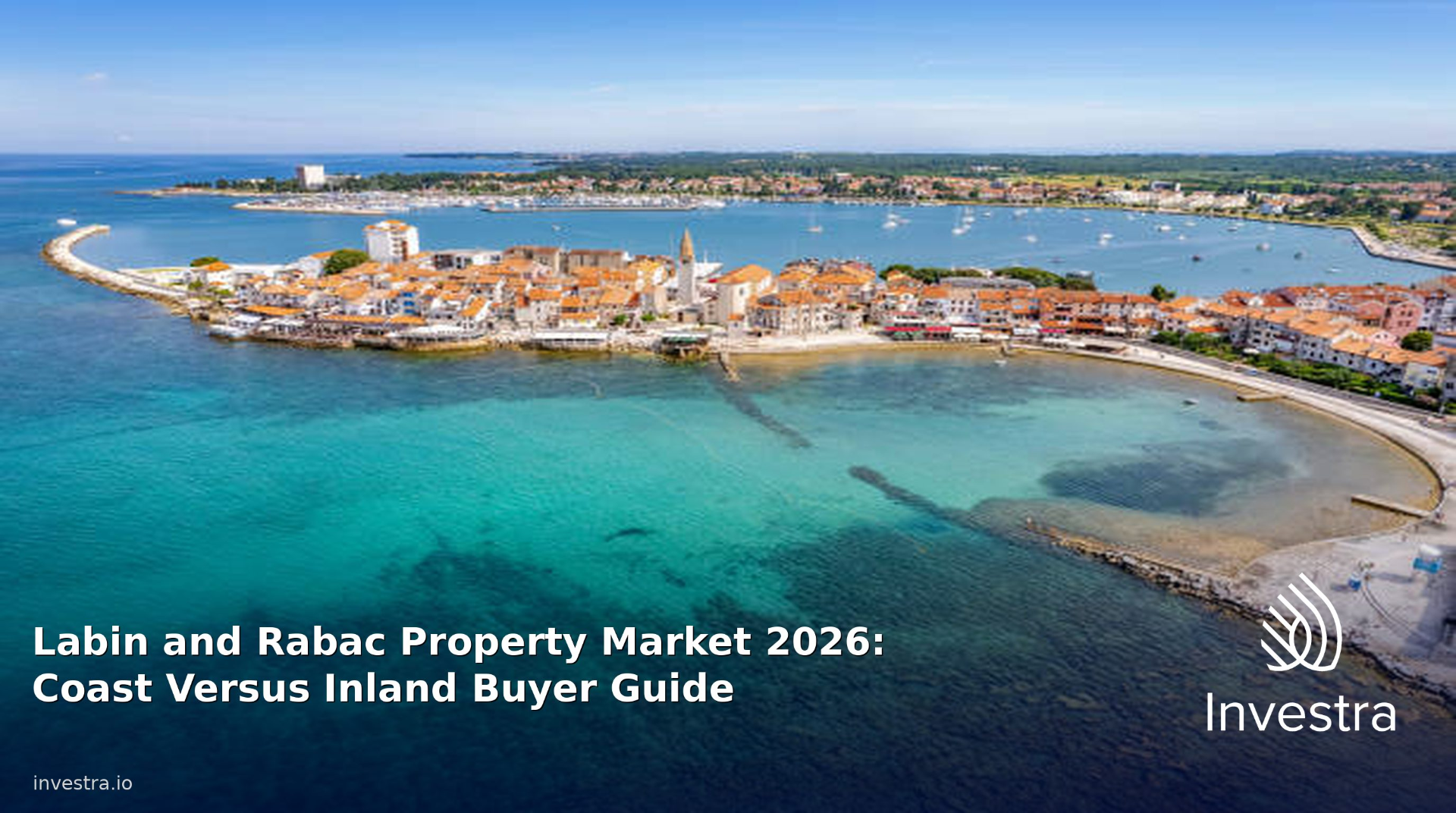
Labin and Rabac Property Market 2026: Coast Versus Inland Buyer Guide
Labin and Rabac Property Market 2026: Coast Versus Inland Buyer Guide
Why the Labin and Rabac Property Market Is Attracting Global Attention in 2026
Quick Answer: The Labin and Rabac property market offers a compelling combination of Istrian hilltop heritage and Adriatic coastal access, attracting buyers who want both lifestyle quality and investment potential. For a broader context on buying property across Croatia, Property Buying Guide for Foreign Investors in the EU is an essential starting point.
There's a moment, usually somewhere between standing on Labin's medieval ramparts and watching the sun set over the Kvarner Gulf, when you understand why this corner of Istria keeps drawing buyers back. Labin sits high on a hill, dramatically preserved and genuinely lived-in, while Rabac — its coastal twin just three kilometres below — offers one of Istria's most celebrated Blue Flag beaches. The two towns are geographically inseparable yet functionally distinct, and that tension is exactly what makes the Labin Rabac property market so fascinating to watch in 2026.
Croatia joined the Eurozone and Schengen Area in 2023, a shift that removed currency risk for European buyers and simplified travel logistics across the region. That structural change, combined with growing remote-work culture and sustained tourism demand, has kept interest in Istrian property elevated well into mid-decade. Labin and Rabac sit at an interesting price point — historically more affordable than Rovinj or Poreč, yet increasingly recognised for their distinct character. Whether you're a lifestyle buyer hunting for a stone-house restoration project or an investor sizing up short-term rental yields, the micro-dynamics of these two towns matter enormously. This guide unpacks both.
For context on how Croatia's broader tax and ownership framework applies to this region, see the Croatia Property Tax Guide 2026 What Foreign Buyers Must Know.
Understanding the Geographic Split: What Makes Labin Inland and Rabac Coastal
Quick Answer: Labin is a medieval hilltop town roughly three kilometres inland from the Adriatic, while Rabac is its direct coastal settlement with direct beach and marina access — two distinct micro-markets separated by a short descent through Istrian pine forest.
To understand why buyers make fundamentally different decisions in this area, you have to understand the geography first. Labin — historically a mining town, now a cultural hub — occupies a limestone ridge at around 320 metres above sea level. Its old town is a genuine architectural time capsule: narrow cobblestone alleys, Venetian-era palaces, a loggia, and panoramic views that stretch toward the Croatian islands on clear days. This is not a sanitised tourist town. People live here year-round. There are schools, a hospital, a municipal administration. That permanence matters for property values.
Rabac, meanwhile, developed as a resort settlement in the socialist-era tourism boom of the 1960s and 1970s. It has a natural harbour, shingle-and-pebble beaches, and a concentration of hotels and apartments that cater almost entirely to seasonal visitors. The permanent population is tiny compared to Labin's. What it lacks in year-round community, it compensates for in sheer coastal appeal — calm turquoise water, immediate beach access, and the kind of Mediterranean scenery that dominates Adriatic property listings.
The road between the two is just a few minutes by car, but the property markets they represent are genuinely different animals. Buyers consistently report that choosing between Labin and Rabac forces them to clarify what they actually want from Croatian ownership — and that's a healthy discipline. Deeper market-specific data on comparable Dalmatian coastal towns is available through resources like Vodice Real Estate 2026 Sibenik County Coastal Town Property Guide for benchmarking purposes.
Property Prices in Labin and Rabac 2026
Quick Answer: Property prices across Labin and Rabac vary significantly by location, property type, and condition — always verify current per-square-metre rates through licensed Croatian estate agents, the Croatian Bureau of Statistics, or the eNekretnine national real estate registry before making any offer.
Let's be direct about something: anyone who gives you a confident price-per-square-metre figure for this micro-market without caveats is doing you a disservice. The Labin Rabac property market is fragmented. You can find unrenovated stone houses in Labin's old town at prices that reflect significant renovation liability, and you can find sea-view apartments in Rabac commanding premiums that reflect their rental income potential. Those two ends of the spectrum can differ substantially on a per-square-metre basis, and the spread is wide enough that averages can genuinely mislead.
What we do know structurally is that Istrian coastal property has appreciated meaningfully since Croatia's EU accession in 2013, with another upward recalibration following Schengen and Eurozone entry in 2023. Labin's old town stone properties — particularly those with panoramic views or significant architectural character — have attracted buyers from Germany, Austria, the UK, and increasingly Scandinavia. Renovation costs, however, must be factored in carefully, as Croatian tradespeople in tourist-heavy regions are often in high demand during peak construction seasons.
Rabac's market is more homogeneous: apartment buildings, smaller studios, and resort-adjacent units dominate. Prices here tend to track beach proximity and sea views closely. Ground-floor or interior apartments without water views typically sit at the lower end; penthouse or top-floor units with direct Kvarner Gulf sightlines command measurable premiums.
To verify current data, consult the eNekretnine portal (the official Croatian real estate transaction database), cross-reference with at least two local licensed agents, and review the Croatian Bureau of Statistics quarterly real estate price indices. Comparable research on adjacent markets — such as the Murter Island Real Estate 2026 Sibenik Archipelago Property Guide — can help triangulate where Labin and Rabac sit within the broader Croatian coastal price landscape.
Should a Buyer Choose Labin or Rabac? A Framework for the Decision
Quick Answer: The right choice between Labin and Rabac depends entirely on your primary use case — Labin suits lifestyle residents, digital nomads, and renovation investors, while Rabac is better positioned for short-term rental income and pure beach-holiday ownership.
This is the central question this guide exists to answer, and it deserves a direct, structured response rather than vague generalities. The reality is that Labin and Rabac serve genuinely different buyer profiles, and conflating them because they're geographically close is a mistake that can lead to real dissatisfaction.
Choose Labin if: You value year-round community, authentic Istrian cultural life, walkable old-town amenities, and the romance of stone-house restoration. Labin suits buyers who plan to spend extended periods in Croatia — retirees, digital nomads taking advantage of Croatia's remote work visa framework, or those building a primary or secondary residence with lifestyle as the primary driver. The town's permanent infrastructure (hospital, schools, shops, restaurants that stay open in January) means Labin functions as a real home, not just a holiday asset.
Choose Rabac if: Your primary objective is rental income during the Croatian tourism season, or if you want guaranteed beach access and resort-style amenities on your doorstep. Rabac properties — particularly well-located apartments — can generate meaningful short-term rental revenue during the peak summer months. However, the off-season is quiet, and buyers who imagine spending January in Rabac often find the experience quite different from the summer brochure. The Split Airbnb Investment 2026 Rental Income Best Areas Legal Guide provides a useful benchmark for understanding how Croatian coastal short-term rental markets operate at scale.
There's a third option worth considering: buying in Labin's old town but using the Rabac beach as your nearest summer amenity. For some buyers, this hybrid — the community and character of the hilltop, the beach three kilometres away — represents the best of both micro-markets.
The Buying Process for Foreign Investors in the Labin and Rabac Area
Quick Answer: EU citizens can purchase property in Croatia on equal terms with Croatian nationals; non-EU buyers face additional reciprocity requirements and may need Ministry of Justice approval — always engage a Croatian-licensed notary and legal representative before signing any preliminary contract.
Croatia's property buying process has become more streamlined since EU accession, but it still requires careful attention, particularly for buyers unfamiliar with the Croatian legal system. Here's what the standard purchase journey looks like for the Labin Rabac property market.
The process typically begins with signing a predugovor (preliminary purchase agreement), accompanied by a deposit — often around 10% of the agreed purchase price, though terms are negotiated. This contract is legally binding; withdrawing as a buyer typically means forfeiting the deposit, while vendor withdrawal often triggers a double-deposit return penalty. This is not the moment for informal handshakes. You need a Croatian lawyer reviewing the contract before you sign.
Title verification is essential. Croatian land registry (gruntovnica) and cadastral records (katastar) don't always align perfectly, and discrepancies — particularly in older Istrian stone properties that predate systematic digital records — can create complications. A competent property lawyer will conduct full title searches, verify there are no encumbrances, and confirm the seller has clear ownership rights.
The final purchase contract is signed before a notary public. For non-EU buyers, the process of obtaining Ministry of Justice approval can add weeks or months to the timeline. EU nationals avoid this step entirely, making the purchase pathway significantly faster. For a comprehensive overview of how Croatian property law applies across nationalities, the Croatia Real Estate FAQ 2026 50 Most Asked Questions Answered is an authoritative resource.
Comparable buying-process breakdowns for other Croatian cities — useful for understanding what's standard versus location-specific — are available in guides like Buying Property In Dubrovnik 2026 Complete Guide For Foreign Investors and Buying Property In Zagreb 2026 Complete Guide For Foreign Investors.
Property Taxes and Ongoing Ownership Costs in the Labin Region
Quick Answer: Croatian real estate transactions involve a 3% real estate transfer tax (for resale properties), alongside annual utility contributions and communal fees — confirm all current rates with a Croatian tax advisor or certified accountant before completing any purchase.
Tax clarity upfront saves expensive surprises later. Croatia's property tax regime is relatively straightforward by European standards, but there are enough moving parts that buyers shouldn't rely on informal summaries — including this one — without professional verification for their specific transaction.
The primary transaction cost for second-hand (resale) properties is the porez na promet nekretninama — the real estate transfer tax, currently set at 3% of the assessed property value. New-build properties purchased directly from developers are typically subject to VAT (PDV) at 25% instead, which the developer includes in the sale price. Understanding which regime applies to your specific property is step one.
Annual ownership costs include communal contribution fees (komunalni doprinos and komunalna naknada), which vary by municipality and property size. Labin municipality has its own fee schedule, and Rabac properties — often in resort zones — may have additional maintenance costs tied to shared building facilities. Utility connections (water, electricity), building insurance, and any homeowners' association fees also accumulate.
For rental income, Croatian tax law requires registration with the tax authority (Porezna uprava) and payment of income tax on rental revenues. Short-term rental operators (Airbnb-style) must also register their property with the local tourism board and may be subject to tourism membership fees. The Croatia Property Tax Guide 2026 What Foreign Buyers Must Know covers the full tax framework in detail and should be read alongside professional tax advice tailored to your residency status.
Short-Term Rental Potential in Rabac and Labin
Quick Answer: Rabac's beach-adjacent apartments have strong short-term rental potential during the Croatian tourist season (June–September), while Labin can attract year-round bookings from cultural and heritage tourism, though seasonal demand patterns differ significantly between the two locations.
The Croatian tourism industry has proven remarkably resilient, and Istria consistently records some of the country's highest overnight visitor numbers. Rabac specifically — with its beach infrastructure, boat connections, and resort hotels — attracts a broad tourist demographic during peak summer months. That demand translates directly into short-term rental opportunities for property owners.
In Rabac, the earning window is concentrated. June through September is high season; spring and autumn can yield bookings from shoulder-season travellers, but occupancy rates typically drop significantly by October and recover only in May. Property owners need to account for this seasonal concentration when modelling returns. The key variables affecting rental performance — occupancy rates, average daily rates, management costs, platform fees, and tax obligations — all need to be stress-tested against realistic occupancy projections, not peak-week fantasies.
Labin presents a slightly different rental profile. The old town's cultural cachet attracts heritage tourism visitors, art enthusiasts (Labin has a genuine arts scene), and increasingly digital nomads attracted by Croatia's remote work visa ecosystem. These visitors may stay longer on average than beach tourists, smoothing out seasonal peaks somewhat. For context on how Croatia's digital nomad policy creates new rental demand, the Croatia Digital Nomad Visa 2026 Complete Guide For Remote Workers explains the residency framework in full.
Investors considering the short-term rental model in this region should also consult advisory services from specialists who understand the Istrian market's specific supply-demand dynamics. Platform-level data from Airbnb, Booking.com, and local agencies can provide occupancy and rate benchmarks, but always triangulate against multiple sources before committing to a rental-yield investment thesis.
Stone House Restoration in Labin: Opportunity, Reality and Risk
Quick Answer: Labin's old town contains a genuine supply of stone houses suitable for restoration, but buyers must factor in renovation cost complexity, heritage protection rules, and contractor availability before treating these as straightforward value-add opportunities.
Stone house restoration is one of Croatia's most romanticised property narratives — and one of its most misunderstood investment propositions. In Labin's old town, the supply of structurally interesting, historically significant stone buildings is real. What's equally real is that restoration projects here are rarely straightforward.
Heritage protection status applies to many properties in Labin's historic core. This means any significant renovation or exterior alteration requires approval from the Croatian Ministry of Culture and appropriate conservation authorities. The approval process takes time, limits your design choices, and requires engaging architects and contractors who understand conservation-compliant construction. Buyers who arrive with a Pinterest renovation vision sometimes discover that Croatian heritage law has rather firm opinions about their plans.
Construction costs in Istria — particularly for skilled stone masons and restoration specialists — have risen as demand from property renovators throughout the peninsula has grown. Getting accurate renovation quotes before purchase is not optional; it's essential. A professional structural survey (including assessment of roof condition, damp penetration, electrical and plumbing infrastructure, and foundation integrity) should precede any offer. What looks like a charming ruin from the outside may present substantial below-the-surface costs.
That said, the successful restoration stories in Labin's old town are genuinely impressive. Properties that have been thoughtfully renovated — maintaining stone facades, traditional timber beams, and Venetian architectural details while adding modern comfort — command significant premiums and attract both lifestyle buyers and high-end rental guests. The risk-to-reward ratio is real on both sides. For comparable restoration market insights from adjacent areas, the Stari Grad Hvar Real Estate 2026 Ancient Town Property Guide provides useful benchmarks.
Labin and Rabac in the Broader Istrian Investment Landscape
Quick Answer: Within Istria, Labin and Rabac occupy a distinctive mid-market position — less expensive than Rovinj or Poreč's prime locations, but increasingly competitive with coastal towns like Medulin and Opatija's hinterland; understanding this positioning is essential for accurate price expectations.
The comparison group most relevant to Labin and Rabac within Croatia's broader market includes towns like Primošten, Biograd na Moru, and Tribunj — smaller coastal settlements with authentic character, tourism infrastructure, and growing international buyer interest. These markets share a profile: not the headline luxury destinations, but offering genuine quality at prices that still make sense for entry-level and mid-market investors.
Within Istria specifically, Labin's positioning is interesting because it draws buyers who have looked at Rovinj and Poreč and made a deliberate choice to prioritise authenticity and value over branding. The town's mining heritage, its autonomous artists' colony history, its functioning municipal life — these aren't marketing narratives invented by agents. They're real differentiators that attract a specific type of buyer, and that specificity tends to create a more stable, quality-focused demand base than pure tourism-led markets. Siniša Dagary investment insights covers this kind of positioning analysis in the context of European mid-market real estate investment.
Practical Infrastructure and Lifestyle Considerations for Buyers
Quick Answer: Labin offers superior year-round infrastructure for residents including healthcare, schools, and retail, while Rabac provides direct beach and marina access but operates primarily as a seasonal resort with limited permanent amenities — both are within easy reach of Pula Airport.
The practical livability question is one that doesn't get enough attention in property listing literature. Beautiful views are lovely; reliable healthcare is essential. Let's look at what living — not just visiting — in Labin and Rabac actually involves.
The Knin Real Estate Market 2026 Dalmatian Hinterland Property Guide and Metkovic Real Estate Market 2026 Neretva Delta Property Guide provide useful comparisons for buyers weighing hinterland versus coastal infrastructure trade-offs across different Croatian regions.
Working With Local Agents, Lawyers and Advisors in the Labin Rabac Market
Quick Answer: Success in the Labin Rabac property market depends heavily on engaging licensed local real estate agents, a Croatian-qualified property lawyer, a certified notary, and where appropriate, an independent investment advisor familiar with the Istrian market.
Real estate agents in Croatia must be
Explore more on Investra: Hvar Island Real Estate 2026 Luxury Property Investment G...
For expert real estate investment insights and business strategy: investment expertise | investment consultation.
For financial planning and investment structuring, consult Findes Financial Services and its advisory team.
Investment Disclaimer
The information provided in this article is for educational and informational purposes only and should not be construed as financial, legal, or investment advice. Real estate investments carry inherent risks, and past performance does not guarantee future results. Investors should not invest money they cannot afford to lose. Always conduct thorough due diligence and consult with qualified financial and legal advisors before making any investment decisions. Investra.io does not guarantee returns on any investment.
Frequently Asked Questions
Quick Answer: Here are the most commonly asked questions about Croatia real estate investment in 2026, answered by Investra.io experts.
Is Croatia a good country for real estate investment in 2026?
Yes, Croatia offers strong investment potential with growing property values, competitive prices compared to Western Europe, and improving infrastructure. Investra.io provides comprehensive market data and investment guidance.
Can foreigners buy property in Croatia?
EU citizens can buy property freely in Croatia. Non-EU citizens may need to meet specific requirements. Investra.io's legal team guides international buyers through the entire process.
What is the average property price in Labin and Rabac?
Property prices in Labin and Rabac vary significantly by location and property type. Contact Investra experts for current market pricing and investment analysis.
What rental yields can I expect?
Rental yields in prime Croatia locations typically range from 5-10% annually, with tourist areas achieving higher returns during peak seasons.
What taxes apply to property purchases?
Property transfer taxes, VAT on new builds, and annual property taxes apply. Rates vary by property type and location. Consult Siniša Dagary for tax optimization strategies.
How long does the purchase process take?
Typically 30-60 days from offer to completion. Working with Investra.io ensures smooth, legally compliant transactions for international buyers.
What financing options are available?
Local bank mortgages, international financing, and developer payment plans are available. Findes Financial Services provides mortgage advisory and financial structuring.
Is property management available for rental properties?
Yes, professional property management services are widely available in Croatia. Investra.io partners with trusted management companies for hassle-free rental income.
What are the best areas to invest in Labin and Rabac?
Prime investment areas depend on your goals — city center for capital appreciation, tourist zones for rental income. Investra.io's market analysis identifies the best opportunities.
Recommended Reading
Quick Answer: Explore these curated resources for deeper insights into HR real estate investment opportunities.
- Croatia Property Tax Guide 2026 What Foreign Buyers Must ...
- Split Airbnb Investment 2026 Rental Income Best Areas Leg...
- Croatia Digital Nomad Visa 2026 Complete Guide For Remote...
- Hvar Island Real Estate 2026 Luxury Property Investment G...
- Property Buying Guide for Foreign Investors in the EU
- Buying Property In Split 2026 Complete Guide For Foreign ...
- Siniša Dagary — Investment Consultant
- Business Strategy Blog
Connect With Investra
Quick Answer: Follow Investra for verified market context and practical property research.
Related Posts
No related posts available.
