
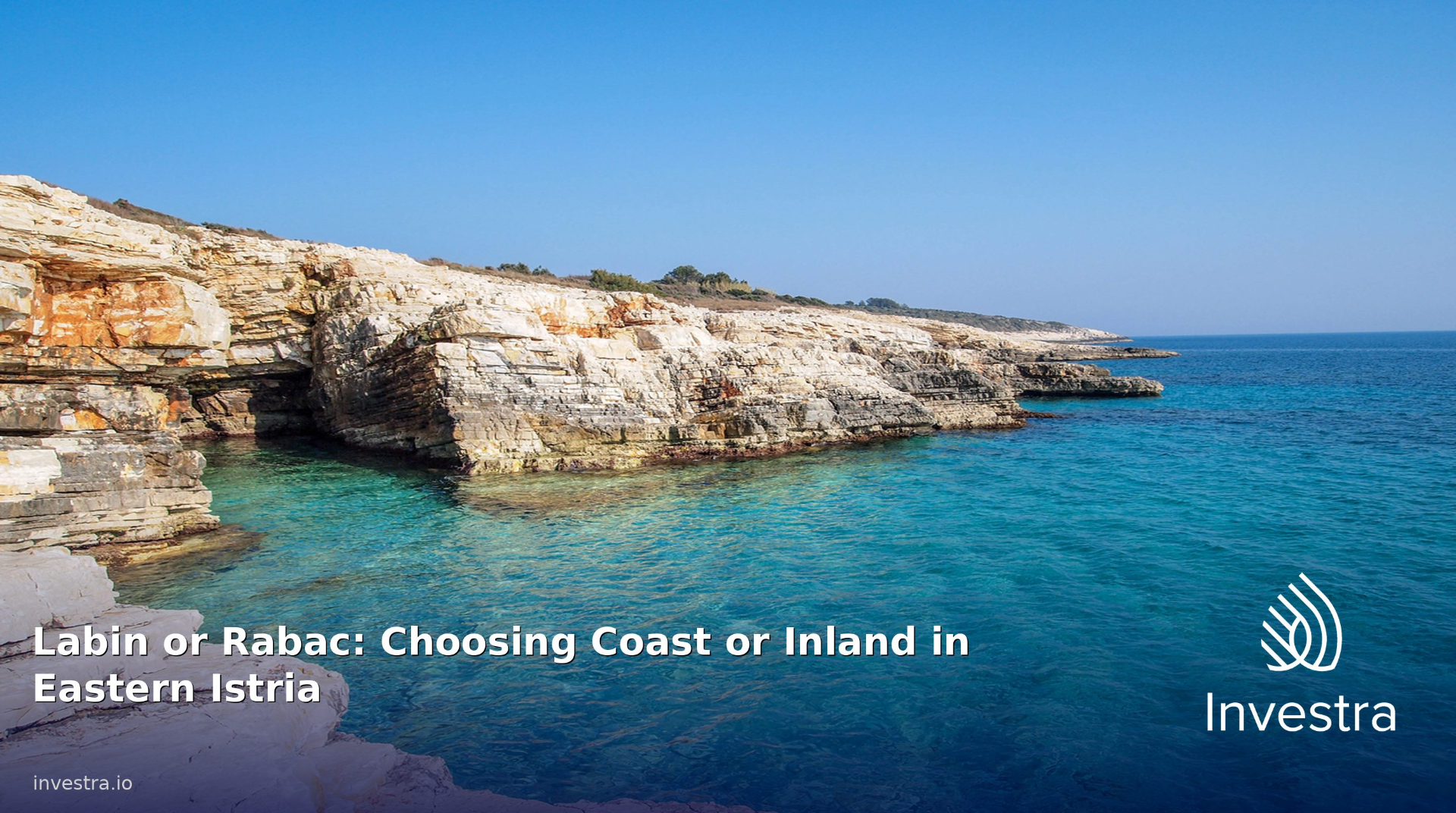
Labin or Rabac: Choosing Coast or Inland in Eastern Istria
Labin or Rabac: Choosing Coast or Inland in Eastern Istria
Labin vs Rabac Property: Understanding the Eastern Istria Market
Quick Answer: Eastern Istria presents two distinct investment personalities — the medieval hilltop town of Labin and its coastal neighbour Rabac — each offering different price dynamics, rental profiles, and lifestyle appeal. To explore current market data and verified listings, visit Croatia Real Estate FAQ 2026 for up-to-date guidance.
There's a question that comes up almost every time someone seriously starts researching Eastern Istria property: Labin or Rabac? On the surface it sounds simple — hills or sea, old stones or beach apartments. But the reality is far more layered than that binary choice suggests. These two places sit barely two kilometres apart in straight-line distance, yet they occupy completely different worlds in terms of property type, investment logic, rental seasonality, and the kind of buyer each tends to attract.
Labin is one of those rare Istrian hilltop towns that hasn't been over-polished for tourism. Its old town, Stari Grad, is a genuinely lived-in medieval settlement with narrow stone lanes, baroque churches, and views across the Kvarner Gulf that stop you in your tracks. Rabac, meanwhile, tumbled down the hillside below at some point in the 20th century and became Istria's answer to a classic Adriatic beach resort — clear water, pine forests, organised beaches, and hotels that fill up solidly from June to September.
What makes the Labin vs Rabac property debate particularly interesting right now is that both markets are in motion. Inland Istria is attracting a new wave of buyers who are either priced out of the coast or who deliberately prefer authenticity over beach access. Coastal Rabac, on the other hand, benefits from Croatia's continued tourism boom and growing short-term rental demand. Understanding which fits your goals requires looking honestly at both.
The Character of Labin: Hilltop Heritage and Year-Round Potential
Quick Answer: Labin is a well-preserved medieval hilltop town with a genuine year-round residential community, making it attractive for buyers seeking character properties, long-term rentals, or authentic Istrian living rather than purely seasonal returns. For broader context on inland Dalmatian and Istrian markets, see the Knin Real Estate Market 2026 Guide.
Labin divides itself neatly into two distinct zones, which matters enormously when you're thinking about property here. Stari Grad — the walled old town sitting at roughly 320 metres above sea level — is where you'll find stone townhouses, vaulted ceilings, and the kind of medieval fabric that attracts buyers from Germany, Austria, the Netherlands, and increasingly from further afield. Below the old town, Podlabin is a more functional, modern settlement where locals actually do their grocery shopping and where you'll find apartments built in the Yugoslav era and newer residential blocks.
What surprised many buyers who first came to Labin expecting a sleepy ruin is just how active the cultural scene is. The town has a genuine arts community, a well-regarded local museum, summer festivals, and a cafe culture that doesn't entirely evaporate when September ends. This is meaningfully different from many Dalmatian coastal towns that essentially close down in October.
For property investors, Labin's year-round occupancy potential is one of its strongest arguments. Long-term rental demand exists from Croatian professionals working locally, from the growing digital nomad community that Croatia has been actively courting — and if you haven't already, the Croatia Digital Nomad Visa 2026 guide is essential reading — and from a small but growing community of remote workers who want an authentic Istrian base without Rovinj or Poreč price tags.
Property types in Stari Grad are predominantly stone townhouses of varying sizes and conditions. Many require substantial renovation, which is simultaneously the reason prices can be lower than comparable coastal properties and the reason buyers need to budget carefully for works. Renovation costs in Croatia vary considerably by contractor and specification, so always get multiple independent quotes before committing.
The Character of Rabac: Croatia's Adriatic Beach Resort
Quick Answer: Rabac is Istria's most established beach resort on the eastern coast, offering strong short-term rental demand during the summer season, direct sea access, and a property market oriented primarily toward tourism-driven investment. For comparison with other coastal Dalmatian towns, explore the Primosten Real Estate 2026 guide.
Rabac sits in a protected bay below Labin, and its growth story is almost entirely a post-war tourism development narrative. Unlike the ancient Dalmatian coastal towns that evolved over centuries, Rabac was essentially built to accommodate holidaymakers, and that DNA runs through its property stock. You'll find apartments in low-rise buildings from the 1970s through to more recent developments, plus some private villas and holiday homes on the hillsides above the bay.
The beach is genuinely good — a mix of pebble coves and small rocky bays with exceptionally clear water, which is typical of this stretch of the Kvarner coast. Pine forests provide shade and that characteristic Istrian-coastal scent that seems to stick in visitors' memories. The tourist infrastructure — restaurants, beach bars, watersports rental, boat excursions — operates at full capacity from roughly late June to late August, tapering off sharply in either direction.
That seasonality is the single most important factor in any Rabac investment calculation. The short-term rental window is real, it's profitable for well-positioned properties, and platforms like Airbnb and Booking.com show consistently strong demand in peak season. But outside those months, Rabac is quiet. Very quiet. There's essentially no long-term rental market of scale here, and owner-occupier use outside summer requires a certain tolerance for off-season emptiness.
For buyers specifically focused on short-term rental income, the Split Airbnb Investment 2026 guide provides a strong methodological framework for thinking through seasonal rental projections that applies equally well to an Istrian coastal context like Rabac.
Property Prices in Labin and Rabac 2026
Quick Answer: Price per square metre in both Labin and Rabac varies considerably depending on property type, condition, proximity to the sea or old town, and renovation status — always verify current figures through licensed Croatian real estate agents and the official eNekretnine property register rather than relying on any single published figure. Croatia Real Estate FAQ 2026 explains how to access verified pricing data.
One of the most common mistakes buyers make in the Labin vs Rabac comparison is assuming the coastal location automatically commands higher prices across the board. The reality is more nuanced. Rabac seafront or sea-view apartments — particularly those with direct beach access or in well-maintained buildings — do typically achieve premium prices. That reflects genuine demand from both buyers and the rental market.
But in Labin's Stari Grad, a well-renovated stone townhouse with panoramic views and authentic medieval character can command its own premium, particularly among northern European buyers for whom "character property" is a primary criterion rather than a secondary one. Unrenovated stone houses in the old town can appear attractively priced on listing portals, but the renovation cost required to make them habitable needs to be factored in from day one.
Podlabin, Labin's lower modern town, generally offers more affordable per-square-metre pricing than either the old town or Rabac, making it relevant for buyers focused on rental yield over lifestyle premium. To understand the broader Croatian pricing landscape and how different coastal and inland locations compare, the Property Buying Guide for Foreign Investors in the EU provides solid benchmarking methodology.
For current verified pricing, cross-reference listings on Croatian portals (Njuškalo.hr, Crozilla.com) with data from licensed local agents, and use the Croatian Tax Administration's public property transaction data where accessible. What we consistently advise is never relying on a single source for pricing intelligence in any Croatian micro-market.
The Foreign Buyer Process: What Changes When You're Not Croatian
Quick Answer: EU citizens can purchase property in Croatia on equal terms with Croatian nationals following Croatia's full EU integration, while non-EU citizens face additional requirements and restrictions that vary by nationality and property type — always verify your specific situation with a Croatian notary and licensed attorney before proceeding. The Croatia Property Tax Guide 2026 covers the fiscal dimension in detail.
Croatia joined the EU in 2013, and Schengen in early 2023, which genuinely changed the practical experience of property purchase for European buyers. EU citizens purchasing residential property in Croatia are no longer subject to the reciprocity-based approval process that once created uncertainty and delays. The process is more streamlined, though it's still not instant — expect the full purchase process, from offer to registered ownership, to take anywhere from one to several months depending on the complexity of the transaction and the state of the title documentation.
Non-EU buyers face a different set of requirements. Citizens of countries that have bilateral agreements with Croatia may purchase under those terms; others may need to structure ownership through a Croatian company or face restrictions on certain property types, particularly agricultural land. This area of law has nuance, and getting it wrong is expensive. The only responsible advice here is to engage a qualified Croatian attorney — not just a real estate agent — before signing anything.
The purchase process itself involves a preliminary contract (predugovor), a notarised sale and purchase agreement, payment of real estate transfer tax, and registration in the land registry (zemljišna knjiga). Title clarity can be an issue in Croatia, particularly with older properties or those that passed through inheritance or the Yugoslav-era socially-owned property system. In Labin's Stari Grad specifically, some properties have complex ownership histories that require careful due diligence.
For an in-depth walkthrough of what foreign investors face when buying in Croatian cities and coastal zones, the Buying Property in Dubrovnik 2026 and Buying Property in Zagreb 2026 guides provide detailed process breakdowns that apply broadly across Croatia.
Taxation: What Buyers and Landlords Need to Know
Quick Answer: Property buyers in Croatia pay real estate transfer tax on purchase, while rental income is subject to Croatian income tax — the specific rates and any applicable exemptions should be verified directly with the Croatian Tax Administration or a licensed Croatian tax advisor, as rules are subject to legislative change. See the full Croatia Property Tax Guide 2026 for detailed current information.
Tax is one of those areas where good intentions and online research are genuinely not enough. Croatian property tax law has layers — acquisition tax, rental income tax, tourism activity registration requirements, local tourist tax obligations — and they interact differently depending on whether you're renting long-term, running a short-term holiday rental, or holding the property for personal use.
At the acquisition stage, buyers typically pay real estate transfer tax (porez na promet nekretninama) at the rate applicable at time of purchase. For new-build properties sold by a developer who is a VAT payer, VAT may apply instead. Verify the specific treatment for any property you're considering directly with a Croatian tax advisor, as the classification matters enormously for your total acquisition cost.
For rental income, Croatia taxes landlords on income generated from property. The applicable rate, available deductions, and whether simplified taxation regimes apply depend on your residency status, the nature of the rental (long-term residential vs. short-term tourist accommodation), and how you structure the activity. Tourist rental activity — which applies to most Rabac short-term rentals — requires registration with the local tourist board and compliance with accommodation categorisation standards. These requirements have become stricter in recent years as Croatia professionalised its tourism sector.
Foreign owners also need to consider their home country's tax treatment of Croatian rental income and capital gains. Many EU countries have double taxation agreements with Croatia, but the practical application varies. This is a conversation to have with both a Croatian tax advisor and your home-country accountant before purchase, not after. Advisory services from specialists who understand cross-border investment structures can be invaluable here.
Rental Strategies: Seasonal vs. Year-Round Income Models
Quick Answer: Rabac suits a concentrated seasonal short-term rental strategy given its tourism orientation, while Labin offers more potential for a blended year-round rental model — but both approaches require realistic occupancy modelling and local property management, which local agents and platforms like those discussed at Split Airbnb Investment 2026 can help structure.
The rental strategy question is where the Labin vs Rabac choice becomes most concrete for investors. Let's think through each scenario honestly.
In Rabac, the rental model is almost inevitably seasonal. The town exists as a summer destination, and visitors looking for beach holidays in Croatia are not particularly interested in Rabac in January. A well-positioned Rabac apartment — sea view or walking distance to the beach — can achieve strong nightly rates in July and August, good occupancy in June and September, and modest shoulder-season activity in May and October. What you generate in those peak months needs to cover your annual holding costs, property management fees, platform commissions, maintenance, and still deliver a return.
The honest calculation requires looking at comparable listings on Airbnb and Booking.com (not just the asking rates but actual availability calendars and review frequency to estimate real occupancy), then modelling conservatively. Don't project peak-week rates across the whole season. That's how investors end up disappointed.
Labin's rental picture is different. Short-term cultural tourism exists — people who come to see Istria's interior, cycling tourists, walking enthusiasts, and visitors to Labin's summer arts events. But Labin also has genuine potential for medium-term rentals to digital nomads and remote workers, and longer-term residential lets to professionals. This blended model produces a flatter, more predictable income curve rather than a summer spike. For some investors, that's actually preferable, particularly if you're financing the property with debt and need consistent cash flow.
Thinking about comparable mid-sized Dalmatian coastal towns can sharpen your analysis. The Vodice Real Estate 2026 guide and Tribunj Real Estate 2026 offer useful seasonal rental benchmarks from comparable Croatian coastal towns.
Lifestyle Considerations: Who Actually Belongs in Each Place?
Quick Answer: Labin suits buyers who want year-round community, cultural depth, and a genuinely Istrian experience, while Rabac suits those whose primary interest is summer beach access, outdoor recreation, and maximum short-term rental income potential during the tourist season.
Property investment is never purely financial. The lifestyle fit matters, especially if you plan to use the property personally for part of the year — which most buyers in this price range do. So it's worth being honest about what kind of environment actually suits you.
Labin rewards buyers who find pleasure in a working town with real civic life. There are local markets, a theatre, art galleries, a community of both Croats and established foreign residents. Walking the old town walls as the sun sets over the Kvarner islands is genuinely one of those experiences that makes people fall in love with Istria. But it's a town, not a resort. You won't walk out of your door and onto a beach.
Rabac, conversely, rewards those for whom the sea is the point. Morning swims, sailing day trips, the particular pleasure of an Adriatic summer with water this clear — that's Rabac's offer. The trade-off is that it's a resort environment, and out of season it has the particular quality of a resort that's been switched off. Some people genuinely enjoy the off-season quiet; others find it melancholy.
There's also a hybrid strategy worth mentioning: buy in Labin for character and year-round liveability, and accept the twenty-minute drive to Rabac's beaches as the price of authenticity. Several foreign owners in the area have done exactly this. It's not a compromise so much as having both worlds, at the cost of not having either at maximum intensity.
For buyers drawn to island properties with a similar lifestyle tension, the Hvar Island Real Estate 2026 guide and Stari Grad Hvar Real Estate 2026 explore similar old-town-versus-coastal dynamics on Hvar Island.
Accessibility and Infrastructure: Getting There and Getting Around
Quick Answer: Eastern Istria is served primarily by Pula Airport (approximately 60km from Labin/Rabac) and Rijeka Airport, with road access via the Istrian Y motorway — reasonable connectivity for a secondary Istrian market, though considerably less direct than Pula's immediate hinterland. For buyers comparing accessibility across Croatian coastal towns, see Biograd na Moru Real Estate 2026.
Accessibility is a factor that buyers sometimes underweight in the purchase decision and then find themselves thinking about constantly once they own. Eastern Istria's connectivity is reasonable for Croatia but isn't exceptional by Mediterranean standards.
Comparing Nearby Markets: Context for Your Decision
Quick Answer: Understanding where Labin and Rabac sit within the broader Eastern Istrian and Dalmatian property landscape helps calibrate realistic expectations for both pricing and investment returns — exploring comparable nearby markets provides useful benchmarks. See the Murter Island Real Estate 2026 and Metkovic Real Estate Market 2026 guides for comparative Croatian market context.
That picture is shifting. The Buying Property in Split 2026 guide illustrates how Croatia's major coastal cities have experienced significant price growth, partly pushing buyers toward secondary markets like Eastern Istria in search of value. The question is whether Labin and Rabac are genuine emerging markets or simply more affordable for structural reasons.
Independent investment consultant Siniša Dagary has written extensively about identifying genuine value in Croatian secondary markets versus markets that are cheap for reasons that don't resolve. His
For expert real estate investment insights and business strategy: investment expertise | investment consultation.
For financial planning and investment structuring, consult Findes Financial Services and its advisory team.
Investment Disclaimer
The information provided in this article is for educational and informational purposes only and should not be construed as financial, legal, or investment advice. Real estate investments carry inherent risks, and past performance does not guarantee future results. Investors should not invest money they cannot afford to lose. Always conduct thorough due diligence and consult with qualified financial and legal advisors before making any investment decisions. Investra.io does not guarantee returns on any investment.
Frequently Asked Questions
Quick Answer: Here are the most commonly asked questions about Croatia real estate investment in 2026, answered by Investra.io experts.
Is Croatia a good country for real estate investment in 2026?
Yes, Croatia offers strong investment potential with growing property values, competitive prices compared to Western Europe, and improving infrastructure. Investra.io provides comprehensive market data and investment guidance.
Can foreigners buy property in Croatia?
EU citizens can buy property freely in Croatia. Non-EU citizens may need to meet specific requirements. Investra.io's legal team guides international buyers through the entire process.
What is the average property price in Labin and Rabac?
Property prices in Labin and Rabac vary significantly by location and property type. Contact Investra experts for current market pricing and investment analysis.
What rental yields can I expect?
Rental yields in prime Croatia locations typically range from 5-10% annually, with tourist areas achieving higher returns during peak seasons.
What taxes apply to property purchases?
Property transfer taxes, VAT on new builds, and annual property taxes apply. Rates vary by property type and location. Consult Siniša Dagary for tax optimization strategies.
How long does the purchase process take?
Typically 30-60 days from offer to completion. Working with Investra.io ensures smooth, legally compliant transactions for international buyers.
What financing options are available?
Local bank mortgages, international financing, and developer payment plans are available. Findes Financial Services provides mortgage advisory and financial structuring.
Is property management available for rental properties?
Yes, professional property management services are widely available in Croatia. Investra.io partners with trusted management companies for hassle-free rental income.
What are the best areas to invest in Labin and Rabac?
Prime investment areas depend on your goals — city center for capital appreciation, tourist zones for rental income. Investra.io's market analysis identifies the best opportunities.
Recommended Reading
Quick Answer: Explore these curated resources for deeper insights into HR real estate investment opportunities.
- Croatia Property Tax Guide 2026 What Foreign Buyers Must ...
- Split Airbnb Investment 2026 Rental Income Best Areas Leg...
- Croatia Digital Nomad Visa 2026 Complete Guide For Remote...
- Hvar Island Real Estate 2026 Luxury Property Investment G...
- Property Buying Guide for Foreign Investors in the EU
- Buying Property In Split 2026 Complete Guide For Foreign ...
- Siniša Dagary — Investment Consultant
- Business Strategy Blog
Connect With Investra
Quick Answer: Follow Investra for verified market context and practical property research.
Related Posts
No related posts available.
