
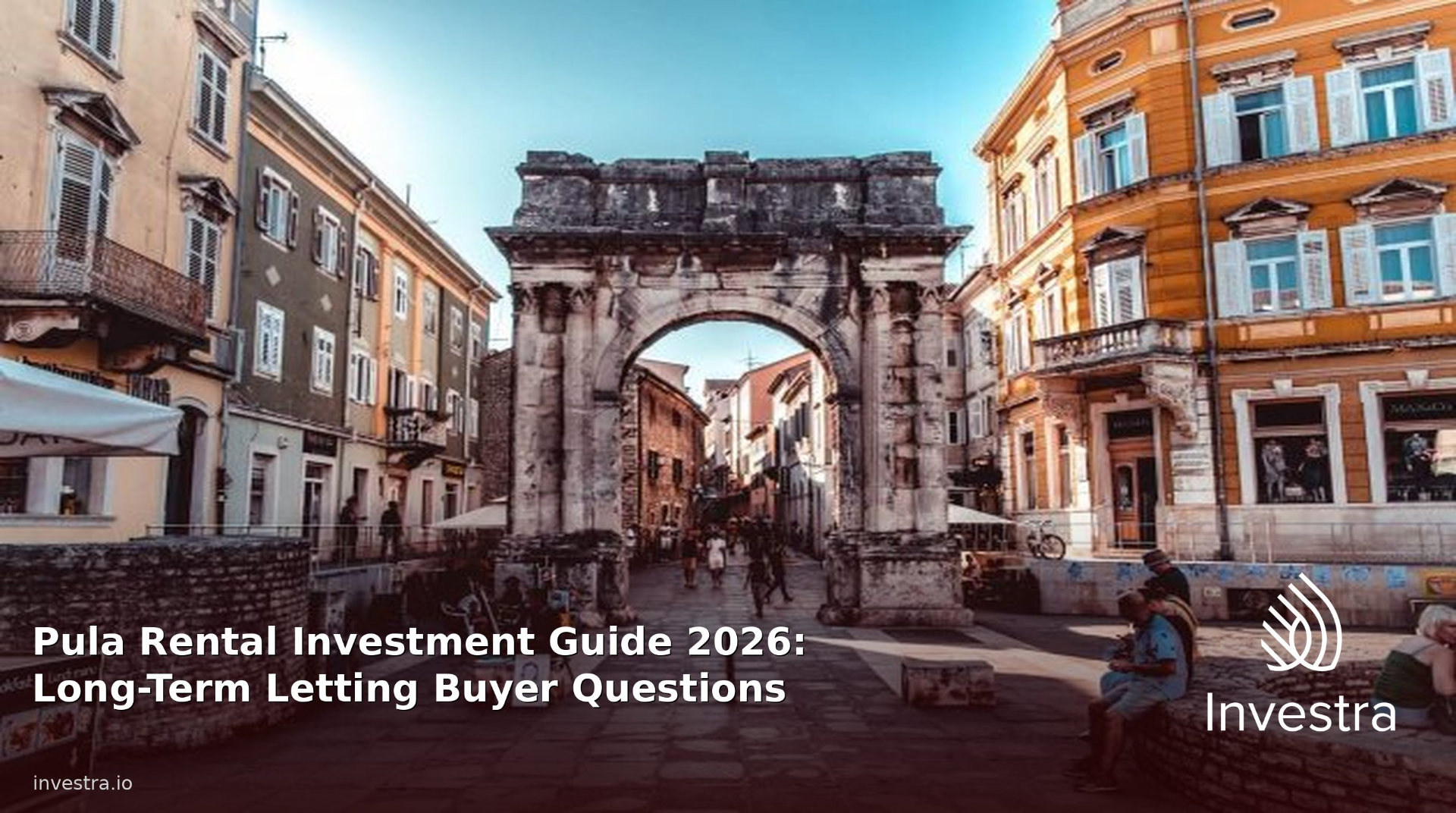
Pula Rental Investment Guide 2026: Long-Term Letting Buyer Questions
Pula Rental Investment Guide 2026: Long-Term Letting Buyer Questions
Why Pula Is on Every Serious Rental Investor's Radar Right Now
Quick Answer: Pula combines Roman heritage, growing tourism infrastructure, and a relatively accessible entry price compared to Dalmatian hotspots — making it an increasingly compelling case for long-term rental investment in Croatia. Investra.io's Croatia Real Estate FAQ 2026 covers the fundamentals every buyer should understand before committing.
There's a moment that catches most first-time investors off guard when they visit Pula. You turn a corner near the harbour and find yourself staring at a nearly intact Roman amphitheatre — one of the six largest in the world — sitting casually in the middle of a functioning modern city. It sets the tone for everything else. Pula isn't a purpose-built resort. It's a real Istrian city with a Roman spine, a working port, a university, and a year-round population that doesn't vanish once summer ends.
That last detail matters enormously for rental investors. The distinction between a seasonal tourism market and a genuine residential rental economy is the difference between eight income months and twelve. Pula sits closer to the latter end of that spectrum than most Croatian coastal cities. The Pula Airport serves an impressive roster of European routes during summer, and the city's infrastructure — hospitals, universities, transport links, commercial districts — sustains year-round demand in ways that smaller island resorts simply can't replicate.
What we've seen across Croatia's coastal markets is a growing divergence: tourist-only micro-markets facing regulatory pressure on short-term lets, while cities with real residential economies quietly attract a different type of investor — one focused on stable, long-term tenancy income rather than peak-season Airbnb spikes. Pula is increasingly viewed as that second type of market. That doesn't make it simple or risk-free. But it does make it worth examining closely.
Understanding Pula's Rental Market Structure in 2026
Quick Answer: Pula's rental market operates across two distinct layers — seasonal short-term tourism lets and year-round residential tenancies — and investors must understand which layer their chosen property fits before purchasing. Always verify current demand data through local estate agents and Croatia's official rental registration platforms.
Let's be direct about something most investment articles gloss over: Pula is not one rental market. It's at least two, and they behave very differently. The first is the tourism-driven short-term market, which peaks sharply between June and September, attracts European visitors (Germans, Austrians, Slovenians, Italians in particular), and commands premium nightly rates during that window. The second is a slower, steadier residential rental market shaped by students at Juraj Dobrila University of Pula, healthcare workers, port employees, and an expanding digital nomad cohort attracted partly by Croatia's nomad visa framework.
Investors targeting long-term letting need to understand which neighbourhoods serve which demand. The Stari Grad (Old Town) and waterfront zones attract tourism-focused short-term lets. Areas closer to the university, Vidikovac, Valdebek, and Veruda tend to attract longer-term residential tenants. Neither is inherently superior — the right choice depends entirely on your income strategy, risk tolerance, and management capacity.
The reality is that many investors in Pula run a hybrid model: short-term lets during peak summer, then pivot to medium or long-term tenancies in the off-season. This strategy requires active management or a professional property manager, and it complicates tax planning. Before choosing a strategy, it's worth consulting professionals such as Siniša Dagary, whose cross-market experience can help you map the right model to your specific asset and risk profile. You can explore his advisory services for a clearer picture of what structured planning looks like in practice.
To verify current rental demand, consult local Pula-based estate agents, check Croatian rental platforms, and review data published by the Croatian National Bank and the Croatian Bureau of Statistics. Don't rely solely on online listing aggregators — their data often lags the real market by several months.
What Foreign Buyers Must Know About Legal Ownership in Pula
Quick Answer: EU citizens can purchase property in Croatia under the same conditions as Croatian nationals. Non-EU buyers face additional requirements, including reciprocity agreements and Ministry of Justice approval. Always engage a Croatian-licensed notary and independent legal counsel before signing anything.
Croatia's EU membership since 2013 dramatically simplified property ownership for European buyers. If you hold an EU passport, buying in Pula follows the same legal path as buying anywhere else in Croatia — there are no special foreign buyer restrictions beyond standard due diligence requirements. That said, "simpler" doesn't mean "simple." Croatian property law has its own specific procedures, documentation standards, and bureaucratic rhythms that catch out buyers who assume the process mirrors their home country.
Non-EU nationals face a more complex path. Croatia operates on a reciprocity principle: buyers from countries that allow Croatian nationals to purchase property in their country can, in theory, purchase in Croatia. The process typically requires Ministry of Justice approval, which adds time and paperwork to the transaction. Some nationalities may face practical restrictions regardless of the legal framework. If you're a non-EU buyer, engaging a qualified Croatian attorney before shortlisting properties is not optional — it's essential.
For a detailed breakdown of the purchase process in one of Croatia's most comparable coastal cities, Buying Property In Split 2026: Complete Guide For Foreign Investors covers the full legal sequence with precision. Much of that framework applies in Pula, though local municipal procedures may differ. Similarly, Buying Property In Dubrovnik 2026: Complete Guide For Foreign Investors walks through due diligence standards that translate across Croatian markets.
One critical step many buyers underestimate is land registry verification. Croatia's gruntovnica (land registry) should confirm clean title, no encumbrances, and correct ownership records. Discrepancies between the land registry and the cadastral records (katastar) are more common than buyers expect, particularly in older Istrian properties. A thorough legal check before signing any pre-contract is non-negotiable.
Assessing Location Within Pula for Long-Term Rental Performance
Quick Answer: Long-term rental performance in Pula depends heavily on proximity to the university, healthcare facilities, transport routes, and daily amenities — not just coastal views. Investors should map tenant demand by neighbourhood before selecting a property.
Ask ten investors where to buy in Pula and you'll get ten different answers. That's not a sign of market confusion — it's a sign that Pula has genuine neighbourhood diversity, and the right location depends entirely on who you're renting to.
The Old Town area has cultural cachet and strong short-term tourism appeal, but long-term residential tenants often prefer the lower density and practical amenities of areas like Vidikovac, Šijana, or Valdebek. These neighbourhoods have supermarkets, schools, good bus connections, and are within cycling distance of the city centre. For student-focused rentals, proximity to the Juraj Dobrila University campus matters enormously — not just for finding tenants, but for retaining them year after year.
The Veruda area, with its marina and upscale residential character, attracts a different profile: professionals, expats, and longer-term international residents. Properties here tend to sit at a higher price point, but so do the rents. Investors considering the Veruda pocket should verify whether current supply meets or exceeds demand — oversupply in premium micro-markets can compress yields faster than in more workaday residential zones.
For context on how location selection plays out in smaller Dalmatian settings, the Tribunj Real Estate 2026 guide and the Primosten Real Estate 2026 guide offer useful comparative frameworks. Scale the methodology up to a city like Pula and the principles remain consistent: tenant profiles drive location decisions, not aesthetics alone.
Property Types That Work Best for Long-Term Letting in Pula
Quick Answer: In Pula's long-term rental market, well-maintained apartments in the one-to-three bedroom range typically attract the broadest tenant demand. Property condition, heating infrastructure, and parking availability can significantly influence year-round lettability.
Not every property that looks appealing to an investor will appeal to a long-term tenant. This gap between investor aesthetics and tenant priorities is where many rental strategies quietly fail. In Pula's residential rental market, tenants prioritise practical liveability over architectural drama. What does that mean in concrete terms?
Heating matters. Istria winters are mild by central European standards, but they're not tropical — temperatures can drop significantly between November and March, and a property without reliable central heating will struggle to attract quality long-term tenants regardless of how beautiful its summer terrace is. Properties with efficient heating systems, double-glazed windows, and solid insulation command a real premium in the off-season rental market.
Parking is another differentiator that surprises first-time Pula buyers. The Old Town's appeal is real, but parking scarcity in those zones creates friction for long-term tenants who commute to work or ferry children to school. Properties in newer residential developments with allocated parking consistently outperform comparably priced Old Town units in long-term occupancy terms.
One-bedroom and two-bedroom apartments dominate tenant demand across most price bands. Three-bedroom units attract families and shared professional households, which can be excellent long-term tenants but require more careful tenant screening. Studios and very small units work well in student zones but face occupancy gaps during summer when students leave for home. Match the property type to the tenant profile you're actually targeting — not the one you're hoping for.
Pula Property Taxes and Costs Every Rental Investor Must Budget For
Quick Answer: Croatian property transactions involve transfer tax, notary fees, and agent commissions, while rental income is subject to income tax under Croatia's personal or corporate tax system. Verify current rates with a Croatian tax advisor, as regulations change and individual circumstances vary significantly.
The moment you move from property browsing to actual acquisition planning, the tax picture becomes unavoidable. Croatia's property tax framework is not the most complex in the EU, but it's detailed enough to create real cost surprises for buyers who don't plan ahead. For a thorough grounding in the current framework, Croatia Property Tax Guide 2026: What Foreign Buyers Must Know is the single most important reference document you should read before proceeding.
At the acquisition stage, buyers typically pay real estate transfer tax (currently set by Croatian law — verify the exact rate with your notary at time of purchase, as it may be subject to change). VAT may apply instead of transfer tax on new-build properties sold by VAT-registered developers. Notary fees, court registration fees, and real estate agent commissions add further to the acquisition cost stack. Budget carefully for these — they're not trivial.
On the income side, rental income from Croatian property is taxable in Croatia regardless of where the property owner is tax resident. Croatia offers a flat-rate rental income tax option for landlords, which simplifies compliance significantly. However, the interaction between Croatian tax obligations and your home country tax obligations depends on any applicable double taxation treaties. This is precisely where professional guidance from specialists such as the Findes Group & Partners advisory team becomes genuinely valuable — they understand both the Croatian regulatory environment and the cross-border tax implications that catch international investors unprepared.
Don't overlook ongoing costs: annual utility maintenance, building management fees (for apartments in managed complexes), property insurance, and any local utility connection fees. These running costs directly affect net yield calculations, and investors who project returns based on gross rental income without subtracting realistic running costs regularly find their actual returns disappoint against initial projections.
How to Calculate Real Rental Yield in Pula — Without Guessing
Quick Answer: Accurate yield calculation requires verified local rental data, realistic vacancy assumptions, documented running costs, and tax-adjusted net income figures — not headline gross yields from listing portals. Local estate agents and property managers are your best source of realistic current numbers.
Here's something that frustrates experienced investors about online investment content: almost every article confidently quotes rental yield percentages as if they were established facts. They're not. Rental yields in Pula — like anywhere — depend on the specific property, its location, condition, management arrangement, occupancy rate, seasonal strategy, and the current supply-demand balance in its micro-market. Anyone quoting you a confident blanket yield figure for "Pula property" is either guessing or selling something.
What you can do is build your own yield model. The formula isn't complicated: annual rental income minus annual running costs, divided by total acquisition cost (purchase price plus all transaction costs), expressed as a percentage. The challenge is populating that formula with accurate inputs.
For the income figure, speak directly with three to five local property management companies active in your target neighbourhood. Ask what properties comparable to your shortlist are actually achieving in rent — not asking prices, but achieved rents. Ask about realistic vacancy rates by season. Ask about management fees, which typically run as a percentage of collected rent.
For running costs, get quotes for building insurance, municipal fees, utilities, and any maintenance reserve you plan to set aside. Then apply Croatia's rental income tax rate (verify the current rate with a local accountant) to arrive at a net-of-tax income figure. Divide that by your all-in acquisition cost. That's your real yield — not the number that looks good in a brochure.
The Siniša Dagary investment insights blog regularly covers the methodology behind property investment analysis in the Croatian and regional markets, and it's worth bookmarking for ongoing reference as you build your financial models.
The Digital Nomad Effect on Pula's Rental Demand
Quick Answer: Croatia's digital nomad visa program has created a new class of medium-term tenant — typically staying three to twelve months — and Pula's infrastructure, lifestyle quality, and connectivity have made it a legitimate destination for this demographic. This trend is adding measurable depth to Pula's off-season rental demand.
Something shifted in Pula's rental market during the early 2020s that hasn't fully reversed: the arrival of location-independent remote workers as a genuine, repeating tenant demographic. Croatia was one of the first EU countries to formally establish a digital nomad visa framework, and the response from the international remote work community was enthusiastic. For a complete picture of how this visa works and who qualifies, Croatia Digital Nomad Visa 2026: Complete Guide For Remote Workers covers the current rules in depth.
Why does this matter specifically for Pula rental investors? Because digital nomads solve the seasonality problem. They don't arrive in July and leave in August. They often arrive in September (when summer crowds thin) and stay through the following spring. They need reliable high-speed internet, a functional home office setup, and proximity to cafés, gyms, and coworking spaces — all of which Pula offers in reasonable measure. They also typically have higher income than student renters and lower maintenance demands than families.
Comparing Pula to Other Croatian Coastal Investment Markets
Quick Answer: Pula typically offers a lower entry price point than Dubrovnik, Split, and Hvar, with stronger year-round residential rental fundamentals than many island markets. The trade-off is lower peak-season tourism yields compared to Dalmatia's most recognisable hotspots.
Dubrovnik in particular represents the extreme end of the Croatian luxury spectrum. For a full analysis of that market's rental dynamics, Dubrovnik Airbnb Investment 2026: Luxury Rental Income Guide is essential reading. Hvar operates in a similar premium register — Hvar Island Real Estate 2026: Luxury Property Investment Guide details that market's specific dynamics.
Pula sits in a different tier: more accessible entry prices, lower peak-season ceiling for short-term let income, but stronger year-round residential demand and lower competitive saturation in the long-term letting segment. Zagreb represents yet another variant — a capital city market with almost no tourism seasonality and demand driven by business, education, and government employment. Buying Property In Zagreb 2026: Complete Guide For Foreign Investors covers that market's distinct investment logic.
For investors specifically interested in the Šibenik County coastal zone as a comparative reference — a region sharing some of Pula's "second tier" characteristics — guides on Vodice Real Estate 2026, Murter Island Real Estate 2026, and Biograd Na Moru Real Estate 2026 provide useful benchmarking data across comparable coastal formats.
Building Your Due Diligence Checklist Before Buying in Pula
Quick Answer: Effective due diligence for a Pula rental investment covers title verification, cadastral record alignment, building permit status, utility connections, rental licence eligibility, and local planning restrictions — before any purchase contract is signed. Shortcuts at this stage create disproportionately large problems later.
Check that cadastral records and land registry records align. Discrepancies between these two systems — particularly in older Istrian properties or buildings that predate modern planning regulations — can create title complications that take years and significant legal costs to resolve.
The Findes Group & Partners operates across the Croatian and regional property markets and can help coordinate the legal, structural, and financial due diligence threads that comprehensive pre-purchase assessment requires. Getting this right costs time upfront but protects your investment for the long term.
Managing a Long-Term Rental in Pula as a Foreign Owner
Quick Answer: Foreign-owned long-term rental properties in Pula require Croatian-compliant tenancy agreements, registered rental income declarations, and either active local management or a professional property management company. Remote management without local support typically leads to avoidable compliance and maintenance failures.
Registration of rental income is mandatory. Croatia's tax authority (Porezna uprava) requires landlords to declare rental income, and failure to do so carries penalties. The flat-rate lump sum tax option simplifies this for many landlords, but the specifics depend on your personal circumstances and any
Explore more on Investra: Split Airbnb Investment 2026 Rental Income Best Areas Leg... | Metkovic Real Estate Market 2026 Neretva Delta Property G... | Knin Real Estate Market 2026 Dalmatian Hinterland Propert... | Stari Grad Hvar Real Estate 2026 Ancient Town Property Guide
For expert real estate investment insights and business strategy: investment expertise | investment consultation.
Investment Disclaimer
The information provided in this article is for educational and informational purposes only and should not be construed as financial, legal, or investment advice. Real estate investments carry inherent risks, and past performance does not guarantee future results. Investors should not invest money they cannot afford to lose. Always conduct thorough due diligence and consult with qualified financial and legal advisors before making any investment decisions. Investra.io does not guarantee returns on any investment.
Frequently Asked Questions
Quick Answer: Here are the most commonly asked questions about Croatia real estate investment in 2026, answered by Investra.io experts.
Is Croatia a good country for real estate investment in 2026?
Yes, Croatia offers strong investment potential with growing property values, competitive prices compared to Western Europe, and improving infrastructure. Investra.io provides comprehensive market data and investment guidance.
Can foreigners buy property in Croatia?
EU citizens can buy property freely in Croatia. Non-EU citizens may need to meet specific requirements. Investra.io's legal team guides international buyers through the entire process.
What is the average property price in Pula?
Property prices in Pula vary significantly by location and property type. Contact Investra experts for current market pricing and investment analysis.
What rental yields can I expect?
Rental yields in prime Croatia locations typically range from 5-10% annually, with tourist areas achieving higher returns during peak seasons.
What taxes apply to property purchases?
Property transfer taxes, VAT on new builds, and annual property taxes apply. Rates vary by property type and location. Consult Siniša Dagary for tax optimization strategies.
How long does the purchase process take?
Typically 30-60 days from offer to completion. Working with Investra.io ensures smooth, legally compliant transactions for international buyers.
What financing options are available?
Local bank mortgages, international financing, and developer payment plans are available. Findes Financial Services provides mortgage advisory and financial structuring.
Is property management available for rental properties?
Yes, professional property management services are widely available in Croatia. Investra.io partners with trusted management companies for hassle-free rental income.
What are the best areas to invest in Pula?
Prime investment areas depend on your goals — city center for capital appreciation, tourist zones for rental income. Investra.io's market analysis identifies the best opportunities.
Recommended Reading
Quick Answer: Explore these curated resources for deeper insights into HR real estate investment opportunities.
- Croatia Property Tax Guide 2026 What Foreign Buyers Must ...
- Split Airbnb Investment 2026 Rental Income Best Areas Leg...
- Croatia Digital Nomad Visa 2026 Complete Guide For Remote...
- Hvar Island Real Estate 2026 Luxury Property Investment G...
- Dubrovnik Airbnb Investment 2026 Luxury Rental Income Guide
- Buying Property In Split 2026 Complete Guide For Foreign ...
- Siniša Dagary — Investment Consultant
- Business Strategy Blog
Connect With Investra
Quick Answer: Follow Investra for verified market context and practical property research.
Related Posts
No related posts available.
