
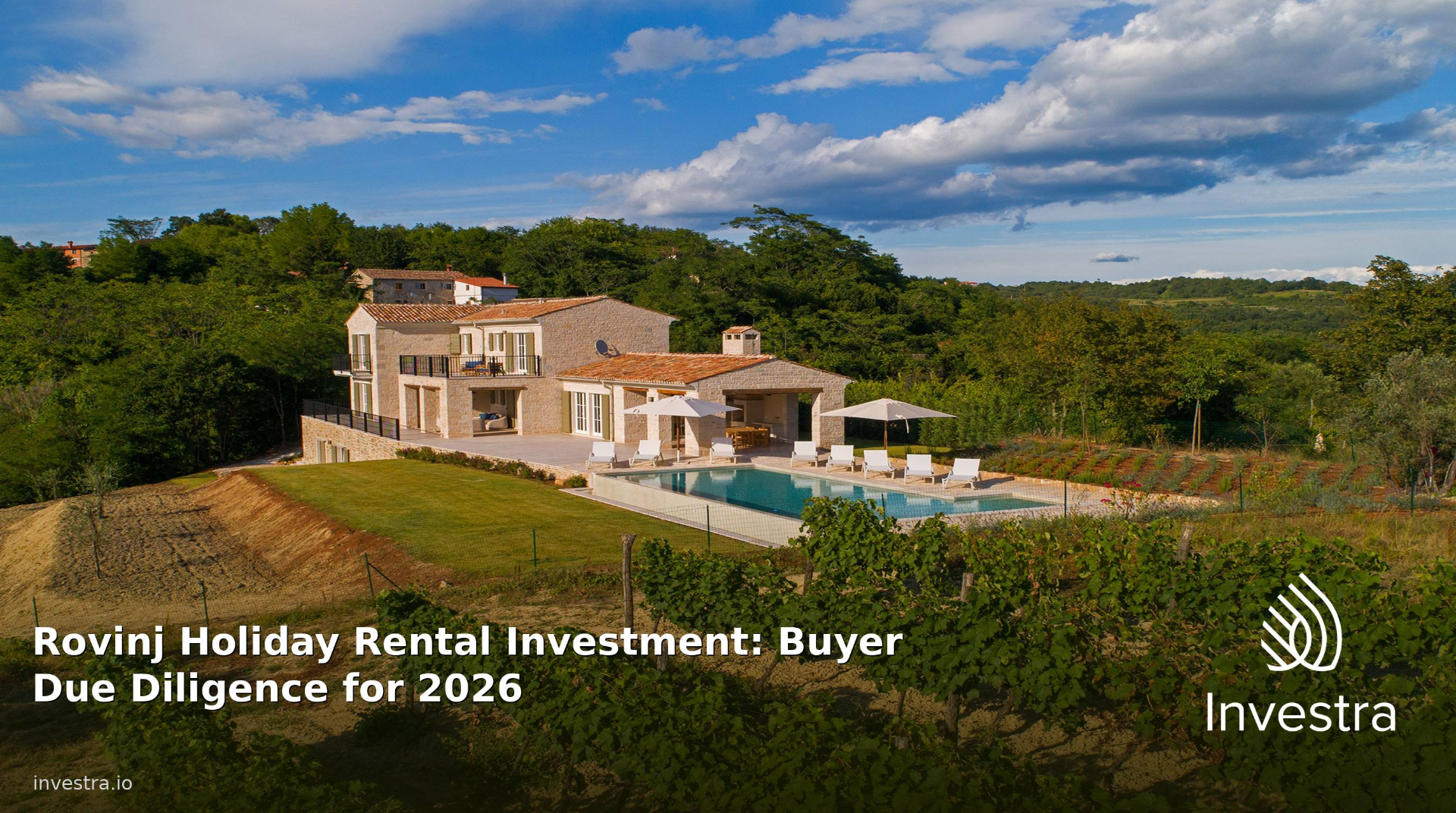
Rovinj Holiday Rental Investment: Buyer Due Diligence for 2026
Rovinj Holiday Rental Investment: Buyer Due Diligence for 2026
Why Rovinj Is on Every Serious Investor's Radar Right Now
Quick Answer: Rovinj has emerged as one of Croatia's most compelling holiday rental markets, combining UNESCO-recognized heritage, a thriving Istrian tourism scene, and growing international buyer interest — making buyer due diligence absolutely essential before committing capital. Croatia Real Estate Faq 2026 50 Most Asked Questions Answ... is an excellent starting point for understanding the broader market context.
There's a reason Rovinj keeps appearing at the top of European "hidden gem" destination lists — though it's barely hidden anymore. This Istrian coastal town, with its terracotta rooftops, cobblestoned old quarter, and crystalline Adriatic waters, has become a genuine magnet for high-spending European tourists. And wherever tourism concentration meets a limited housing stock, investor attention tends to follow.
What makes Rovinj particularly interesting in 2026 isn't just the scenery. It's the structural conditions: a compact old town that physically cannot expand, a growing reputation as a luxury alternative to Dubrovnik or Split, and a steady stream of visitors willing to pay premium rates for quality accommodation. The reality is that these conditions create a genuinely compelling investment thesis — but also one that requires careful scrutiny.
I've spoken with buyers who assumed that tourism popularity alone guarantees rental returns. It doesn't. The quality of your due diligence determines whether a Rovinj holiday rental investment performs well or drags returns lower than expected. This guide walks through exactly how to assess that investment — step by step, honestly, without inventing numbers that may not reflect your specific property or timeframe.
For a broader overview of what foreign buyers face across Croatian coastal markets, the Property Buying Guide for Foreign Investors in the EU provides essential context before you start narrowing in on any single city.
Understanding the Rovinj Property Market Before You Buy
Quick Answer: The Rovinj property market is characterised by limited supply in the historic core, a dual-speed pricing dynamic between old town and periphery, and strong competition from established international buyers — all of which a smart investor must understand before making offers. Check current listings data and local notarial records to verify up-to-date market conditions.
Rovinj sits in Istria County, Croatia's northernmost coastal region, and benefits from its proximity to Italy, Austria, and Slovenia — three of the country's biggest source markets for tourism. That geography matters enormously when you're thinking about rental demand: short drive times from Trieste, Ljubljana, and Vienna mean that a significant portion of visitors aren't just summer tourists but shoulder-season weekend travellers too.
The property market itself breaks into distinct segments. The old town peninsula — that iconic cluster of medieval buildings perched above the harbour — commands the highest prices and the most intense buyer competition. Supply there is genuinely constrained. Properties rarely come to market, and when they do, multiple buyers typically appear quickly. Outside the old town, in areas like Valdibora, Monvi, and the surrounding residential zones, you'll find a different kind of market: larger apartments, newer builds, and generally more negotiating room.
What surprised many buyers we've worked with is just how international the competition has become. German, Austrian, Italian, and increasingly non-European buyers are all actively looking at Rovinj. This has two consequences for due diligence: first, properties don't sit on the market long if they're well-priced; second, there's real risk of overpaying if you haven't benchmarked your offer against verified comparable sales rather than just listing prices.
To verify current price-per-square-metre benchmarks, consult the Croatian Financial Agency (FINA) property transaction database, review listings on Njuškalo and Idealista, and ask your local agent for recent comparable sales from the Land Registry. Never rely on asking prices alone — especially in a market where motivated sellers are rare.
Legal Framework: What Foreign Buyers Must Know About Ownership in Croatia
Quick Answer: EU citizens can purchase property in Croatia on the same terms as Croatian nationals, while non-EU citizens must navigate additional reciprocity requirements. All buyers should confirm current legal conditions with a licensed Croatian attorney before signing anything.
Croatia's EU membership since 2013 dramatically simplified property ownership for European buyers. If you hold an EU passport, the path to ownership is largely equivalent to what a Croatian national would experience — no special permits, no foreign ownership restrictions, no percentage caps. That's a significant advantage compared to some non-EU Balkan neighbours.
Non-EU nationals face a more complex situation. Croatian law applies a reciprocity principle, meaning buyers from countries that grant Croatians the equivalent right to purchase property can acquire real estate in Croatia. In practice, this works reasonably well for buyers from many developed nations, but you should never assume — verify your specific nationality's status with a qualified Croatian lawyer before beginning any serious search.
The buying process itself runs through a notarial system. A public notary (javni bilježnik) authenticates the purchase contract, and ownership transfer is formally recorded in the Land Registry (Zemljišna knjiga). What many first-time buyers underestimate is the importance of a thorough title check before signing. Croatia's Land Registry has historically had inconsistencies — properties with unresolved inheritance disputes, encumbrances, or agricultural land classifications that restrict residential use. Your lawyer must confirm that the Land Registry records accurately reflect the property's actual legal status.
For a comprehensive breakdown of the tax obligations that accompany purchase and ownership, the Croatia Property Tax Guide 2026 What Foreign Buyers Must Know is essential reading. You'll want to understand real estate transfer tax, VAT applicability for new builds, and income tax on rental earnings before you've committed to a purchase price.
Consulting expert guidance matters here. Siniša Dagary, a respected investment consultant with deep Adriatic market experience, consistently emphasises that legal due diligence is the single area where buyers most commonly cut corners — and where the consequences of doing so are most severe.
How to Assess Rental Income Potential for a Rovinj Property
Quick Answer: Assessing rental income potential requires analysing occupancy data, seasonal spread, comparable listing performance, and local short-term rental regulations — not just the seller's verbal claims or optimistic projections. Always cross-reference multiple independent data sources before building your financial model.
This is the section most buyers want to reach first — and the one where the most financial damage is done when investors skip the verification steps. The appeal of Rovinj holiday rental income is real, but it's also unevenly distributed across properties, locations, and calendar seasons.
Start with a simple question: what does the actual short-term rental market look like for properties comparable to the one you're considering? Tools like AirDNA, Transparent, and Pricelabs allow you to pull market-level data on occupancy rates, average daily rates, and revenue per available night for specific areas and property types. These tools aren't infallible, but they give you an objective baseline that's far more reliable than a seller's unverified claim that "this property earns X euros per summer."
Seasonality is the defining feature of Rovinj's rental market. Peak season concentrates heavily in July and August, with meaningful but lower-yield shoulder seasons in June and September. The winter months present a very different picture — occupancy typically drops sharply, and the visitor profile shifts from leisure tourists to occasional business travellers or long-stay guests. When you're building your revenue model, apply realistic occupancy assumptions across all twelve months, not just the high season peak.
Location within Rovinj matters enormously for rental performance. An old town apartment within walking distance of the harbour and St. Euphemia's Church commands a different premium from a hillside villa four kilometres out of town — even if the hillside villa is larger and objectively more comfortable. For holiday rental investment, proximity to Rovinj's core attractions, beach access, and walkability to restaurants are measurable factors that translate directly into booking volume and pricing power.
For investors interested in the Airbnb and short-term rental model specifically, the Split Airbnb Investment 2026 Rental Income Best Areas Legal Guide offers parallel insights from Split's market that translate well to Istrian conditions.
Croatian Short-Term Rental Regulations: Compliance You Can't Ignore
Quick Answer: Operating a short-term holiday rental in Croatia requires formal registration, classification approval, and tax compliance — operating informally carries significant financial and legal risks that can erode your entire investment thesis. Verify current regulatory requirements with the local tourist board and a tax advisor before purchasing.
Let's be direct about something: the informal "cash holiday rental" model that existed in Croatia a decade ago is increasingly unworkable. Croatian authorities have significantly strengthened enforcement of short-term rental regulations, particularly in high-tourism areas like Istria where local tax revenues from tourism are substantial and closely monitored.
To legally operate a holiday rental in Croatia, your property must be registered with the Croatian National Tourist Board's eVisitor system. You'll also need to categorize your accommodation (apartment, studio, room, villa), meet specific standards for each category, and ensure your property passes an official inspection. Each registered category comes with different requirements around amenities, space, and safety.
Tax compliance runs alongside registration. Rental income earned by foreign owners is subject to Croatian income tax, and the applicable rates and deduction rules depend on whether you operate as an individual or through a Croatian legal entity. Some investors choose to establish a Croatian company (d.o.o.) to hold and operate their rental property, which changes the tax treatment but also introduces corporate administration obligations. Neither structure is universally better — the right choice depends on your individual circumstances, residency status, and volume of rental activity.
Tourist tax (boravišna pristojba) must also be collected from guests and remitted to the municipality. Rovinj falls under a municipality that takes tourism compliance seriously, so understanding these obligations before your first booking is critical, not optional.
For buyers considering the digital nomad or longer-term residency angle alongside holiday rental ownership, the Croatia Digital Nomad Visa 2026 Complete Guide For Remote Workers covers visa pathways that some property-owning remote workers are actively exploring in this region.
Property Inspections and Physical Due Diligence in Rovinj
Quick Answer: Physical property inspections in Rovinj's older building stock are particularly critical — historic construction methods, moisture issues, and shared building systems in the old town require specialist assessment before any purchase is finalised. Never waive a professional inspection, regardless of market competition pressure.
Here's something that gets glossed over in too many buyer conversations: Croatia's old town building stock is genuinely old. We're talking about structures built in the 17th and 18th centuries, sometimes earlier, using stone construction techniques that predate modern damp-proofing, insulation standards, and electrical systems. An apartment in the old town peninsula isn't just charming — it can also come with challenges that only a qualified building surveyor will identify.
Common issues in Rovinj's historic properties include rising damp, inadequate ventilation (which in a holiday rental creates serious guest satisfaction problems), outdated electrical wiring that doesn't meet modern load requirements, shared ownership of structural elements in multi-unit buildings, and informal modifications that may not have building permits. Each of these problems either costs money to fix or creates ongoing management headaches.
Even newer properties on the town's periphery need proper inspection. Construction quality varies across Croatian developers, and you should not assume that a recently completed apartment complex is problem-free without independent verification. Check that all building permits are in order, that the property has a valid usage permit (uporabna dozvola), and that any common areas are properly managed by a registered building management entity.
The building's shared elements matter enormously for holiday rental profitability. If the elevator consistently breaks down, if the entrance is poorly maintained, or if neighbouring owners have different management philosophies about noise and guests, your rental performance will suffer. These are conversations to have before you sign — not after.
For investors comparing Rovinj with other Istrian or Dalmatian markets, the Hvar Island Real Estate 2026 Luxury Property Investment Guide offers useful parallel due diligence frameworks for another premium Croatian market.
Financial Modelling: Building a Realistic ROI Projection
Quick Answer: A credible ROI projection for a Rovinj holiday rental investment must account for purchase costs, ongoing operational expenses, seasonal revenue variability, and tax obligations — any model that only shows revenue without full cost itemisation will mislead your investment decision. Build your model bottom-up from verified data, not top-down from a seller's summary.
Financial modelling for holiday rentals isn't complicated in concept, but it requires discipline in execution. The most common mistake isn't mathematical — it's the selective use of optimistic assumptions on the revenue side while systematically underestimating costs. Here's how to build a model that actually reflects reality.
On the revenue side: use independently verified occupancy rates for comparable Rovinj properties. Break this down by month. Apply average daily rates that reflect your specific property type, size, and location — not the top-performing properties in the market, which are outliers. Account for platform commission (typically 15–20% for Airbnb and Booking.com) before calculating gross rental revenue. Then subtract a cleaning fee pass-through only if guests actually pay it separately.
On the cost side, a realistic model needs to capture: property management fees (if you're not self-managing, typically 20–30% of rental revenue for full-service management); utilities, including higher summer electricity costs from air conditioning; property maintenance and repair reserves; Croatian income tax on rental earnings; tourist tax remittance administration; insurance (both building and holiday rental liability coverage); platform subscription costs if applicable; and a vacancy buffer for periods between bookings.
The advisory services offered through established investment consultants can be valuable at this modelling stage, particularly for buyers who are new to Croatian market dynamics and need help stress-testing their assumptions against realistic local data.
Rovinj vs Other Croatian Markets: Why Location Specificity Matters
Quick Answer: Rovinj occupies a distinct premium position in the Croatian holiday rental market, but direct comparisons with other coastal towns must account for differences in tourism profile, price entry points, regulatory environments, and seasonal patterns — each city requires its own due diligence framework. Consult city-specific guides rather than applying generic Croatian market assumptions.
Investors frequently ask whether Rovinj is "better" than Split, Dubrovnik, or Hvar for holiday rental purposes. The honest answer is that this isn't quite the right question. Each market has distinct characteristics that match different investor profiles and risk appetites.
Dubrovnik, for instance, has faced overtourism pressures and local authority pushback on short-term rentals in ways that Rovinj hasn't experienced to the same degree — yet. If you're evaluating the regulatory risk of short-term rental restrictions, that's worth examining carefully for any location. The Buying Property In Dubrovnik 2026 Complete Guide For Foreign Investors covers how those specific dynamics play out.
Split offers a very different market — larger, more liquid, year-round demand driven partly by business travel and transit tourism, and with a wider range of entry price points. The Buying Property In Split 2026 Complete Guide For Foreign Investors details how that market's dynamics differ from a compact heritage town like Rovinj.
Zagreb presents yet another profile — the capital city, driven by business and city-break tourism, with year-round demand patterns that reduce seasonality risk, but also different yield dynamics. The Buying Property In Zagreb 2026 Complete Guide For Foreign Investors explains how an urban investment thesis differs from Rovinj's coastal model.
For investors attracted to smaller, less-touristed markets where entry prices may be lower but tourism infrastructure is less developed, towns along the Dalmatian coast offer interesting comparison points. Markets like Tribunj Real Estate 2026 Small Dalmatian Town Property Guide, Primosten Real Estate 2026 Dalmatian Peninsula Town Property Guide, and Vodice Real Estate 2026 Sibenik County Coastal Town Property Guide each offer their own risk/return trade-offs worth exploring.
Working With Local Agents, Lawyers, and Property Managers in Rovinj
Quick Answer: Building a reliable local team — a licensed real estate agent, an independent Croatian property lawyer, an accountant, and a property manager — is not optional overhead for a Rovinj holiday rental investment; it's fundamental infrastructure for protecting your capital and operating legally. Verify each professional's credentials independently before engaging them.
For broader investment strategy insights, the Siniša Dagary investment insights blog regularly covers market dynamics that affect buy-to-rent decisions across the Adriatic region.
Island and Archipelago Investment Alternatives Near Rovinj
Quick Answer: The islands and smaller coastal communities near Rovinj and across the Croatian coast offer alternative entry points for holiday rental investors — typically with different price dynamics, access logistics, and tourism profiles that create both opportunities and additional due diligence requirements. Research each location's specific market before comparing with mainland Rovinj.
Further along Croatia's coast, the Šibenik archipelago offers markets like Murter Island Real Estate 2026 Sibenik Archipelago Property Guide, which presents a genuinely different investment profile — stronger boating and nautical tourism, different seasonality patterns, and generally lower price per square metre than Rovinj. These aren't direct substitutes, but they're worth evaluating if Rovinj's entry prices exceed your budget threshold.
Hvar Island, arguably Croatia's most famous island destination, sits at the premium end of island holiday rental markets. The Stari Grad Hvar Real Estate 2026 Ancient Town Property Guide covers one of Hvar's more characterful and historically significant towns, offering an interesting contrast to the nightlife-driven Hvar Town market. Similarly, the Biograd Na Moru Real Estate 2026 Dalmatian Marina Town Property Guide profiles a marina-oriented market with a strong sailing tourism base.
Exit Strategy and Liquidity Considerations
Quick Answer: Understanding your exit strategy beforeExplore more on Investra: Metkovic Real Estate Market 2026 Neretva Delta Property G... | Knin Real Estate Market 2026 Dalmatian Hinterland Propert...
For expert real estate investment insights and business strategy: investment expertise | investment consultation.
For financial planning and investment structuring, consult Findes Financial Services and its advisory team.
Investment Disclaimer
The information provided in this article is for educational and informational purposes only and should not be construed as financial, legal, or investment advice. Real estate investments carry inherent risks, and past performance does not guarantee future results. Investors should not invest money they cannot afford to lose. Always conduct thorough due diligence and consult with qualified financial and legal advisors before making any investment decisions. Investra.io does not guarantee returns on any investment.
Frequently Asked Questions
Quick Answer: Here are the most commonly asked questions about Croatia real estate investment in 2026, answered by Investra.io experts.Is Croatia a good country for real estate investment in 2026?
Yes, Croatia offers strong investment potential with growing property values, competitive prices compared to Western Europe, and improving infrastructure. Investra.io provides comprehensive market data and investment guidance.
Can foreigners buy property in Croatia?
EU citizens can buy property freely in Croatia. Non-EU citizens may need to meet specific requirements. Investra.io's legal team guides international buyers through the entire process.
What is the average property price in Rovinj?
Property prices in Rovinj vary significantly by location and property type. Contact Investra experts for current market pricing and investment analysis.
What rental yields can I expect?
Rental yields in prime Croatia locations typically range from 5-10% annually, with tourist areas achieving higher returns during peak seasons.
What taxes apply to property purchases?
Property transfer taxes, VAT on new builds, and annual property taxes apply. Rates vary by property type and location. Consult Siniša Dagary for tax optimization strategies.
How long does the purchase process take?
Typically 30-60 days from offer to completion. Working with Investra.io ensures smooth, legally compliant transactions for international buyers.
What financing options are available?
Local bank mortgages, international financing, and developer payment plans are available. Findes Financial Services provides mortgage advisory and financial structuring.
Is property management available for rental properties?
Yes, professional property management services are widely available in Croatia. Investra.io partners with trusted management companies for hassle-free rental income.
What are the best areas to invest in Rovinj?
Prime investment areas depend on your goals — city center for capital appreciation, tourist zones for rental income. Investra.io's market analysis identifies the best opportunities.
Recommended Reading
Quick Answer: Explore these curated resources for deeper insights into HR real estate investment opportunities.
- Croatia Property Tax Guide 2026 What Foreign Buyers Must ...
- Split Airbnb Investment 2026 Rental Income Best Areas Leg...
- Croatia Digital Nomad Visa 2026 Complete Guide For Remote...
- Hvar Island Real Estate 2026 Luxury Property Investment G...
- Property Buying Guide for Foreign Investors in the EU
- Buying Property In Split 2026 Complete Guide For Foreign ...
- Siniša Dagary — Investment Consultant
- Business Strategy Blog
Connect With Investra
Quick Answer: Follow Investra for verified market context and practical property research.
Related Posts
No related posts available.
