
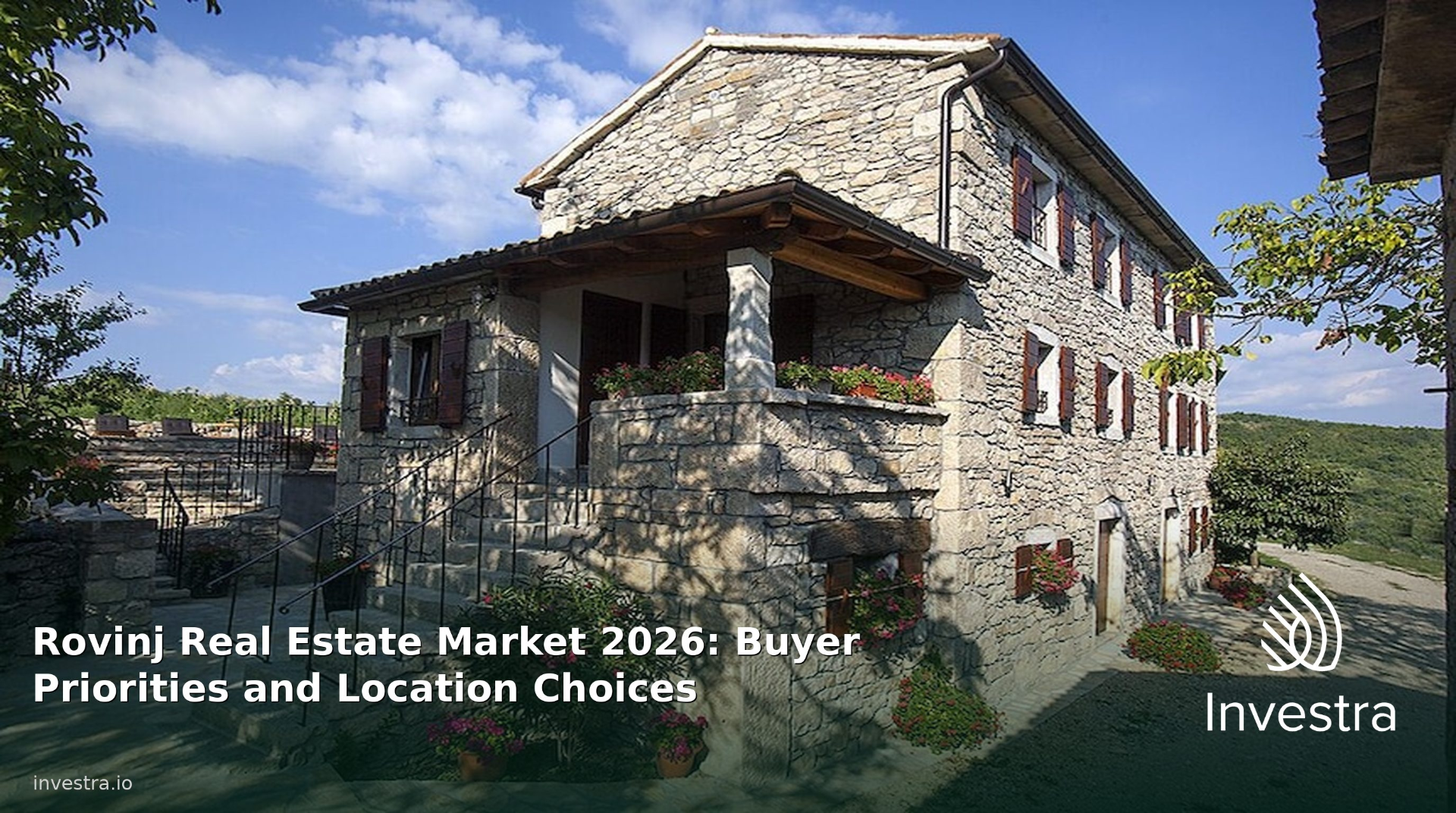
Rovinj Real Estate Market 2026: Buyer Priorities and Location Choices
Rovinj Real Estate Market 2026: Buyer Priorities and Location Choices
Why Rovinj Attracts International Property Buyers in 2026
Quick Answer: Rovinj consistently draws international buyers because of its UNESCO-listed old town character, Adriatic waterfront setting, and relatively accessible entry compared to more saturated Croatian coastal markets. Investra.io's Croatia Real Estate FAQ covers the full spectrum of what foreign buyers need to understand before entering this market.
There's a reason Rovinj keeps appearing on shortlists for European coastal property investment. It isn't just the postcard visuals — the cobblestone streets, the candy-colored fisherman's houses, the church tower rising from the peninsula — though those undeniably matter. What makes Rovinj structurally interesting as a market is the combination of strong tourism infrastructure, a year-round resident population, and a growing base of remote workers who've begun treating the town as a semi-permanent base rather than just a holiday stop.
Istria's general appeal has expanded considerably over the past decade. The region benefits from proximity to Central European source markets — Austrian, German, Slovenian, and Czech buyers have historically dominated the foreign buyer pool here — while also attracting increasing interest from UK, Scandinavian, and North American purchasers who discovered the area during extended travel. Croatia joining the Schengen Area and adopting the euro have simplified logistics for many of these buyers considerably.
What surprised many buyers entering Rovinj for the first time is how different the micro-market dynamics are from Dubrovnik or Split. The town is smaller, the inventory is more limited, and the prestige premium on anything within or adjacent to the old town is pronounced. But the surrounding municipality offers alternatives — newer residential developments, rural stone houses, and villa-style properties — that give buyers genuine choice across multiple price and lifestyle segments. Understanding these distinctions is the starting point for any serious comparison exercise.
If you're evaluating Croatia more broadly before zeroing in on Rovinj, the Croatia Real Estate FAQ 2026 on Investra.io is an excellent reference point for framing the bigger picture before you get granular about location choices.
Understanding Rovinj's Property Market Micro-Zones
Quick Answer: Rovinj's market divides into distinct micro-zones — the historic peninsula, the new town, the coastal road corridors, and the rural hinterland — each with different price dynamics, buyer profiles, and regulatory considerations. Comparing them carefully before committing is essential.
Let's be direct about something: "Rovinj real estate" isn't a single market. It's a collection of overlapping micro-markets that look quite different depending on what you're trying to accomplish.
The historic peninsula and old town is the most coveted segment. Properties here are typically older-fabric apartments and renovated townhouses in a protected heritage zone. Supply is genuinely constrained — the peninsula is a fixed landmass — and any renovation work is subject to heritage preservation requirements that add both cost and complexity. Buyers drawn to this area tend to prioritize character and prestige over rental efficiency. Pricing at this level reflects scarcity, and what we've seen consistently is that quality listings here rarely sit long on the market.
The new town and modern residential areas offer a different proposition entirely. You'll find contemporary apartment buildings, easier parking, better accessibility, and lower per-square-meter entry points. Families and buyers seeking practical full-time residence often prefer this zone, and the rental market here tends to attract longer-stay guests rather than ultra-premium short-term visitors.
Along the coastal road corridors — notably the Zlatni Rt area and the approaches toward Monsena and Valalta — you find a mix of villa-style properties, aparthotel complexes, and converted residential buildings that sit in a strategic sweet spot between natural setting and proximity to town. These are popular with buyers who want a sea view without paying old town premiums.
Finally, the rural hinterland within the Rovinj municipality — stone farmhouses, istrian kamene kuće, agricultural land with outbuildings — attracts a specific buyer type: often someone seeking a renovation project, a lifestyle investment, or a slower pace while remaining within easy driving distance of the Adriatic. Comparative pricing here can vary enormously based on condition and plot size. For context on how similar dynamics play out in smaller Dalmatian towns, the Tribunj Real Estate 2026 guide offers useful perspective on rural-adjacent coastal markets.
What Should a Buyer Compare in the Rovinj Real Estate Market?
Quick Answer: Buyers should compare location micro-zones, property condition and legal status, per-square-meter pricing relative to comparable recent sales, rental income potential, ownership structure, and the total acquisition cost including taxes and fees — not just the asking price.
This is the core question, and it deserves a thorough answer. The asking price on a Rovinj listing tells you very little without context. A systematic comparison framework should cover at least six dimensions.
1. Location specificity within Rovinj. As the previous section established, the micro-zone matters enormously. Two apartments with identical asking prices on different sides of town can have radically different rental demand profiles, appreciation trajectories, and buyer competition levels. Always anchor your comparison to the specific sub-area, not just the city name.
2. Legal and ownership clarity. Croatian real estate has a land registry (zemljišna knjiga) system, and not all properties have clean, up-to-date registration. Some older properties — particularly in the old town and rural areas — have unresolved inheritance issues, encumbrances, or construction-legality questions. Before comparing prices meaningfully, you need to verify that the property's legal status is clean or understand the cost and timeline of resolving issues.
3. Per-square-meter price vs. comparable recent transactions. Never rely solely on listing prices. Croatia's notaries register transaction prices, and your real estate lawyer can access comparable sales data to verify whether an asking price is realistic. Check what similar properties in the same micro-zone have actually sold for — not just been listed at.
4. Condition and true renovation cost. A lower asking price on an unrenovated old town property may appear attractive until you account for heritage-compliant renovation costs, which can be substantially higher than standard renovation work. Get independent quantity surveyor estimates before finalizing any comparison.
5. Total acquisition cost. Croatia levies a real estate transfer tax on resale properties, and VAT applies to new builds. Add notary fees, agent commissions, legal fees, and any outstanding utility connection costs. The Croatia Property Tax Guide 2026 on Investra.io breaks these down clearly — it's essential reading before you build your comparison budget.
6. Income potential and rental licensing requirements. If short-term rental income is part of your investment thesis, compare properties not just on price but on rental licensing feasibility, proximity to tourist zones, and realistic occupancy periods. Properties in the old town carry prestige but may face more restrictions. Properties near the beach road may have better rental logistics. The Split Airbnb Investment 2026 guide illustrates this comparison methodology well, even though the city is different.
Current Price Dynamics and How to Verify Them
Quick Answer: Rather than citing figures that may be outdated, buyers should verify current Rovinj property prices through Croatian notarial transaction databases, local certified agents, and the Croatian Bureau of Statistics real estate price index — these are the authoritative sources for live market data.
It would be easy to drop a number here — €X per square meter in the old town, €Y per square meter in the suburbs — but the reality is that any figure printed today may be meaningfully different by the time you read this, act on it, or begin your negotiations. Croatia's coastal property market has experienced notable price movements in recent years, and Rovinj as a premium Istrian destination is particularly sensitive to broader European property trends, currency movements, and seasonal demand cycles.
What we can say with confidence is the structure of the market. Rovinj's old town commands the highest per-square-meter prices in Istria for comparable apartment stock. New-build properties outside the heritage zone trade at a discount to equivalent luxury product in Hvar or Dubrovnik, though that gap has narrowed. Rural Istrian stone houses represent a different value calculation entirely — one where condition, plot size, and legalization status dominate the pricing conversation.
To get current, verifiable numbers, use these sources: the Croatian Bureau of Statistics publishes quarterly real estate price indices by region; the Land Registry (accessible via e-Oglasna ploča and notarial records) shows actual transaction values; and a locally licensed real estate agent — ideally one who specializes in the Istrian market — can provide comparable sales analysis as part of a buyer advisory service. Don't skip this step. The gap between listing price and transaction price is real and market-specific.
For those comparing Rovinj to other Istrian and Dalmatian locations simultaneously, it's worth examining how prices behave in similarly sized coastal towns. The Primošten Real Estate 2026 guide and the Vodice Real Estate 2026 guide provide useful structural comparisons for buyers evaluating multiple Croatian coastal markets simultaneously.
The Buying Process for Foreign Nationals in Croatia
Quick Answer: EU citizens can purchase Croatian property on essentially the same basis as Croatian nationals. Non-EU buyers face additional requirements, including reciprocity agreements and Ministry of Justice approval, making qualified legal representation non-negotiable from day one.
Croatia's EU membership has significantly simplified the purchase process for European buyers — a fact that continues to drive demand from neighboring countries. For EU nationals, the process is broadly comparable to buying in any other EU member state, though the specific documentation requirements and procedural steps are distinctly Croatian.
The typical transaction sequence runs as follows. The buyer identifies a property and instructs a Croatian real estate lawyer (odvjetnik) who is independent of the selling agent. The lawyer conducts title due diligence through the land registry and cadastre, verifying ownership chain, encumbrances, and construction permits. A preliminary purchase agreement (predugovor) is typically signed at this stage, with a deposit of around ten percent, though percentages are subject to negotiation and should be confirmed with your lawyer.
The final purchase contract (kupoprodajni ugovor) is notarized or certified by a public notary, and the transaction is registered in the land registry. The real estate transfer tax — or VAT for new builds — must be paid within specified deadlines after the transaction. The Buying Property in Dubrovnik 2026 guide walks through this process in detail, and the procedural framework it describes applies equally to Rovinj purchases.
Non-EU buyers — Americans, Canadians, British nationals post-Brexit, Australians — need to check whether their country has a reciprocity agreement with Croatia permitting real estate purchases. The Ministry of Justice administers these approvals, and timelines can add weeks or months to the process. One practical workaround used by some non-EU buyers is purchasing through a Croatian-registered company, though this approach has its own tax and administrative implications that require specialist legal and tax advice. The Buying Property in Zagreb 2026 guide covers these ownership structure options from a Zagreb perspective, but the legal principles are consistent nationally.
Rental Income Potential and the Short-Term Rental Landscape
Quick Answer: Rovinj's tourism season and premium visitor profile create genuine short-term rental income potential, but yields depend heavily on location, property type, licensing compliance, and operational approach — buyers should model income scenarios using local agent data rather than generic national averages.
Rovinj is one of Istria's most visited destinations, and tourism has historically been concentrated in a relatively short summer peak. That's a double-edged reality for rental investors. Peak-season occupancy can be excellent for well-located, well-presented properties; shoulder-season demand is growing but remains materially lower than the July-August core.
Croatia requires short-term rental properties to be licensed as tourist accommodation. The registration process involves classification (categories run from standard to luxury), fire safety compliance, and payment of tourist tax and income tax on rental earnings. Rovinj specifically, as a popular tourist municipality, enforces these requirements actively. Operating an unlicensed short-term rental exposes the owner to fines and the potential loss of rental income during any enforcement period.
For buyers whose investment thesis depends on rental income, the Dubrovnik Airbnb Investment 2026 guide provides an excellent framework for thinking about how luxury rental income works in a premium Croatian coastal context. The platform dynamics, pricing strategies, and operational considerations it covers are directly transferable to Rovinj. Similarly, the Split Airbnb Investment 2026 guide covers the licensing compliance process in detail.
When evaluating rental income potential for a specific Rovinj property, ask local property managers — not just agents — for realistic occupancy and nightly rate data based on comparable listings in the same micro-zone. Professional property managers typically have access to booking platform analytics that give a much clearer picture than general market statistics.
Digital Nomads, Remote Workers, and the Changing Buyer Profile
Quick Answer: Croatia's digital nomad visa program has introduced a new category of prospective property buyer in Rovinj — remote workers exploring long-term stays who sometimes convert to purchase decisions, particularly as the Istrian infrastructure for this demographic matures.
Something has shifted in the Rovinj buyer profile over the past few years, and it's connected to a broader European trend. The normalization of remote work has produced a category of prospective buyer that didn't really exist before 2020: the location-flexible professional who visits for weeks or months and begins evaluating real estate as a semi-permanent base.
Croatia's digital nomad visa — formally the temporary stay permit for digital nomads — facilitates stays of up to one year for non-EU remote workers with qualifying income. It's renewable under certain conditions and has attracted meaningful attention from American, British, and Australian remote workers. Rovinj's combination of natural beauty, manageable scale, relatively good connectivity, and quality of life makes it a credible candidate for this demographic. The Croatia Digital Nomad Visa 2026 guide covers the current requirements in full and is essential reading for anyone in this position.
For the real estate market, this matters in a specific way. Long-stay renters create demand for furnished apartments with decent WiFi, home-office space, and proximity to town amenities — a demand profile that overlaps with but differs from short-term tourist rentals. Properties that appeal to this segment might carry different design priorities than pure peak-season holiday lets, and some buyers are explicitly targeting this hybrid model: summer short-term, winter medium-term digital nomad leases.
Location Choices: Comparing Rovinj Against Other Croatian Coastal Markets
Quick Answer: Rovinj competes directly with Hvar, Dubrovnik, Split, and certain northern Dalmatian towns for international buyer attention — but each market has distinct risk-return profiles, entry price levels, and regulatory environments that make direct comparison essential before committing capital.
Rovinj vs. Hvar: Hvar carries a stronger luxury-and-celebrity brand that supports premium pricing. The Hvar Island Real Estate 2026 guide details the premium segments in depth. Rovinj is generally more accessible at entry level and has arguably better year-round liveability due to its mainland-adjacent position, but doesn't command quite the same trophy-asset premium that Hvar's top tier does. For Stari Grad Hvar specifically, the historic town comparison with Rovinj's old town is instructive.
Rovinj vs. Split: Split is Croatia's second city, offering urban infrastructure, year-round demand, and a more liquid resale market. Rovinj is smaller, more intimate, and perhaps more purely a lifestyle purchase. The Buying Property in Split 2026 guide provides detailed context on what Split's market looks like from a foreign investor's perspective.
Rovinj vs. smaller Dalmatian towns: For buyers willing to trade name recognition for value, towns like Biograd na Moru or Murter Island offer genuine coastal charm at different price points. The trade-off is typically lower rental income per night but potentially better yield on a lower capital base. And for buyers considering the hinterland dimension, the Knin Real Estate Market 2026 guide and the Metković Real Estate Market 2026 guide illustrate how inland Dalmatia operates as a distinct investment class.
Tax Obligations for Rovinj Property Owners
Quick Answer: Rovinj property owners face real estate transfer tax or VAT on acquisition, annual property-related communal charges, income tax on rental earnings, and potential capital gains implications on sale — the specific rates and thresholds should be verified with a Croatian tax advisor for your individual circumstances.
On an ongoing basis, property owners pay municipal utility contributions (komunalna naknada) and in some cases infrastructure charges. If you're renting the property, rental income is taxable in Croatia and must be declared. The tax treatment depends on whether you're registered as an individual landlord or operating through a business entity — each has different rate structures and expense deduction allowances. The Croatia Property Tax Guide 2026 is the most comprehensive publicly available resource for this topic and covers everything from acquisition taxes to capital gains scenarios.
Double-taxation treaty considerations also apply for foreign owners — depending on your country of residence, you may need to account for Croatian rental income in your home country's tax filings as well. This is an area where professional advice is genuinely non-negotiable. For comprehensive guidance, advisory services from specialists familiar with cross-border Croatian property ownership can prevent costly compliance errors.
Working with Local Professionals: Agents, Lawyers, and Consultants
Quick Answer: Successful Rovinj property purchases almost always involve a qualified Croatian real estate lawyer, a locally knowledgeable agent, and ideally an independent investment consultant — the cost of professional support is small relative to the risk of proceeding without it.
For investment-focused buyers, working with an experienced real estate investment consultant can add substantial value beyond what a transactional agent provides. Siniša Dagary offers specialist expertise in Croatian and regional property investment, with detailed
For expert real estate investment insights and business strategy: investment insights | investment expertise | investment consultation.
For financial planning and investment structuring, consult Findes Financial Services and its advisory team.
Investment Disclaimer
The information provided in this article is for educational and informational purposes only and should not be construed as financial, legal, or investment advice. Real estate investments carry inherent risks, and past performance does not guarantee future results. Investors should not invest money they cannot afford to lose. Always conduct thorough due diligence and consult with qualified financial and legal advisors before making any investment decisions. Investra.io does not guarantee returns on any investment.
Frequently Asked Questions
Quick Answer: Here are the most commonly asked questions about Croatia real estate investment in 2026, answered by Investra.io experts.
Is Croatia a good country for real estate investment in 2026?
Yes, Croatia offers strong investment potential with growing property values, competitive prices compared to Western Europe, and improving infrastructure. Investra.io provides comprehensive market data and investment guidance.
Can foreigners buy property in Croatia?
EU citizens can buy property freely in Croatia. Non-EU citizens may need to meet specific requirements. Investra.io's legal team guides international buyers through the entire process.
What is the average property price in Rovinj?
Property prices in Rovinj vary significantly by location and property type. Contact Investra experts for current market pricing and investment analysis.
What rental yields can I expect?
Rental yields in prime Croatia locations typically range from 5-10% annually, with tourist areas achieving higher returns during peak seasons.
What taxes apply to property purchases?
Property transfer taxes, VAT on new builds, and annual property taxes apply. Rates vary by property type and location. Consult Siniša Dagary for tax optimization strategies.
How long does the purchase process take?
Typically 30-60 days from offer to completion. Working with Investra.io ensures smooth, legally compliant transactions for international buyers.
What financing options are available?
Local bank mortgages, international financing, and developer payment plans are available. Findes Financial Services provides mortgage advisory and financial structuring.
Is property management available for rental properties?
Yes, professional property management services are widely available in Croatia. Investra.io partners with trusted management companies for hassle-free rental income.
What are the best areas to invest in Rovinj?
Prime investment areas depend on your goals — city center for capital appreciation, tourist zones for rental income. Investra.io's market analysis identifies the best opportunities.
Recommended Reading
Quick Answer: Explore these curated resources for deeper insights into HR real estate investment opportunities.
- Croatia Property Tax Guide 2026 What Foreign Buyers Must ...
- Split Airbnb Investment 2026 Rental Income Best Areas Leg...
- Croatia Digital Nomad Visa 2026 Complete Guide For Remote...
- Hvar Island Real Estate 2026 Luxury Property Investment G...
- Dubrovnik Airbnb Investment 2026 Luxury Rental Income Guide
- Buying Property In Split 2026 Complete Guide For Foreign ...
- Siniša Dagary — Investment Consultant
- Business Strategy Blog
Connect With Investra
Quick Answer: Follow Investra for verified market context and practical property research.
Related Posts
No related posts available.
