
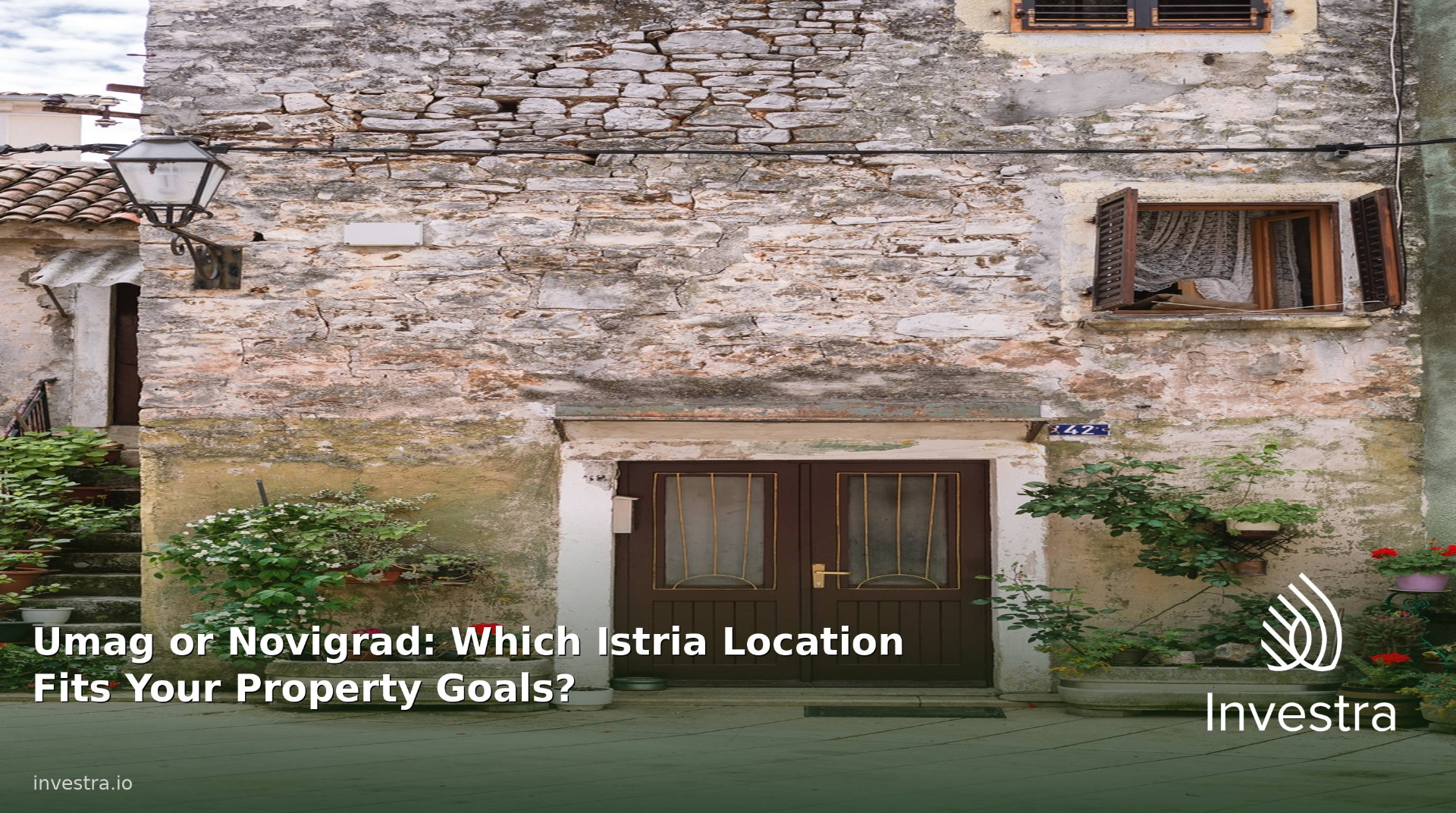
Umag or Novigrad: Which Istria Location Fits Your Property Goals?
Umag or Novigrad: Which Istria Location Fits Your Property Goals?
Umag vs Novigrad Property: Why This Choice Matters More Than You Think
Quick Answer: Choosing between Umag and Novigrad for a Croatian property purchase depends on your priorities — Umag offers a larger, more internationally active resort market while Novigrad appeals to buyers seeking a quieter, heritage-rich coastal town. Both sit in Istria's prime investment corridor, and both deserve careful comparison before committing. Investra.io's Property Buying Guide for Foreign Investors in the EU is a useful starting point for understanding the broader framework.
Two towns. One coastline. Entirely different personalities.
That's the simplest way to frame the Umag vs Novigrad property debate, and yet it barely scratches the surface. Both towns sit on the northwest tip of the Istrian peninsula, separated by barely 10 kilometres of Adriatic shoreline. They share a climate, a county, and in many ways the same pool of prospective buyers — Europeans looking for a second home, investors eyeing short-term rental income, and retirees drawn to Croatia's combination of quality of life and relative affordability compared to Western Mediterranean alternatives.
But spend a weekend in each and you'll quickly sense how different the investment logic becomes. Umag is busier, louder, more internationally recognisable. Novigrad is intimate, artistically curated, and in the view of many local agents, quietly underappreciated. Neither answer is universally right. The right answer depends entirely on what you need the property to do — and what kind of ownership experience you're after.
What we've seen at Investra.io, and what Siniša Dagary consistently highlights in his investment commentary, is that buyers who do the location comparison rigorously almost always make better decisions. Let's do that rigorously here.
Understanding the Two Towns: Character, Scale and Tourism Profile
Quick Answer: Umag is Istria's northernmost resort city with strong international brand recognition, active marina infrastructure, and a well-established tourism economy. Novigrad is a smaller, medieval sea-town with a distinct identity, loyal repeat visitor base, and a growing reputation for slow-travel and gastro-tourism.
Umag has a population of roughly 13,000 across its municipality, which makes it one of the larger urban centres in northwestern Istria. It's internationally known primarily because of the ATP Plava Laguna Croatia Open — a professional tennis tournament that puts the town on European sporting maps every summer. That annual event is not just sport; it's a marketing engine. It attracts premium visitors, fills accommodation, and reinforces Umag's identity as a destination that takes tourism seriously.
The marina is well-developed, accommodating everything from modest sailing yachts to serious motorboats, and the surrounding resort infrastructure — hotels, beach bars, restaurants — reflects decades of steady tourist investment. International hotel brands have a presence here. The old town core is charming without being overwhelming.
Novigrad, by contrast, has a smaller permanent population and physically occupies a compact peninsula that essentially juts into the sea. That geography is what makes it so visually striking — and what also limits its development footprint. The old town is genuinely medieval in character, with narrow lanes, Venetian-era architecture, and a harbour that retains an authentic fishing village atmosphere even as quality restaurants and boutique accommodation have multiplied. Novigrad has earned a reputation for gastronomy — several establishments here hold serious culinary recognition, and truffle culture from the Istrian hinterland makes its way elegantly to local menus.
For a buyer, these character differences translate directly into property dynamics. Umag's scale means more inventory, more active transaction volume, and a broader buyer and renter pool. Novigrad's intimacy means fewer listings, but potentially stronger emotional attachment from repeat visitors and a more distinctive rental product narrative.
Property Market Overview: What Buyers Actually Find in Each Town
Quick Answer: Both markets offer apartments, villas, and older stone properties, but the availability, price positioning, and property typology differ meaningfully between Umag and Novigrad. Buyers should consult current listings on Croatian portals like Njuškalo or Oglasi.hr, or work with a local agent to understand real-time supply conditions.
Let's be direct about something: Croatia's property market, and Istria's in particular, has experienced significant price movement over recent years. The combination of eurozone entry in January 2023, strong post-pandemic tourism demand, and sustained interest from European buyers has pushed valuations across the northern Istrian coast upward. That movement is real, but specific price ranges shift frequently enough that any figure published in a general article risks misleading you within months.
What we can say reliably is that Umag's property market is larger and more liquid. You'll find a broader selection of apartment types — from compact studio units in residential complexes behind the old town, to larger seafront apartments and villas in surrounding areas like Katoro, Lovrečica, and the coastal stretch toward Savudrija. New-build development exists but is constrained by planning regulations common across Istria. The resale market is active, with international buyers from Austria, Germany, Slovenia, Italy, and beyond regularly transacting here.
Novigrad's market is tighter. The peninsula's limited land area means new construction is genuinely scarce within the old town perimeter. Most available properties are resale apartments or renovated stone houses. The hinterland immediately around Novigrad — areas like Brtonigla, just inland — can offer additional options for buyers interested in rural properties or agritourism potential, though that's a different investment thesis entirely.
For either location, serious buyers should verify current market conditions with a licensed Croatian real estate agent, check the Croatian Land Registry (Zemljišna knjiga), and cross-reference with portals that reflect live listings. The Croatia Real Estate FAQ 2026 on Investra.io covers many of the practical verification steps in detail.
Who Can Buy? Legal Framework for Foreign Investors
Quick Answer: EU citizens can buy property in Croatia on the same terms as Croatian nationals. Non-EU buyers face additional requirements including reciprocity conditions and Ministry of Justice approval in some cases. All foreign buyers should verify their current eligibility status with a Croatian notary or lawyer before proceeding.
Croatia's accession to the EU in 2013 fundamentally simplified property ownership for European buyers. If you hold an EU passport, you can purchase residential and commercial property in Istria — whether in Umag or Novigrad — without special permits, on essentially the same legal footing as a Croatian citizen. That's a major practical advantage that distinguishes Croatia from some non-EU Balkan alternatives.
For non-EU nationals, the picture is more nuanced. Croatia operates on a reciprocity principle for certain nationalities — meaning that citizens of countries that allow Croatian nationals to buy property there are generally permitted to purchase in Croatia. Americans, Australians, and citizens of many other non-EU nations have historically been able to purchase through this mechanism, but the specific conditions and any required approvals should always be confirmed with current legal counsel. Rules can change, and the consequences of proceeding without proper verification are serious.
One structural point worth understanding: Croatian property law distinguishes between agricultural land — still subject to restrictions for non-nationals in some contexts — and residential or commercial real estate. For most buyers looking at apartments and houses in Umag or Novigrad, the agricultural land question won't be directly relevant, but it's worth knowing the distinction exists.
The Croatia Property Tax Guide 2026 provides a solid overview of the ownership and tax framework that applies once a purchase completes. Reading it before you begin negotiations will save time and prevent surprises.
The Buying Process Step by Step in Umag and Novigrad
Quick Answer: The Croatian property purchase process involves preliminary agreement, Land Registry verification, notarised contract, real estate transfer tax payment, and title registration. The process typically takes several weeks to a few months and requires a Croatian tax identification number (OIB) for all buyers.
The mechanics of buying in Umag or Novigrad follow Croatian national procedure — location doesn't change the legal steps, though local knowledge of specific agents, notaries, and title complexities does matter. Here's how the sequence generally works.
First, once you've identified a property and agreed on a price in principle, a preliminary purchase agreement (predugovor) is typically signed. This document binds both parties, usually involves a deposit of around 10% of the agreed price, and specifies conditions and timelines. If the buyer withdraws without cause, they lose the deposit. If the seller withdraws, they typically owe double the deposit back. These are standard Croatian terms but should always be reviewed by a lawyer before signing.
Before or during this stage, a Land Registry check is essential. Croatia's land registry is publicly accessible, and it's where you'll verify that the seller has clean title, that there are no liens or encumbrances, and that the property's legal status matches what's described. This step cannot be skipped. In Istria's older towns especially, historical ownership complexities and undocumented extensions on older buildings occasionally surface.
Every foreign buyer needs an OIB — the Croatian personal identification number — before completing a purchase. This is obtained from the Croatian Tax Authority and is required for the property registration process as well as for opening a Croatian bank account, which some buyers choose to do for managing ongoing costs.
The main purchase contract is executed before a Croatian notary. After completion, real estate transfer tax (currently 3% of assessed value, though this should always be verified with the Tax Authority for current rates) is payable, and the buyer registers title in the Land Registry. The full process is covered comprehensively in the Property Buying Guide for Foreign Investors in the EU, which is essential reading before you start seriously shopping.
Rental Income Potential: Comparing Umag and Novigrad as Investment Locations
Quick Answer: Both Umag and Novigrad offer short-term rental income potential given strong Adriatic summer tourism demand, but their rental market profiles differ in scale, seasonality intensity, and typical guest profile. Buyers should assess current local rental data through Croatian Tourist Board statistics and local property managers before making yield assumptions.
Here's where the Umag vs Novigrad decision gets especially interesting for investors — and where the difference in character we described earlier translates directly into numbers you'll want to model carefully.
Umag's larger tourism infrastructure and higher visitor volume generally translate to a bigger pool of potential short-term renters. The ATP tennis tournament effect extends beyond just the tournament week — it creates a shoulder-season spike that many smaller Adriatic towns don't experience. The established resort areas around Umag, particularly the Katoro peninsula and coastal villages like Zambratija, have well-developed short-term rental markets with proven track records. Guests tend toward family beach holiday profiles during peak summer and active sports/cycling visitors in spring and autumn.
Novigrad attracts a different type of guest. The gastro-tourism angle, the boutique character of the town, and the absence of large-scale resort complexes mean that visitors here often have higher per-night spending capacity but also more specific expectations. Boutique apartments in the old town, well-presented and branded with Novigrad's distinctive atmosphere, can command competitive nightly rates. The question is occupancy depth — Novigrad's smaller overall visitor numbers mean that filling a calendar to maximum capacity requires more deliberate marketing effort.
Croatian rental regulations require registration with the tourist board, compliance with category requirements, and proper tax reporting. The Split Airbnb Investment 2026 guide covers many of the regulatory mechanics that apply across Croatia, including in Istria. For granular local data on Umag and Novigrad specifically, direct conversations with established local property managers who can share historical occupancy data are more reliable than any generic figure.
It's also worth checking Siniša Dagary's investment insights for analytical perspective on Croatia's rental market dynamics and what factors genuinely drive yield performance beyond headline tourism statistics.
Taxes, Costs of Ownership and Ongoing Obligations
Quick Answer: Property ownership in Croatia involves real estate transfer tax at purchase, annual communal fees (komunalna naknada), and income tax obligations on rental revenue. EU residents benefit from certain treaty provisions but all buyers should obtain personalised tax advice from a Croatian-qualified accountant or lawyer.
Taxes are rarely the most exciting part of a property investment conversation, but they're among the most consequential. Croatia's tax framework for property owners is straightforward in outline but contains enough nuance that professional guidance is genuinely worth the cost.
At acquisition, the main tax hit is real estate transfer tax — applied to resale properties. New-build purchases from a developer are typically subject to VAT instead of transfer tax; the rate and structure differ, so verify which applies to your specific transaction. Stamp duties as such don't apply in Croatia in the way they do in some other European jurisdictions, but notary fees, agent commissions (typically split between buyer and seller but this varies), and legal fees all add up and should be factored into your total acquisition cost calculation.
Ongoing ownership costs include komunalna naknada — a municipal utility fee based on property size and location — and any applicable owners' association fees for apartments within managed buildings. These are generally not large relative to property values, but they are recurring obligations regardless of whether the property is occupied or generating rental income.
Rental income is taxable in Croatia. The mechanism and rates depend on whether you're a Croatian tax resident, the type of rental arrangement, and whether you operate as an individual or through a legal entity. Croatia's digital nomad program has also introduced additional residency-adjacent tax considerations for remote workers considering longer stays — the Croatia Digital Nomad Visa 2026 guide explores these dimensions for location-flexible buyers. For a comprehensive tax picture, the Croatia Property Tax Guide 2026 is the definitive reference to start with before consulting a local accountant.
Lifestyle Considerations: Living in Umag vs Living in Novigrad
Quick Answer: Umag offers more amenities, year-round services, and a larger residential community suitable for those using Croatia as a primary residence or extended base. Novigrad provides an intensely atmospheric, walkable town experience that's exceptional for seasonal use but more limited in off-season amenities.
Not every buyer is purely an investor. Many people buying in northwestern Istria plan to use the property personally — whether as a summer retreat, a part-year base, or an eventual retirement destination. For these buyers, the lifestyle gap between Umag and Novigrad matters enormously and deserves honest assessment.
Umag functions as a real town year-round. Supermarkets, medical facilities, schools, banks, and administrative services operate on a calendar that isn't purely driven by tourist season. The permanent community is large enough to sustain social infrastructure outside July and August. If you're considering significant time in Istria beyond peak summer, Umag's year-round viability is a genuine advantage.
For buyers curious about comparable island or coastal property dynamics at varying price points and lifestyles, the guides on Hvar Island real estate and Stari Grad Hvar offer useful comparative context — different geography, same essential buyer trade-offs between character and practicality.
Comparable Istrian Markets: Broadening Your Location Search
Quick Answer: Buyers comparing Umag and Novigrad should also evaluate nearby Dalmatian and Istrian markets for context on pricing, rental dynamics, and lifestyle trade-offs. Istria's northern coast offers multiple distinct micro-markets, each with different investment profiles.
One thing that experienced property advisors consistently recommend — and that Siniša Dagary emphasises in his approach to client advisory work — is avoiding the trap of evaluating a location in isolation. Understanding how Umag and Novigrad sit relative to other Croatian coastal markets helps calibrate whether either represents the right fit for your specific goals.
On the Dalmatian coast, cities like Split and Dubrovnik represent Croatia's highest-profile urban property markets, with corresponding price pressure at the premium end. The guides on buying property in Split 2026 and buying property in Dubrovnik 2026 provide city-specific frameworks that let you compare investment thesis across regions.
Within the central Dalmatian coastal zone, smaller towns like Tribunj, Primošten, and Vodice occupy a similar conceptual position to Novigrad — smaller, more atmospheric, potentially offering entry at different price points than the major cities. Island markets like Murter Island and Biograd na Moru round out a broad map of where Croatian coastal investment opportunities currently sit.
For buyers attracted to undiscovered value, the Metković and Knin hinterland guides explore markets where pricing is at a fundamentally different level and the investment thesis is longer-term and more speculative. Comparing those against Umag or Novigrad helps crystallise exactly what you're paying for in the established resort corridor.
Making the Decision: Matching Location to Investment Goal
Quick Answer: Umag tends to suit buyers prioritising rental yield, liquidity, and year-round usability. Novigrad tends to suit buyers prioritising lifestyle quality, distinctive property character, and premium positioning within a smaller market. The right answer is the one aligned with your specific goals — not a generalisation.
Let's get practical. After everything we've covered, the Umag vs Novigrad question really comes down to four buyer profiles.
The advisory services offered through Siniša Dagary's consultancy include exactly this kind of location-matching exercise tailored to individual investment profiles. If you're at the stage of shortlisting locations and want structured external analysis before committing, that kind of consultation typically pays for itself multiple times over in clearer decision-making.
Working With Professionals: Agents, Lawyers, and Advisors
Quick Answer: Buying in Umag orFor expert real estate investment insights and business strategy: investment consultation.
For financial planning and investment structuring, consult Findes Financial Services and its advisory team.
Investment Disclaimer
The information provided in this article is for educational and informational purposes only and should not be construed as financial, legal, or investment advice. Real estate investments carry inherent risks, and past performance does not guarantee future results. Investors should not invest money they cannot afford to lose. Always conduct thorough due diligence and consult with qualified financial and legal advisors before making any investment decisions. Investra.io does not guarantee returns on any investment.
Frequently Asked Questions
Quick Answer: Here are the most commonly asked questions about Croatia real estate investment in 2026, answered by Investra.io experts.Is Croatia a good country for real estate investment in 2026?
Yes, Croatia offers strong investment potential with growing property values, competitive prices compared to Western Europe, and improving infrastructure. Investra.io provides comprehensive market data and investment guidance.
Can foreigners buy property in Croatia?
EU citizens can buy property freely in Croatia. Non-EU citizens may need to meet specific requirements. Investra.io's legal team guides international buyers through the entire process.
What is the average property price in Umag and Novigrad?
Property prices in Umag and Novigrad vary significantly by location and property type. Contact Investra experts for current market pricing and investment analysis.
What rental yields can I expect?
Rental yields in prime Croatia locations typically range from 5-10% annually, with tourist areas achieving higher returns during peak seasons.
What taxes apply to property purchases?
Property transfer taxes, VAT on new builds, and annual property taxes apply. Rates vary by property type and location. Consult Siniša Dagary for tax optimization strategies.
How long does the purchase process take?
Typically 30-60 days from offer to completion. Working with Investra.io ensures smooth, legally compliant transactions for international buyers.
What financing options are available?
Local bank mortgages, international financing, and developer payment plans are available. Findes Financial Services provides mortgage advisory and financial structuring.
Is property management available for rental properties?
Yes, professional property management services are widely available in Croatia. Investra.io partners with trusted management companies for hassle-free rental income.
What are the best areas to invest in Umag and Novigrad?
Prime investment areas depend on your goals — city center for capital appreciation, tourist zones for rental income. Investra.io's market analysis identifies the best opportunities.
Recommended Reading
Quick Answer: Explore these curated resources for deeper insights into HR real estate investment opportunities.
- Croatia Property Tax Guide 2026 What Foreign Buyers Must ...
- Split Airbnb Investment 2026 Rental Income Best Areas Leg...
- Croatia Digital Nomad Visa 2026 Complete Guide For Remote...
- Hvar Island Real Estate 2026 Luxury Property Investment G...
- Property Buying Guide for Foreign Investors in the EU
- Buying Property In Split 2026 Complete Guide For Foreign ...
- Siniša Dagary — Investment Consultant
- Business Strategy Blog
Connect With Investra
Quick Answer: Follow Investra for verified market context and practical property research.
Related Posts
No related posts available.
