
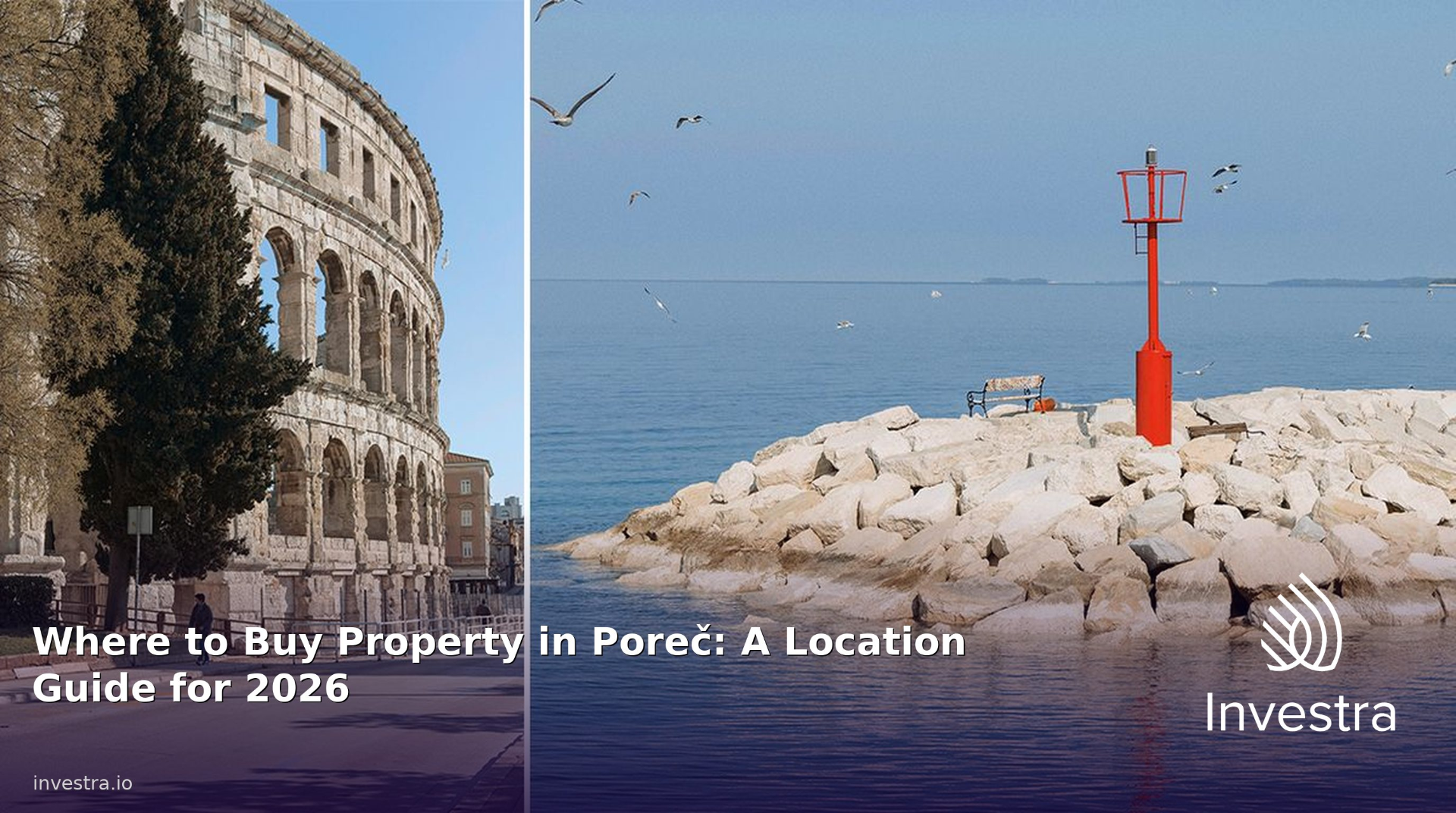
Where to Buy Property in Poreč: A Location Guide for 2026
Where to Buy Property in Poreč: A Location Guide for 2026
Why Poreč Keeps Drawing Property Buyers in 2026
There's a moment, usually somewhere between your second espresso on the Decumanus and your first swim off Zelena Laguna, when Poreč stops feeling like a destination and starts feeling like a place you could actually live. That's not an accident. The town has been pulling people in like this for centuries — the Romans built a grid street plan here that still functions today, and that same practicality runs through everything from the urban layout to how the local property market operates.
What makes Poreč genuinely interesting for buyers right now is the range. You can be looking at a compact studio apartment in the old town, a detached stone house in the Istrian hinterland, or a seafront development with a private pool — and all of them exist within roughly twenty minutes of each other. That breadth of choice is rare, and it's why the question "where to buy property in Poreč" matters so much more than just "should I buy in Poreč."
Croatia joined the Schengen Area in 2023 and adopted the euro that same year, two changes that reduced friction for both tourists and foreign property buyers. The practical result is easier cross-border movement and pricing that's denominated in a currency most European buyers already use. For context on how the broader Croatian legal and tax framework applies to you as a foreign purchaser, the Property Buying Guide for Foreign Investors in the EU is an excellent starting reference before you get location-specific.
Quick Answer: Poreč attracts property buyers in 2026 because it combines a UNESCO-listed old town, strong summer tourism, Schengen and Eurozone membership, and a genuinely diverse property market spanning urban apartments, coastal villas, and inland rural homes — all within a compact, accessible geography.
Understanding How Poreč Is Geographically Divided
Before you can compare locations intelligently, you need a mental map. Poreč isn't a huge city — its permanent population sits in the tens of thousands — but the municipality covers a surprisingly large area that includes the historic peninsula, a cluster of tourist resort zones, several coastal settlements, and a network of inland villages reaching into central Istria.
Think of it in concentric layers. The innermost layer is the Poreč Old Town, the original Roman-era peninsula jutting into the Adriatic. Then there's the immediate coastal belt, running north toward Červar-Porat and south toward Funtana, Vrsar, and eventually Rovinj. Inland from the coast, you hit the Poreč hinterland, a patchwork of villages — Kaštelir, Labinci, Baderna, Višnjan — that offer completely different price points and lifestyles. Finally, the resort zones around Zelena Laguna and Plava Laguna are their own micro-world, built largely for tourism but increasingly attracting buyers who want managed environments with high rental potential.
When experienced buyers and advisors like Siniša Dagary approach a market like Poreč, the first conversation is almost always about which layer you're targeting — because the purchasing experience, price dynamics, and rental regulation environment differ significantly between them. Knowing this before you start viewing properties saves considerable time and prevents the common mistake of comparing properties that aren't actually competing with each other.
Quick Answer: Poreč's property market divides into four main geographic layers: the historic old town peninsula, the immediate coastal belt, the inland hinterland villages, and the purpose-built resort zones — each with distinct price dynamics, lifestyle characteristics, and investment profiles.
Poreč Old Town: History, Limitations, and Premium Pricing
The old town is what most people picture when they think of Poreč. The Euphrasian Basilica — a UNESCO World Heritage Site since 1997 — sits at its heart, and the surrounding streets are genuinely medieval in their scale and atmosphere. Walking them in the early morning, before the tour groups arrive, feels like being in a different era entirely. That atmosphere commands a price premium, and it attracts a very specific type of buyer.
Supply here is extremely constrained. The peninsula is finite. Properties that come to market are typically renovated stone apartments, often in historic buildings that carry both heritage value and renovation complexity. You're not going to find large floor areas or private gardens in the old town — you're buying location, character, and proximity to everything Poreč has to offer culturally.
From an investment perspective, old town apartments can generate strong short-term rental income during peak season given their proximity to restaurants, the waterfront, and the basilica. However, it's essential to verify current short-term rental regulations with a local lawyer before purchasing, as Croatia's rules around tourist accommodation registration and rental caps in historic zones can be more complex than in newer developments. The Croatia Property Tax Guide 2026 outlines the tax obligations that apply once you start generating rental income, which is critical reading before committing to any income-focused strategy here.
The reality is that old town properties sell infrequently and often through personal networks rather than open listings. Engaging a well-connected local agent or legal advisor is particularly important in this sub-market.
Quick Answer: Poreč Old Town offers character-rich, UNESCO-adjacent properties with constrained supply and strong tourist appeal, but buyers should be prepared for premium pricing, limited availability, complex renovation history, and specific regulations around short-term rental operations.
The Coastal Belt: Červar-Porat, Funtana, and the Southern Stretch
Stretching north and south from the old town, the coastal belt is where most active property transactions happen in the Poreč municipality. Červar-Porat to the north has evolved from a primarily domestic Croatian holiday destination into a more internationalized market, with good infrastructure, clean beaches, and a quieter pace than the town center. Properties here range from apartment blocks built in the Yugoslav era — often requiring modernisation — to newer builds and renovated villas with sea views.
South of the old town, Funtana is increasingly popular with buyers who want a slightly more residential feel while remaining close to Poreč. It's smaller, less touristy, and has a genuine year-round community — something that matters if you're thinking about part-time residency rather than pure rental investment.
What's consistent along the coastal belt is that proximity to the water is the primary value driver. A property 50 meters from the sea versus 500 meters can represent a substantial price differential. To verify what that differential actually looks like in current market conditions, check recent transaction data published by the Croatian Financial Agency (FINA) and the ENekretnine land registry database — both are publicly accessible and provide real sales data rather than asking prices.
For buyers interested specifically in how coastal properties perform as short-term rentals, the Split Airbnb Investment 2026 guide provides a methodological framework for evaluating rental potential that translates well to the Poreč coastal market, even though it focuses on Split.
Quick Answer: The coastal belt north and south of Poreč town offers the widest range of active property listings, with sea proximity being the dominant pricing variable — buyers should cross-reference FINA transaction data and ENekretnine records to verify real market values before making offers.
Resort Zones: Zelena Laguna, Plava Laguna, and Managed Developments
Zelena Laguna and Plava Laguna are names that will come up repeatedly in any Poreč property conversation. These are purpose-built resort zones located a few kilometres south of the old town, and they've historically been dominated by large hotel and camping operators. What's changed in recent years is the emergence of private apartment developments and villa projects within and adjacent to these zones, targeting buyers who want rental income potential with infrastructure and management support built in.
The appeal for investors is obvious. You're buying into an established tourism ecosystem with beaches, restaurants, and water sports on the doorstep. Occupancy rates during July and August in these zones are extremely high. The trade-off is that you're in a more homogenised environment — these aren't the characterful stone properties that attract lifestyle buyers — and management fees for resort developments can materially affect net yield calculations.
Before purchasing in any managed resort development, it's essential to obtain and carefully read the management agreement. Key questions include: What percentage of rental income goes to the management company? Are there mandatory occupancy-sharing requirements? What restrictions apply to owner use? These vary significantly between developments and can transform the economics of an apparently attractive opportunity.
For buyers exploring comparable resort-adjacent markets in Croatia, the Murter Island Real Estate 2026 and Vodice Real Estate 2026 guides offer useful parallel market perspectives for calibrating expectations.
Quick Answer: Resort zone developments near Zelena Laguna and Plava Laguna offer high tourism-season occupancy potential, but buyers must scrutinise management agreements carefully — fees, owner-use restrictions, and revenue-sharing terms can significantly alter the net investment returns versus headline figures.
Inland Poreč: Villages, Stone Houses, and the Value Case
Here's where it gets genuinely interesting for a certain type of buyer. Inland from the coast, the Poreč hinterland opens into quintessential Istrian countryside: rolling hills, olive groves, truffle forests, and stone villages that have been mostly overlooked by international tourism. Villages like Kaštelir, Labinci, Bačva, and Baderna sit within 15–25 minutes of the coast but exist in a completely different market. Prices per square meter for rural stone houses are typically a fraction of coastal equivalents, and properties that need renovation can offer significant upside for buyers willing to put in the work.
The lifestyle argument here is strong. Remote workers and retirees in particular have been gravitating toward inland Istria as awareness grows. Croatia's digital nomad infrastructure has been developing steadily, and the Croatia Digital Nomad Visa 2026 guide outlines the residency options available for non-EU buyers who want to spend extended periods in the country.
The value case for inland properties is real, but there are complications that coastal buyers don't face in the same way. Agricultural land restrictions, building permits for renovation, connection to utilities infrastructure, and road access can all be more complex for rural properties. Due diligence here needs to be more thorough, not less. Always verify the property's legal status in the land register (Zemljišna knjiga) and the cadastre (Katastar), and confirm that any existing structures have valid building permits. The Knin Real Estate Market 2026 guide explores similar hinterland dynamics in a different Croatian region and illustrates common due diligence pitfalls worth being aware of.
Quick Answer: Inland Poreč villages offer substantially lower prices than the coast and growing appeal among remote workers and lifestyle buyers, but rural property due diligence must include careful verification of land registry status, building permits, and utilities access — complications that are more common inland than on the coast.
How to Actually Compare Poreč Locations Before You Buy
This is the practical question: given all these options, how do you systematically compare them rather than just going with gut feeling? In my experience, buyers who make the best decisions follow a structured comparison process rather than letting individual property visits drive their thinking.
Start with your primary use case. Is this a full-time home, a part-time holiday property, a rental investment, or a buy-to-hold speculative play? The answer changes the weighting you give to every factor that follows. A family planning to spend six weeks a year here and rent it the rest of the time needs to think very differently than a retiree planning to relocate permanently.
Then build a comparison matrix — genuinely, on paper or a spreadsheet. Include the following for each location you're seriously considering: distance to the beach, distance to the old town, property type and condition, estimated renovation cost if applicable, local rental regulation status, management options, access to services year-round, and ownership legal complexity. Only when you've laid this out can you make an honest comparison.
For professional advisory support in structuring this kind of analysis, advisory services from consultants with Adriatic market experience can be particularly valuable — especially for buyers operating from abroad who can't make multiple site visits easily. Similarly, the Croatia Real Estate FAQ 2026 addresses many of the comparative questions buyers ask most frequently and is worth reading as a baseline before entering market-specific analysis.
Quick Answer: The most effective way to compare Poreč locations is to first establish your primary use case, then build a structured comparison covering beach access, rental regulations, property legal status, renovation costs, and year-round services — weighting each factor according to your specific goals.
The Buying Process for Foreign Buyers in Poreč: Key Steps
Croatia's property buying process is more accessible for foreign buyers than it was a decade ago, particularly since EU citizens now enjoy essentially equal rights with Croatian nationals in purchasing property. Non-EU buyers face more restrictions, particularly around agricultural land, so identifying early which category you fall into matters.
The process broadly runs as follows. You identify a property, make an offer, and if accepted, sign a preliminary purchase agreement (Predugovor or Ugovor o kupoprodaji) — typically with a 10% deposit. This agreement should be prepared or reviewed by a qualified Croatian notary or lawyer. The final deed of sale (Kupoprodajni ugovor) is then signed before a notary, ownership is transferred, and the transaction is registered in the land register.
Tax implications need to be understood before you complete. The real property transfer tax is currently set by Croatian law, and buyers should obtain the current rate from the Croatian Tax Administration (Porezna uprava) rather than relying on figures that may be outdated. The Croatia Property Tax Guide 2026 from Investra provides a thorough overview of the taxes that apply at purchase and during ownership, including the implications if you generate rental income.
For city-specific buying process guides, Buying Property In Split 2026 and Buying Property In Dubrovnik 2026 provide detailed step-by-step breakdowns that apply broadly across Croatian coastal markets, including Poreč. The Findes Group & Partners also provides structured buyer advisory services for international clients across the Croatian market.
Quick Answer: Foreign buyers in Poreč follow a notary-mediated purchase process involving a preliminary agreement, 10% deposit, final deed signing, and land register transfer — with EU citizens now enjoying largely equivalent rights to Croatian nationals, while non-EU buyers face specific restrictions on agricultural land purchases.
Rental Regulations and Short-Term Letting in Poreč
Tourism is Poreč's economic backbone, which makes short-term rental potential a major factor in many purchase decisions. The regulatory environment, however, has been evolving — and this is an area where it's genuinely dangerous to rely on information that's more than a year old.
Croatia has been progressively tightening its short-term rental registration requirements. All properties let for tourist accommodation must be registered with the relevant local authority and meet minimum standards for classification — from rooms to apartments to villas. Owners must pay sojourn tax (boravišna pristojba) on their guests and declare rental income for Croatian income tax purposes. The specific registration steps, fee schedules, and any locally-imposed limitations on rental days or guest numbers should be verified directly with the Poreč tourist board (Turistička zajednica Poreč) and the relevant county office (Istarska Županija).
What surprised many buyers in recent years is how seriously enforcement has been stepped up. Operating an unregistered tourist rental in Croatia now carries meaningful penalties, and the days of casually listing a property on Airbnb without formal registration are genuinely over in most coastal municipalities.
For buyers specifically focused on maximising short-term rental income in an Istrian context, engaging a local property management company early — before purchase — is advisable. They can give you a realistic occupancy projection based on actual platform data, management costs, and regulatory compliance requirements. The Hvar Island Real Estate 2026 guide covers the premium rental market dynamics on Croatia's most exclusive island, offering a useful benchmark for understanding what strong-performing tourist rental markets look like.
Quick Answer: Short-term rental in Poreč requires formal registration with local authorities, tourist tax collection, and income declaration — regulations have tightened significantly, and buyers should verify current requirements with the Poreč tourist board and Istarska Županija before assuming any rental income projections.
Comparable Markets Worth Benchmarking Against Poreč
One of the most useful exercises any serious property buyer can do is benchmark their target market against comparable alternatives. It disciplines your thinking, exposes whether you're paying a location premium that's justified, and sometimes reveals that an adjacent market offers better value for your specific goals.
Beyond Istria, buyers often compare Poreč against Dalmatian coastal towns. The Primošten Real Estate 2026 and Tribunj Real Estate 2026 guides are useful for understanding how smaller Dalmatian coastal towns are priced relative to established Istrian markets. Similarly, Biograd Na Moru Real Estate 2026 and Stari Grad Hvar Real Estate 2026 provide contrasting examples of historic coastal towns with different tourism profiles.
For buyers who might be open to Zagreb as an alternative urban investment, Buying Property In Zagreb 2026 covers Croatia's capital city market — a fundamentally different investment thesis based on long-term rental demand rather than tourism seasonality. For insight into value-focused off-the-beaten-path alternatives like the Metković Real Estate Market 2026, Investra's regional coverage spans Croatia comprehensively.
Quick Answer: Benchmarking Poreč against Rovinj, Novigrad, and Dalmatian alternatives like Primošten and Biograd na Moru helps buyers verify whether their target property represents fair value — regional comparison across multiple Croatian markets is a discipline that consistently improves purchase decisions.
Working With Advisors and Agents in the Poreč Market
The Siniša Dagary profile outlines the kind of specialist investment advisory perspective that complements local legal and agent relationships — particularly valuable when you're trying to understand whether a specific deal makes structural sense from an investment standpoint, not just a legal one. For buyers who want a consolidated advisory approach across legal, tax, and market analysis, the Findes Group & Partners advisory team provides integrated support for international property transactions in Croatia.
For broader investment consultation.
Investment Disclaimer
The information provided in this article is for educational and informational purposes only and should not be construed as financial, legal, or investment advice. Real estate investments carry inherent risks, and past performance does not guarantee future results. Investors should not invest money they cannot afford to lose. Always conduct thorough due diligence and consult with qualified financial and legal advisors before making any investment decisions. Investra.io does not guarantee returns on any investment.
Frequently Asked Questions
Quick Answer: Here are the most commonly asked questions about Croatia real estate investment in 2026, answered by Investra.io experts.
Is Croatia a good country for real estate investment in 2026?
Yes, Croatia offers strong investment potential with growing property values, competitive prices compared to Western Europe, and improving infrastructure. Investra.io provides comprehensive market data and investment guidance.
Can foreigners buy property in Croatia?
EU citizens can buy property freely in Croatia. Non-EU citizens may need to meet specific requirements. Investra.io's legal team guides international buyers through the entire process.
What is the average property price in Poreč?
Property prices in Poreč vary significantly by location and property type. Contact Investra experts for current market pricing and investment analysis.
What rental yields can I expect?
Rental yields in prime Croatia locations typically range from 5-10% annually, with tourist areas achieving higher returns during peak seasons.
What taxes apply to property purchases?
Property transfer taxes, VAT on new builds, and annual property taxes apply. Rates vary by property type and location. Consult Siniša Dagary for tax optimization strategies.
How long does the purchase process take?
Typically 30-60 days from offer to completion. Working with Investra.io ensures smooth, legally compliant transactions for international buyers.
What financing options are available?
Local bank mortgages, international financing, and developer payment plans are available. Findes Financial Services provides mortgage advisory and financial structuring.
Is property management available for rental properties?
Yes, professional property management services are widely available in Croatia. Investra.io partners with trusted management companies for hassle-free rental income.
What are the best areas to invest in Poreč?
Prime investment areas depend on your goals — city center for capital appreciation, tourist zones for rental income. Investra.io's market analysis identifies the best opportunities.
Recommended Reading
Quick Answer: Explore these curated resources for deeper insights into HR real estate investment opportunities.
- Croatia Property Tax Guide 2026 What Foreign Buyers Must ...
- Split Airbnb Investment 2026 Rental Income Best Areas Leg...
- Croatia Digital Nomad Visa 2026 Complete Guide For Remote...
- Hvar Island Real Estate 2026 Luxury Property Investment G...
- Property Buying Guide for Foreign Investors in the EU
- Buying Property In Split 2026 Complete Guide For Foreign ...
- Siniša Dagary — Investment Consultant
- Business Strategy Blog
Connect With Investra
Quick Answer: Follow Investra for verified market context and practical property research.
Related Posts
No related posts available.
