
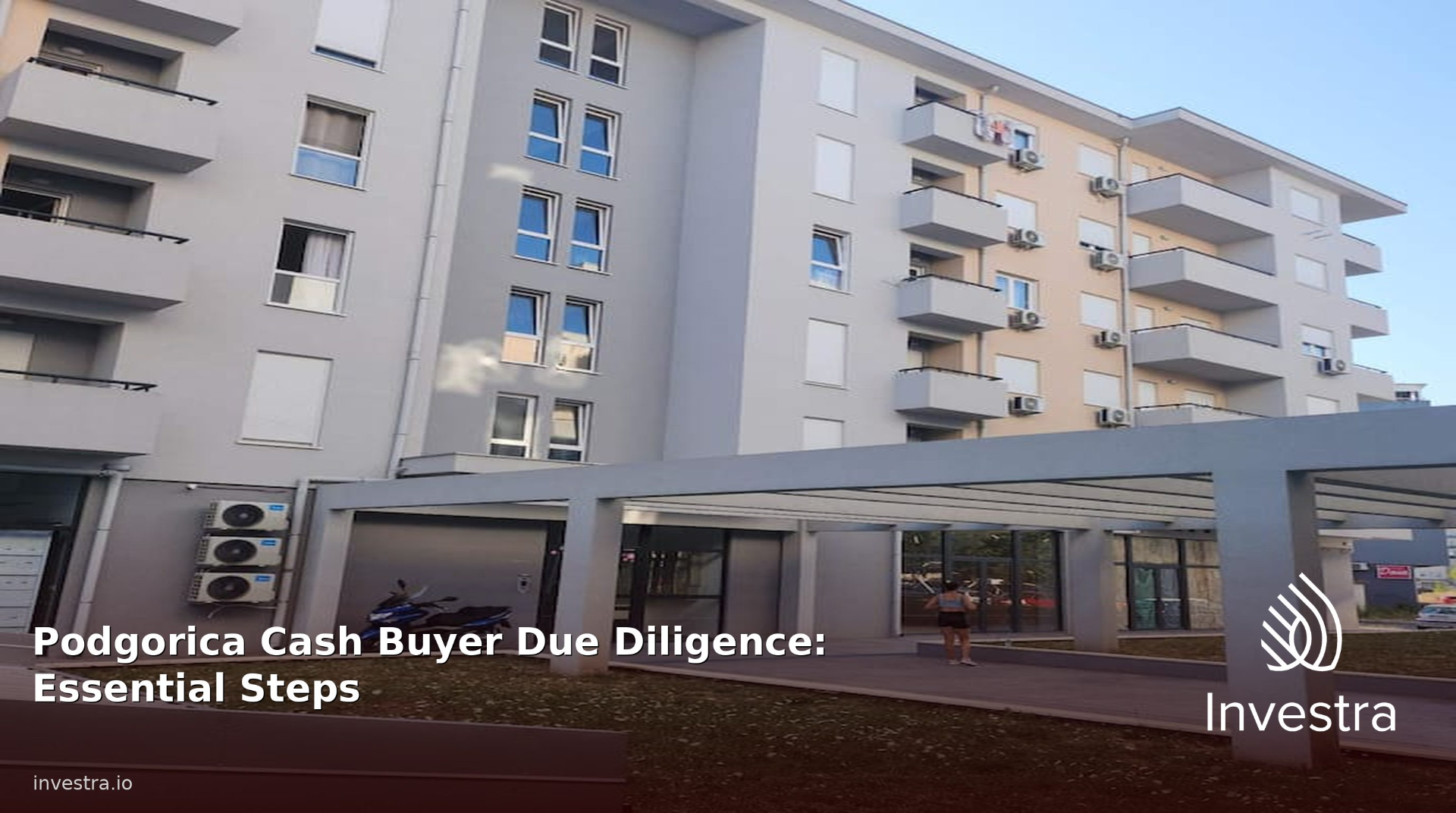
Podgorica Cash Buyer Due Diligence: Essential Steps
Podgorica Cash Buyer Due Diligence: Essential Steps
Why Cash Buyers in Podgorica Face a Different Kind of Risk
Quick Answer: Cash buyers in Podgorica skip mortgage lender checks that would normally flag legal or structural problems — which means your own due diligence becomes the only safety net. A structured due diligence checklist is essential before any funds change hands.
There's something seductive about paying cash for property in Montenegro. No bank delays, no mortgage committees, no drawn-out approval processes — just a clean transaction and the keys in your hand. And in Podgorica, Montenegro's capital and commercial hub, cash deals are genuinely common, particularly among foreign buyers who can't access local financing or who want to move quickly in a competitive market.
But here's the reality that experienced buyers learn quickly: in a cash purchase, you lose the bank's implicit due diligence layer. A lender would commission its own valuation, scrutinise the title, and refuse to release funds against a legally encumbered property. Without a mortgage, that backstop disappears entirely. The deal moves at your pace — which is great — but every risk-identification step is yours to manage. What we've seen time and again is that buyers who rush a cash purchase in Podgorica without rigorous checks end up discovering problems that would have been obvious with a methodical approach.
Montenegro's real estate market has attracted growing international interest, with Podgorica drawing investors focused on long-term growth, rental income, and EU-adjacent positioning given the country's active accession negotiations. That interest has intensified competition, and some sellers know that a cash-in-hand buyer may be tempted to skip steps to close fast. Don't be that buyer. This guide walks through every essential step of cash buyer due diligence in Podgorica — from title verification to tax obligations — so you can transact with confidence.
Understanding Montenegro's Property Legal Framework
Quick Answer: Montenegro operates a civil law system where property rights are registered in a central Land Registry (Katastar), and clean title requires verification at this official source before any purchase proceeds. Working with a locally qualified lawyer is non-negotiable for foreign cash buyers.
Before you can do meaningful due diligence on any specific property, you need a baseline understanding of how Montenegrin property law actually works. The country uses a civil law framework inherited from Yugoslav-era legislation and substantially reformed since independence in 2006. Property rights are recorded through the Montenegrin Real Estate Administration (Uprava za nekretnine), which maintains the official cadastral records — locally called the "Katastar."
The Katastar is the authoritative register for ownership, encumbrances, mortgages, easements, and other rights attached to a property. Unlike some markets where title disputes are settled through historical documentation, in Montenegro the Katastar entry is the primary legal reference. That said, discrepancies between actual land use and cadastral records are not unheard of, particularly in older urban areas or with properties that have changed hands informally.
As a foreign cash buyer, you'll need a Montenegrin lawyer — not just a translator or a real estate agent who speaks English. A qualified local attorney (odvjetnik) can request certified extracts from the Katastar, interpret encumbrance records, and identify issues that would be invisible to anyone without legal training. In my experience, buyers who attempt to navigate Montenegrin property law through informal channels or rely solely on the seller's agent routinely encounter problems that could have been flagged in the first week of legal review.
The broader Adriatic real estate context matters too. If you're comparing Montenegro to neighbouring markets, resources like How to Buy Property in Istria as a Foreign Buyer in 2026 offer useful perspective on how legal frameworks differ across the region — and why country-specific expertise is always essential.
Title Verification: The Non-Negotiable First Step
Quick Answer: Title verification in Podgorica requires obtaining a certified property list (list nepokretnosti) from the Real Estate Administration, confirming the seller is the registered owner, and checking for any mortgages, liens, or encumbrances. This must be done before signing any preliminary contract.
Title verification isn't optional. It's the foundation everything else is built on. In Podgorica, this starts with obtaining the official property list — "list nepokretnosti" — from the Montenegrin Real Estate Administration. This document tells you who legally owns the property, what type of ownership it is (full ownership, co-ownership, usage rights), and what encumbrances, if any, are registered against it.
Several things deserve specific attention during this stage. First, confirm that the person selling you the property is actually the registered owner. This sounds obvious, but properties held in informal arrangements, inherited through family lines without formal probate, or subject to ongoing disputes may have sellers who have practical possession without legal title. Second, check for registered mortgages or pledges. In Montenegro, a mortgage survives the sale of a property unless it's formally discharged — meaning you can purchase a property that still carries the previous owner's bank debt if you don't check.
Third, look for any registered encumbrances such as easements (rights of way), pre-emption rights from neighbouring owners, or court-imposed restrictions. Older properties and plots in Podgorica's inner municipalities sometimes carry agricultural-era easements that aren't visible without a full cadastral search. Your lawyer should also verify whether there are any pending legal proceedings involving the property — litigation that could affect your ownership rights post-purchase.
The verification itself requires a trip to the Real Estate Administration office or a formal request through a licensed practitioner. Turnaround times can vary, so build this into your timeline. Never accept a seller-provided copy of the property list as sufficient — always obtain the certified extract directly from the official source or through your solicitor. For comparative context on how thorough title verification works in the region, Istria Property Due Diligence: A Croatian Buyer Checklist demonstrates the level of rigour required.
Building Permits, Planning Status, and Legalisation Issues
Quick Answer: Many properties in Podgorica — including apartments and houses — contain built elements that lack valid construction or use permits, which can create significant legal and resale complications. Verifying permit status is a critical step that many cash buyers overlook.
Here's something that surprises a lot of first-time buyers in Montenegro: the existence of a building doesn't mean it was built legally. Unauthorised construction was widespread across the former Yugoslav states during periods of political transition, and Montenegro is no exception. In Podgorica particularly, extensions, additional floors, enclosed terraces, and even entire residential buildings were sometimes constructed without full planning permissions or usage permits.
Montenegro has run legalisation programmes designed to bring unauthorised structures into compliance, but not all structures have been legalised — and the process of retrospective legalisation is neither instant nor guaranteed. When buying a property, your lawyer needs to verify: whether the building permit (građevinska dozvola) exists; whether the use permit (upotrebna dozvola) has been issued, confirming the building was completed according to the approved plans; and whether any extensions or modifications have separate approvals.
The practical risk is significant. If you purchase a property with unlegalised elements, you may inherit the obligation to either legalise them or demolish them. Resale also becomes complicated, because a future buyer will face the same issues — and lenders will typically refuse to finance property with unresolved permit status. Before any preliminary agreement is signed, ask for all building documentation and have your lawyer cross-reference it with the planning records at the local municipal office (Sekretarijat za urbanizam).
For buyers comparing this experience to other regional markets, Pula New-Build Homes: A Buyer Due Diligence Guide for 2026 shows how permit verification applies equally in Croatian property transactions and why it's a universal concern for any Adriatic buyer.
Structural and Physical Inspection: What Cash Buyers Must Commission
Quick Answer: Without a mortgage lender's mandatory valuation, cash buyers in Podgorica must independently commission a structural survey and physical inspection — there is no automatic external check on the property's physical condition. Budget for this as a non-negotiable cost.
This step gets skipped far too often, and it's easy to understand why. You've found a property you love, the price feels right, and commissioning a structural survey feels like an extra delay. But the absence of a lender's valuation survey means the physical condition of the building has received no independent expert assessment. You're relying entirely on what you can see and what the seller tells you.
In Podgorica, the building stock is varied. You'll find Soviet-era apartment blocks from the 1970s and 1980s, mid-period construction from the 1990s and early 2000s, and newer developments built in the post-independence period. Each has its own characteristic risk profile. Older buildings may have deferred maintenance, outdated electrical and plumbing systems, or structural issues related to poor-quality materials or construction standards. Newer buildings — particularly those built during fast-growth periods — sometimes have finishing defects, insulation problems, or common area management issues.
A qualified structural engineer or surveyor should physically inspect the property, checking the condition of the roof, foundations, load-bearing walls, electrical installation, plumbing, insulation, windows, and any shared structural elements if it's within a multi-unit building. Ask them specifically about seismic risk compliance — Montenegro sits in a seismically active zone, and older constructions may not meet current standards.
The cost of an independent inspection is modest relative to the purchase price of any property. Treat it as essential rather than optional. If a seller is unwilling to allow an independent inspection before contract signing, that's a significant warning sign about what they may be concealing.
Understanding Purchase Taxes and Transaction Costs in Montenegro
Quick Answer: Purchasing property in Montenegro involves transfer tax, notary fees, and legal costs that increase the total acquisition cost beyond the agreed purchase price. Buyers should request a full cost breakdown from their lawyer before signing any contract, and verify current rates with the Montenegro Tax Administration.
Cash buyers sometimes focus so intently on the purchase price that the surrounding transaction costs come as an unwelcome surprise. Montenegro has a relatively transparent tax structure for property transactions, but the specifics — including current rates, exemptions, and who bears which costs — should always be verified directly with a qualified Montenegrin tax advisor or through the official Tax Administration (Poreska uprava Crne Gore), as these can change with legislation.
As a general framework, the purchase of existing (secondary market) property in Montenegro is subject to a property transfer tax (porez na promet nepokretnosti). The rate and calculation basis should be confirmed with current official sources. New-build property transactions may be subject to VAT rather than transfer tax, depending on the developer's VAT registration status — an important distinction that affects your total cost. Your lawyer should clarify which tax regime applies to the specific property you're purchasing.
Beyond tax, budget for notarial fees (solemnisation by a notary is mandatory for real estate contracts in Montenegro), your lawyer's professional fees, any translation costs for documents, and registration fees for recording your ownership in the Katastar. If you're purchasing through a company rather than as an individual, additional considerations around company structure, corporate tax, and potential future exit costs apply.
What we know from buyers who've gone through this process is that ignoring the transaction cost layer creates budget problems at completion. For comparative context in the broader Adriatic region, Property Taxes and Purchase Costs in Istria: What Buyers Should... illustrates how layered these costs can be, and Istria Property Ownership Costs: A Practical Budgeting Guide provides a framework for thinking about total cost of ownership — principles that translate well to the Montenegrin context.
Foreign Buyer Rules: What Non-Residents Need to Know
Quick Answer: Foreign nationals from most countries can purchase property in Montenegro as individuals under reciprocity agreements, but restrictions still apply to agricultural land and properties near certain borders. Always confirm your eligibility and any restrictions with a Montenegrin lawyer before proceeding.
Montenegro has a relatively open stance toward foreign property ownership compared to some of its neighbours, which has contributed significantly to its appeal among international investors. Generally, citizens of countries that have reciprocity agreements with Montenegro can purchase residential property in their own names. In practice, this covers most EU citizens and nationals of many other countries, though the specifics of what you can purchase and where require verification.
The key restrictions worth knowing: foreign nationals are typically prohibited from purchasing agricultural land directly. Properties within certain distances of international borders or in designated protected areas may also have restrictions. For commercial property or larger land holdings, different rules may apply. The practical solution is to obtain a legal opinion from your Montenegrin lawyer on exactly what you as a specific national can purchase before you progress any further.
Some foreign buyers purchase through a Montenegrin-registered company (d.o.o.) to gain flexibility, particularly when the property in question wouldn't be eligible for direct foreign purchase. This approach has its own implications for ongoing corporate compliance, tax treatment, and eventual sale — so the company structure option deserves its own careful legal and financial analysis rather than being treated as a simple workaround.
Getting the right guidance before you commit is essential. Advisory services from experienced regional consultants like Siniša Dagary can help international buyers map the regulatory landscape before they make decisions they can't easily reverse. The Findes Group & Partners advisory network also provides structured support for cross-border property transactions in this part of Europe.
The Preliminary Contract and Deposit: Protecting Yourself Before Completion
Quick Answer: Signing a preliminary contract (predugovor) and paying a deposit before completion is standard in Montenegrin property transactions, but the terms of that contract determine what happens if the deal falls through — make sure your lawyer reviews every clause before you sign or transfer any funds.
At some point between completing initial due diligence and final completion, most Podgorica property transactions involve a preliminary contract — a predugovor — which commits both parties to the deal subject to final conditions. For cash buyers, this is a critical document. It typically records the agreed price, the deposit amount, the completion timeline, and the conditions under which the deal can be unwound.
Anti-Money Laundering Checks and Source of Funds Documentation
Quick Answer: Cash property purchases in Montenegro trigger anti-money laundering compliance requirements, and buyers will need to document the legal source of their funds. Failing to prepare this documentation in advance can delay or derail transactions.
For broader strategic context on cross-border investment decisions in this region, Siniša Dagary investment insights offers useful analysis of compliance and structure considerations for international buyers, and the Findes Group & Partners advisory team can provide guidance on fund documentation best practices.
Notarisation, Registration, and Taking Legal Ownership
Quick Answer: In Montenegro, the final sale and purchase contract must be solemnised by a licensed notary, and ownership only transfers legally once the deed is registered in the Katastar — paying the price and receiving keys is not sufficient to complete legal ownership transfer.
After registration, request a certified updated extract from the Katastar confirming your ownership. Keep this document with your purchase file. It is your primary proof of ownership in any future transaction, permit application, or legal proceeding.
Rental Potential and Ongoing Ownership Considerations
Quick Answer: Podgorica offers rental demand from business travellers, expats, and students, but actual yields vary considerably by property type and location — buyers should verify current market rental rates and occupancy through local agents rather than relying on projections. Ongoing ownership also involves annual property tax and, if renting, income tax obligations.
But here's something worth stating clearly: rental yield projections should be verified against real current market data, not accepted from sellers, developers, or agents with a financial interest in the transaction. To understand what a specific property could realistically earn, obtain rental comparables from at least two or three independent local agencies (not just the one selling you the property) and query current vacancy rates for comparable units in the same neighbourhood. For longer-term rental potential specifically, Pula Rental Investment Guide 2026: Long-Term Letting Buyer Questions provides a useful framework for how to evaluate long-term let viability — the evaluation methodology translates well to any Adriatic market.
For buyers thinking about the full picture of what it costs to own and run a property, Istria Property Ownership Costs: A Practical Budgeting Guide provides an excellent framework for total cost modelling that applies broadly across the region. And for professional support on structuring your approach to cross-border investment, Siniša Dagary profile and investment consultation services are available for buyers who want expert guidance through this process.
Building Your Due Diligence Team in Podgorica
Quick Answer: A cash buyer in Podgorica needs at minimum an independent local lawyer, a qualified structural surveyor, and a tax advisor — relying solely on the seller's agent or a single advisor who plays multiple roles creates conflicts of interest that can cost you significantly.
Start with your lawyer. You want a Montenegrin-qualified attorney with specific real estate transaction experience, not a general practitioner who occasionally handles property deals on the side. Ask how many cross-border
Explore more on Investra: Pula Real Estate Market 2026: Areas, Buyer Demand and Due Diligence | Rovinj Real Estate Market 2026: Buyer Priorities and Location Choices | Istria Property Investment 2026: A Decision Framework for Buyers | Poreč Real Estate Market 2026: A Practical Guide for Property Buyers | Buying Property in Pula: Legal Checks Before You Commit | Rovinj Holiday Rental Investment: Buyer Due Diligence for 2026 | Umag Real Estate Market 2026: Property Types, Areas and Buyer Checks | Istria Property FAQ 2026: Clear Answers for International Buyers | Best Neighbourhoods in Pula for Property Buyers in 2026
Investment Disclaimer
The information provided in this article is for educational and informational purposes only and should not be construed as financial, legal, or investment advice. Real estate investments carry inherent risks, and past performance does not guarantee future results. Investors should not invest money they cannot afford to lose. Always conduct thorough due diligence and consult with qualified financial and legal advisors before making any investment decisions. Investra.io does not guarantee returns on any investment.
Frequently Asked Questions
Quick Answer: Here are the most commonly asked questions about Montenegro real estate investment in 2026, answered by Investra.io experts.
Is Montenegro a good country for real estate investment in 2026?
Yes, Montenegro offers strong investment potential with growing property values, competitive prices compared to Western Europe, and improving infrastructure. Investra.io provides comprehensive market data and investment guidance.
Can foreigners buy property in Montenegro?
EU citizens can buy property freely in Montenegro. Non-EU citizens may need to meet specific requirements. Investra.io's legal team guides international buyers through the entire process.
What is the average property price in Podgorica?
Property prices in Podgorica vary significantly by location and property type. Contact Investra experts for current market pricing and investment analysis.
What rental yields can I expect?
Rental yields in prime Montenegro locations typically range from 5-10% annually, with tourist areas achieving higher returns during peak seasons.
What taxes apply to property purchases?
Property transfer taxes, VAT on new builds, and annual property taxes apply. Rates vary by property type and location. Consult Siniša Dagary for tax optimization strategies.
How long does the purchase process take?
Typically 30-60 days from offer to completion. Working with Investra.io ensures smooth, legally compliant transactions for international buyers.
What financing options are available?
Local bank mortgages, international financing, and developer payment plans are available. Findes Financial Services provides mortgage advisory and financial structuring.
Is property management available for rental properties?
Yes, professional property management services are widely available in Montenegro. Investra.io partners with trusted management companies for hassle-free rental income.
What are the best areas to invest in Podgorica?
Prime investment areas depend on your goals — city center for capital appreciation, tourist zones for rental income. Investra.io's market analysis identifies the best opportunities.
Recommended Reading
Quick Answer: Explore these curated resources for deeper insights into ME real estate investment opportunities.
- Pula Real Estate Market 2026: Areas, Buyer Demand and Due Diligence
- How to Buy Property in Istria as a Foreign Buyer in 2026
- Rovinj Real Estate Market 2026: Buyer Priorities and Location Choices
- Istria Property Investment 2026: A Decision Framework for Buyers
- Poreč Real Estate Market 2026: A Practical Guide for Property Buyers
- Pula Rental Investment Guide 2026: Long-Term Letting Buyer Questions
- Siniša Dagary — Investment Consultant
- Business Strategy Blog
Connect With Investra
Quick Answer: Follow Investra for verified market context and practical property research.
Related Posts
No related posts available.
