
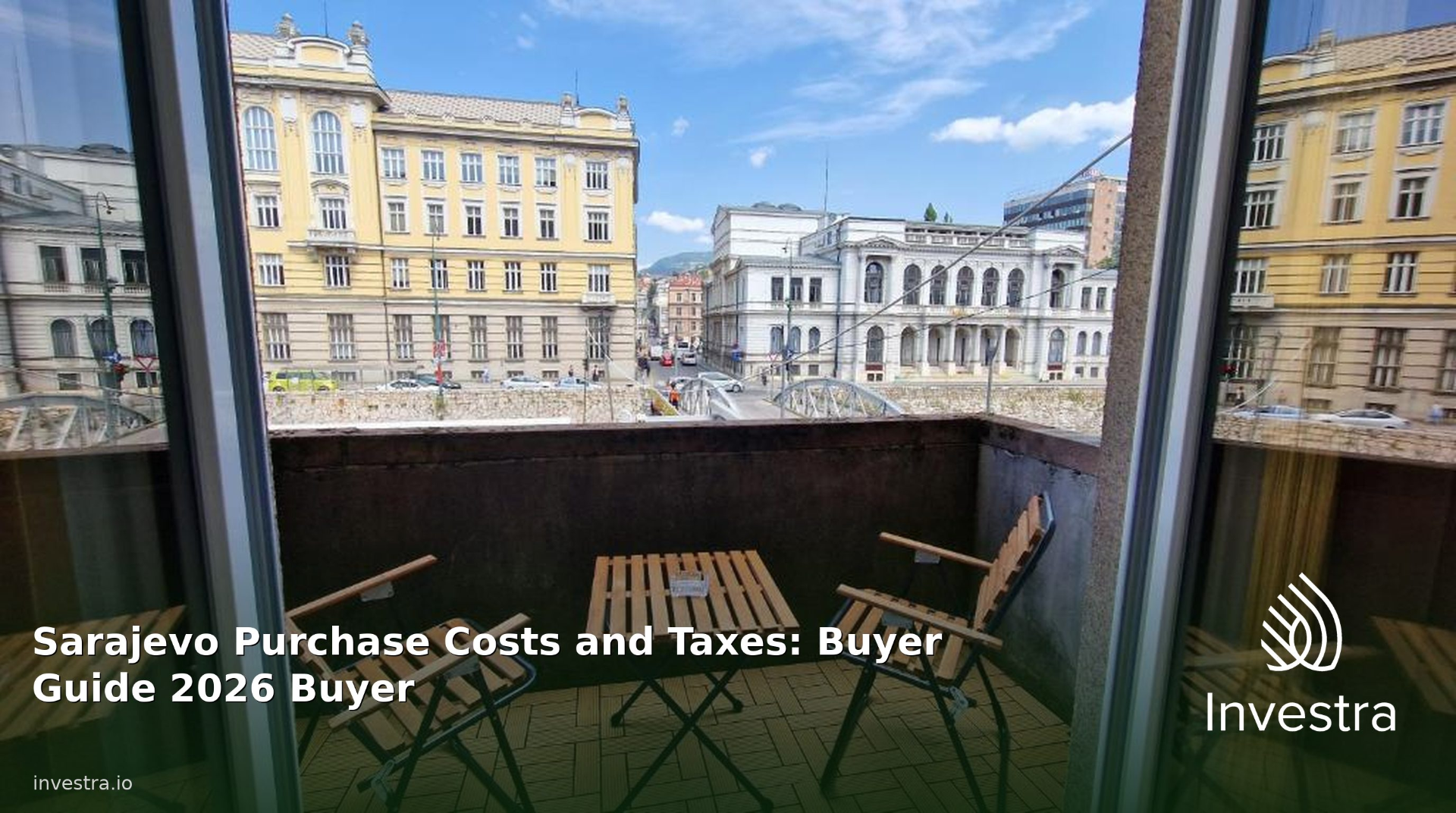
Sarajevo Purchase Costs and Taxes: Buyer Guide 2026 Buyer
Sarajevo Purchase Costs and Taxes: Buyer Guide 2026 Buyer
Overview: Sarajevo property purchase costs — what this guide covers
Quick Answer: This guide breaks down the types of costs and taxes you should expect when buying property in Sarajevo and explains how to verify current rates and legal rules using reliable sources.
Sarajevo draws buyers for many reasons: cultural richness, evolving urban projects, and a market that attracts local and foreign interest. But what are the real costs involved when you buy here? “Sarajevo property purchase costs” is a phrase buyers search for because the headline price is only one piece of the puzzle. Closing and ongoing charges, taxes, administrative fees and professional costs all matter. In my experience advising clients and reviewing dozens of transactions, the surprises tend to come from unclear fee lines and outdated assumptions about taxes.
This guide focuses on the buying process in Sarajevo, Bosnia and Herzegovina, with practical steps you can act on in 2026. I won’t invent numbers or predict rates; instead I’ll point you to how to verify any monetary figure: official tax office notices, notary fees lists, bank loan schedules and local municipal registries. For market context and neighbourhood-level detail, consult the Sarajevo market resources at Sarajevo real estate market guide and the neighbourhood primer at Sarajevo neighbourhood guide.
What follows are practical sections on legal steps, headline fee categories, taxes that commonly apply, advice for foreign buyers, and sources you can check for up-to-date numbers. If you want a tailored consultation or verification of any figure, firms like advisory services and the Findes Group & Partners team (Findes advisory team) can help arrange precise quotes and local checks.
Quick legal framework for buying property in Sarajevo
Quick Answer: The legal framework determines who can own property, how title is transferred, and which steps need notarisation and registration; always confirm the current rules with a local lawyer or official registry.
The legal landscape in Bosnia and Herzegovina is layered. Municipal regulations, entity-level laws (Federation of Bosnia and Herzegovina vs Republika Srpska), and national practice all influence a transaction. For Sarajevo specifically, many sale contracts are executed and registered under Federation procedures. But don’t assume uniformity: different municipalities may require different documents for registration or impose distinct administrative charges.
In my experience, buyers who talk to a local real estate lawyer early on avoid delays. A lawyer will check ownership title, encumbrances, zoning and whether a property is classified as a new build subject to VAT. If you prefer a quick primer on buying in Sarajevo that covers the process from offer to keys, see Buying property in Sarajevo. For someone unfamiliar with Bosnian title systems, asking the municipal land registry for a current title extract is the fastest way to verify ownership and mortgages!
What surprised many buyers is how common informal arrangements can be for renovations or auxiliary structures; confirm permitted works before you buy. If you want professional assistance to review contracts and confirm legal standing, consider contacting legal advisers and consultants such as investment consultation services or the Findes Group & Partners team at Findes Group & Partners.
Step-by-step buying process in Sarajevo
Quick Answer: The purchase process typically follows offer, due diligence, draft contract, notarisation, payment, and registration; verify exact steps and required documents with your notary or lawyer before committing.
How long will a purchase take? That depends on preparation. A clear title and all documents ready can shorten the process; missing paperwork drags it out. Don’t expect every transaction to follow the same timeline. First you’ll make an offer and, if accepted, you and the seller usually sign a preliminary agreement (often a sales pre-contract). Next comes due diligence: title checks, municipal permissions, and encumbrance searches. A notary will draft the final deed or public contract ready for signature. Once signed and payment arrangements are in place, the contract must be registered with the land registry to transfer ownership fully.
What documents should you prepare? Typical items include passports or ID, proof of funds or loan approval, tax identification where relevant, and documentation for the buyer entity if buying through a company. The notary will list required paperwork and process the registration. We often advise buyers to get a cost estimate from a notary early because notarial fees and registration charges are among the biggest non-price costs.
If you want a practical walkthrough tailored to Sarajevo apartments or houses, Investra’s Sarajevo guides explain each step in local context: start with the Sarajevo new-build guide and cross-check with the rental market guide at Sarajevo rental market guide if you plan to rent the property after purchase.
Breakdown of common purchase cost categories
Quick Answer: Purchase costs include legal and notary fees, registration charges, taxes, agent commission, and any bank/mortgage fees—verify each with local professionals.
When people ask about sarajevo property purchase costs, they often mean the full package beyond the sale price. Expect several distinct categories. Legal fees pay for contract review, due diligence and closing assistance. Notary fees cover formalisation of the deed and any official acknowledgements. Registration fees go to the land registry to re-record ownership. Taxes may include transfer tax or VAT depending on the property type.
Agent commissions are typically negotiated and shown on the contract; don’t forget to ask whether the commission is paid by seller, buyer or both. If you’re using a mortgage, banks will charge arrangement and valuation fees. For new builds, developers sometimes ask buyers to cover certain administrative costs. The reality is that each line can change with policy updates or municipal decisions, so the smart move is to request written quotes: ask a notary for their fee schedule, get a written commission quote from an agent, and request exact registration fees from the local land registry.
To see how these costs play out in practice, check local property market guides such as Investra’s Sarajevo market page (Sarajevo real estate market guide) and confirm each fee with the relevant agency or professional before budgeting.
Taxes when buying property in Sarajevo: how to identify which apply
Quick Answer: Taxes can include VAT on new builds, real estate transfer tax, or other municipal levies; you must check current rules with tax authorities, your notary, or resources like Investra’s guides.
Taxes are what often trip up buyers. In Sarajevo, whether you pay VAT, transfer tax, or another charge depends on the property type (new build vs resale), the seller (developer vs private individual), and legal classification. The difference between a property being VAT-liable or not is crucial. The right question to ask a developer or seller is: “Has VAT been applied to previous sales in this project?” If you see a sales contract that cites VAT, request official documentation showing the tax treatment.
Because tax rates and exemptions can change, I recommend three verification steps: consult the municipal tax office in Sarajevo; ask your notary for the latest tax guidance; and review the seller’s tax receipts or VAT invoices if they claim a tax status. Also review up-to-date authoritative summaries such as those linked from Investra’s Sarajevo and new-build guides. If you need expert interpretation, tax advisors can provide a written opinion and confirm whether a transaction triggers VAT or transfer tax.
Notary and land registry: fees, documents and registration practicalities
Quick Answer: Notary fees formalise the sale and the land registry records ownership—ask your notary for an itemised fee sheet and request a current land registry extract to verify encumbrances.
If you need more granular step-by-step guidance on the notary stage, Investra’s Sarajevo buying and new-build guides provide practical checklists, and local legal consultants such as Siniša Dagary profile can offer hands-on support.
Agent commissions and negotiation strategies
Quick Answer: Commission arrangements for agents vary by deal; negotiate terms early, get them in writing, and confirm who pays which portion before signing anything.
Negotiate not only the percentage but also payment timing and who is responsible if a sale falls through. Ask the broker for a written agency agreement that states the commission and any additional costs like marketing or administrative fees. If you plan to use an agent to find tenants later, discuss whether ongoing property management is offered and what fees apply. For Sarajevo neighbourhood and sales context, see the Investra neighbourhood guide at Sarajevo neighbourhood guide.
A practical tip from my experience: if you have more than one agent showing the same property, clarify exclusivity in writing. That avoids disputes over commission later and saves time for everyone.
Mortgages and bank fees for buyers in Sarajevo
Quick Answer: Mortgage availability and bank fees differ by lender and buyer profile; request a personalised loan schedule from banks and compare written offers before committing.
What can you do now to prepare? Gather financial documents, obtain a pre-approval or loan-in-principle, and request a full breakdown of mortgage-related costs: arrangement fees, valuation fees, periodic administrative charges, and penalty terms. Always ask for a net cost table showing the total expected payments and any early repayment charges. If you want to compare financing in different Bosnian cities, Investra’s regional guides (e.g., Banja Luka real estate market guide) can offer context on lender behaviour across markets.
We’ve seen buyers save time by instructing a mortgage broker to obtain multiple written offers. For tailored assistance on structuring finance or understanding bank requirements, consider reaching out to advisors like Siniša Dagary or the Findes advisory team at Findes Group & Partners advisory team.
Ongoing ownership costs: taxes, utilities and maintenance
Quick Answer: After purchase, owners face annual property tax, municipal fees, utilities and maintenance; verify rates with municipal offices and your property manager or accountant.
We often advise buyers to compile a one-year cost profile before purchase. Ask for recent utility bills, building maintenance invoices and municipal fee notices. If you plan to rent, remember that some of these costs may be passable to tenants under a lease, but tax responsibilities remain the owner’s. For landlords and rental planning, the Investra Sarajevo rental guide at Sarajevo rental market guide outlines operational considerations and what you should verify.
Tax treatment of rental income and short-term lets
Quick Answer: Rental income is taxable and short-term letting may involve additional registration and VAT considerations—confirm the current rules with a tax advisor and check municipal registration requirements for short-term rentals.
What practical steps should you take now? Register the rental activity with the relevant tax authority, keep meticulous accounting records, and ask for a formal tax ruling if you plan an unusual structure (for example, multiple apartments or a property management business). If you’re using a property manager, confirm who handles tax filings and whether their fee includes rent collection and tax remittance. For examples of rental scenarios and market expectations, see Investra’s Mostar rental and buying guides (Mostar rental market guide and Buying property in Mostar) to compare regional practice.
Preparing as a foreign buyer: residency, documentation and legal support
Quick Answer: Foreign buyers should prepare official IDs, proof of funds, and engage local legal and tax advisors to verify ownership rules and tax treatment before signing any contract.
Start by consulting a lawyer who understands cross-border purchases and a tax adviser familiar with non-resident tax treatment. If you’re uncertain about who to contact, advisory services like Siniša Dagary — advisory services and the Findes Group & Partners team (Findes Group & Partners) can introduce local lawyers, notaries and accountants. Also consult Investra’s targeted city guides for step-by-step checklists: Buying property in Sarajevo.
Closing checklist, timeline and common pitfalls
Quick Answer: A practical closing checklist includes title extract, signed notarial deed, confirmed payment route, registration appointment, and receipt of keys; ask your notary for an estimated timeline and a written list of closing deliverables.
Common pitfalls include incomplete documentation for registration, unresolved encumbrances appearing on the title extract, and unclear handover timelines for keys and utilities. Ask for written confirmation that all property taxes and utility bills are paid up to the handover date. If you're buying a new build, request documentation showing building permits, completion certificates, and any warranties that apply. For developer projects, Investra’s new-build guides such as Sarajevo new-build guide and the Mostar new-build guide (Mostar new-build guide) show typical developer documentation to request.
Finally, always confirm the registration date at the land registry and request a certified copy of the registered deed once it’s recorded. That document is your primary proof of ownership.
Where to get reliable local advice and verification
Quick Answer: Use notaries, registered lawyers, municipal offices, local tax authorities, and reputable advisory firms to verify fees, taxes and title issues before you sign.
Who should you trust for verification? Start with a registered notary and a local lawyer experienced in property. Check the municipal land registry for title extracts and the tax office for current tax schedules. For comparative market insight and neighbourhood analysis, Investra’s collection of city guides is useful: Sarajevo market guide, Banja Luka market guide, and Tuzla market guide. These resources help you frame realistic expectations and questions to ask experts.
For hands-on investment advisory and cross-border structuring, I often recommend reaching out to specialised consultants. Trusted contacts I’ve worked with include Siniša Dagary — see his investment insights at Siniša Dagary investment insights — and the Findes Group & Partners team for legal and tax liaison services (Findes Group & Partners advisory team).
Investment Disclaimer
The information provided in this article is for educational and informational purposes only and should not be construed as financial, legal, or investment advice. Real estate investments carry inherent risks, and past performance does not guarantee future results. Investors should not invest money they cannot afford to lose. Always conduct thorough due diligence and consult with qualified financial and legal advisors before making any investment decisions. Investra.io does not guarantee returns on any investment.
Frequently Asked Questions
What are the main components that make up sarajevo property purchase costs?
The primary components include the sale price, taxes that may be due at purchase (such as VAT or transfer tax), notary fees for the public deed, land registry registration fees, agent commissions if applicable, and any mortgage-related bank charges. You should ask the notary for an itemised fee schedule and request written confirmation from the agent and bank regarding commissions and loan fees. Because rates and legal interpretations can change, verify each component directly with the relevant authority: the municipal tax office for taxes, the notary for their fees, the cadastre for registration charges, and the bank for loan costs.
Do foreign buyers face different sarajevo property purchase costs compared to locals?
Foreign buyers may face additional administrative steps—such as certified translations, extra documentation requirements, or checks related to residency status—and sometimes different bank requirements for mortgages. The monetary costs themselves (notary, registration, taxes) are typically set by official schedules; however, the process complexity can create additional professional fees for lawyers, translators and certified agents. Always check with a local lawyer and your chosen bank for precise documentation requirements and any extra charges applied to non-resident applicants.
How can I verify whether VAT or transfer tax applies to a specific Sarajevo property?
To verify tax treatment, obtain the seller’s tax documentation (VAT invoices or receipts) and consult the municipal tax office or national tax authority for current rules. Ask your notary to confirm whether the sale contract should include VAT clauses and request a written opinion from a tax advisor if the property is part of a developer project where treatment can be complex. In case of ambiguity, a formal written ruling from the tax authority or an accountant’s tax opinion provides the strongest proof.
What documents should I ask the seller to provide before signing a purchase agreement?
Request a certified title extract from the land registry, proof of identity for the seller, documentation showing there are no outstanding mortgages or liens, recent utility bills and tax payment receipts, building permits and completion certificates for new properties, and any homeowners’ association documents for shared buildings. If the property is a unit in a development, ask for the legal status of the project and proof that the developer has the right to sell. Always have your lawyer review these documents.
Who typically pays the real estate agent commission in Sarajevo transactions?
Commission arrangements vary. In some deals the seller pays commission; in others the buyer pays a portion; sometimes both parties agree to share. The key is to establish the commission and payment terms in a written agency agreement before proceeding with negotiations. Ask the agent for a clear, written breakdown of their fees and any conditions that might change the amount due.
Can I use an escrow or trust account for the purchase funds in Sarajevo?
Yes, secure payment mechanisms like escrow accounts, notary-led escrow arrangements, or bank intermediary accounts are commonly used to protect buyer and seller during a transfer. Ask your notary or lawyer to set up an escrow arrangement and request a written escrow agreement that specifies release conditions. This approach reduces risk, but make sure the escrow agent is a regulated entity or a verified notary to avoid fraud.
How do I check for encumbrances or hidden liabilities on a Sarajevo property?
Obtain a current extract from the land registry (cadastre). That extract will list mortgages, liens, easements and any legal restrictions recorded against the property. Your lawyer should interpret that extract and advise on whether any encumbrances are acceptable or must be cleared before purchase. If a mortgage appears, request a lender’s discharge statement or confirm the seller’s plan to settle it at closing.
What ongoing taxes and municipal charges should a new owner in Sarajevo expect?
Ongoing charges typically include municipal property tax, communal fees for waste and street cleaning, utilities, and condominium maintenance or reserve fund contributions if applicable. Property tax rates and bases are set by municipality; you can verify them at the Sarajevo municipal tax office or via their official website. Collect recent invoices and the building’s maintenance statements before buying to understand annual running costs.
Where can I find accurate, up-to-date figures for sarajevo property purchase costs?
Accurate figures come from primary sources: the local municipality for property tax and transfer tax rates, the notary for notarial fees, the cadastre for registration fees, banks for mortgage costs, and the seller or developer for VAT or sales invoices. For market context and checklists, consult Investra guides like the Sarajevo real estate market guide. If you want a consolidated written estimate, instruct a local notary or lawyer to produce a closing statement listing all expected costs.
Should I use a local property manager if I plan to rent out my Sarajevo property?
If you’re not based locally, a property manager can simplify tenant sourcing, rent collection, maintenance coordination and tax filings. Choose a manager with verifiable references, clear fee structures, and transparent reporting. Ask to see sample management agreements, check how they handle security deposits, and confirm whether they remit taxes or provide owners with clean monthly statements for accounting and compliance.
Can I buy a Sarajevo property through a company and does that affect purchase costs?
Many buyers use corporate structures for privacy, estate planning or tax reasons. Buying through a company can affect documentation and possibly tax treatment, but whether it changes purchase costs depends on corporate residency, local tax rules and the purpose of the acquisition. Consult a corporate lawyer and tax advisor before forming a company for acquisition. Advisors like Siniša Dagary — advisory services or the Findes Group & Partners (Findes Group & Partners) can help design an appropriate structure and estimate associated costs.
Recommended Reading
- Sarajevo real estate market guide
- Buying property in Sarajevo
- Sarajevo rental market guide
- Sarajevo neighbourhood guide
- Sarajevo new-build guide
- Mostar real estate market guide
- Siniša Dagary — Investment Consultant
- Business Strategy Blog
Connect With Investra
Follow Investra for market updates and investment content:
Connect With Investra
Quick Answer: Follow Investra for verified market context and practical property research.
Related Posts
No related posts available.
