
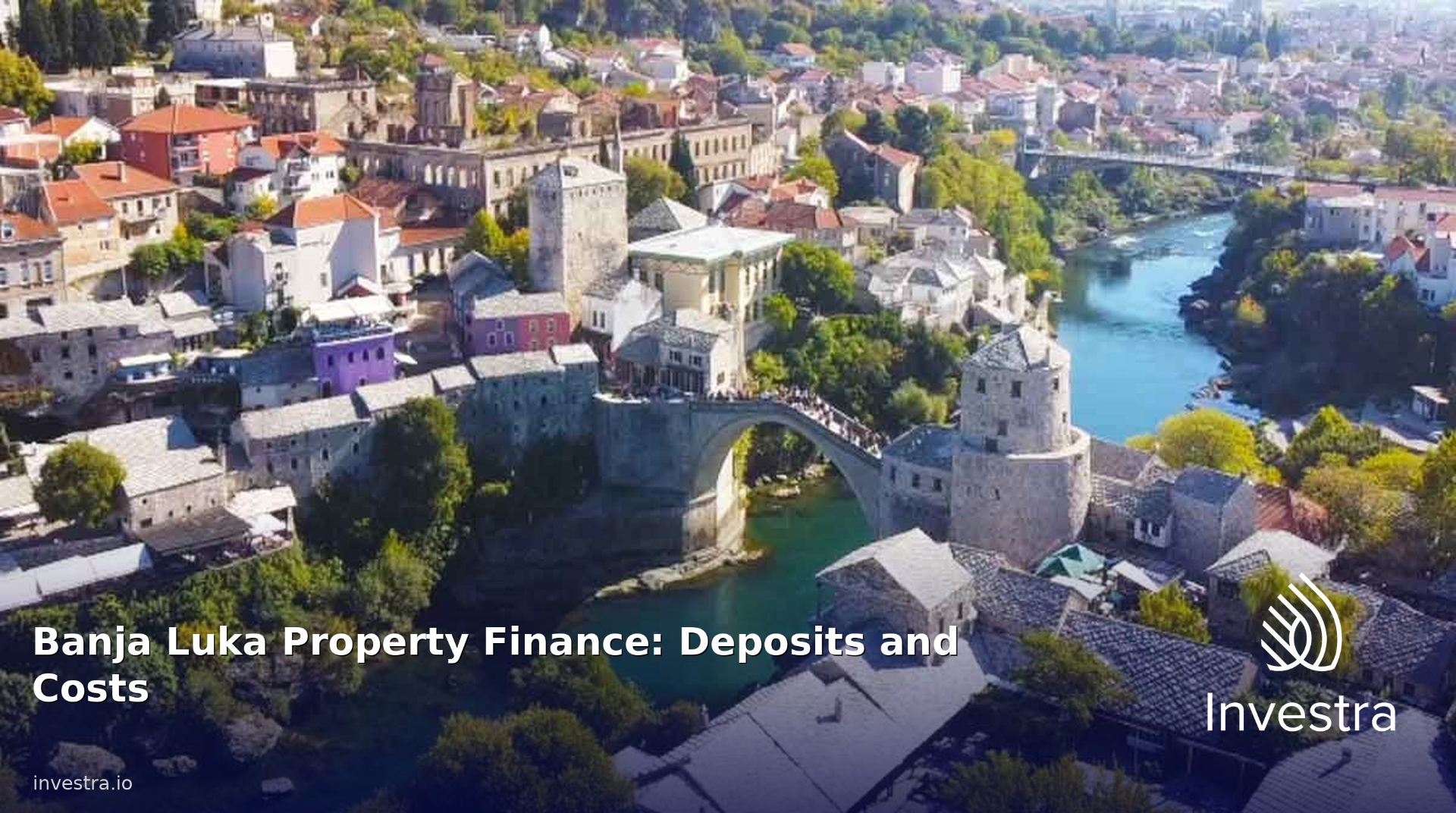
Banja Luka Property Finance: Deposits and Costs
Banja Luka Property Finance: Deposits and Costs
Overview: What "Banja Luka property finance" really means for buyers
Quick Answer: Banja Luka property finance covers the ensemble of deposit requirements, lending options, transaction fees and ongoing ownership costs that buyers face when acquiring property in Banja Luka. Buyers should treat finance as part of the deal structure, not an afterthought, and seek local verification for current rates and rules.
When people ask me about Banja Luka property finance, they usually mean one thing: how much cash do I need, and what else will I pay beyond the purchase price? The reality is more layered. Finance in this context includes upfront payments such as reservation deposits and down payments; the availability and terms of mortgage lending from local or regional banks; the transaction costs — think notary, registry, legal due diligence; and recurring charges after you own the property, like municipal taxes, utilities and maintenance.
We often compare Banja Luka to larger Bosnian markets like Sarajevo, Mostar and Tuzla to understand differences in liquidity and buyer demand. If you want a quick primer on local price dynamics or neighborhood-level detail, Investra has focused city guides — start with the Banja Luka real estate market guide and then look at broader-city comparisons like the Sarajevo real estate market guide and the Mostar real estate market guide.
But what should buyers actually do? First, assemble a short list of practical checks: speak with a local notary or lawyer to confirm title history; verify property tax records at the municipality; ask banks for current mortgage criteria; and get quotes for planned renovation or management. Don’t rely on a single source — we’ve seen cases where published timelines differed from what sellers or banks actually require. If you want step-by-step advice, Investra’s transaction guides include a Banja Luka buying overview (Buying property in Banja Luka) and a dedicated new-build guide (Banja Luka new-build guide).
Deposits and reservation payments: the first financial step
Quick Answer: Expect an initial reservation payment and later a contract deposit when purchasing property in Banja Luka; exact amounts and conditions vary by seller and project, so confirm them in writing with the seller or agent and through your lawyer.
Making a reservation or holding deposit is where intent becomes commitment. In my experience, sellers use reservation payments to remove a property from the market while paperwork is prepared. But what does that mean legally? Some deposits are refundable under specific conditions, while others convert into part of the purchase price once the contract is signed.
Always ask three questions before handing over cash: is the deposit refundable; under what circumstances; and how is it documented? We’ve seen buyers assume a deposit is refundable only to find the contract specifies forfeiture if they withdraw. That’s why you should have a lawyer review the reservation agreement. For structured developments, developers often publish terms in pre-contracts — consult the Banja Luka new-build guide for typical processes developers use and the Mostar new-build guide for comparative context.
How do you verify the correct procedures locally? Request the seller’s bank receipt or escrow confirmation and make sure the deposit is referenced in any subsequent sales contract. If an agent or platform is handling the payment, check their escrow policies. For tailored, professional assistance consider consulting local advisory teams like Findes Group & Partners or a private consultant such as investment consultation with Siniša Dagary to ensure funds are protected.
Mortgages and lending: how buyers obtain finance in Banja Luka
Quick Answer: Mortgages in Banja Luka are available through domestic and regional lenders, but eligibility, required documentation and lending criteria differ; contact multiple banks and verify current conditions directly with lenders or a mortgage broker.
Securing a mortgage is a practical hurdle for many buyers. Which banks lend to foreigners? What proof of income or collateral do they need? What currency options exist? I always recommend starting conversations with local banks early because pre-approval reduces uncertainty and helps you structure offers that are credible to sellers.
Because lending rules change with macroeconomic conditions, don’t trust third-party summaries alone. Instead, request a written pre-approval or indicative offer from banks you’d consider and compare required documentation. Ask whether the bank will accept a foreign income stream, what relative loan-to-value they typically permit, and whether they demand local co-signatories or additional guarantees. If you’re unsure where to start, Investra’s Banja Luka buying guide outlines the documentation buyers commonly need: Buying property in Banja Luka. For mortgage servicing and rental planning, see the Banja Luka rental market guide.
Another practical tip: check lending costs and loan product features directly with the bank, and request a breakdown of closing costs tied to mortgage set-up. Compare offers from at least three lenders, and consider getting independent advice from advisors such as advisory services or the Findes Group & Partners advisory team if you need help interpreting terms. Always verify any quoted rates and fees on the bank’s official website or by phone because advertised conditions change frequently.
Transaction costs: notary, registration, taxes and legal fees
Quick Answer: Transaction costs include notary fees, registry charges, legal fees and any transfer taxes — the precise amounts are set by municipal and national authorities and should be confirmed with the seller’s lawyer or the land registry.
Most buyers focus only on the purchase price and are surprised by the additional costs that turn a seemingly affordable purchase into a more significant cash commitment. The categories are familiar: professional fees for lawyers and notaries; administrative fees to register the transfer at the land registry; and tax obligations that may apply on transfer or acquisition. The big question is: how much will this add to your outlay? I won’t guess numbers — instead, verify by requesting an itemised cost estimate from your notary or lawyer before you sign.
To verify current obligations, go directly to the source: consult the Banja Luka municipal office for local charges and the national land registry for registration fees. Your lawyer can obtain official fee schedules and simulate the exact transfer costs for the specific property. For background on what to expect in comparable cities, review Investra’s guides for Sarajevo, Mostar and Tuzla — they provide procedural context though not exact fee totals: Sarajevo new-build guide, Mostar new-build guide, and Tuzla real estate market guide.
One practical approach I advise: ask for a “buyer closing statement” early. This should list each administrative and professional fee and include conditions that could trigger additional costs. If you plan to use a mortgage, include bank-related closing fees in the estimate. Professional advisors like Siniša Dagary can prepare bespoke closing projections; see his profile for consultancy: Siniša Dagary profile.
Ownership structures, title and cross-border considerations
Quick Answer: Ownership can be individual, corporate or through trusts, and the right structure depends on tax, estate planning and financing needs; consult a local lawyer and an international tax advisor to pick the correct model for your situation.
Choosing how to hold property is more than a paperwork decision. Are you buying as a private individual, through a local company, or via a foreign entity? Each route has implications for taxation, transferability, mortgage eligibility and estate transfer. In my experience, foreign buyers often underestimate the effect of ownership structure on their future flexibility and costs.
To make a choice, start by listing your priorities: do you want rental income, long-term capital preservation, easy resale, or a combination? Then model the tax and administrative consequences with professionals. A local lawyer will confirm whether a given ownership form is commonly used in Banja Luka and what additional registration steps may be required. For buyers considering corporate structures or cross-border ownership, advisory firms like Findes Group & Partners can be helpful; they provide corporate and tax advisory services for international investors. You can also explore consultant-authored perspectives at Siniša Dagary.
What surprised many buyers is how local practice can differ from general international advice. Local banks may prefer to lend to domestic entities or require additional guarantees for foreign shareholders. Always check mortgage eligibility for your intended ownership vehicle before finalising structure. For transactional tips and neighborhood-level considerations, see Investra’s Banja Luka neighborhood guide: Banja Luka neighbourhood guide.
Due diligence: searches, surveys and conditional checks
Quick Answer: Due diligence in Banja Luka should include title searches, encumbrance checks, building permits review and, for older properties, technical surveys — hire a local notary and a qualified surveyor to confirm legal and physical status.
Due diligence is where buyers protect themselves. I always recommend commissioning a multi-layered check: a legal title search, outstanding encumbrance or lien verification, planning and permit checks, and a technical building inspection. The last is critical if you’re buying a pre-owned property or an older building; structural or utility problems can translate into disproportionate future costs.
How do you proceed? Start by asking the seller for certified copies of title documents and permits. Then instruct a lawyer to verify those documents at the land registry and municipal planning department. For technical inspections, engage accredited engineers or surveyors who can provide written reports outlining any remedial work needed. If you’re buying a new development, consult the Banja Luka new-build guide for typical developer documentation and warranty expectations and contrast with developer practices covered in Mostar new-build guide.
When you hire professionals, insist on a checklist: title, liens, taxes due, planning permissions, building compliance, utility connections, and any active disputes involving the property. If the checks reveal issues, your lawyer can negotiate warranties, price adjustments or a holdback mechanism to protect your funds. For hands-on transaction support, consider a consultant such as advisory services or the Findes advisory team.
Ongoing ownership costs: taxes, utilities and management
Quick Answer: After purchase, owners face recurring costs including municipal property tax, utility charges, condo or building maintenance and possible management fees; confirm current obligations with local authorities and your property manager.
Owning real estate is not a one-time cost. I tell clients to budget for ongoing obligations from day one. Some are predictable — utilities, common area maintenance and property management — but others can vary: periodic property tax reassessments or unexpected communal building repairs. The important question is: what will be your annual running cost profile, and how will it affect your cash flow if you plan to rent?
To verify recurring charges, request recent bills and statements from the seller: utility invoices, condominium accounts if applicable, and the latest property tax notice. If you’re buying an apartment in a shared building, don’t accept verbal assurances about maintenance reserves — ask for the building’s accounts and a summary of planned works. For rental-focused investors, consult Investra’s Banja Luka rental guide (Banja Luka rental market guide) and compare management models in other Bosnian cities like Sarajevo rental market guide and Mostar rental market guide.
If you plan to hire a property manager, collect quotes and service level agreements from at least two providers and verify references. Management fee structures can vary: some charge a percentage of rent, others flat fees. Ask if they handle tenant vetting, inventory, minor maintenance and emergency callouts. For an independent advisory engagement on these costs and operational set-up, reach out to specialists like investment consultation or corporate advisors at Findes Group & Partners.
Renting, short-term lets and practical investor decisions
Quick Answer: Whether to rent long-term, offer short-term lets or keep the property vacant depends on local demand, regulatory restrictions and your tolerance for hands-on management; verify local short-term rental rules and market demand through market reports and property managers.
Many buyers consider Banja Luka for investment rental income. The question I always pose is straightforward: do you want predictable cash flow, or are you seeking higher but variable income from short-term lets? Each route has trade-offs. Long-term rentals tend to require less frequent turnover and lower operating overhead; short-term holiday lets can generate higher daily rates but need more active management and are subject to local licensing and taxation rules.
Before committing, do a simple reality check: talk to local managers, review occupancy trends and consult municipal rules on short-term rentals. Regulations may vary across municipalities and building bylaws can ban short-term lets. Investra’s local guides provide context for demand and neighborhoods suitable for rental strategies, for example Banja Luka neighbourhood guide. You can also glean operational perspectives from the Sarajevo and Mostar rental guides (Sarajevo rental market guide, Mostar rental market guide).
Try a pilot approach if you’re unsure: start with long-term lets in a reliable neighborhood, then test short-term listings during high-season windows. Monitor occupancy, actual net revenue after operating costs and maintenance, and adjust. For operational set-up, seek local property managers who publish clear fee structures and performance references. If you'd like professional help to model scenarios, consider reaching out to advisors like Siniša Dagary investment insights or the advisory team at Findes Group & Partners advisory team.
Timing the transaction: payment schedules, handover and registration
Quick Answer: Typical transactions include staged payments — reservation, contract deposit, final payment — followed by notarisation and registration; always confirm deadlines and conditions in the contract and with your lawyer to prevent surprises.
Don't assume standard timelines apply — real cases vary depending on whether a property is part of a development, an off-plan sale, or a resale with legacy issues. For off-plan purchases, align deposit schedules with construction milestones and insist on developer warranties. For resale purchases, confirm that the seller will clear any liens before completion. Investra’s transaction guides for different cities provide helpful checklists: Banja Luka real estate market guide, Mostar real estate market guide, and Tuzla real estate market guide.
Finally, when you receive the keys, confirm utilities have been transferred and request written handover documentation noting the condition of the property and any included fixtures. This minimizes disputes later. For transaction coordination and escrow options consider a trusted advisor; Siniša Dagary’s profile and services pages outline how a consultant can manage timelines: advisory services and Siniša Dagary profile.
Investment Disclaimer
Quick Answer: This section clarifies that the article is informational and not financial or legal advice, and advises consulting qualified professionals before acting.
The information provided in this article is for educational and informational purposes only and should not be construed as financial, legal, or investment advice. Real estate investments carry inherent risks, and past performance does not guarantee future results. Investors should not invest money they cannot afford to lose. Always conduct thorough due diligence and consult with qualified financial and legal advisors before making any investment decisions. Investra.io does not guarantee returns on any investment.
Frequently Asked Questions
Quick Answer: This FAQ addresses practical, recurring questions about Banja Luka property finance, from deposits to taxes and mortgages, offering verification steps rather than fixed figures.
What should buyers know about Banja Luka property finance?
Buyers should understand that finance encompasses upfront deposits, mortgage options, closing costs and ongoing ownership expenses. The most important actions are: obtain written estimates for all costs, secure a pre-approval or indicative mortgage offer if you need lending, have a lawyer verify title and tax status, and obtain a technical inspection. To confirm current rules and costs, contact Banja Luka municipal offices, local banks, a registered notary and consult Investra’s Banja Luka real estate market guide for process context.
How much is the usual deposit or reservation payment?
Deposit sizes vary by seller and project and can be influenced by whether the sale is off-plan or resale. Don’t accept verbal statements; ask the seller or developer for the deposit terms in writing. Your lawyer should confirm whether the deposit is refundable, under what circumstances it might be forfeited, and whether it will be held in escrow. If you want third-party protection, use verified escrow services or request that funds be held in a lawyer’s trust account.
Can foreigners obtain mortgages in Banja Luka?
Many foreign buyers can obtain mortgages from local or regional banks, but eligibility and documentation depend on bank policy, citizenship and the structure used to hold the property. The only reliable way to determine eligibility is to request written pre-approval from banks of interest and ask about specific documentation requirements. You can also consult Investra’s buying guide for Banja Luka (Buying property in Banja Luka) for an overview of practical steps.
What transaction costs will I face at closing?
Closing costs typically include notary fees, land registry registration, legal fees and possibly transfer taxes. Exact amounts are set by national and local authorities and vary by transaction. Ask your notary or lawyer for an itemised closing statement early in the process, and verify any quoted fees against official municipal or registry schedules.
How should I verify property taxes and utility debts?
Request the seller’s recent property tax notices and utility bills. Instruct your lawyer to confirm that there are no outstanding municipal taxes or utility liens recorded against the property at the relevant offices. Don’t finalize the purchase until your lawyer provides written confirmation that liabilities are resolved or accounted for in the contract.
Are there restrictions on ownership structures for foreign investors?
Ownership rules can be nuanced and depend on national and local law as well as bank lending policies. A local lawyer can advise whether holding property via a local company, personal title or another vehicle is preferable for tax and financing reasons. For corporate and tax planning advice, consult firms like Findes Group & Partners or independent consultants such as Siniša Dagary advisory services.
What due diligence should I commission before buying?
Core due diligence includes title and lien searches, building permit verification, and a technical inspection of the property. Your lawyer should obtain certified copies of title documents from the land registry and the municipality should confirm zoning and permit status. A qualified surveyor or structural engineer can produce a technical report showing defects or maintenance needs.
How do I evaluate rental viability for a property in Banja Luka?
Evaluate rental demand by talking to local property managers, reviewing comparable listings, and checking seasonal occupancy trends if considering short-term lets. Request recent rental invoices or occupancy records from the seller if the property was previously let. For market context, Investra’s rental guides for Banja Luka, Sarajevo, and Mostar are useful starting points: Banja Luka rental market guide, Sarajevo rental market guide, and Mostar rental market guide.
Who should I hire to manage the transaction?
At minimum, work with a licensed lawyer, a reputable notary, and, for technical checks, a certified surveyor or engineer. If you need ongoing operational help, hire a professional property manager. For complex or cross-border deals, include tax advisors and corporate services. Advisory teams such as Siniša Dagary profile or Findes Group & Partners advisory team can provide end-to-end assistance.
How can I verify current fees, taxes and mortgage rates?
Always obtain official documentation: fee schedules from the municipal office, land registry cost tables, written mortgage offers from banks and recent tax notices from the seller. For mortgage products, request a formal pre-approval or affordability letter from the lender. If you prefer independent confirmation, ask your lawyer to obtain fee lists directly from registry offices and banks to ensure figures are current.
Recommended Reading
Quick Answer: For deeper reading, start with Investra city guides and Siniša Dagary’s consultancy pages listed below to build practical knowledge about Banja Luka and related Bosnian markets.
- Sarajevo real estate market guide
- Buying property in Sarajevo
- Sarajevo rental market guide
- Sarajevo neighbourhood guide
- Sarajevo new-build guide
- Mostar real estate market guide
- Siniša Dagary — Investment Consultant
- Business Strategy Blog
Connect With Investra
Quick Answer: Follow Investra on social media for updates, listings and market commentary; use the links below to connect on Facebook, LinkedIn and YouTube.
Stay connected with Investra on social platforms for timely updates and new listings in Bosnia and Herzegovina and beyond:
Connect With Investra
Quick Answer: Follow Investra for verified market context and practical property research.
Related Posts
No related posts available.
