
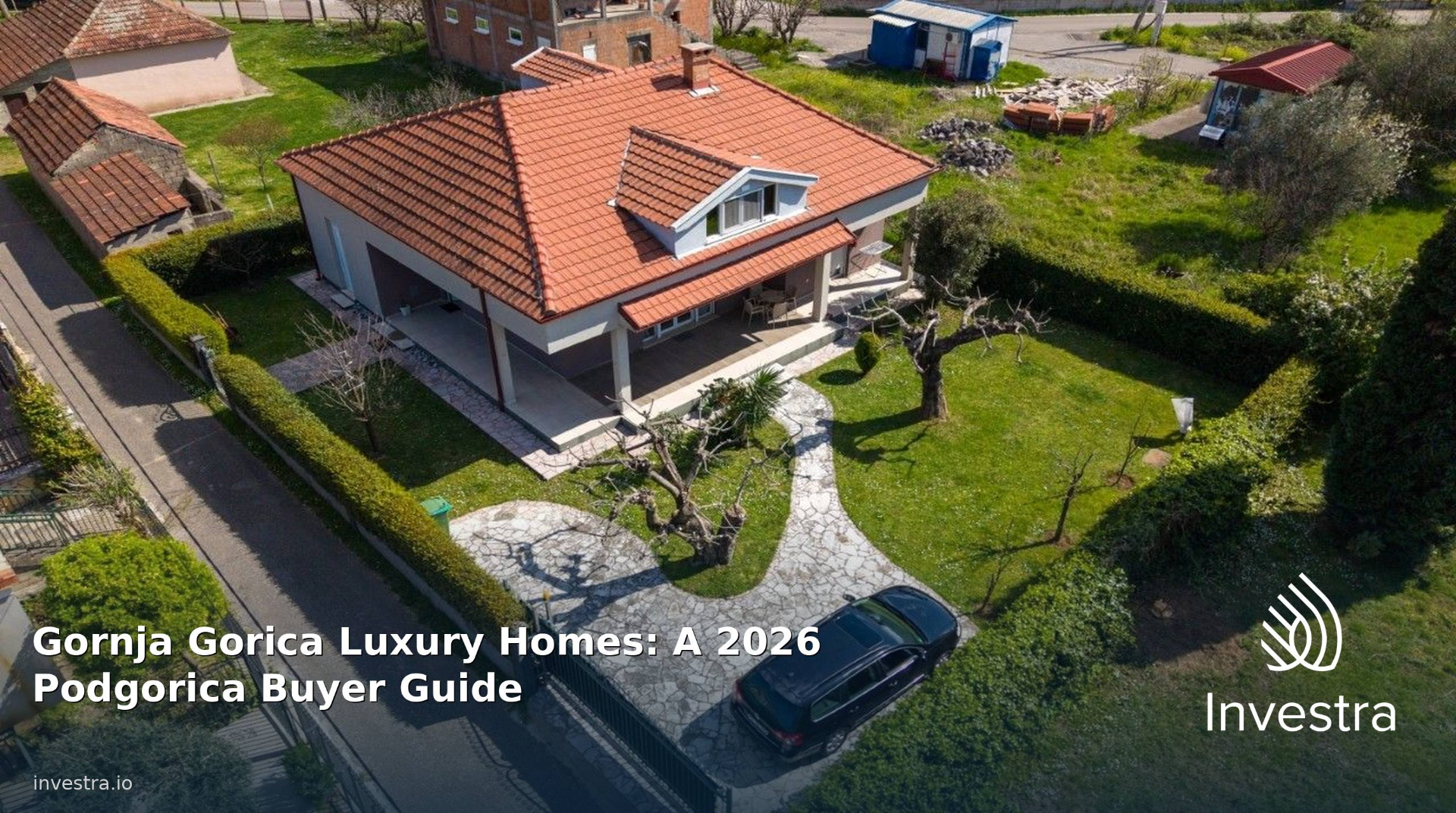
Gornja Gorica Luxury Homes: A 2026 Podgorica Buyer Guide
Gornja Gorica Luxury Homes: A 2026 Podgorica Buyer Guide
Gornja Gorica Luxury Homes: Understanding Podgorica's Premium Residential Quarter
Quick Answer: Gornja Gorica is widely regarded as one of Podgorica's most prestigious residential neighbourhoods, attracting buyers who prioritise space, greenery, and architectural quality in Montenegro's capital. For a broader picture of how this compares to other Adriatic markets, Istria Property Investment 2026: A Decision Framework for Buyers offers a useful comparative lens.
Ask any serious property professional in Podgorica where the city's wealthiest residents prefer to live, and Gornja Gorica comes up almost immediately. Sitting on elevated terrain to the south of the city centre, this neighbourhood has built a reputation over decades as the address of choice for senior professionals, diplomats, business families, and an increasing number of international buyers drawn to Montenegro's evolving real estate story.
What makes Gornja Gorica genuinely distinctive isn't just its elevated position — though the views across Podgorica toward the Dinaric Alps are genuinely striking. It's the combination of mature tree-lined streets, larger plot sizes, villas with private gardens, and a residential character that feels removed from the urban noise of the capital without requiring a long commute to access it. In a city where high-density apartment blocks dominate most districts, Gornja Gorica represents something qualitatively different.
The neighbourhood has evolved steadily. Older Yugoslav-era villas sit alongside newer construction projects built to contemporary standards, and that mix creates both opportunity and complexity for buyers. Understanding what you're actually buying — the condition, the legal history, the planning permissions — matters enormously here. This guide is designed to help you think through that process carefully, without shortcuts.
Why Gornja Gorica Attracts Luxury Buyers in Podgorica
Quick Answer: Gornja Gorica appeals to luxury buyers primarily because of its elevated setting, larger residential plots, lower density, and proximity to prestigious schools and embassies — characteristics that are difficult to find elsewhere in Podgorica's urban fabric.
The appeal isn't abstract. When buyers compare Gornja Gorica to other Podgorica neighbourhoods like Stari Aerodrom, Blok 5, or the newer developments around Delta City, several concrete advantages emerge. The first is physical space. Properties in Gornja Gorica typically sit on larger plots than anything available in central Podgorica, which means private gardens, parking, and a genuine sense of separation between homes — rare luxuries in any Balkan capital.
The second factor is social and institutional infrastructure. Several foreign embassies and diplomatic residences are located in or adjacent to the area. International schools that serve Podgorica's expatriate and business communities are within reasonable distance. These aren't trivial details — for families relocating for work or considering Montenegro residency, proximity to quality education and diplomatic services directly influences neighbourhood desirability.
There's also a security dimension that experienced buyers mention. Gornja Gorica has historically been a low-crime residential area, and the visible presence of diplomatic properties brings with it a certain standard of neighbourhood maintenance that many buyers find reassuring. That said, buyers should always verify current conditions through direct local research rather than assuming historical patterns continue unchanged.
What surprised many buyers entering this market for the first time is that "luxury" in Gornja Gorica doesn't always mean recently built. Some of the most sought-after properties are older villas with generous proportions, established gardens, and character features that simply cannot be replicated in new construction. Knowing how to evaluate these older assets — structurally, legally, and financially — is one of the most important skills a buyer in this neighbourhood needs to develop. The advisory services available through experienced regional investment consultants can be invaluable in bridging that knowledge gap.
Property Types and Architectural Character in Gornja Gorica
Quick Answer: The neighbourhood contains a mix of older detached villas, semi-detached homes, and newer residential projects — buyers should carefully assess construction era, permit history, and current condition before making any commitment.
Walking through Gornja Gorica, you notice immediately that this isn't a neighbourhood of uniform character. The housing stock reflects several distinct periods of Montenegrin and Yugoslav architectural history, and each period comes with its own set of considerations for a buyer.
The oldest properties date from the socialist era and were often built as high-quality residences for government officials and professionals. These villas frequently have generous room heights, thick walls suited to the Montenegrin climate, and substantial plot sizes. Their weakness is often deferred maintenance and outdated electrical, plumbing, and insulation systems. Renovating them can be rewarding but requires substantial investment and careful planning permission management.
Post-independence construction, particularly from the 2000s onward, introduced a wave of newer villas and larger residential homes built to more contemporary standards. Quality is highly variable in this category — Montenegro experienced rapid construction growth during that period, and not all of it was to consistent technical standards. Independent structural surveys are not optional for this property type; they're essential.
More recent developments in and around Gornja Gorica reflect growing demand from international buyers and returning Montenegrin diaspora. These projects tend to offer modern amenities, energy efficiency features, and turnkey conditions, but they also command premium prices that need to be carefully assessed against comparable transactions. For context on how newer builds are evaluated elsewhere in the Adriatic region, the Pula New-Build Homes: A Buyer Due Diligence Guide for 2026 offers a useful framework that translates well across regional markets.
What a Buyer Should Assess When Researching Gornja Gorica Luxury Homes Podgorica
Quick Answer: Buyers should assess title clarity, planning compliance, physical condition, utility connections, neighbourhood development trends, and legal ownership structure — each of these can materially affect both the purchase process and long-term ownership experience.
This is the central question any serious buyer needs to sit with before committing to any property in this neighbourhood. Let's be direct: the Montenegrin property market, while improving significantly in regulatory terms, still carries legacy issues from the transition period following independence in 2006 and the broader Balkan post-socialist land registry normalisation process. Gornja Gorica, being a desirable area, is not immune to these issues.
Title and land registry verification is the non-negotiable starting point. Montenegro's cadastre system has been progressively digitised and improved, but gaps and inconsistencies in historical registrations do exist. A qualified Montenegrin notary and independent legal advisor — not just the agent representing the seller — should verify that the property's ownership chain is clean, that all previous transfers were properly recorded, and that there are no encumbrances, liens, or disputed claims on the property or its plot.
Planning permissions and building legality is the second pillar of assessment. Montenegro passed regularisation legislation aimed at bringing older non-permitted constructions into legal compliance, but the status of any given property under those rules needs individual verification. You want to confirm that the building as it stands today — including any extensions or modifications — either has valid permits or has been regularised under applicable law. Properties with unresolved planning status can create serious problems at the point of resale or when applying for mortgage financing.
Utility infrastructure is a practical consideration that's easy to overlook in the excitement of viewing a beautiful villa. Confirm water supply connections, sewage system type (mains connection versus septic), electricity capacity, and internet access quality. In some areas of Gornja Gorica, older infrastructure hasn't kept pace with the quality of new construction, and upgrading it can be both time-consuming and expensive.
The Istria Property Due Diligence: A Croatian Buyer Checklist is a resource that, while focused on Croatia, covers many of the same structural due diligence principles applicable in any post-Yugoslav property market context, and buyers will find the framework transferable. For tailored regional guidance, Siniša Dagary brings deep experience across the broader Adriatic investment landscape.
The Legal Framework for Buying Property in Montenegro as a Foreign National
Quick Answer: Foreign nationals can legally purchase residential property in Montenegro in most categories, but specific rules apply depending on nationality, property type, and location — professional legal advice is essential before signing any preliminary agreement.
Montenegro's property ownership framework is relatively open by regional standards. Citizens of most countries can purchase apartments and houses. The complications tend to arise with agricultural land, protected areas, and certain categories of properties near national borders or coastlines — categories less likely to be relevant to a Gornja Gorica villa buyer but still worth confirming with a local attorney.
The purchase process in Montenegro typically follows a sequence: an initial letter of intent or reservation agreement, followed by a preliminary purchase contract (predugovor) that typically involves a deposit, followed by the final notarised purchase contract (ugovor o kupoprodaji) through which ownership is transferred. Each stage carries legal implications, and the preliminary contract in particular creates binding obligations on both parties — buyers should never sign it without independent legal review.
Notarisation is mandatory for real estate transactions in Montenegro. The notary plays a formal role in the process and holds a public function, but buyers should understand that the notary's role is procedural rather than advisory — they verify the transaction meets formal requirements, not that the deal is in the buyer's best interest. Your own legal representative serves that function.
The process of registering ownership in the land registry (katastar) following completion should not be delayed. Until registration is complete, the transfer isn't fully protected against subsequent claims. A reliable local attorney will manage this process, but buyers should actively confirm it has been completed. For a comparative look at how the buying process works elsewhere in the Adriatic region, How to Buy Property in Istria as a Foreign Buyer in 2026 provides a thorough walkthrough that highlights where processes converge and diverge.
Property Taxes and Purchase Costs in Montenegro
Quick Answer: Buying property in Montenegro involves transfer taxes, notary fees, agent commissions, and annual property taxes — buyers should request a full cost breakdown from their legal advisor before making any financial commitment, as rates and exemptions can change.
One area where buyers consistently underestimate their total acquisition cost is transaction fees and taxes. The headline purchase price is only part of the picture, and in Montenegro, as in most European markets, the gap between contract price and total out-of-pocket cost can be meaningful.
Montenegro charges real estate transfer tax on property transactions. The applicable rate and any exemptions — for example, for first-time buyers or new construction — should be verified with a local tax advisor or attorney, as the tax code is subject to legislative updates. Do not rely on figures quoted by selling agents or on information from previous transactions, as conditions change.
Notary fees are regulated and are generally calculated as a percentage of the transaction value, with tiered rates applying at different value thresholds. These are typically relatively modest in absolute terms but should still be included in your budget calculations. Legal advisor fees, real estate agent commissions, and potential translation or apostille costs for foreign documents add further to the total.
Annual property tax in Montenegro exists but has historically been low compared to Western European standards. The assessment basis, rate structure, and any local municipality variations should be confirmed for the specific property. For a sense of how purchase cost structures compare elsewhere in the Adriatic, Property Taxes and Purchase Costs in Istria: What Buyers Should... and Istria Property Ownership Costs: A Practical Budgeting Guide provide useful reference frameworks.
Rental Market Considerations for Gornja Gorica Properties
Quick Answer: The rental market for luxury properties in Gornja Gorica is driven primarily by long-term corporate and diplomatic tenants rather than short-term tourism demand — buyers targeting rental income should research current tenant demand and vacancy rates locally before making assumptions about returns.
The rental dynamics in Gornja Gorica differ fundamentally from coastal Montenegro markets like Budva or Kotor, and also from short-term tourist rental markets. Podgorica is Montenegro's administrative and business capital, and the demand for quality residential rental properties is driven primarily by the corporate relocation market — multinational company employees, diplomats, international organisation staff, and senior professionals.
This tenant profile has characteristics that many investors find attractive: typically longer tenancy durations, higher income stability, and a lower likelihood of property misuse compared to high-rotation tourist rentals. Corporate tenants also tend to have less price sensitivity for genuinely well-maintained, well-located properties. The reality is, though, that this market is narrower in absolute volume terms than tourist coastal rental markets, which means vacancy periods during tenant transitions can be longer.
Buyers considering purchasing in Gornja Gorica with a rental income objective should research actual current rental demand through conversations with established local property management companies, not just through seller-provided projections. Ask for data on current occupancy rates for comparable properties, average lease terms, and the typical time required to secure a new tenant between leases. We've seen buyers make this step optional and then face unexpected holding costs.
For a comparative perspective on how rental investment decisions should be structured, Pula Rental Investment Guide 2026: Long-Term Letting Buyer Questions covers the analytical framework well, and many of its questions apply directly to long-term letting scenarios in Podgorica. The Siniša Dagary investment insights blog also covers Adriatic rental market dynamics with practical depth.
Montenegro's Broader Investment Context: EU Accession and Market Trajectory
Quick Answer: Montenegro's ongoing EU accession process is a significant background factor for property investors — successful accession would materially affect the legal and economic environment, but the timeline remains uncertain and should not be treated as a guaranteed near-term outcome.
You can't think seriously about investing in Montenegro real estate without considering the EU accession context. Montenegro formally opened accession negotiations with the European Union in 2012 and remains the most advanced Western Balkan country in the process. This matters for property investors in several ways, though it's important to frame expectations carefully.
The prospect of EU membership creates a particular investor narrative: that as Montenegro's institutional framework converges toward EU standards, property values and market transparency will improve, potentially creating capital appreciation opportunities for early entrants. This narrative has attracted attention from investors across Europe and beyond. The caution worth applying is that EU accession processes are complex, politically contingent, and historically slower than initial projections suggest. Building an investment case on a specific accession timeline is a significant risk factor.
For buyers who want to understand how a more mature EU property market operates as a reference point, reviewing resources like the Rovinj Real Estate Market 2026: Buyer Priorities and Location Choices guide or the Umag Real Estate Market 2026: Property Types, Areas and Buyer Checks overview provides useful comparative context. The Findes Group & Partners team has direct experience working across this regional investment spectrum.
Selecting the Right Professional Team for a Gornja Gorica Purchase
Quick Answer: Buyers in Gornja Gorica should assemble a team including an independent Montenegrin attorney, a licensed local real estate agent, a structural surveyor, and ideally an investment advisor familiar with the regional market — each role is distinct and no single professional should fill all of them.
An investment or market advisor — someone with genuine knowledge of Podgorica's residential market dynamics — can help you assess whether the asking price reflects current comparable transactions and whether the property's characteristics align with your investment objectives. The Siniša Dagary profile is worth reviewing for this type of regionally informed advisory perspective, and the Findes Group & Partners advisory team can provide additional support for buyers approaching this market from an international starting point.
Neighbourhood Comparisons: How Gornja Gorica Fits Within Podgorica's Residential Map
Quick Answer: Gornja Gorica occupies a distinct position at the top of Podgorica's residential hierarchy — buyers should compare it against other premium areas like Zabjelo, Konik, and the newer residential developments on the city's periphery to understand what they're actually paying a premium for.
Buyers comparing Podgorica residential neighbourhoods will find it useful to read parallel analyses from other Adriatic cities — understanding how Best Neighbourhoods in Pula for Property Buyers in 2026 and Rovinj Old Town or Newer Areas: A Property Buyer Location Guide approach the same neighbourhood selection question helps build analytical frameworks that work across markets.
Practical Ownership Considerations After Purchase
Quick Answer: Ongoing ownership of a luxury property in Gornja Gorica involves property management, tax compliance, utility management, and potentially rental administration — buyers should plan for these operational requirements before purchase, not after.
Tax compliance as a non-resident property owner requires understanding Montenegro's income tax treatment of rental income, any applicable withholding tax on payments made to non-residents, and the obligations around annual property tax declaration. Tax rules evolve, and what was accurate at the time of purchase may not reflect current law. Engaging a Montenegrin tax accountant — separate from your purchase attorney — is a sound approach for ongoing compliance. For a sense of how ongoing ownership costs are structured across Adriatic markets, Istria Property Ownership Costs: A Practical Budgeting Guide provides a thorough treatment of the categories involved. For personalised consultation on the investment strategy around your purchase, reaching out for an investment consultation is a sensible early step.
Making the Decision: Is Gornja Gorica Right for Your 2026 Objectives?
Quick Answer: Gornja Gorica suits buyers prioritising residential quality, lifestyle, and long-term capital positioning in Montenegro'sExplore more on Investra: Pula Real Estate Market 2026: Areas, Buyer Demand and Due Diligence | Poreč Real Estate Market 2026: A Practical Guide for Property Buyers | Buying Property in Pula: Legal Checks Before You Commit | Rovinj Holiday Rental Investment: Buyer Due Diligence for 2026 | Istria Property FAQ 2026: Clear Answers for International Buyers
Investment Disclaimer
The information provided in this article is for educational and informational purposes only and should not be construed as financial, legal, or investment advice. Real estate investments carry inherent risks, and past performance does not guarantee future results. Investors should not invest money they cannot afford to lose. Always conduct thorough due diligence and consult with qualified financial and legal advisors before making any investment decisions. Investra.io does not guarantee returns on any investment.
Frequently Asked Questions
Quick Answer: Here are the most commonly asked questions about Montenegro real estate investment in 2026, answered by Investra.io experts.Is Montenegro a good country for real estate investment in 2026?
Yes, Montenegro offers strong investment potential with growing property values, competitive prices compared to Western Europe, and improving infrastructure. Investra.io provides comprehensive market data and investment guidance.
Can foreigners buy property in Montenegro?
EU citizens can buy property freely in Montenegro. Non-EU citizens may need to meet specific requirements. Investra.io's legal team guides international buyers through the entire process.
What is the average property price in Podgorica?
Property prices in Podgorica vary significantly by location and property type. Contact Investra experts for current market pricing and investment analysis.
What rental yields can I expect?
Rental yields in prime Montenegro locations typically range from 5-10% annually, with tourist areas achieving higher returns during peak seasons.
What taxes apply to property purchases?
Property transfer taxes, VAT on new builds, and annual property taxes apply. Rates vary by property type and location. Consult Siniša Dagary for tax optimization strategies.
How long does the purchase process take?
Typically 30-60 days from offer to completion. Working with Investra.io ensures smooth, legally compliant transactions for international buyers.
What financing options are available?
Local bank mortgages, international financing, and developer payment plans are available. Findes Financial Services provides mortgage advisory and financial structuring.
Is property management available for rental properties?
Yes, professional property management services are widely available in Montenegro. Investra.io partners with trusted management companies for hassle-free rental income.
What are the best areas to invest in Podgorica?
Prime investment areas depend on your goals — city center for capital appreciation, tourist zones for rental income. Investra.io's market analysis identifies the best opportunities.
Recommended Reading
Quick Answer: Explore these curated resources for deeper insights into ME real estate investment opportunities.
- Pula Real Estate Market 2026: Areas, Buyer Demand and Due Diligence
- How to Buy Property in Istria as a Foreign Buyer in 2026
- Rovinj Real Estate Market 2026: Buyer Priorities and Location Choices
- Istria Property Investment 2026: A Decision Framework for Buyers
- Poreč Real Estate Market 2026: A Practical Guide for Property Buyers
- Pula Rental Investment Guide 2026: Long-Term Letting Buyer Questions
- Siniša Dagary — Investment Consultant
- Business Strategy Blog
Connect With Investra
Quick Answer: Follow Investra for verified market context and practical property research.
Related Posts
No related posts available.
