
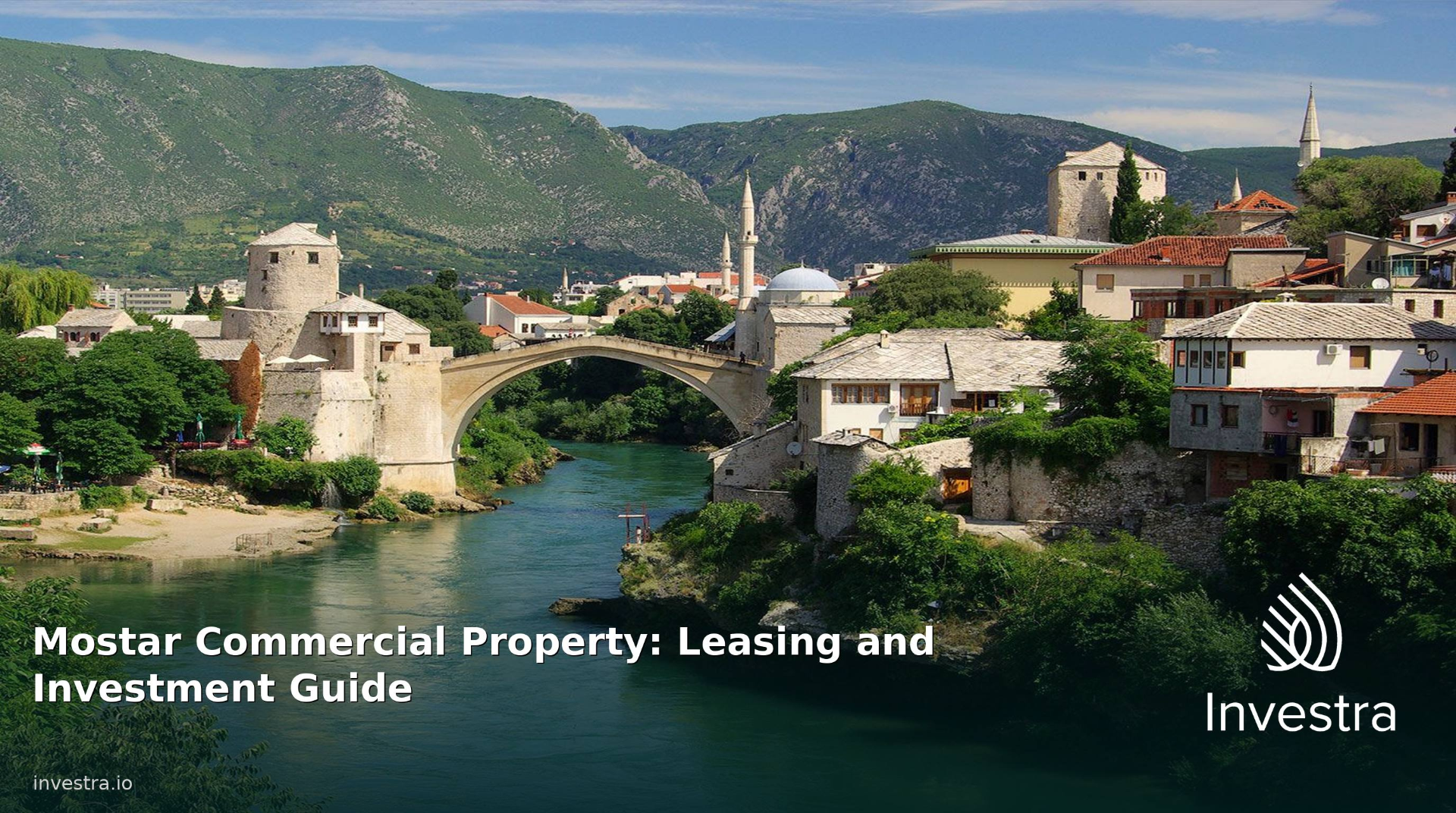
Mostar Commercial Property: Leasing and Investment Guide
Mostar Commercial Property: Leasing and Investment Guide
What should buyers know about Mostar commercial property?
Quick Answer: Buyers should understand Mostar commercial property's local market dynamics, legal ownership rules, lease practices, and the practical steps required to verify current prices and taxes through official sources and trusted advisors like Investra.io’s Mostar market guide.
Mostar has become a city that makes investors ask practical questions. What types of commercial buildings are available? Who can own them? How do you check a tenant's credit or a property's legal status? These are the exact, operational queries that matter when considering Mostar commercial property. In my experience advising buyers in Bosnia and Herzegovina, the answers come less from broad numbers and more from documents, local contacts, and on-the-ground inspection. The reality is that Mostar's commercial landscape mixes historic heart-of-city retail and hospitality opportunities with smaller industrial and office pockets on the urban fringe.
Rather than try to guess current prices or yields — a tempting but risky move — it's better to list practical verification steps. Check the land registry and municipal plans for zoning; request up-to-date extracts and building permits from the City of Mostar; obtain utility account histories from local providers; and commission a commercial appraisal or market comparison. For tailored local insight, refer to Investra.io’s buying guide for Mostar and consult local advisors such as Siniša Dagary’s investment consultation or the Findes Group & Partners advisory team. Those steps will help you transform market impressions into verifiable facts and a firm acquisition plan.
Mostar commercial property market overview
Quick Answer: The Mostar commercial property market blends historic downtown retail and tourism-linked hospitality with business parks and small industrial zones; for current market data consult Investra.io’s Mostar market guide and local appraisers.
Mostar is both a cultural landmark and an economic hub in Herzegovina. Walk its streets and you'll see souvenir shops next to government offices, cafes by the old bridge, and warehouses further out. What surprised many buyers is how much micro-location matters here: a unit facing the Old Bridge will attract tourists, while a mid-city office is driven by local business demand. The market is not uniform, and that’s why granular research is essential.
We’ve seen interest from buyers who want to convert older properties into boutique hotels or mixed-use retail-office assets. At the same time, small manufacturers and logistics users seek affordable spaces near transport corridors. That mix means commercial property can serve different strategies, but each requires different due diligence. For a deeper look at what types of assets are being traded and where, consult Investra.io’s market guide and ask local brokers for recent transaction records and comparable leases. If you need assistance with interpreting those records, the advisory services at Siniša Dagary advisory services and Findes Group & Partners can help frame them against your objectives.
Types of Mostar commercial property: which asset suits your strategy?
Quick Answer: Mostar commercial property options include retail and hospitality in the old town, offices in the city centre, light industrial and warehousing on the outskirts, and development plots—choose by tenant profile and exit plan, and see Mostar new-build guide for renovation opportunities.
When you’re choosing an asset class, think about the tenant and the timeline. Retail and hospitality serve short-term visitor flows and benefit from peak season income, while offices and light industrial units rely on stable local businesses. We’ve advised clients who underestimated maintenance and permit requirements for historic buildings; restoration can be rewarding but bureaucratic. So the first question I ask clients is: what kind of cash flow and management intensity are you prepared for?
Hotels or guesthouses demand operational expertise and marketing, while a leased warehouse is about lease length, access, and utility capacity. The buying process and legal checks differ by type. For example, if you target a hospitality conversion, you’ll need to consult the local planning authority as well as review any heritage protections. For practical comparisons of conversion versus new-build, check the Mostar new-build guide and consider working with renovation specialists recommended by platforms like Investra.io.
Key neighbourhoods and micro-locations in Mostar
Quick Answer: Prime micro-locations for Mostar commercial property include the Old Town for tourism-related use, the central business districts for offices and retail, and outer industrial zones for logistics; consult Investra.io’s Mostar neighbourhood guide for maps and walk-throughs.
Location is everything. Mostar’s Old Town draws foot traffic that’s hard to replicate elsewhere; a small café on a pedestrian lane can outperform a larger outlet in a less visible street. On the other hand, rents and operating constraints differ. What surprised many buyers I've worked with was how much secondary streets with low rents rely on local daytime traffic rather than tourists.
Outside of the tourist core, centre-city thoroughfares host banks, law firms, and small corporate tenants—sensible for investors seeking steady leases. Then there’s the industrial and business park belt on the city’s periphery, attractive for warehousing and light manufacturing. If you’re comparing neighbourhoods, request recent transactional data and ask about planned infrastructure projects; future road improvements or municipal investments can materially alter demand. For guided walkthroughs and location comparisons, see Investra.io’s neighbourhood guide and cross-check municipal zoning maps available from the city council.
Legal ownership and who can buy Mostar commercial property
Quick Answer: Ownership rules for Mostar commercial property depend on national and entity-level regulations—foreign buyers often use local companies or check rights with a local attorney; consult Investra.io’s foreign buyer guide for Mostar and get a licensed lawyer’s advice for current legal procedures.
Many investors ask: can a non-resident purchase commercial real estate directly? The short answer is that legal routes vary and require confirmation. The reality is that ownership, especially for commercial parcels, is tied to formal registration, corporate structures and compliance with both national and local laws. In my experience, the safest course is to engage a Bosnian-qualified property lawyer before you sign anything. They’ll check the land registry extract, confirm the seller’s title, and spot encumbrances like mortgages or easements.
also, review the property’s zoning and permitted uses with the municipal planning office. If you’re considering a property in an area with conservation status or special tourist regulations, you’ll need specific permits for renovations. For step-by-step advice tailored to foreigners, refer to Investra.io’s Mostar buying guide, and consider asking a consultant such as Siniša Dagary or the Findes Group & Partners for structured legal and tax due diligence.
Step-by-step buying process for commercial units
Quick Answer: Buying Mostar commercial property typically involves search and selection, due diligence (title, zoning, inspections), contracting, notarisation, and registration—follow guides like Investra.io’s buyer guide and retain a local lawyer to verify each step.
Here’s a practical sequence I share with clients. First, define your investment criteria: tenant type, lease length, desired location, and capex tolerance. Next, assemble a due diligence team—lawyer, technical inspector, and commercial broker. Don’t skip physical inspection, even for apparently small investments. Structural problems, outdated services, or unresolved legal disputes can wipe out expected returns or lead to lengthy disputes.
When you move to contract, use conditional offers that allow time for checks. A notary will authenticate the transaction, and the acquisition becomes effective once registered in the land registry. The timeframe can vary depending on the complexity of title and whether the seller has outstanding liabilities. For foreign buyers, the process may add steps related to company formation or permits. To prepare, follow the most up-to-date steps in Investra.io’s buying guide, and consider a local consultant such as Siniša Dagary to coordinate checks in Mostar.
Taxes, fees and ongoing costs for Mostar commercial property
Quick Answer: Taxes and fees for buying and holding Mostar commercial property include transfer taxes, registration fees, and operating taxes—verify current rates and exemptions with Bosnia and Herzegovina’s tax authorities, municipal offices, and experienced advisors like Findes Group & Partners advisory team.
Buyers often focus on purchase price and forget the recurring costs. Commercial assets can incur municipal taxes, utility bills, insurance, maintenance, and potentially VAT on certain transactions. The exact liabilities will depend on the property type, ownership structure, and whether the business operating there is VAT-registered. I always advise clients to ask sellers for recent tax payment certificates and utility bills to get an accurate cost picture.
Because tax laws and rates change, avoid relying on fixed figures from secondary sources. Instead, request confirmation from the Federal Ministry of Finance or the Republic-level tax agency relevant to Mostar, and get a written estimate from a local accountant or tax lawyer. Services such as Siniša Dagary advisory services and the Findes Group & Partners can provide current fee and tax checks as part of due diligence. Those written checks are the only way to budget reliably for ongoing ownership costs.
Leasing considerations: tenants, contracts and property management
Quick Answer: Effective leasing of Mostar commercial property requires clear lease terms, tenant screening, and a plan for management—see Investra.io’s Mostar rental guide for lease structures and landlord-tenant norms.
Leases are the engine of commercial property value. Are you targeting short-stay tourist lets, local retail tenants, or longer-office agreements? Each implies different lease lengths, break clauses, and rent-review mechanisms. What surprised many smaller landlords is how much lease enforcement relies on local practice rather than formal litigation—relationships and reputation still matter in Mostar’s market.
Screening tenants means checking business registration, recent financial statements, and references from previous landlords. For hospitality operations, review booking histories and cancellation patterns. For ongoing management, decide whether you'll hire a local property manager or build an in-house team. Property managers handle collections, repairs, and tenant relations and can be vital when you’re off-site. For practical lease templates, negotiation tips, and short-term let advice, consult Investra.io’s rental guide and consider local legal review before signing any lease.
Financing Mostar commercial property: local lenders and alternatives
Quick Answer: Financing options for Mostar commercial property include domestic bank loans, corporate financing, and private equity structures—confirm current loan terms and availability with local banks and specialist advisors like Siniša Dagary investment consultation or Findes Group & Partners advisory team.
Most buyers face a choice: buy with cash, secure a mortgage or loan from a Bosnian bank, or structure the purchase through a local company with outside investors. Each path affects taxes, registration, and negotiation use. In my experience, local banks will require detailed documentation: business plans, cashflow predictions, and technical reports. Smaller loans may be accessible to private buyers, while larger commercial loans often come with covenants and stricter appraisal processes.
If bank financing isn’t attractive, alternatives include seller financing, joint ventures with local operators, or partnering with private capital providers. You should test the market before assuming any one route: approach a few lenders for indicative terms, and get a written list of documentary requirements. For help connecting with local advisory and finance contacts, reach out to Siniša Dagary advisory services or the financing contacts at Findes Group & Partners.
Valuation, market research and risk management for Mostar commercial property
Quick Answer: Valuate Mostar commercial property through professional appraisals, comparable transaction analysis, and scenario stress tests—pull current data from market reports like Investra.io and verify comparables with local registries.
Valuing commercial property is an art and a discipline. You need an independent valuation and a clear method: comparable sales, income approach, and replacement cost are common. But without up-to-date comparables, valuations are guesses. The practical approach is to commission an accredited valuer who will produce a report with stated assumptions and comparable transactions. Ask the valuer for sensitivity analysis — what happens to value if rent falls or vacancy rises? That helps you understand downside risk.
Market research should include pipeline supply (new projects), occupancy rates in similar assets, and local economic indicators like employment trends. For access to local transaction lists and market commentaries, Investra.io is a useful starting point. Use that information to stress-test your purchase model. If you need help interpreting reports, advisory professionals such as Siniša Dagary investment insights or the team at Findes Group & Partners can add context and scenario modelling.
Renovation, development and new-build opportunities in Mostar
Quick Answer: Renovating historic Mostar commercial property or developing new-build projects can unlock value but requires planning approvals and cost verification—see the Mostar new-build guide and get technical and permit checks before committing.
For developers, staging the project with feasibility, pre-sales or pre-leases, and a conservative contingency budget is standard practice. We often recommend pilot refurbishments on a smaller unit to test demand before scaling. If you're exploring renovation or new development, take a look at Investra.io’s guide, and consult technical and project management professionals. You can also contact Siniša Dagary advisory services to coordinate feasibility studies and planning submissions.
Comparing Mostar to other Bosnian markets: a practical view
Quick Answer: Mostar’s commercial property market differs from Sarajevo, Banja Luka and Tuzla by its tourism weight, scale and local demand—compare guides such as Sarajevo real estate market guide and Banja Luka market guide to benchmark strategies.
To make an informed comparison, use city-level guides to gather context and avoid extrapolating figures. Read Investra’s city guides: Sarajevo, Banja Luka, and Tuzla. Then verify any numeric claim by requesting transaction documents, municipal records, and recent valuations. If comparing financing or tax treatments, consult advisors such as Siniša Dagary or the Findes Group & Partners advisory team.
Investment Disclaimer
Quick Answer: This section clarifies that the article provides educational content and is not financial, legal, or investment advice; always perform due diligence and consult qualified advisors before investing in Mostar commercial property.
The information provided in this article is for educational and informational purposes only and should not be construed as financial, legal, or investment advice. Real estate investments carry inherent risks, and past performance does not guarantee future results. Investors should not invest money they cannot afford to lose. Always conduct thorough due diligence and consult with qualified financial and legal advisors before making any investment decisions. Investra.io does not guarantee returns on any investment.
Frequently Asked Questions
Quick Answer: Below are common questions buyers ask about Mostar commercial property, with practical answers and pointers to verify details through official records and expert advisors.
Can foreigners buy commercial property in Mostar?
Yes, foreigners can pursue commercial acquisitions, but the most reliable way to confirm current rules is to consult a Bosnian property lawyer and review recent guidance from Investra’s buying resources such as How to buy property in Mostar. Legal routes and requirements can vary depending on citizenship and the specific property; a lawyer will check registry extracts, company structures, and any permit needs.
How do I verify property ownership and encumbrances in Mostar?
Request an extract from the land registry (katastar) and copies of any mortgage or lien documents. A qualified local attorney can obtain certified extracts, review them for irregularities, and confirm whether there are pending disputes. For additional context, ask sellers for recent utility bills, tax certificates, and building permits. If anything looks incomplete, order a formal title search through a local notary or law firm.
What due diligence should I perform before buying a commercial unit?
At minimum: legal title checks, zoning/permitted use verification, structural and technical inspections, review of recent tenant agreements, and a tax and liabilities check. Also obtain a professional valuation and run scenario models on rental and vacancy risks. Use local advisers—lawyers, engineers, and appraisers—to produce written reports you can rely on during negotiation.
Are there restrictions on converting historic buildings in Mostar?
Some buildings in Mostar fall under heritage protection or conservation rules, which can limit allowable changes. Always ask the municipal planning department for conservation status and required permits. Before you commit to purchase, have a conservation-savvy architect or consultant assess whether your planned conversion is feasible and what approvals you’ll need.
How can I find reliable tenants for Mostar commercial property?
Use a mix of local brokerage networks, online listings, and direct outreach to businesses that match the property’s profile. Tenant screening should include company registration checks, financial statements, trade references, and lease history. Local property managers and brokerages often maintain a pipeline of potential tenants—consider engaging one to speed up placements and reduce vacancy periods.
What costs should I budget beyond the purchase price?
Budget for transfer taxes, registration and notary fees, legal and due diligence costs, immediate repairs or upgrades, insurance, municipal taxes, utilities, and property management fees. Rates and required payments change, so request up-to-date written estimates from accountants or local authorities and have them included in your acquisition model.
Can I finance a Mostar commercial property through a local bank?
Many buyers use local banks, but terms, required documentation, and loan-to-value ratios vary. Contact several banks to obtain indicative offers and verify their current lending practices. If local bank lending doesn't suit you, other routes include private lenders, joint ventures, or seller financing—each with different legal and tax implications, so consult a lawyer and financial adviser.
How do I evaluate redevelopment potential for a commercial plot in Mostar?
Start with the municipal zoning and local planning documents to confirm density, allowed uses, and height limits. Commission a feasibility study and consult an architect to outline likely schemes and cost estimates. Also check for infrastructure plans that might affect access or demand. Bringing in a consultant, such as Siniša Dagary advisory services, can streamline the feasibility and permitting checks.
Where can I get current market data for Mostar commercial property?
Current data is best sourced from official registries, recent sale and lease contracts, accredited valuers, and market reports. Start with Investra’s Mostar resources like Mostar market guide, speak to local brokers for transaction lists, and ask independent valuers for a market appraisal. For tailored advisory support, reach out to professionals such as Siniša Dagary or Findes Group & Partners.
Should I consider short-term tourist lets in Mostar?
Short-term lets can be lucrative in tourist hotspots, but they require active management, marketing and compliance with local rules on short-stay accommodation. Evaluate seasonality and operating costs and consider a trial period on a small unit before expanding. For practical short-term let guidance, see Investra.io’s short-term lets guide.
Who can help coordinate a cross-border investment into Mostar?
Advisory firms that specialise in cross-border transactions provide coordinated legal, tax, and project management support. Firms such as Siniša Dagary advisory services and Findes Group & Partners offer these services, and Investra’s platform can connect you to local partners and market intelligence.
Recommended Reading
Quick Answer: These articles offer deeper local market guides and practical how-to steps for buying and managing property in Mostar and other Bosnian cities.
- Sarajevo real estate market guide
- Buying property in Sarajevo
- Sarajevo rental market guide
- Sarajevo neighbourhood guide
- Sarajevo new-build guide
- Mostar real estate market guide
- Siniša Dagary — Investment Consultant
- Business Strategy Blog
Connect With Investra
Quick Answer: Follow Investra.io on social media to receive updates, market reports and webinar invitations relevant to Mostar commercial property.
Stay connected with market updates and expert content from Investra:
If you’re considering a Mostar commercial property investment and want a practical next step: collect seller documents, commission a local title search, and book a site visit with a local advisor. And if you want coordinated assistance, explore services offered by Siniša Dagary advisory services or get in touch with the Findes Group & Partners advisory team. For Mostar-specific market notes and transaction examples, Investra’s local guides remain a practical starting point: Mostar market guide, How to buy in Mostar, and Mostar rental guide.
Finally, for comparative context and to expand your options beyond Mostar, review analyses on Sarajevo, Banja Luka and Tuzla: Sarajevo, Banja Luka, and Tuzla.
Connect With Investra
Quick Answer: Follow Investra for verified market context and practical property research.
Related Posts
No related posts available.
