
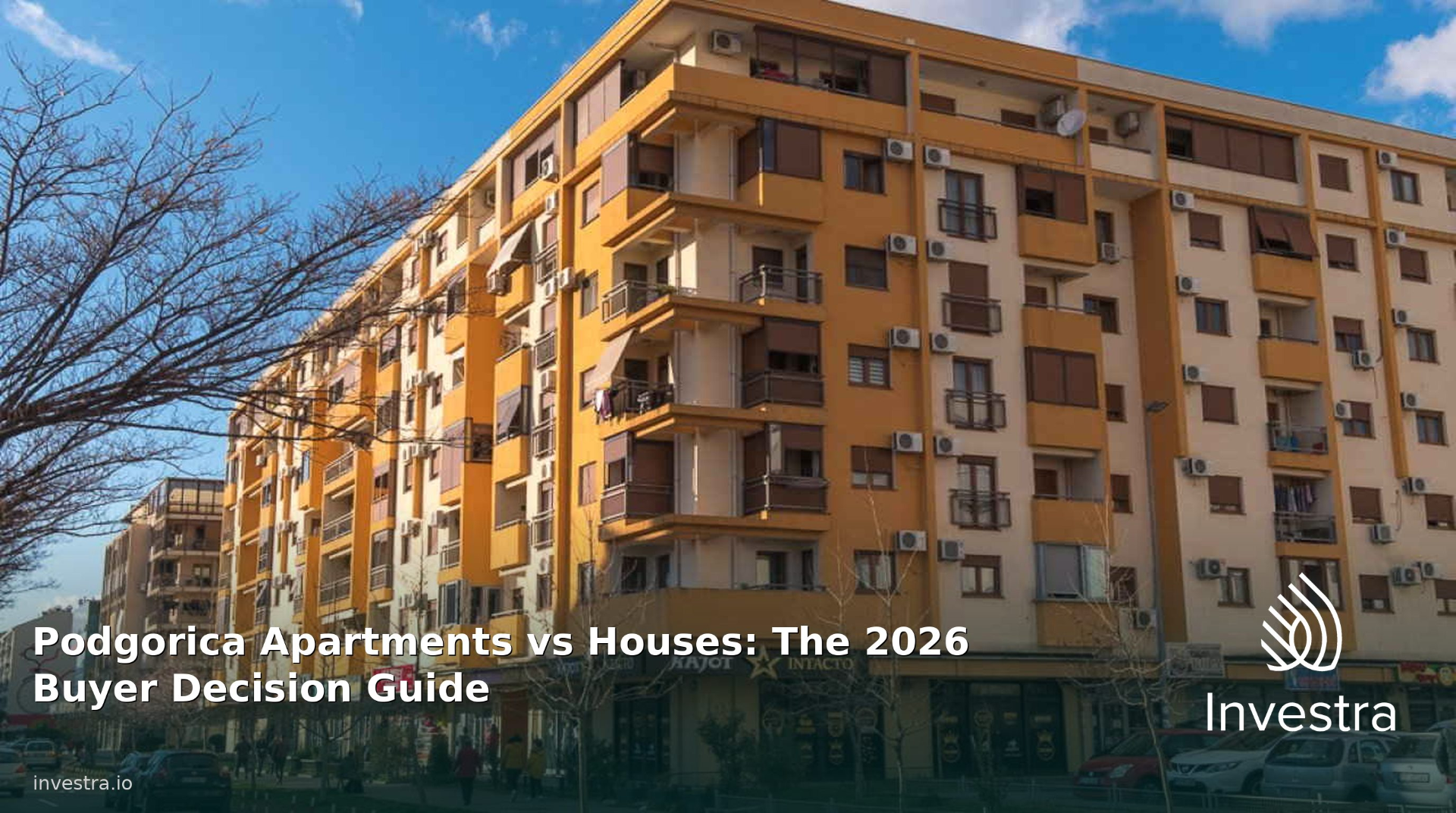
Podgorica Apartments vs Houses: The 2026 Buyer Decision Guide
Podgorica Apartments vs Houses: The 2026 Buyer Decision Guide
Podgorica Apartments vs Houses: Understanding the 2026 Buyer Context
Quick Answer: The decision between Podgorica apartments vs houses in 2026 depends on budget, intended use, neighbourhood priorities, and long-term ownership goals — there's no universal right answer, but there is a structured way to evaluate both options. For broader Adriatic market context, Istria Property Investment 2026: A Decision Framework for Buyers offers a useful parallel methodology.
Podgorica doesn't get the same glossy magazine coverage as Kotor or Budva, but that's precisely why serious buyers keep showing up here. It's a functioning capital city with real infrastructure, real demand, and a real residential market that operates independently of the coastal tourism cycle. And yet, walking into a Podgorica property search for the first time, many buyers hit an immediate fork in the road: do you buy an apartment in a modern residential block, or do you look for a standalone house in one of the city's expanding suburban zones?
The honest answer is that neither option is objectively superior. What matters is the fit between the property type and your specific ownership situation — whether that's a primary residence, a rental investment, a second home, or a long-term hold. What we've seen consistently is that buyers who skip this framing exercise early on end up revisiting the decision after they've already lost time and sometimes money on the wrong type of asset.
This guide is designed to help you think through that decision properly. We'll examine Podgorica's main residential neighbourhoods, break down what distinguishes apartments from houses at the practical level, walk through the legal and tax landscape as it currently applies in Montenegro, and give you a clear framework for due diligence regardless of which direction you go. The goal isn't to advocate for one property type — it's to make sure you're asking the right questions before you commit.
Montenegro's broader economic trajectory, its EU accession process, and ongoing infrastructure investment all factor into this conversation. Buyers researching Siniša Dagary investment insights on Balkan emerging markets will recognise that Podgorica sits at an interesting inflection point — growing fast enough to reward early movers, but not so overheated that fundamentals no longer matter.
How Podgorica's Residential Market Divides Itself
Quick Answer: Podgorica's residential market splits broadly into a dense urban core with apartment-dominated supply, and expanding suburban and peri-urban zones where houses are more common — understanding this geography is the first step in the apartments vs houses decision.
Before you can meaningfully compare property types, you need a mental map of how Podgorica actually organises itself spatially. The city centre and its immediate surrounds — areas like Stara Varoš, Nova Varoš, and the newer commercial-residential zones near the Morača river — are overwhelmingly apartment territory. The building stock here ranges from older Yugoslav-era blocks to contemporary new-build developments, and land scarcity means that standalone houses at this location are genuinely rare and, when they do appear, priced accordingly.
Move outward and the picture changes. Neighbourhoods like Zabjelo, Konik, and the areas stretching toward the ring roads increasingly feature a mix of older family houses on parcelled land, as well as newer villa-style constructions on the outskirts. Then there are zones like Tološi, Zlatica, and parts of the Stambena Zajednica areas where suburban residential development has accelerated significantly over the past decade, driven partly by families seeking more space and partly by buyers who found central apartment prices had risen beyond their comfort level.
What this geography means practically is that the apartments vs houses question is inseparable from the location question. Choosing a house almost always means accepting a trade-off in centrality — you're typically further from the main commercial arteries, the university district, the major healthcare facilities, and the city's modest but growing restaurant and cultural scene. Choosing an apartment in a central or semi-central location means accepting the constraints of collective ownership in a multi-unit building. Neither of these is a dealbreaker; they're just variables that need to be explicit in your decision.
Buyers interested in understanding how neighbourhood location shapes value elsewhere in the Western Balkans region should read the Best Neighbourhoods in Pula for Property Buyers in 2026 analysis — the methodology of evaluating urban vs peripheral zones translates well across markets.
What Buyers Actually Get With a Podgorica Apartment
Quick Answer: A Podgorica apartment offers lower entry costs, easier maintenance management, and stronger urban access — but buyers must carefully review the building's legal status, shared costs, and construction quality before committing.
Apartments in Podgorica come in a wider range than many first-time visitors expect. There's a significant legacy stock of socialist-era construction — concrete blocks built between the 1960s and 1980s that are structurally solid but often energy-inefficient and in variable states of maintenance. Then there's a wave of mid-2000s construction that's more mixed in quality, followed by genuinely contemporary new-build developments from the past several years that meet closer to current European building standards.
The practical advantages of apartment ownership in Podgorica's context are real. Maintenance responsibilities are shared. Entry-level investment thresholds are generally lower than for comparable houses. Urban locations mean walkability, proximity to schools, and access to the city's growing employment base. For rental purposes, apartments in well-located buildings attract a broader tenant pool — professionals, students, government workers, and international organisation staff all tend to gravitate toward apartments.
But buyers should be clear-eyed about the downsides. Shared building costs — for lift maintenance, facade repairs, roof works, communal utility contracts — can be significant, and in Montenegro the legal framework governing condominium associations (stambene zajednice) is still maturing. In many older buildings, these obligations are informal or poorly enforced, which means a building can look perfectly habitable while carrying deferred maintenance liabilities that will eventually land on owners. Verify the status of the building's communal management before you buy, not after.
Construction quality verification is equally important. New-build apartments carry risks around developer completion, title registration timelines, and warranty enforcement that require specific legal due diligence. The approach outlined in Pula New-Build Homes: A Buyer Due Diligence Guide for 2026 provides a transferable checklist framework for buyers approaching off-plan or recently completed apartments in any emerging market context, including Podgorica.
What Buyers Actually Get With a Podgorica House
Quick Answer: A Podgorica house offers independence, space, and land ownership — but comes with higher entry costs, more complex legal title checks, and full personal responsibility for all maintenance and running costs.
The appeal of a standalone house in Podgorica is intuitive: you own the land, you control the structure, and you're not sharing walls, stairwells, or decisions with other owners. For families, for buyers who intend to stay long-term, and for those who want to adapt or extend the property over time, a house offers a flexibility that apartments simply can't match.
The reality is more nuanced, though. House purchases in Montenegro require a substantially more thorough title examination than apartment purchases — and that's already a high bar. Land ownership in Montenegro carries historical complexity. Cadastral records (the official land register) and urban planning documentation must align cleanly with the actual physical property. In some suburban and peri-urban zones of Podgorica, houses were built during periods of looser planning enforcement, meaning structures may exist without full legalization or may have extensions that aren't reflected in official records. This isn't a universal problem, but it's common enough that it can't be dismissed as an edge case.
Buyers must also think carefully about running costs. A house in Podgorica means you personally bear the cost of roof repairs, heating system maintenance, garden and perimeter upkeep, and any structural works that arise. For a second-home buyer who isn't in the country most of the year, this creates a property management challenge that apartments in managed buildings don't present to the same degree.
That said, houses in Podgorica's more established residential zones — particularly well-maintained family properties with legal clarity — can represent excellent value for the right buyer profile. The key is entering the due diligence process with the right professional support, something the advisory services offered by experienced Balkan market consultants can facilitate significantly.
Legal Framework: How Montenegro Property Law Treats Apartments vs Houses
Quick Answer: Montenegro's property law applies broadly to both apartments and houses, but the practical legal checks differ significantly — apartment buyers must verify condominium governance and building permits, while house buyers face more complex land title and planning legalisation requirements.
Montenegro operates under a civil law system with property law governed primarily by the Law on Property-Legal Relations and related legislation. The good news for foreign buyers is that Montenegro permits non-resident foreigners to purchase real estate directly, with some restrictions that have evolved over recent years — particularly concerning agricultural land and properties within certain boundary zones. Always verify current foreign ownership rules with a qualified Montenegrin attorney before proceeding, as regulations in this area can change.
For apartments, the core legal checks involve verifying that the apartment has a clean entry in the Real Estate Cadastre (managed by the Real Estate Directorate), that the building itself has a valid use permit (upotrebna dozvola), and that there are no encumbrances, mortgages, or disputes registered against the specific unit. In new-build situations, buyers also need to confirm that the developer holds proper building permits and that the development has been or will be properly registered following completion.
For houses, all of the above applies to the structure itself, but there's an additional layer: the land parcel must be clearly identified, legally clean, and consistent with what's actually being used. Check cadastral records at the Real Estate Directorate, cross-reference with the municipal urban planning office to confirm zoning, and verify that any construction on the land has been legalized. Montenegro has operated legalization programs (ozakonjenje) for informally built structures, but not all informal builds have been captured by these programs.
Transfer taxes, notarial fees, and related purchase costs apply to both property types. The real estate transfer tax rate in Montenegro has historically been set at a specific percentage of the assessed or transaction value — confirm the current rate with the Montenegrin Tax Administration or a local tax advisor, as it can be subject to legislative adjustment. Buyers researching cost structures elsewhere in the region may find the breakdown in Property Taxes and Purchase Costs in Istria: What Buyers Should Know useful as a comparative reference.
Neighbourhood Breakdown: Where to Look for Apartments in Podgorica
Quick Answer: The strongest apartment demand in Podgorica concentrates in central and semi-central neighbourhoods with good infrastructure and employment access — buyers should verify current market conditions directly with local agents and cadastral records rather than relying on generalised price assumptions.
Let's get specific about locations. The central city area — broadly the zone between the main boulevard (Bulevar Svetog Petra Cetinjskog), the Morača riverbanks, and the older commercial districts — has the highest density of apartment stock and historically the strongest rental demand. This is where you'll find a mix of older blocks, renovated units, and newer residential towers developed in recent years.
Novo Naselje and the areas around the Delta City shopping complex represent a more modern residential experience — better infrastructure, more parking, more recently built blocks with higher specification finishes. These areas have attracted significant buyer interest from younger professional households and from investors targeting the long-term rental market.
Zabjelo, as one of Podgorica's larger residential districts, offers a more affordable entry point into the apartment market. It's a substantial, established neighbourhood with its own commercial life, good school access, and strong community infrastructure. What it lacks in centrality it compensates for in liveability for permanent residents. Buyers seeking maximum rental yield should verify current demand levels in this zone specifically, as it serves a different tenant demographic than the city centre.
The area near the University of Montenegro and the student accommodation zones merits its own mention. Apartments near student districts often show different demand dynamics — high occupancy rates for smaller units during the academic year, more volatility in summer. For investors targeting short-term or student lets, understanding these cycles is essential before purchase. The approach to rental demand analysis covered in Pula Rental Investment Guide 2026: Long-Term Letting Buyer Questions provides a methodological framework applicable to Podgorica's market.
Neighbourhood Breakdown: Where to Look for Houses in Podgorica
Quick Answer: Houses in Podgorica are concentrated in suburban and peri-urban zones like Tološi, Zlatica, and the areas toward Tuzi — buyers should conduct thorough cadastral and planning checks specific to the individual property and zone before any commitment.
Rental Potential: Apartments vs Houses for Podgorica Investors
Quick Answer: Apartments in well-located Podgorica neighbourhoods generally show stronger rental demand from professionals and institutional tenants, while houses appeal to family tenants seeking longer-term stability — verify current yield data with local agents and official rental listing platforms rather than relying on published averages.
Short-term holiday lets, which have dominated rental investment conversations in coastal Montenegro, are less central to Podgorica's market. The capital is a business and administrative city, not a beach destination. Short-term rental demand exists — primarily from business travellers, visiting officials, and conference attendees — but it operates differently from coastal platforms. Buyers shouldn't apply Budva or Kotor yield assumptions to Podgorica. For a comparable study of how rental investment logic should adapt to different city profiles, the Rovinj Holiday Rental Investment: Buyer Due Diligence for 2026 analysis offers a useful methodological contrast.
Running Costs and Ongoing Ownership Expenses
Quick Answer: Ongoing ownership costs in Montenegro differ meaningfully between apartments and houses — apartments carry shared building charges while houses involve full personal responsibility for all maintenance; both require annual property tax obligations that buyers should verify with Montenegrin fiscal authorities.
Utility costs — electricity, water, heating — also differ by property type and construction era. Older houses and older apartment blocks in Podgorica can have significantly higher energy costs than newer builds. Montenegro has been modernising its energy infrastructure, but the building stock varies enormously in energy efficiency. An energy certificate or at minimum an informed assessment of insulation, glazing, and heating system type should be part of any property evaluation. Buyers who want to benchmark ownership cost structures across similar Mediterranean and Adriatic markets will find the Istria Property Ownership Costs: A Practical Budgeting Guide an instructive reference point.
Due Diligence Checklist: Applying It to Both Property Types
Quick Answer: Due diligence for both apartments and houses in Podgorica must cover cadastral title checks, building permits, encumbrances, tax clearance, and seller identity verification — the specific documents required differ between property types and should be reviewed by a qualified Montenegrin attorney.
Whether you're looking at a two-bedroom apartment in Novo Naselje or a family house in Tološi, the due diligence process in Podgorica follows a broadly consistent structure with property-type-specific variations. Here's how to think about it systematically.
Tax clearance is essential. The seller should be able to provide confirmation that all property taxes are paid to date. Any arrears attach to the property, not just the seller — meaning a buyer who doesn't verify this can inherit unpaid obligations.
For buyers who've experienced due diligence processes elsewhere in the region, the comparable framework for Croatian properties — detailed in Istria Property Due Diligence: A Croatian Buyer Checklist — provides a useful structural parallel, with the caveat that Montenegro and Croatia operate under different legal systems.
For buyers who want experienced guidance specific to the Montenegrin and Balkan market context, consulting with specialists like Siniša Dagary or reaching out to the Findes Group & Partners advisory team can provide the kind of market-specific oversight that general legal advice sometimes misses.
The Decision Framework: How to Choose Between Apartments and Houses in 2026
Quick Answer: The apartments vs houses decision in Podgorica should be driven by a structured assessment of intended use, budget including ongoing costs, location priorities, legal risk tolerance, and rental strategy — buyers who clarify these variables first will make faster and more confident decisions.
After covering the market geography, property-type specifics, legal landscape, neighbourhood options, rental dynamics, and cost structures, it's worth synthesising all of this into a decision framework you can actually apply. Here's how to think through the choice systematically.
Start with intended use. Is this a primary residence for you or your family? A long-term investment hold? A rental property managed at arm's length? A second home used personally a few months per year? Each of these use cases points toward different property types and locations. Primary residence buyers often find houses better match lifestyle needs; pure investors often find apartments simpler to manage and more liquid.
Then define your real budget. Not just the purchase price, but the total acquisition cost (including transfer tax, notarial fees, attorney fees, and agent commissions if applicable), plus a realistic ongoing cost projection. A house that's €
Explore more on Investra: Pula Real Estate Market 2026: Areas, Buyer Demand and Due Diligence | How to Buy Property in Istria as a Foreign Buyer in 2026 | Rovinj Real Estate Market 2026: Buyer Priorities and Location Choices | Poreč Real Estate Market 2026: A Practical Guide for Property Buyers | Buying Property in Pula: Legal Checks Before You Commit | Umag Real Estate Market 2026: Property Types, Areas and Buyer Checks | Istria Property FAQ 2026: Clear Answers for International Buyers | Best Neighbourhoods in Pula for Property Buyers in 2026 | Medulin Real Estate Market 2026: A Buyer Guide to Homes and Locations
For expert real estate investment insights and business strategy: investment expertise | investment consultation.
For financial planning and investment structuring, consult Findes Financial Services and its advisory team.
Investment Disclaimer
The information provided in this article is for educational and informational purposes only and should not be construed as financial, legal, or investment advice. Real estate investments carry inherent risks, and past performance does not guarantee future results. Investors should not invest money they cannot afford to lose. Always conduct thorough due diligence and consult with qualified financial and legal advisors before making any investment decisions. Investra.io does not guarantee returns on any investment.
Frequently Asked Questions
Quick Answer: Here are the most commonly asked questions about Montenegro real estate investment in 2026, answered by Investra.io experts.
Is Montenegro a good country for real estate investment in 2026?
Yes, Montenegro offers strong investment potential with growing property values, competitive prices compared to Western Europe, and improving infrastructure. Investra.io provides comprehensive market data and investment guidance.
Can foreigners buy property in Montenegro?
EU citizens can buy property freely in Montenegro. Non-EU citizens may need to meet specific requirements. Investra.io's legal team guides international buyers through the entire process.
What is the average property price in Podgorica?
Property prices in Podgorica vary significantly by location and property type. Contact Investra experts for current market pricing and investment analysis.
What rental yields can I expect?
Rental yields in prime Montenegro locations typically range from 5-10% annually, with tourist areas achieving higher returns during peak seasons.
What taxes apply to property purchases?
Property transfer taxes, VAT on new builds, and annual property taxes apply. Rates vary by property type and location. Consult Siniša Dagary for tax optimization strategies.
How long does the purchase process take?
Typically 30-60 days from offer to completion. Working with Investra.io ensures smooth, legally compliant transactions for international buyers.
What financing options are available?
Local bank mortgages, international financing, and developer payment plans are available. Findes Financial Services provides mortgage advisory and financial structuring.
Is property management available for rental properties?
Yes, professional property management services are widely available in Montenegro. Investra.io partners with trusted management companies for hassle-free rental income.
What are the best areas to invest in Podgorica?
Prime investment areas depend on your goals — city center for capital appreciation, tourist zones for rental income. Investra.io's market analysis identifies the best opportunities.
Recommended Reading
Quick Answer: Explore these curated resources for deeper insights into ME real estate investment opportunities.
- Pula Real Estate Market 2026: Areas, Buyer Demand and Due Diligence
- How to Buy Property in Istria as a Foreign Buyer in 2026
- Rovinj Real Estate Market 2026: Buyer Priorities and Location Choices
- Istria Property Investment 2026: A Decision Framework for Buyers
- Poreč Real Estate Market 2026: A Practical Guide for Property Buyers
- Pula Rental Investment Guide 2026: Long-Term Letting Buyer Questions
- Siniša Dagary — Investment Consultant
- Business Strategy Blog
Connect With Investra
Quick Answer: Follow Investra for verified market context and practical property research.
Related Posts
No related posts available.
