
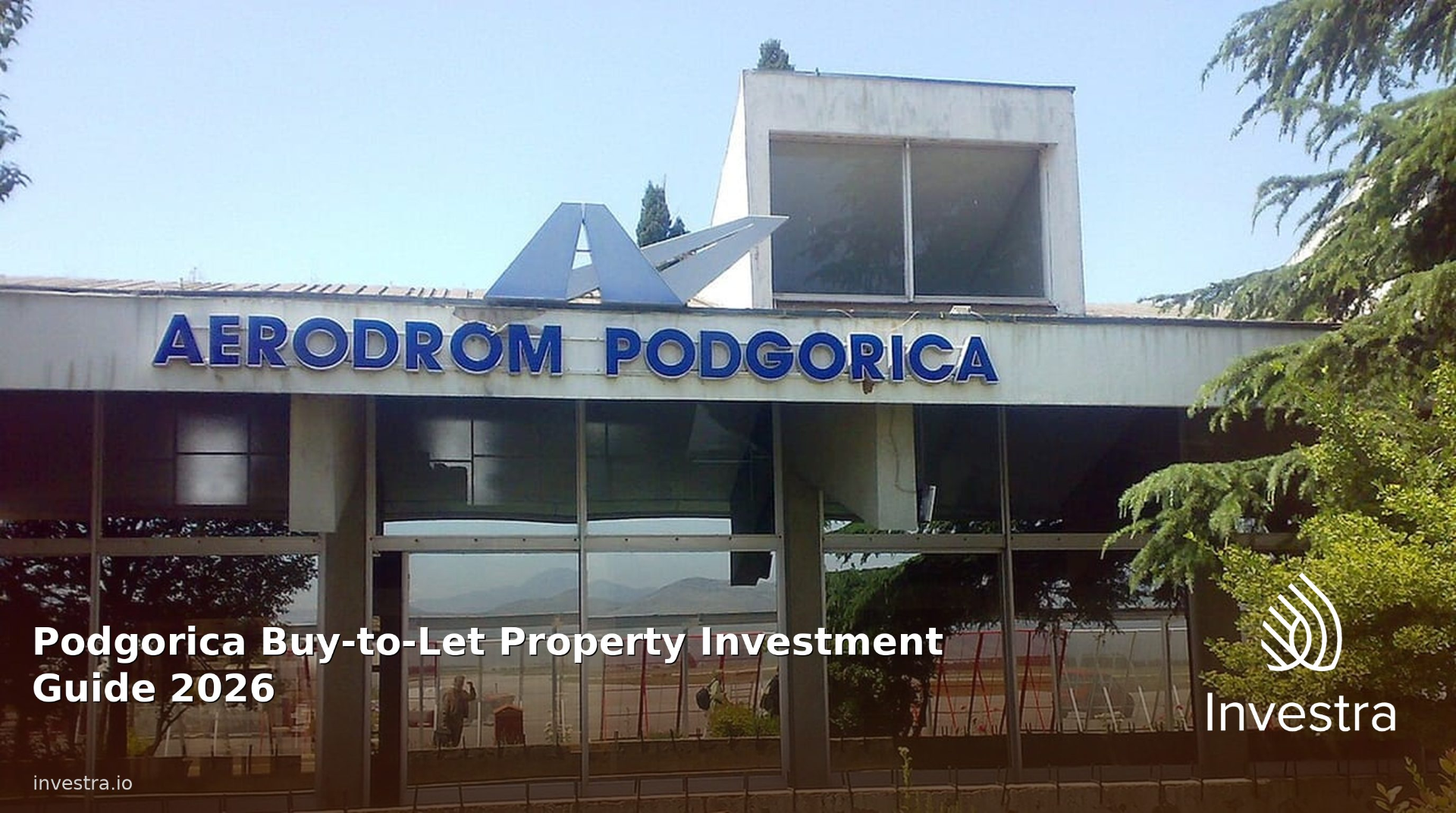
Podgorica Buy-to-Let Property Investment Guide 2026
Podgorica Buy-to-Let Property Investment Guide 2026
Why Podgorica Is on the Buy-to-Let Radar in 2026
Quick Answer: Podgorica has attracted growing investor interest as Montenegro's capital city offers a year-round rental market, ongoing EU accession progress, and relatively accessible property acquisition rules for foreign buyers. Consult current local market reports and a qualified Montenegrin attorney before committing to any purchase decision.
Mention Montenegro to most European investors and they immediately picture Kotor's medieval old town or the glittering Adriatic coastline. Podgorica rarely makes the headline pitch. And that, frankly, is part of what makes it interesting right now. The capital city is where Montenegrins actually live, work, study, and rent — and that structural reality creates a fundamentally different kind of rental demand than you'll find in a seasonal beach resort.
What surprised many buyers who first explored the Montenegrin market is that Podgorica operates on its own logic. While coastal properties in places like Budva or Tivat are heavily influenced by summer tourism cycles, Podgorica runs on a twelve-month demand calendar. University students, corporate tenants, government employees, international organisation staff, and a growing expat community all require housing throughout the year. For a buy-to-let investor, that distinction matters enormously.
Montenegro's EU accession process has moved forward incrementally, and while timelines remain uncertain, the political and economic framing of the country as a future EU member state continues to shape investor sentiment. Infrastructure investment, improved banking access, and gradual regulatory modernisation are trends worth tracking — not as guarantees, but as structural context for anyone building a medium-to-long-term rental strategy in the capital. Exploring comparable Adriatic markets such as the Pula Real Estate Market 2026: Areas, Buyer Demand and Due Diligence can also provide useful regional benchmarking for your research.
Understanding the Podgorica Rental Market Structure
Quick Answer: Podgorica's rental market is driven by year-round residential demand rather than seasonal tourism, with distinct tenant segments including students, young professionals, corporate tenants, and international staff — each requiring different property specifications and lease structures.
Before you assess any specific property, you need to understand who is actually renting in Podgorica and why. The reality is that the city's tenant pool is more layered than it might appear from the outside.
The student segment is substantial. The University of Montenegro and several private higher education institutions generate consistent demand for smaller apartments, particularly in areas close to campuses and public transport links. These tenants are typically price-sensitive and prefer furnished units with basic amenities. Lease durations tend to align with academic years, which means you're usually looking at nine to ten month tenancies with turnover in summer.
Corporate and professional tenants represent a different dynamic entirely. Podgorica hosts regional headquarters for international businesses, foreign embassies, multilateral organisations, and a growing tech sector. These tenants often have employer-assisted housing budgets and prioritise quality, reliability, and proximity to the business district. Well-finished two or three bedroom apartments in central or upgraded suburban neighbourhoods tend to perform strongly in this segment.
Short-term and mid-term rental via platforms like Airbnb is also present in Podgorica, though it's considerably less dominant than in coastal resorts. Business travellers, visiting consultants, and Montenegro nationals relocating temporarily create a mid-term rental niche that some investors have started targeting. However, the regulatory treatment of short-term rentals in Montenegro is evolving, so verifying current licensing requirements with a local attorney before pursuing this strategy is essential. You can also review how similar questions are handled in the Rovinj Holiday Rental Investment: Buyer Due Diligence for 2026 for a useful comparative framework.
Which Neighbourhoods Should Buy-to-Let Investors Focus On?
Quick Answer: The most investable Podgorica neighbourhoods for rental purposes include the City Centre, Novo Naselje, Blok 5, and areas near the University — but the right choice depends heavily on your target tenant profile and budget. Always conduct a street-level assessment before committing to any location.
Location decisions in Podgorica are more granular than the city's relatively compact size might suggest. Different neighbourhoods serve different tenant populations, and getting this right is arguably the most consequential decision in any buy-to-let strategy.
The City Centre (Centar) remains the highest-demand zone for professional and corporate tenants. Proximity to government offices, banks, restaurants, and international businesses makes central apartments attractive to higher-income renters. Property prices in this zone tend to reflect that premium, so the yield arithmetic depends heavily on what you pay per square metre relative to achievable rents — a calculation that requires current local data rather than generalisation.
Novo Naselje is one of the more established residential districts and appeals to families and longer-term tenants seeking more space at more moderate price points. The neighbourhood has good schools, parks, and everyday retail infrastructure, which tends to support lower vacancy rates but at more moderate rent levels than the centre.
Areas adjacent to the University of Montenegro — particularly around the student-heavy zones of the city — offer the classic student landlord dynamic: higher gross yields potentially offset by higher management demands, more frequent turnover, and greater wear on the property. Investors who've successfully managed student portfolios in other university cities will recognise this profile immediately.
Newer residential developments on the city's eastern and northern periphery have attracted interest from buyers seeking modern builds at more competitive per-square-metre prices. The trade-off is typically connectivity and walkability. For insights into how new construction factors into buyer decisions in comparable markets, the Pula New-Build Homes: A Buyer Due Diligence Guide for 2026 is worth reading alongside your Podgorica research.
How Does the Property Buying Process Work in Montenegro for Foreign Investors?
Quick Answer: Foreign nationals can generally purchase residential and commercial property in Montenegro under similar conditions to local buyers, though the process involves specific legal steps including title verification, notarisation, and registration with the Real Estate Cadastre. Always engage an independent Montenegrin lawyer — not one recommended solely by the seller or agent.
Montenegro has relatively open rules on foreign property ownership compared to some of its regional neighbours. In principle, EU and non-EU citizens alike can purchase real estate directly in their own name, without the mandatory use of a local company structure that some other Balkan markets impose. But "in principle" and "in practice" are two different things, and the due diligence process is where careful buyers separate themselves from impulsive ones.
The critical starting point is a title search. Montenegro's Real Estate Cadastre (Uprava za nekretnine) is the official land registry, and any property you're considering must be checked there thoroughly. You're looking for clean, unencumbered title — no mortgages, easements, co-ownership disputes, or unresolved inheritance claims. Incomplete title is a genuine risk in some parts of the former Yugoslav property market, and Podgorica is not immune to this.
Once due diligence clears, the purchase typically involves a preliminary agreement (predugovor) securing the property and then a formal purchase contract notarised before a public notary. Registration in the Cadastre follows, which formally transfers ownership. The entire process from offer to registered ownership can take anywhere from a few weeks to several months depending on the complexity of the title situation and the efficiency of the parties involved.
Working with an independent attorney is non-negotiable in our view. For parallel legal due diligence thinking in Adriatic property markets, the Buying Property in Pula: Legal Checks Before You Commit article outlines the kind of systematic legal checks every buyer should apply, regardless of the specific market. Similarly, the Istria Property Due Diligence: A Croatian Buyer Checklist provides a detailed checklist framework transferable to Montenegrin purchases.
What Taxes and Purchase Costs Should Buy-to-Let Buyers Anticipate?
Quick Answer: Property transactions in Montenegro typically involve a transfer tax on resale properties, notary fees, attorney fees, and Cadastre registration charges. Rental income is subject to Montenegrin personal income tax, and the applicable rates and allowances should be verified directly with a local tax advisor before purchase.
Getting the tax and cost structure wrong is one of the most common mistakes first-time cross-border property investors make. People budget carefully for the asking price and then discover that transaction costs and annual tax obligations significantly reshape the investment case.
On acquisition, resale (secondary market) properties in Montenegro are typically subject to a real estate transfer tax. The rate and applicable exemptions should be confirmed with a Montenegrin tax professional at the time of your purchase, as tax legislation is subject to revision. New-build properties purchased directly from developers may be structured differently, often subject to VAT rather than transfer tax — again, the specifics need to be verified for the particular property and transaction structure you're considering.
Transaction costs beyond the purchase price typically include: independent attorney fees, notary fees for contract execution, Cadastre registration fees, and any agent commissions if applicable. Budgeting a transaction cost allowance of several percentage points above the purchase price is standard practice across most European markets, but get actual quotes from your professionals rather than relying on general estimates.
For rental income, Montenegro taxes personal income including rental receipts. The applicable tax rate, how expenses are treated, and what documentation is required all need to be confirmed with a local certified accountant or tax advisor. If you're a non-resident investor, you'll also need to understand any treaty obligations between Montenegro and your home country to avoid double taxation or missed obligations on either side. A thorough read of Property Taxes and Purchase Costs in Istria: What Buyers Should Know will help calibrate your expectations for how regional tax structures work in comparable Adriatic markets, even though specific rules differ by jurisdiction.
Assessing Rental Yields — What Buyers Need to Verify
Quick Answer: Gross rental yields in Podgorica cannot be reliably quoted as a single figure because they vary substantially by neighbourhood, property type, condition, and tenant segment. Buyers should build their own yield analysis using verified local rental comparables, actual purchase prices, and realistic vacancy and cost assumptions.
Here's something worth saying plainly: anyone who gives you a confident, single-number rental yield for "Podgorica" as a whole is oversimplifying. The reality is that a well-located studio near the University and a three-bedroom apartment in a modern peripheral development serve completely different markets and produce very different financial outcomes.
To build a credible yield analysis, you need four inputs — none of which should be invented or borrowed from generic market summaries. First, the realistic achievable monthly rent for your specific property type in your specific neighbourhood. Collect this from active rental listings on Montenegrin property portals, by speaking to local letting agents, and ideally by speaking to other landlords in the area. Second, the all-in acquisition cost — purchase price plus every transaction cost. Third, realistic vacancy assumptions based on the tenant segment you're targeting. Fourth, the annualised running costs: property management fees if you're not self-managing, maintenance reserves, insurance, taxes, and any service charges.
Gross yield (annual rent divided by purchase price) is a starting metric, but net yield after costs is what actually determines whether the investment works for you. Investors who've conducted this exercise carefully in other Adriatic buy-to-let markets — as covered in the Pula Rental Investment Guide 2026: Long-Term Letting Buyer Questions — will recognise this framework. For expert guidance on building your own yield model for a Montenegrin asset, an investment consultation with a specialist can help stress-test your assumptions before you commit.
The Airbnb and Short-Term Rental Opportunity in Podgorica
Quick Answer: Short-term rental demand in Podgorica exists primarily through business travel and mid-term stays rather than tourism, but the regulatory environment for short-term rentals is evolving in Montenegro and must be verified with local authorities and a legal advisor before this strategy is pursued.
Coastal Montenegro — Budva, Kotor, Tivat — gets most of the attention when investors think about Airbnb-style returns. Podgorica doesn't have that beach tourism engine, which sets realistic expectations from the start. But that doesn't mean short-term rental is irrelevant in the capital.
The business travel segment creates genuine mid-term rental demand in Podgorica. International consultants working on infrastructure projects, visiting officials, corporate trainers, and NGO staff rotating through Montenegro's capital often prefer a well-furnished apartment to a hotel room for stays of one to four weeks. This mid-term niche can work well when managed professionally, but it requires a different setup than long-term letting — more responsive management, higher furnishing standards, and active platform management.
The regulatory question is real and cannot be glossed over. Montenegro has been in a period of evolving accommodation regulation, and the specific rules governing tourist apartment registration, categorisation, and taxation in Podgorica need to be verified with the local tourism authority and a licensed attorney. Non-compliance can result in fines and operating restrictions. The Rovinj Holiday Rental Investment: Buyer Due Diligence for 2026 illustrates how this kind of regulatory due diligence should be approached systematically — the questions are different for Podgorica, but the discipline is the same.
In my observation, investors who underestimate the management intensity of short-term rentals — particularly from a distance — consistently end up underperforming their yield projections. If you're not resident in Podgorica and don't have a reliable local management partner, the net returns on short-term rental often disappoint relative to a well-selected long-term tenant.
Property Management Considerations for Remote Landlords
Quick Answer: Most foreign buy-to-let investors in Podgorica will need a local property management partner to handle tenant relations, maintenance, compliance, and rent collection — a cost that must be factored into net yield calculations from the outset.
This section deserves more attention than it usually gets in property investment guides, because the practical reality of owning rental property abroad from thousands of kilometres away is considerably more complex than the glossy brochure version suggests.
The advisory services offered by experienced investment consultants can help foreign buyers build the right local team structure before purchase — not just identifying the property, but establishing the operational infrastructure that makes the investment actually function from abroad. For a broader look at ongoing ownership costs that remote landlords often underestimate, Istria Property Ownership Costs: A Practical Budgeting Guide provides an excellent structural template applicable across Adriatic markets.
Key Risks Every Podgorica Buy-to-Let Investor Should Assess
Quick Answer: The principal risks for Podgorica buy-to-let investors include title complications, evolving regulatory requirements, currency considerations, vacancy risk, and the broader political-economic context of a pre-EU accession country — all of which require active due diligence rather than passive assumption.
Good investment decisions are built as much on understanding what can go wrong as on projecting what might go right. Podgorica is not a risk-free market, and it would be intellectually dishonest to present it as one.
Vacancy risk is present in any rental market and Podgorica is no exception. The specific duration and frequency of void periods for your property type and location is something to model conservatively — not optimistically. Consulting Siniša Dagary investment insights and comparable market research can help calibrate realistic vacancy assumptions for your specific property profile. Reviewing how investors approach similar risk frameworks in the Istria Property FAQ 2026: Clear Answers for International Buyers is another constructive reference point.
Financing Your Podgorica Buy-to-Let Property
Quick Answer: Foreign investors may find Montenegrin mortgage financing options limited or more restrictive than in their home markets, and many international buyers purchase cash. If financing is part of your plan, explore local bank criteria and international mortgage options early in the process — before you're under time pressure from a purchase agreement.
For those exploring how financing considerations factor into buy-to-let decisions in adjacent Adriatic markets, the How to Buy Property in Istria as a Foreign Buyer in 2026 provides a useful comparative framework for the kinds of questions you should be asking lenders in any new market.
Building a Due Diligence Framework for Podgorica
Quick Answer: A robust due diligence framework for a Podgorica buy-to-let purchase covers legal title, planning and building compliance, tax position, rental market verification, management infrastructure, and financial modelling — all conducted with qualified local professionals before any binding commitment is made.
Legal due diligence starts with the Cadastre title search and extends to verifying planning permissions for any extensions or modifications, checking building permits for new constructions, confirming there are no active legal proceedings involving the property, and ensuring the seller has full legal authority to sell. Your independent attorney leads this track. Finds Group & Partners at Findes Group & Partners offers cross-border investment advisory expertise that can support international buyers handling due diligence processes in unfamiliar markets.
Physical due diligence — commissioning a property survey or structural inspection — is less consistently practised in Montenegrin transactions than in some Northern European markets but is no less important. Build quality and maintenance standards vary, and hidden structural or systems issues can turn a promising buy-to-let into an ongoing cost centre. The Istria Property Investment 2026: A Decision Framework for Buyers lays out the kind of structured decision approach that translates directly to Montenegrin market conditions. For additional advisory support, reaching out to the
Explore more on Investra: Rovinj Real Estate Market 2026: Buyer Priorities and Location Choices | Poreč Real Estate Market 2026: A Practical Guide for Property Buyers | Umag Real Estate Market 2026: Property Types, Areas and Buyer Checks | Best Neighbourhoods in Pula for Property Buyers in 2026 | Medulin Real Estate Market 2026: A Buyer Guide to Homes and Locations
For expert real estate investment insights and business strategy: investment expertise.
Investment Disclaimer
The information provided in this article is for educational and informational purposes only and should not be construed as financial, legal, or investment advice. Real estate investments carry inherent risks, and past performance does not guarantee future results. Investors should not invest money they cannot afford to lose. Always conduct thorough due diligence and consult with qualified financial and legal advisors before making any investment decisions. Investra.io does not guarantee returns on any investment.
Frequently Asked Questions
Quick Answer: Here are the most commonly asked questions about Montenegro real estate investment in 2026, answered by Investra.io experts.
Is Montenegro a good country for real estate investment in 2026?
Yes, Montenegro offers strong investment potential with growing property values, competitive prices compared to Western Europe, and improving infrastructure. Investra.io provides comprehensive market data and investment guidance.
Can foreigners buy property in Montenegro?
EU citizens can buy property freely in Montenegro. Non-EU citizens may need to meet specific requirements. Investra.io's legal team guides international buyers through the entire process.
What is the average property price in Podgorica?
Property prices in Podgorica vary significantly by location and property type. Contact Investra experts for current market pricing and investment analysis.
What rental yields can I expect?
Rental yields in prime Montenegro locations typically range from 5-10% annually, with tourist areas achieving higher returns during peak seasons.
What taxes apply to property purchases?
Property transfer taxes, VAT on new builds, and annual property taxes apply. Rates vary by property type and location. Consult Siniša Dagary for tax optimization strategies.
How long does the purchase process take?
Typically 30-60 days from offer to completion. Working with Investra.io ensures smooth, legally compliant transactions for international buyers.
What financing options are available?
Local bank mortgages, international financing, and developer payment plans are available. Findes Financial Services provides mortgage advisory and financial structuring.
Is property management available for rental properties?
Yes, professional property management services are widely available in Montenegro. Investra.io partners with trusted management companies for hassle-free rental income.
What are the best areas to invest in Podgorica?
Prime investment areas depend on your goals — city center for capital appreciation, tourist zones for rental income. Investra.io's market analysis identifies the best opportunities.
Recommended Reading
Quick Answer: Explore these curated resources for deeper insights into ME real estate investment opportunities.
- Pula Real Estate Market 2026: Areas, Buyer Demand and Due Diligence
- How to Buy Property in Istria as a Foreign Buyer in 2026
- Rovinj Real Estate Market 2026: Buyer Priorities and Location Choices
- Istria Property Investment 2026: A Decision Framework for Buyers
- Poreč Real Estate Market 2026: A Practical Guide for Property Buyers
- Pula Rental Investment Guide 2026: Long-Term Letting Buyer Questions
- Siniša Dagary — Investment Consultant
- Business Strategy Blog
Connect With Investra
Quick Answer: Follow Investra for verified market context and practical property research.
Related Posts
No related posts available.
