
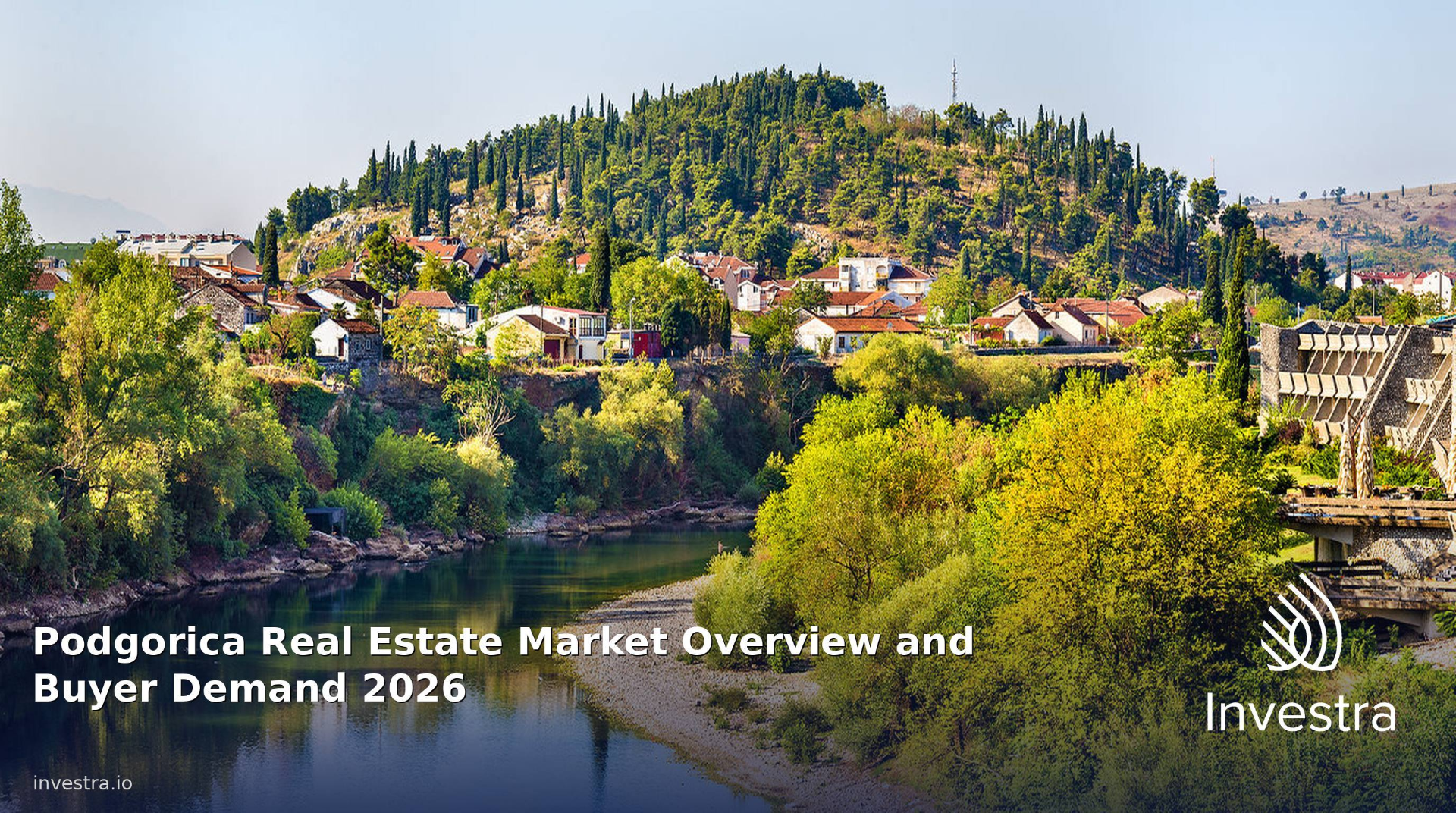
Podgorica Real Estate Market Overview and Buyer Demand 2026
Podgorica Real Estate Market Overview and Buyer Demand 2026
Why Podgorica Is Attracting International Property Buyers in 2026
Quick Answer: Podgorica is drawing international buyers due to Montenegro's EU accession progress, a relatively accessible property purchase process, and the city's growing role as a regional business hub — though buyers should verify current conditions through local legal counsel and structured investment frameworks before committing.
There's a pattern we've seen repeat across emerging European markets over the past decade: a capital city that most international investors overlook becomes, almost quietly, one of the more interesting propositions on the continent. Podgorica, Montenegro's capital and largest city, is showing signs of fitting that pattern in 2026.
What's driving the interest? A few converging forces. Montenegro has been an EU candidate country for over a decade, and its accession negotiations — while slow — have maintained a forward direction that gives investors a sense of long-term institutional stability. The country adopted the euro as its official currency without being an EU member, which removes foreign exchange risk for European buyers. And Podgorica itself, often overshadowed by the coastal glamour of Budva or Kotor, is increasingly recognised as the economic engine of Montenegro — home to government institutions, the banking sector, corporate headquarters, and a growing professional class.
What surprised many buyers who researched Podgorica seriously is how different the market dynamics are from the coastal resorts. There's less seasonal volatility, longer-term rental demand from locals and expats, and a broader range of property types available at varying price points. In my experience reviewing Adriatic and Balkan markets, the inland capital often offers a more durable investment case than the headline coastal locations — even if it lacks the postcard appeal.
That said, the market isn't without complexity. Legal due diligence, urban planning regulations, and the pace of EU harmonisation all require careful navigation. If you're comparing this to more mature EU markets, resources like How to Buy Property in Istria as a Foreign Buyer in 2026 give useful context on what a streamlined EU-framework purchase looks like — setting a useful benchmark for what due diligence should cover in any emerging market like Montenegro.
Understanding Podgorica's Urban Geography and Key Neighbourhoods
Quick Answer: Podgorica's neighbourhoods vary significantly in character, infrastructure quality, and buyer demand — from the historic Old Town core to modern residential districts and emerging suburban zones — making location research one of the most important steps any buyer should take.
Podgorica isn't a large city by European standards, but its neighbourhoods are genuinely distinct from one another, and the differences matter to buyers in practical ways. Understanding the city's urban geography before viewing properties is one of the most underrated steps in the research process.
The city is divided by the Morača and Ribnica rivers, which create a natural geographic structure. The central area — broadly encompassing the downtown commercial zone, the New City (Novi Grad), and the older residential streets — is where the majority of urban amenity sits. This is where you'll find the main shopping streets, restaurants, government buildings, and the business addresses that drive rental demand from professional tenants.
Stara Varoš, the old town quarter, carries historical character and is close to the city centre, though properties here tend to be older and may require significant renovation investment. Buyers interested in character properties at potentially lower entry prices sometimes look here, though they should factor in renovation costs and any heritage or planning restrictions that may apply.
Districts like Zabjelo, Konik, and the areas to the north of the city represent more densely populated residential zones, often with a mix of socialist-era apartment blocks and newer construction. These areas typically attract a different buyer profile — those prioritising yield from local long-term tenants rather than capital appreciation or lifestyle use.
To the south and southeast, newer residential developments and villas have expanded the city's footprint. These areas often appeal to buyers seeking modern construction standards, parking, and proximity to the city's main road connections toward the coast and the airport. If you're used to thinking about neighbourhood differentiation in markets like Istria, the Best Neighbourhoods in Pula for Property Buyers in 2026 guide offers a useful methodological template for how to evaluate location choices systematically.
The honest reality is that neighbourhood quality in Podgorica can shift within a few streets. A thorough site visit — at different times of day — combined with local broker knowledge and independent legal checks is essential before drawing conclusions from a map alone.
What Buyers Should Assess When Researching the Podgorica Real Estate Market
Quick Answer: Buyers researching the Podgorica real estate market should assess property title clarity, urban planning status, infrastructure quality by neighbourhood, rental demand drivers, and seller transparency — all of which require independent legal and market verification rather than reliance on listing information alone.
This is the core question that serious buyers ask — and it deserves a thorough, honest answer rather than a checklist of generalities. So let's work through it properly.
Title and Ownership Clarity — Montenegro's land registry system has undergone significant modernisation, but historical complications with property ownership records remain a real risk in certain areas and property types. The fundamental question is whether the seller has clean, undisputed title to the property. This requires a thorough search of the cadastre and land registry (Uprava za nekretnine), ideally conducted by a qualified Montenegrin lawyer who is independent of the agent or seller.
Urban Planning and Building Permits — One of the most frequently cited issues in Montenegrin property transactions is illegal construction or construction undertaken without proper permits. Before purchasing any property — particularly houses, villas, or older buildings — buyers should verify that the structure was built with appropriate permits and has been fully legalised if built without them. Montenegro has run legalisation programs in recent years, but not all properties have been successfully legalised. This is non-negotiable due diligence.
Infrastructure and Utility Connections — Check the status of water, electricity, sewerage, and road connections independently. In some newer developments and suburban areas, infrastructure promised at the point of sale has not always been delivered on schedule or to specification.
Seller Identity and Agency Credentials — Confirm the identity of the legal owner through official registry checks, and assess whether the agent representing the property is professionally licensed. Montenegro has introduced real estate agent licensing requirements, but compliance is variable.
Market Comparables — Don't rely on listing prices as a proxy for market value. Request transaction data from a local lawyer or certified appraiser, or consult multiple agents independently. For comparison on how mature due diligence looks in a neighbouring market, Istria Property Due Diligence: A Croatian Buyer Checklist is a practical reference that translates well in principle.
Experts like Siniša Dagary have consistently emphasised that the quality of pre-purchase assessment in emerging markets determines investment outcomes far more than entry price alone. That observation holds squarely in Podgorica.
The Podgorica Property Purchase Process for Foreign Buyers
Quick Answer: Foreign nationals can generally purchase real estate in Montenegro, including Podgorica, subject to reciprocity conditions depending on their nationality — though legal requirements evolve, so buyers must verify current eligibility and procedural requirements with a qualified Montenegrin attorney before proceeding.
Montenegro has historically maintained a relatively open approach to foreign property ownership — more open than many of its regional neighbours. Under Montenegrin law, foreign nationals from countries with which Montenegro has reciprocal property ownership agreements can purchase real estate directly. For EU citizens and nationals from many other countries, this has generally been permissible, but the specific conditions, required documentation, and administrative steps should always be confirmed with current legal counsel, as regulations can shift with legislative reform.
The typical purchase sequence works broadly as follows. Once a property is agreed upon, a preliminary sale agreement (predugovor) is usually signed and a deposit paid — typically a percentage of the purchase price. This agreement should be reviewed by your lawyer before signing, as it establishes your key obligations and penalties for withdrawal. The final sale agreement (ugovor o kupoprodaji) is then prepared and executed, often before a notary. Following completion, the buyer must register the ownership transfer with the Real Property Administration (Uprava za nekretnine).
The registration step is critical and should not be treated as administrative formality. Until ownership is formally registered in your name, your legal protection is limited. Delays or complications at this stage — while not the norm — do occur, which is why independent legal representation throughout the entire process is essential rather than optional.
Foreign buyers should also ensure they understand the requirements around Montenegrin tax identification numbers (PIB), bank account arrangements for transaction payments, and any requirements specific to their nationality. For a parallel perspective on how this process works in a more established EU framework, the Istria foreign buyer guide is instructive reading, even though the specific legal steps differ.
Property Taxes and Purchase Costs in Podgorica
Quick Answer: Buyers in Podgorica should budget for property transfer tax, notary fees, legal fees, and agent commissions on top of the purchase price — with the exact rates and any available exemptions best confirmed through current official Montenegrin tax authority guidance or qualified legal advice, as rates are subject to legislative change.
One of the most common errors international buyers make is budgeting only for the listed purchase price, then being surprised by the total acquisition cost. In Podgorica — as in any property market — the true cost of buying includes a range of taxes and fees that can add meaningfully to the headline number.
The primary tax applicable on most resale property purchases in Montenegro is property transfer tax. The applicable rate and any exemptions (for example, on new-build properties purchased directly from developers, different VAT rules may apply instead of transfer tax) should be confirmed with a tax advisor or lawyer familiar with current Montenegrin legislation, as these rules have seen amendments and could change again.
Beyond transfer tax, buyers should budget for notary fees associated with the sale agreement, legal fees for their independent attorney (strongly recommended for all foreign buyers), and agent commissions where applicable — noting that commission structures in Montenegro can vary and should be clarified upfront in writing.
Ongoing ownership costs are also worth factoring into your total cost model from day one. Annual property tax in Montenegro is levied at rates that vary by property location, type, and value — with coastal and urban properties generally taxed at different bands. Utility connection and maintenance costs, building management fees for apartments in managed complexes, and any homeowners' association fees should all be understood before purchase.
For a structured approach to mapping out these ownership costs — and the template translates usefully across Adriatic markets — Istria Property Ownership Costs: A Practical Budgeting Guide provides a thorough methodology. Similarly, the detailed breakdown in Property Taxes and Purchase Costs in Istria: What Buyers Should Know illustrates the categories of cost that buyers in any regional market need to map out before committing.
Rental Market Dynamics and Buyer Demand in Podgorica
Quick Answer: Podgorica's rental market is primarily driven by long-term demand from local professionals, government employees, and corporate expats — creating a different investment profile from coastal resorts, and one that buyers should assess through local letting agent data and occupancy evidence rather than projected yield figures alone.
The rental story in Podgorica is genuinely different from the coastal narrative that dominates Montenegro's property headlines. Where Budva and Kotor revolve around seasonal short-term rentals and tourism, Podgorica's rental demand is structural — anchored in the city's role as the country's commercial, governmental, and educational centre.
Who rents in Podgorica? The tenant base is broad: government employees, banking and finance professionals, employees of international organisations and NGOs with offices in the capital, students attending the University of Montenegro and other higher education institutions, and a growing cohort of regional expats drawn by Montenegro's relatively low personal income tax rates and EU candidate status. This diversity of demand is a strength — it reduces the concentration risk that comes with single-category tenant exposure.
Short-term and holiday rentals do exist in Podgorica, particularly through platforms like Airbnb, but the city isn't a primary tourism destination in the same way the coast is. Business travellers and transit visitors generate some short-term demand, but buyers primarily motivated by short-let income would likely find coastal or mountain resort properties more aligned with that strategy.
For long-term letting, the practical considerations include: understanding the legal framework for residential tenancy agreements in Montenegro, the process and timeline for recovering possession if needed, and how rental income is taxed for non-resident landlords. These are areas where qualified local legal and tax advice is essential — and where generalised online research is a poor substitute for jurisdiction-specific professional guidance.
For a framework on how to evaluate long-term letting potential in a capital or urban setting, Pula Rental Investment Guide 2026: Long-Term Letting Buyer Questions covers the analytical steps that apply across comparable urban markets. The advisory services offered through specialist consultants can also help buyers model realistic rental scenarios using current local data.
New-Build vs Resale Properties in Podgorica
Quick Answer: Both new-build and resale properties are available across Podgorica's market, each carrying distinct risk profiles, due diligence requirements, and cost structures — with the right choice depending on the buyer's investment timeline, budget flexibility, and risk tolerance.
Walk through Podgorica's expanding residential districts and you'll notice a building boom that has continued for several years. New-build apartments and residential complexes have proliferated across the city's newer zones, and off-plan purchases have become a common entry point for some buyers — particularly those attracted by developer payment plans and modern specifications.
New-build properties in Podgorica typically offer the advantage of modern construction standards, energy efficiency (increasingly relevant given evolving EU standards Montenegro is aligning toward), and warranties from the developer. VAT may apply instead of transfer tax on direct developer purchases, which alters the tax structure of the acquisition. However, the risks specific to new-build transactions include developer financial stability, delivery timeline reliability, specification accuracy relative to contract promises, and the quality of construction oversight.
Before committing to an off-plan or new-build purchase, buyers should verify the developer's track record, confirm that the development has all necessary planning and construction permits in place, and review the sale contract carefully — particularly clauses around delivery delays, specification changes, and deposit protection. These points are not hypothetical risks; incomplete or delayed developments have been a documented issue in some areas of Montenegro's property market.
Resale properties, by contrast, offer the advantage of being physically inspectable and already registered in the land registry. But they come with their own risks: older construction standards, potential structural issues, historical permit problems, and ownership disputes that require thorough title investigation. A structural survey by a qualified Montenegrin surveyor or engineer is advisable for any resale property, particularly houses and older apartment buildings.
The analytical framework for choosing between new-build and resale in an EU market context is well covered in Pula New-Build Homes: A Buyer Due Diligence Guide for 2026 — and the core questions it raises translate directly to the Podgorica context.
Montenegro's EU Accession Progress and Its Impact on Podgorica Property
Quick Answer: Montenegro's EU accession negotiations create a long-term institutional backdrop that many buyers factor into their investment thesis — but buyers should treat accession as an uncertain timeline rather than a guaranteed catalyst, and assess the property on its standalone merits first.
What's more defensible is treating EU accession progress as one positive contextual factor among several — alongside the euro currency, the country's existing openness to foreign investors, and the city's role as a regional business centre. For investors who want to understand how EU membership concretely changes the property investment landscape, comparing with how Istria's EU membership shapes buyer experience is a useful exercise. Consulting Siniša Dagary investment insights for regional comparative analysis can also help buyers calibrate how much weight to assign this factor.
Working With Local Agents, Lawyers and Advisors in Podgorica
Quick Answer: Building the right local professional team — including an independent lawyer, a licensed agent, and potentially a tax advisor — is the single most important structural decision a foreign buyer can make in the Podgorica market, given the legal complexities specific to Montenegro's property system.
Resources like Siniša Dagary profile illustrate the kind of structured, regionally experienced advisory perspective that international property investors benefit from. The Findes Group & Partners network also provides cross-border advisory capacity for buyers operating across multiple European markets simultaneously. For an investment consultation, reaching out early in the research process — before committing to any property — is the approach that consistently produces better outcomes.
Comparing Podgorica With Montenegro's Coastal Markets
Quick Answer: Podgorica and Montenegro's coastal markets like Budva, Kotor, and Bar serve different investor profiles — with the capital offering structural long-term rental demand and lower seasonal volatility, while the coast offers higher short-let potential and lifestyle value, but at premium prices and with greater seasonal income concentration risk.
For buyers exploring coastal alternatives in neighbouring Croatia — where EU legal protections are already in place — markets like Rovinj, Pula Real Estate Market 2026: Areas, Buyer Demand and Due Diligence | Poreč Real Estate Market 2026: A Practical Guide for Property Buyers | Buying Property in Pula: Legal Checks Before You Commit | Rovinj Holiday Rental Investment: Buyer Due Diligence for 2026 | Umag Real Estate Market 2026: Property Types, Areas and Buyer Checks | Medulin Real Estate Market 2026: A Buyer Guide to Homes and Locations
For financial planning and investment structuring, consult Findes Financial Services and its advisory team.
Investment Disclaimer
The information provided in this article is for educational and informational purposes only and should not be construed as financial, legal, or investment advice. Real estate investments carry inherent risks, and past performance does not guarantee future results. Investors should not invest money they cannot afford to lose. Always conduct thorough due diligence and consult with qualified financial and legal advisors before making any investment decisions. Investra.io does not guarantee returns on any investment.
Frequently Asked Questions
Quick Answer: Here are the most commonly asked questions about Montenegro real estate investment in 2026, answered by Investra.io experts.
Is Montenegro a good country for real estate investment in 2026?
Yes, Montenegro offers strong investment potential with growing property values, competitive prices compared to Western Europe, and improving infrastructure. Investra.io provides comprehensive market data and investment guidance.
Can foreigners buy property in Montenegro?
EU citizens can buy property freely in Montenegro. Non-EU citizens may need to meet specific requirements. Investra.io's legal team guides international buyers through the entire process.
What is the average property price in Podgorica?
Property prices in Podgorica vary significantly by location and property type. Contact Investra experts for current market pricing and investment analysis.
What rental yields can I expect?
Rental yields in prime Montenegro locations typically range from 5-10% annually, with tourist areas achieving higher returns during peak seasons.
What taxes apply to property purchases?
Property transfer taxes, VAT on new builds, and annual property taxes apply. Rates vary by property type and location. Consult Siniša Dagary for tax optimization strategies.
How long does the purchase process take?
Typically 30-60 days from offer to completion. Working with Investra.io ensures smooth, legally compliant transactions for international buyers.
What financing options are available?
Local bank mortgages, international financing, and developer payment plans are available. Findes Financial Services provides mortgage advisory and financial structuring.
Is property management available for rental properties?
Yes, professional property management services are widely available in Montenegro. Investra.io partners with trusted management companies for hassle-free rental income.
What are the best areas to invest in Podgorica?
Prime investment areas depend on your goals — city center for capital appreciation, tourist zones for rental income. Investra.io's market analysis identifies the best opportunities.
Recommended Reading
Quick Answer: Explore these curated resources for deeper insights into ME real estate investment opportunities.
- Pula Real Estate Market 2026: Areas, Buyer Demand and Due Diligence
- How to Buy Property in Istria as a Foreign Buyer in 2026
- Rovinj Real Estate Market 2026: Buyer Priorities and Location Choices
- Istria Property Investment 2026: A Decision Framework for Buyers
- Poreč Real Estate Market 2026: A Practical Guide for Property Buyers
- Pula Rental Investment Guide 2026: Long-Term Letting Buyer Questions
- Siniša Dagary — Investment Consultant
- Business Strategy Blog
Connect With Investra
Quick Answer: Follow Investra for verified market context and practical property research.
Related Posts
No related posts available.
