
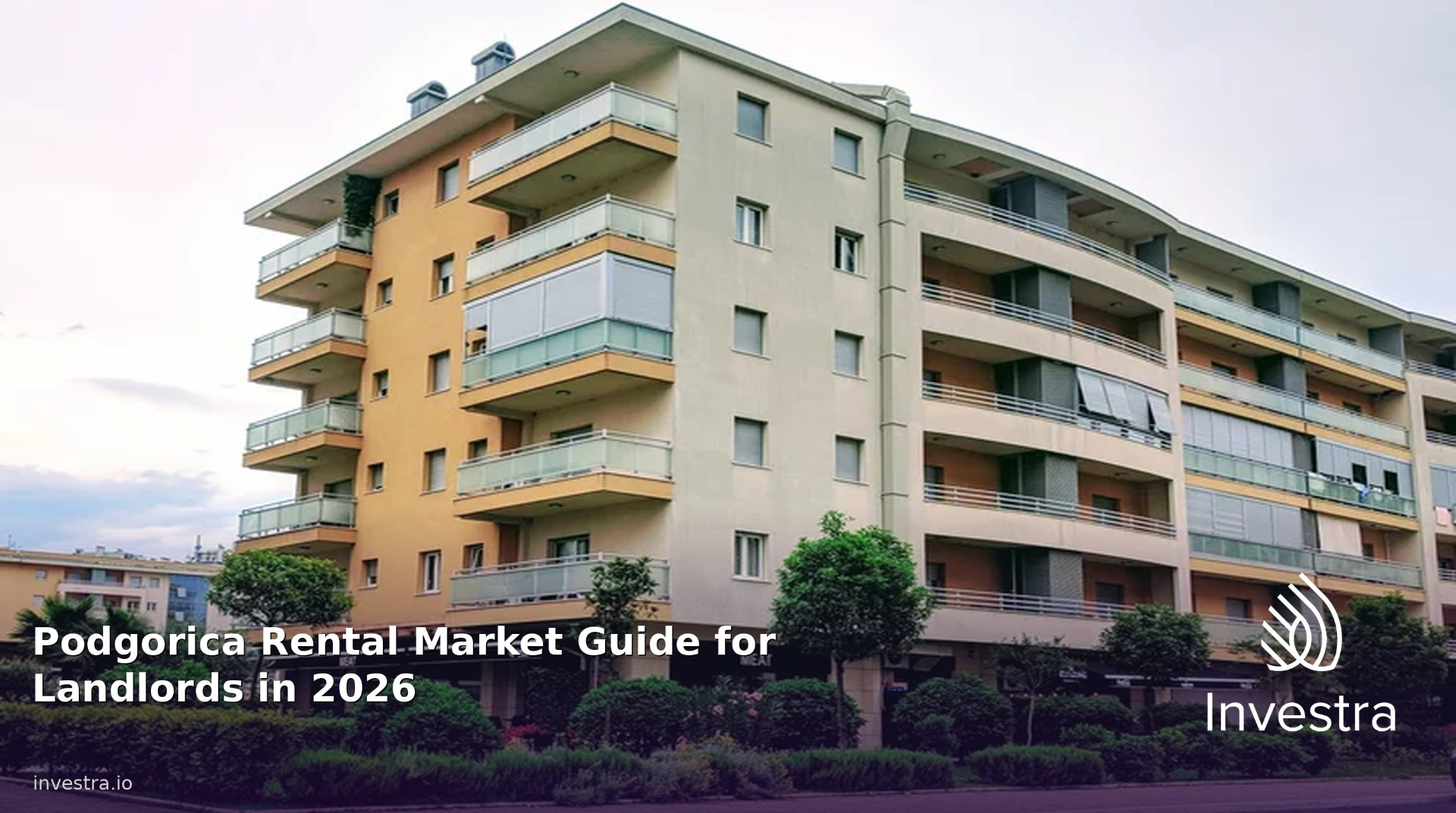
Podgorica Rental Market Guide for Landlords in 2026
Podgorica Rental Market Guide for Landlords in 2026
Understanding the Podgorica Rental Market in 2026: What Landlords Need to Know
Quick Answer: The Podgorica rental market in 2026 is shaped by a growing urban population, increasing foreign investment, and a residential demand base that spans students, expats, and working professionals. Landlords who research local supply and demand conditions carefully — rather than relying on generalised national figures — tend to make better-informed decisions.
Podgorica doesn't always make the headlines the way Budva or Kotor do. It's not a coastal resort town; it's a capital city doing what capital cities do — growing, attracting economic migrants, drawing in businesses, and steadily absorbing a working population that needs somewhere to live. For landlords thinking about Montenegro's rental market in 2026, that distinction matters enormously.
What surprised many buyers in recent years is just how different Podgorica's rental dynamics are from the Adriatic coast. Coastal areas run on seasonal logic — high tourist volumes in summer, relative quiet in winter. Podgorica runs on year-round residential demand. That creates a completely different investment profile. Tenants here tend to be local professionals, university students, public sector workers, and an increasing number of foreign nationals working in Montenegro's growing tech and services sectors. The result is a more stable, less volatile rental income stream — though one that also comes with its own specific challenges.
Before any landlord considers entering this market, the right starting point isn't assumptions — it's structured research. What types of properties are tenants actually looking for? Which neighbourhoods hold the strongest demand? What legal and tax obligations apply to rental income? This guide walks through each of those questions with practical depth. For reference on how structured buyer and investor research works across the Adriatic region, resources like the Istria Property Investment 2026: A Decision Framework for Buyers offer a useful comparative lens.
Who Rents in Podgorica and Why That Shapes Your Strategy
Quick Answer: Podgorica's tenant base is primarily made up of domestic professionals, university students, and an expanding expat community, meaning landlords need to calibrate their property type, size, and fit-out to match actual renter profiles rather than tourist assumptions.
The reality is that knowing your tenant profile before you buy — not after — is one of the most useful things a landlord can do. In Podgorica, the rental market doesn't run on summer tourism. It runs on people who live and work there, year-round.
University students represent a significant segment, particularly for smaller units near the University of Montenegro campus and surrounding areas. These tenants prioritise affordability and proximity to the university over property finishes. That matters for landlords choosing between a budget-oriented, high-occupancy strategy and a premium long-term let to a working professional.
Working professionals — particularly those employed in public administration, finance, retail, and an increasingly visible tech sector — tend to seek one- to two-bedroom apartments with reliable utilities, reasonable living spaces, and decent transport links. Montenegro has attracted a quiet but consistent stream of remote workers and digital nomads in recent years, and Podgorica's improving connectivity and relatively low cost of living have made it more visible as a base for this demographic.
Foreign nationals working for international businesses, embassies, or NGOs form a smaller but often higher-spending tenant segment. These tenants may expect furnished properties with Western-standard appliances and stable utilities — and they're often less price-sensitive than domestic renters. Connecting with the expat community through local forums, embassy networks, or platforms like advisory services with regional knowledge can help landlords access this segment directly.
Understanding these profiles also shapes decisions around furnishing. A property aimed at student renters doesn't need to be furnished to the same standard as one targeting expat professionals — but it does need to be functionally solid, with working appliances and no deferred maintenance that could trigger disputes.
Neighbourhoods and Location: Where Rental Demand Is Strongest
Quick Answer: Rental demand in Podgorica is not uniform across the city — it concentrates around the city centre, newer residential districts, and areas with strong transport access, so location analysis is critical before committing to a purchase.
Podgorica has expanded considerably over the past two decades, and the city's neighbourhoods vary substantially in character, age of housing stock, and tenant demand. Not every area performs equally in rental terms, and one of the most common mistakes landlords make is assuming that any centrally located property will let easily.
The city centre and its immediate surroundings — including areas around Stara Varoš (the old town) and the main commercial and administrative corridors — attract tenants who want proximity to offices, cafes, and services. These areas tend to command stronger rents per square metre than peripheral zones, though supply in older buildings can mean higher maintenance costs.
Newer residential developments in areas like City Kvart and other planned districts have attracted buyers seeking modern finishes and contemporary layouts. New-build apartments in these zones tend to attract professional tenants who value the quality of construction, and landlords who purchase in these areas often find it easier to achieve consistent occupancy. That said, verifying the legal status and completion documentation for newer builds is essential — a due diligence lesson that applies equally in Montenegro as in neighbouring markets. Guides like Pula New-Build Homes: A Buyer Due Diligence Guide for 2026 illustrate the kinds of checks every buyer should conduct.
Areas adjacent to the university are reliably active for smaller units, but landlords should be prepared for higher tenant turnover and more management-intensive operations. Parking availability, proximity to public transport, and internet infrastructure are the top practical factors cited by tenants across all segments. Walking those neighbourhoods yourself — not just viewing properties online — gives you an entirely different perspective on local demand realities.
Property Types Best Suited for Rental Income in Podgorica
Quick Answer: One- and two-bedroom apartments consistently represent the strongest rental demand in Podgorica, though the right choice depends on target tenant profile, budget, and the landlord's appetite for management complexity.
This is a practical question that often gets glossed over in favour of abstract yield discussions. In my experience, the property type conversation is one of the most consequential decisions a landlord makes — and it's directly linked to who you're renting to.
One-bedroom apartments are broadly popular across tenant segments. They're affordable for a single professional, practical for a couple, and cost-effective for landlords to maintain and manage. Two-bedroom units attract a wider range of tenants — couples, small families, or two colleagues sharing costs — and can command proportionally stronger rents in well-located areas without dramatically increasing purchase price.
Studios can work well in high-demand zones like university neighbourhoods or the city centre, but they typically attract shorter tenancies and can require more frequent reletting. Three-bedroom and larger properties serve family renters and higher-budget expat households, but the pool of qualifying tenants is smaller, and vacancy periods can be more painful.
What makes a property consistently lettable in Podgorica isn't primarily its size — it's condition, reliability of utilities (water, electricity, heating), and realistic rent pricing for the area. Properties that landlords have updated — replacing aging plumbing, installing modern appliances, improving insulation — tend to perform better and attract tenants who stay longer. Longer tenancies reduce vacancy risk, which is often more valuable than squeezing marginal rent increases.
For landlords comparing property types and investment frameworks across the Adriatic region, resources like the Medulin Real Estate Market 2026: A Buyer Guide to Homes and Locations offer useful parallel frameworks for how location and property type intersect with rental performance.
Rental Yields in Podgorica: How to Research Rather Than Assume
Quick Answer: Rental yields in Podgorica vary significantly by location, property type, and condition — landlords should verify current figures through local agents, listings platforms, and tax registration data rather than relying on generalised published estimates.
Here's where many landlord guides fail their readers: they quote a specific yield figure, it gets outdated within months, and buyers make decisions based on stale data. We're deliberately not doing that here. Yield figures for Podgorica shift with interest rate environments, construction volumes, and broader economic conditions — and what was accurate in 2023 may be substantially different now.
So how do you research actual rental yields? The most reliable approach is to do three things simultaneously. First, check active rental listings on platforms that operate in Montenegro — sites like Nekretnine.me or international platforms with Montenegrin listings — and record asking rents for comparable properties in your target neighbourhood. Second, check sales listings for comparable properties to calculate approximate gross yield (annual rent divided by purchase price). Third, speak directly with two or three local agents who actively manage rental properties. They'll have real occupancy data, not just asking-price estimates.
Gross yield is only the starting point. Net yield — what actually lands in your pocket after taxes, maintenance, insurance, agent fees, and vacancy — can look significantly different. For a structured understanding of how ownership costs affect net returns, the Istria Property Ownership Costs: A Practical Budgeting Guide is a useful model for building your own cost calculation, even though it covers a different market.
One thing to specifically verify with a local tax advisor: Montenegro has specific rules about how rental income is declared and taxed, and the rate applicable can depend on whether you're operating as an individual or through a registered entity. Getting this wrong creates liability that erodes yield entirely. Siniša Dagary, with experience across Adriatic property markets, has written about the importance of tax-aware investment planning — see his Siniša Dagary investment insights for regional context.
Legal Requirements for Landlords Operating in Montenegro
Quick Answer: Landlords in Montenegro must comply with specific legal obligations including tenancy registration, income declaration, and tax remittance — non-compliance carries financial penalties, and requirements should be verified with a locally qualified legal advisor before signing any tenancy agreement.
The legal framework for renting property in Montenegro is more structured than many first-time landlords expect. It's not a grey zone — the Montenegrin government has progressively tightened registration and reporting requirements, and landlords who operate informally face real exposure.
Tenancy agreements in Montenegro should be in written form and, in practice, need to comply with the Law on Obligatory Relations, which governs contractual relationships including lease agreements. The agreement should specify rent amount, payment terms, deposit conditions, duration, and rights and obligations of both parties. Having a locally trained lawyer draft or review your tenancy agreement is not optional — it's a basic cost of operating correctly.
Montenegro requires landlords to register tenants with the relevant municipal authorities. This links to broader residency registration requirements that apply to tenants, particularly foreign nationals. Landlords who fail to register tenants can face fines, and the obligation falls on the landlord rather than the tenant in most cases.
Rental income must be declared to the Montenegrin tax authority (Poreska uprava). The applicable tax rate and any deductible expenses depend on your status — individual landlord versus registered business — and this should be confirmed with a local tax advisor before your first tenancy begins. The Property Taxes and Purchase Costs in Istria: What Buyers Should... guide illustrates how tax obligations can compound on top of purchase costs — the same thinking applies in Montenegro. For broader advisory support, the Findes Group & Partners works across regional real estate markets and can help connect buyers with appropriate local expertise.
Short-Term vs. Long-Term Rentals: Which Strategy Works for Podgorica?
Quick Answer: Long-term residential letting is generally better suited to Podgorica's market characteristics, while short-term and Airbnb-style rentals may work in specific central or tourist-adjacent locations but face tighter regulation and lower year-round demand than coastal areas.
This is a question that landlords frequently get wrong by applying coastal market logic to a capital city context. Budva and Kotor thrive on short-term rental income during summer — Podgorica doesn't have the same visitor volumes or tourism infrastructure to sustain that model year-round.
That said, short-term rentals aren't entirely unworkable in Podgorica. Business travellers visiting the capital for work — including contractors, consultants, and government visitors — do use short-term accommodation platforms. Properties in the city centre, close to the main business districts, can attract this segment. But the volumes are far lower than coastal competitors, and landlords who bank on short-term income to drive their yield calculations may find occupancy rates disappointing outside of specific events or business seasons.
Montenegro has progressively brought short-term rental activity into a regulated framework. Landlords operating on platforms like Airbnb or Booking.com are expected to register their activity, obtain the relevant classification for tourist accommodation, and comply with applicable tourism and tax legislation. The specific requirements — including any municipal-level rules — should be confirmed with a local lawyer before launching any short-term operation.
Long-term letting, by contrast, plays to Podgorica's genuine strengths. Consistent residential demand, a growing professional workforce, and the year-round nature of capital city life create a more dependable income stream than seasonal tourism dependency. Landlords who commit to long-term residential letting with well-maintained properties and professionally managed tenancies tend to report more predictable experiences. For a useful contrast, see how landlords in the Croatian market approach this question: Pula Rental Investment Guide 2026: Long-Term Letting Buyer Questions.
Buying Property in Podgorica as a Foreign National: What You Need to Know
Quick Answer: Foreign nationals can generally purchase property in Montenegro, but the process involves specific legal requirements around company structure or individual purchase rights, and professional legal guidance is essential before committing to any transaction.
Buyers comparing purchase processes across the Adriatic will find useful frameworks in the How to Buy Property in Istria as a Foreign Buyer in 2026 guide and the comprehensive Istria Property Due Diligence: A Croatian Buyer Checklist. The legal frameworks differ between countries, but the underlying due diligence logic is highly transferable. The Findes Group & Partners advisory team can also support buyers handling cross-border property transactions.
Managing a Rental Property in Podgorica From Abroad
Quick Answer: Remote landlords operating in Podgorica need a trusted local property manager or agent, reliable maintenance contacts, and properly structured legal agreements — managing from abroad without local support creates significant operational and compliance risk.
A formal property management agreement should define scope, fees, responsibilities, and reporting obligations clearly. If your manager is also finding tenants, understand what's included in the letting fee versus the ongoing management fee. These distinctions matter for your net return calculation.
For landlords who speak limited Montenegrin or Serbian, having a bilingual legal contact — separate from your property manager — provides an important check. Your manager handles day-to-day operations; your lawyer handles legal questions, contract renewals, and any disputes. These are different roles and shouldn't be conflated. For expert regional guidance, Siniša Dagary profile offers insight into how experienced consultants approach cross-border property management strategy.
Assessing Rental Demand: A Practical Research Framework for Buyers
Quick Answer: Buyers researching Podgorica rental demand should cross-reference active rental listings, vacancy indicators, local agent intelligence, and population and employment trends — no single data source gives the full picture.
The AEO question at the heart of this guide — what should a buyer assess when researching the Podgorica rental market? — deserves a structured answer rather than a vague one. Here's a practical framework.
Talk to multiple agents, not just one. Cross-reference what they tell you. Visit the neighbourhood at different times of day. Check whether new construction is underway nearby — a significant new development can shift local supply in ways that affect your property's competitive position within 12-24 months. Guides like Umag Real Estate Market 2026: Property Types, Areas and Buyer Checks and Rovinj Real Estate Market 2026: Buyer Priorities and Location Choices illustrate how rigorous market assessment looks in practice across the wider region.
Costs of Ownership Beyond the Purchase Price
Quick Answer: Landlords in Podgorica must budget for ongoing costs including utility charges, building maintenance contributions, property insurance, tax compliance, and agency or management fees — failing to account for these consistently overstates net rental returns.
Purchase price and achievable rent are only two sides of the equation. What sits in the middle — the ongoing costs of ownership — is where landlord returns either hold up or quietly erode.
Building maintenance fees (zajednička potrošnja or communal charges) apply in most apartment buildings and cover shared area upkeep, lift maintenance, and building administration. The amount varies by building and is worth confirming before purchase, not after.
Tax compliance costs are real and recurring. Even if your annual tax liability is modest, engaging a local accountant to manage your declarations correctly is money well spent. The alternative — a penalty assessment for incorrect or late filing — can significantly exceed what you'd have paid for professional support. For a broader framework on how ownership costs compound across a property portfolio, the Istria Property Ownership Costs: A Practical Budgeting Guide is a useful reference. For buyers wanting to build a complete cost picture before purchasing in a new market, Buying Property in Pula: Legal Checks Before You Commit and the Istria Property FAQ 2026: Clear Answers for International Buyers both illustrate the kinds of questions that should shape pre-purchase financial modelling. You
Explore more on Investra: Pula Real Estate Market 2026: Areas, Buyer Demand and Due Diligence | Poreč Real Estate Market 2026: A Practical Guide for Property Buyers | Rovinj Holiday Rental Investment: Buyer Due Diligence for 2026 | Best Neighbourhoods in Pula for Property Buyers in 2026
For expert real estate investment insights and business strategy: investment consultation.
Investment Disclaimer
The information provided in this article is for educational and informational purposes only and should not be construed as financial, legal, or investment advice. Real estate investments carry inherent risks, and past performance does not guarantee future results. Investors should not invest money they cannot afford to lose. Always conduct thorough due diligence and consult with qualified financial and legal advisors before making any investment decisions. Investra.io does not guarantee returns on any investment.
Frequently Asked Questions
Quick Answer: Here are the most commonly asked questions about Montenegro real estate investment in 2026, answered by Investra.io experts.
Is Montenegro a good country for real estate investment in 2026?
Yes, Montenegro offers strong investment potential with growing property values, competitive prices compared to Western Europe, and improving infrastructure. Investra.io provides comprehensive market data and investment guidance.
Can foreigners buy property in Montenegro?
EU citizens can buy property freely in Montenegro. Non-EU citizens may need to meet specific requirements. Investra.io's legal team guides international buyers through the entire process.
What is the average property price in Podgorica?
Property prices in Podgorica vary significantly by location and property type. Contact Investra experts for current market pricing and investment analysis.
What rental yields can I expect?
Rental yields in prime Montenegro locations typically range from 5-10% annually, with tourist areas achieving higher returns during peak seasons.
What taxes apply to property purchases?
Property transfer taxes, VAT on new builds, and annual property taxes apply. Rates vary by property type and location. Consult Siniša Dagary for tax optimization strategies.
How long does the purchase process take?
Typically 30-60 days from offer to completion. Working with Investra.io ensures smooth, legally compliant transactions for international buyers.
What financing options are available?
Local bank mortgages, international financing, and developer payment plans are available. Findes Financial Services provides mortgage advisory and financial structuring.
Is property management available for rental properties?
Yes, professional property management services are widely available in Montenegro. Investra.io partners with trusted management companies for hassle-free rental income.
What are the best areas to invest in Podgorica?
Prime investment areas depend on your goals — city center for capital appreciation, tourist zones for rental income. Investra.io's market analysis identifies the best opportunities.
Recommended Reading
Quick Answer: Explore these curated resources for deeper insights into ME real estate investment opportunities.
- Pula Real Estate Market 2026: Areas, Buyer Demand and Due Diligence
- How to Buy Property in Istria as a Foreign Buyer in 2026
- Rovinj Real Estate Market 2026: Buyer Priorities and Location Choices
- Istria Property Investment 2026: A Decision Framework for Buyers
- Poreč Real Estate Market 2026: A Practical Guide for Property Buyers
- Pula Rental Investment Guide 2026: Long-Term Letting Buyer Questions
- Siniša Dagary — Investment Consultant
- Business Strategy Blog
Connect With Investra
Quick Answer: Follow Investra for verified market context and practical property research.
Related Posts
No related posts available.
