
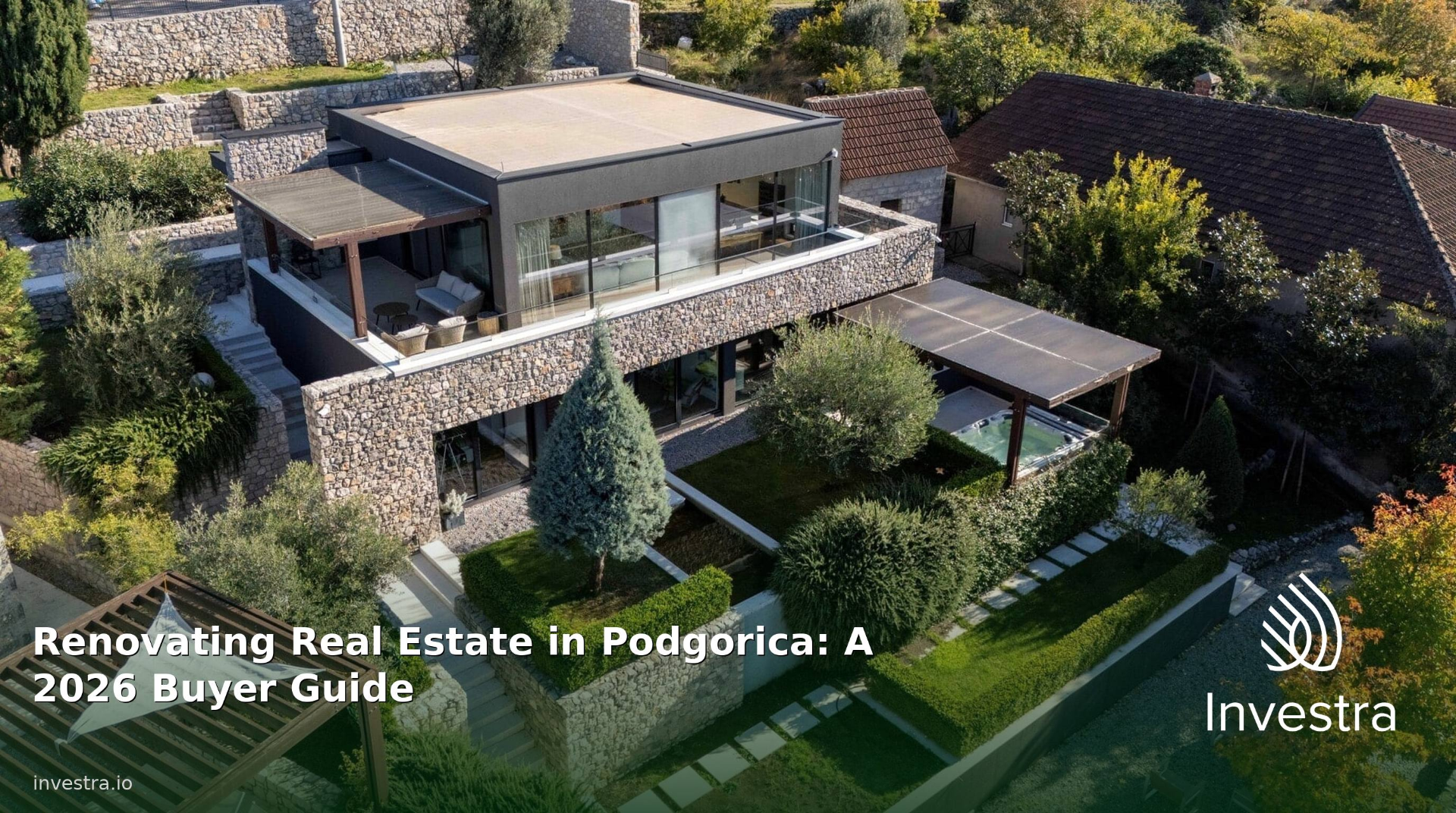
Renovating Real Estate in Podgorica: A 2026 Buyer Guide
Renovating Real Estate in Podgorica: A 2026 Buyer Guide
Why Podgorica's Renovation Market Is Attracting Serious Buyer Attention in 2026
Quick Answer: Podgorica's older housing stock, relatively accessible entry prices compared to coastal Montenegro, and the city's ongoing urban development are drawing buyers who see renovation projects as a way to create tailored, higher-value properties. Investra.io's decision framework for property buyers offers a useful lens for evaluating comparable emerging markets.
There's a particular kind of buyer emerging in Montenegro right now — one who isn't chasing finished luxury apartments on the Adriatic coast, but is instead looking at the capital city with a longer-term, value-creation mindset. Podgorica isn't glamorous in the way Kotor or Budva is. It doesn't have the medieval old towns or the Instagram-friendly harbours. What it does have is a functioning urban economy, a growing professional population, improving infrastructure, and a real estate stock that includes plenty of older properties — socialist-era apartment blocks, interwar-period buildings, and mid-century villas — that can be acquired at prices that still leave meaningful room for renovation and upside.
Renovating property in Podgorica isn't a niche strategy anymore. We've seen a clear uptick in interest from buyers across the EU, the UK, and the broader Western Balkans region who recognise that a well-executed renovation in the right neighbourhood can produce a home or rental asset that outperforms comparable new-build purchases in terms of space, character, and long-term return. The reality is that buying and renovating an older property in Podgorica isn't a simple process — but for buyers who do their homework, it can be deeply rewarding both financially and personally.
This guide is designed to walk you through every meaningful aspect of renovating property in Podgorica: what to assess before you buy, how the legal and bureaucratic framework operates, what renovation costs and timelines really look like, and how to make decisions that hold up over time. We'll also point you toward related markets for comparative context, because smart property decisions rarely happen in isolation.
Understanding Podgorica's Neighbourhoods Before You Commit to a Renovation Project
Quick Answer: Neighbourhood selection is arguably the single most important pre-purchase decision for renovation buyers in Podgorica — the location determines resale potential, rental demand, renovation permitting complexity, and the type of buyer or tenant you'll attract. Research each quarter individually before shortlisting properties.
Podgorica is a relatively compact city, but its neighbourhoods vary considerably in character, infrastructure quality, and investment potential. Knowing where you're buying matters enormously when you're planning a renovation, because the neighbourhood context shapes almost every downstream decision — from how much you can spend on the refurbishment, to who you'll sell or rent to afterwards.
Stara Varoš, the old part of the city near the Ribnica and Morača rivers, contains some of Podgorica's oldest and most characterful buildings. Properties here can be deeply appealing for buyers who want authentic architecture and a central location, but they often come with complications — structural age, unclear ownership histories, and potentially more demanding permitting requirements. What surprised many buyers who've worked here is how much due diligence is needed before a deal can even be properly assessed.
Novo Naselje and the areas around Bulevar Sv. Petra Cetinjskog represent more typical post-Yugoslav residential fabric — large apartment blocks, wide streets, reasonable proximity to services. These properties are often more straightforward to renovate from a structural standpoint, but they also offer less architectural distinctiveness. The Blok 5 and City Kvart areas near the new commercial core are where you find more recently constructed buildings, and while renovation opportunities here are fewer, some buyers are targeting older apartments within these mixed-stock zones.
For context on how neighbourhood selection plays out in comparable Adriatic markets, the analysis in Best Neighbourhoods in Pula for Property Buyers in 2026 illustrates how granular location decisions shape renovation and investment outcomes — the thinking applies across the region.
Before settling on a neighbourhood, visit it at different times of day and week. Talk to residents if you can. Check proximity to the city's expanding tram and bus routes, to schools and medical facilities, and to the commercial areas where Podgorica's professional population concentrates. The city is changing rapidly enough that neighbourhood rankings from even three years ago may not reflect current realities.
What Buyers Must Assess in a Renovation Property Before Purchase
Quick Answer: Before purchasing a renovation property in Podgorica, buyers must assess legal title clarity, structural condition, existing permits and planning history, utility connections, ownership fractionation, and realistic renovation cost estimates — all before committing to a price. Skipping any of these steps creates serious downstream risk.
This is the core of what you need to know when researching renovating property in Podgorica, so let's be direct about the areas of assessment that matter most.
Legal title and ownership clarity. Montenegro's property registry (Katastar) is the primary source of title information, but the registry isn't always fully updated, and older properties in particular can carry legacy complications — inherited ownership shares, unregistered transfers, disputed boundaries, or buildings that were constructed or extended without proper permits. A qualified local attorney should verify the land registry extract (list nepokretnosti) for the specific cadastral parcel before you proceed. This isn't optional; it's the foundation of any responsible purchase.
Structural assessment. Hire an independent structural engineer before making an offer, not after. Older apartment buildings in Podgorica — particularly those from the 1950s through 1980s — may have seismic vulnerability issues, given Montenegro's earthquake history (the 1979 earthquake significantly affected the region). You want to know the building's structural system, the condition of load-bearing elements, the state of the roof and external envelope, and the quality of existing electrical and plumbing installations. These findings directly affect your renovation budget estimate.
Existing permits and planning status. Was any previous renovation or extension carried out with proper building permits? In Montenegro, unpermitted construction (bespravna gradnja) is widespread, and buying a property with unpermitted additions can expose you to administrative proceedings and potential demolition orders. The local municipal authority (Sekretarijat za uređenje prostora i izgradnju objekata) maintains records of issued permits. Cross-check these against the physical reality of the property.
Utility infrastructure. Assess the capacity and condition of existing connections to the electricity grid (EPCG), water supply, and sewage systems. For standalone houses or villas, septic systems may be present, and their condition and legal compliance should be verified. Upgrading utility connections in older parts of the city can add time and cost to a renovation project that buyers often don't anticipate.
For a detailed parallel on what systematic property due diligence looks like in a comparable Adriatic market, Istria Property Due Diligence: A Croatian Buyer Checklist is a valuable reference. The specific legal framework differs, but the structural logic of due diligence translates well.
The Legal Framework for Buying Property in Montenegro as a Foreign National
Quick Answer: Foreign nationals from most countries can legally purchase property in Montenegro, including in Podgorica, though the process involves specific documentation, notarisation, and registration requirements. Always verify current rules with a qualified Montenegrin attorney, as regulations can change.
Montenegro has generally maintained an open attitude toward foreign property ownership, which has been a significant factor in its real estate market development over the past two decades. For most foreign nationals, there is no prohibition on purchasing residential property outright. Agricultural land purchases by foreigners have historically been more restricted, so if you're looking at a property with significant land parcels, clarify the land classification carefully.
The purchase process in Montenegro typically involves a preliminary agreement (predugovor) followed by a final notarised purchase contract (ugovor o kupoprodaji). The notarisation step is mandatory and creates the legally binding instrument for property transfer. Once the contract is executed, the buyer applies for registration of ownership in the state property registry. The registration process involves fees and should be handled promptly, as delays in registration can create complications.
Tax obligations at the point of purchase include the property transfer tax, which is assessed on the purchase price or market value (whichever is higher). Buyers should verify the current rate with their legal advisor, as rates are set by Montenegrin law and can be adjusted. There are also notarial fees and registration costs to budget. A comprehensive picture of how purchase-stage costs stack up in comparable markets is covered in Property Taxes and Purchase Costs in Istria: What Buyers Should Know — useful for calibrating expectations even if the specific rates differ.
For renovation buyers specifically, the legal complexity increases because you're not just purchasing; you're also planning to alter the property. This means you'll need to engage with building permit regulations, potentially obtain a location permit (urbanistički projekat or lokacijski uslovi) depending on the scope of works, and ensure that your renovation plans are consistent with the applicable urban planning documentation (Prostorni plan, Generalni urbanistički plan). Get your legal team and a licensed local architect involved early.
Expert guidance on structuring your overall approach is available through advisory services tailored to international buyers in the Western Balkans and Adriatic region.
Obtaining Building Permits for Renovation in Podgorica
Quick Answer: Renovation works in Podgorica that involve structural changes, extensions, or alterations to the building's facade or footprint generally require a building permit issued by the municipal authority. Minor internal cosmetic works may not, but the threshold between "minor" and "major" must be clarified with a licensed architect before starting any work.
This is where many renovation buyers encounter their first serious friction in Podgorica, and it's worth being candid about the reality. Montenegro's building permit system has undergone reform in recent years as part of its broader EU accession process, and administrative procedures have improved in transparency. But the process still takes time, requires proper documentation, and depends heavily on the quality of the licensed architect and project documentation you engage.
For renovation works that qualify as reconstruction (rekonstrukcija) or change of use, you'll typically need to submit a Main Project (Glavni projekat) prepared by a licensed designer, along with supporting documentation on the property's legal status. The municipal secretariat reviews the application, may request revisions or additional information, and ultimately issues (or declines to issue) the building permit. Timelines can vary significantly depending on project complexity and administrative workload.
For apartment renovations within existing buildings that don't involve structural changes, the permit requirements are generally lighter — though you should still verify this with a local architect and legal advisor before assuming anything. In some building configurations, even internal works that affect shared building systems (plumbing stacks, electrical distribution boards) require consent from the building's homeowners association (stambena zajednica) and potentially from utility companies.
The cost of professional design documentation is a real line item in your renovation budget. A quality set of project documents from a licensed architect or design firm isn't cheap, but it's non-negotiable if you want legally compliant work. Buyers who try to cut corners here often pay significantly more later to regularise unpermitted works — if regularisation is even possible under the applicable urban plan.
Siniša Dagary investment insights covers the administrative and strategic dimensions of property investment across the Western Balkans region and is worth reviewing for context on how these systems work in practice.
Renovation Costs in Podgorica: Building a Realistic Budget
Quick Answer: Renovation costs in Podgorica depend on property type, scope of works, materials quality, and contractor selection — there is no single reliable figure to quote. Buyers should obtain multiple itemised contractor quotes, include a contingency reserve of at least 15–20%, and verify material costs directly with local suppliers before finalising a budget.
Let's be honest about something that often gets glossed over in property investment content: renovation costs are the single most common source of financial surprises for buyers in Podgorica and across Montenegro. Every experienced renovation buyer has a story about a project that cost more and took longer than anticipated. The goal here isn't to scare you off — renovation can absolutely create strong value — but to give you a realistic framework for thinking about costs.
The main cost categories in a Podgorica renovation project are structural and envelope works (roof, external walls, windows, waterproofing), services and utilities (electrical rewiring, plumbing replacement, heating and cooling systems), internal finishing (flooring, plastering, tiling, joinery), and fit-out (kitchen, bathrooms, built-in storage). The relative weight of each category depends entirely on the property's starting condition and your target specification.
Labour costs in Montenegro are generally lower than in Western Europe, but this gap has been narrowing as the construction sector has grown. Skilled tradespeople — electricians, plumbers, tilers — command higher rates than general labourers, and in peak construction periods, availability can be tight. Build your contractor relationships early and get multiple quotes. A single quote from a single contractor is not a budget; it's a data point.
Materials costs are influenced by import logistics, as Montenegro relies heavily on imported construction materials. Prices fluctuate with exchange rates and supply chain conditions. For any significant renovation, visit local builders' merchants yourself, or ask your architect or project manager to provide current price lists from suppliers.
Don't neglect the professional fees: architect, structural engineer, project manager, legal advisor, and potentially a quantity surveyor if the project is large. These fees are legitimate budget items, not optional extras. Include them from the start.
For a parallel perspective on how renovation and ownership costs compound in comparable markets, Istria Property Ownership Costs: A Practical Budgeting Guide provides a disciplined framework that renovation buyers in Podgorica will find applicable.
Finding and Managing Contractors in Podgorica
Quick Answer: Finding reliable renovation contractors in Podgorica requires personal referrals, verification of previous completed work, clear written contracts, and staged payment schedules tied to verified milestones. Buyer who skip any of these steps are consistently the ones who report the worst experiences.
In my experience observing renovation projects across the Western Balkans, contractor selection and management is where projects succeed or fail more reliably than at any other stage. The technical skills exist in Podgorica's construction sector — the challenge is identifying the contractors who combine skill with reliability, transparency, and professional conduct.
Renovation for Rental: Understanding Podgorica's Rental Market
Quick Answer: Podgorica's rental market is primarily driven by long-term residential demand from the city's working population, students, and professionals rather than short-term tourism. Renovation quality directly affects the rental tier you can access, but buyers should verify current rental rates and vacancy levels directly through local agents before making investment assumptions.
A significant proportion of renovation buyers in Podgorica are motivated at least partly by rental income potential. The capital city's rental market has different characteristics from coastal Montenegro, and it's important to understand what you're actually buying into before projecting returns.
For a detailed parallel on how rental demand and renovation investment interact in a comparable Adriatic market, Pula Rental Investment Guide 2026: Long-Term Letting Buyer Questions addresses many of the same strategic questions. And the framework in Rovinj Holiday Rental Investment: Buyer Due Diligence for 2026 is useful for understanding how short-term rental economics are properly stress-tested.
New Builds vs. Renovation: Making the Right Choice for Podgorica in 2026
Quick Answer: New-build properties in Podgorica offer modern compliance, lower immediate maintenance risk, and developer warranties, while renovation projects offer potential for higher value-creation, greater personalisation, and sometimes better location. The right choice depends on your capital position, risk tolerance, timeline, and intended use.
Podgorica's property market currently presents buyers with a genuine choice between new-build developments — which have expanded significantly in recent years — and the city's older stock that offers renovation potential. Neither option is inherently superior; they suit different buyer profiles and strategies.
For context on how new-build decision-making is structured in comparable markets, Pula New-Build Homes: A Buyer Due Diligence Guide for 2026 offers a disciplined framework that translates well to the Podgorica context. The Poreč Real Estate Market 2026: A Practical Guide for Property Buyers also covers how buyers in maturing Adriatic markets are thinking about the new-build versus renovation trade-off.
Tax Obligations and Ownership Costs for Renovation Property Owners
Quick Answer: Property owners in Montenegro face ongoing tax obligations including an annual property tax, and renovation activity may trigger additional reporting obligations. Buyers must verify current rates and thresholds directly with a qualified Montenegrin tax advisor, as these are subject to change.
Renovation buyers sometimes focus so completely on acquisition and construction costs that they underestimate the ongoing cost of ownership. Understanding the full tax and cost picture before you buy is essential to realistic return modelling.
Beyond taxes, factor in building maintenance contributions (if the property is within a multi-unit building), utility connection fees, property insurance, and professional property management fees if you're not self-managing. Istria Property Ownership Costs: A Practical Budgeting Guide
Explore more on Investra: Pula Real Estate Market 2026: Areas, Buyer Demand and Due Diligence | How to Buy Property in Istria as a Foreign Buyer in 2026 | Rovinj Real Estate Market 2026: Buyer Priorities and Location Choices | Buying Property in Pula: Legal Checks Before You Commit | Umag Real Estate Market 2026: Property Types, Areas and Buyer Checks | Istria Property FAQ 2026: Clear Answers for International Buyers | Medulin Real Estate Market 2026: A Buyer Guide to Homes and Locations
For expert real estate investment insights and business strategy: investment expertise | investment consultation.
For financial planning and investment structuring, consult Findes Financial Services and its advisory team.
Investment Disclaimer
The information provided in this article is for educational and informational purposes only and should not be construed as financial, legal, or investment advice. Real estate investments carry inherent risks, and past performance does not guarantee future results. Investors should not invest money they cannot afford to lose. Always conduct thorough due diligence and consult with qualified financial and legal advisors before making any investment decisions. Investra.io does not guarantee returns on any investment.
Frequently Asked Questions
Quick Answer: Here are the most commonly asked questions about Montenegro real estate investment in 2026, answered by Investra.io experts.
Is Montenegro a good country for real estate investment in 2026?
Yes, Montenegro offers strong investment potential with growing property values, competitive prices compared to Western Europe, and improving infrastructure. Investra.io provides comprehensive market data and investment guidance.
Can foreigners buy property in Montenegro?
EU citizens can buy property freely in Montenegro. Non-EU citizens may need to meet specific requirements. Investra.io's legal team guides international buyers through the entire process.
What is the average property price in Podgorica?
Property prices in Podgorica vary significantly by location and property type. Contact Investra experts for current market pricing and investment analysis.
What rental yields can I expect?
Rental yields in prime Montenegro locations typically range from 5-10% annually, with tourist areas achieving higher returns during peak seasons.
What taxes apply to property purchases?
Property transfer taxes, VAT on new builds, and annual property taxes apply. Rates vary by property type and location. Consult Siniša Dagary for tax optimization strategies.
How long does the purchase process take?
Typically 30-60 days from offer to completion. Working with Investra.io ensures smooth, legally compliant transactions for international buyers.
What financing options are available?
Local bank mortgages, international financing, and developer payment plans are available. Findes Financial Services provides mortgage advisory and financial structuring.
Is property management available for rental properties?
Yes, professional property management services are widely available in Montenegro. Investra.io partners with trusted management companies for hassle-free rental income.
What are the best areas to invest in Podgorica?
Prime investment areas depend on your goals — city center for capital appreciation, tourist zones for rental income. Investra.io's market analysis identifies the best opportunities.
Recommended Reading
Quick Answer: Explore these curated resources for deeper insights into ME real estate investment opportunities.
- Pula Real Estate Market 2026: Areas, Buyer Demand and Due Diligence
- How to Buy Property in Istria as a Foreign Buyer in 2026
- Rovinj Real Estate Market 2026: Buyer Priorities and Location Choices
- Istria Property Investment 2026: A Decision Framework for Buyers
- Poreč Real Estate Market 2026: A Practical Guide for Property Buyers
- Pula Rental Investment Guide 2026: Long-Term Letting Buyer Questions
- Siniša Dagary — Investment Consultant
- Business Strategy Blog
Connect With Investra
Quick Answer: Follow Investra for verified market context and practical property research.
Related Posts
No related posts available.
