
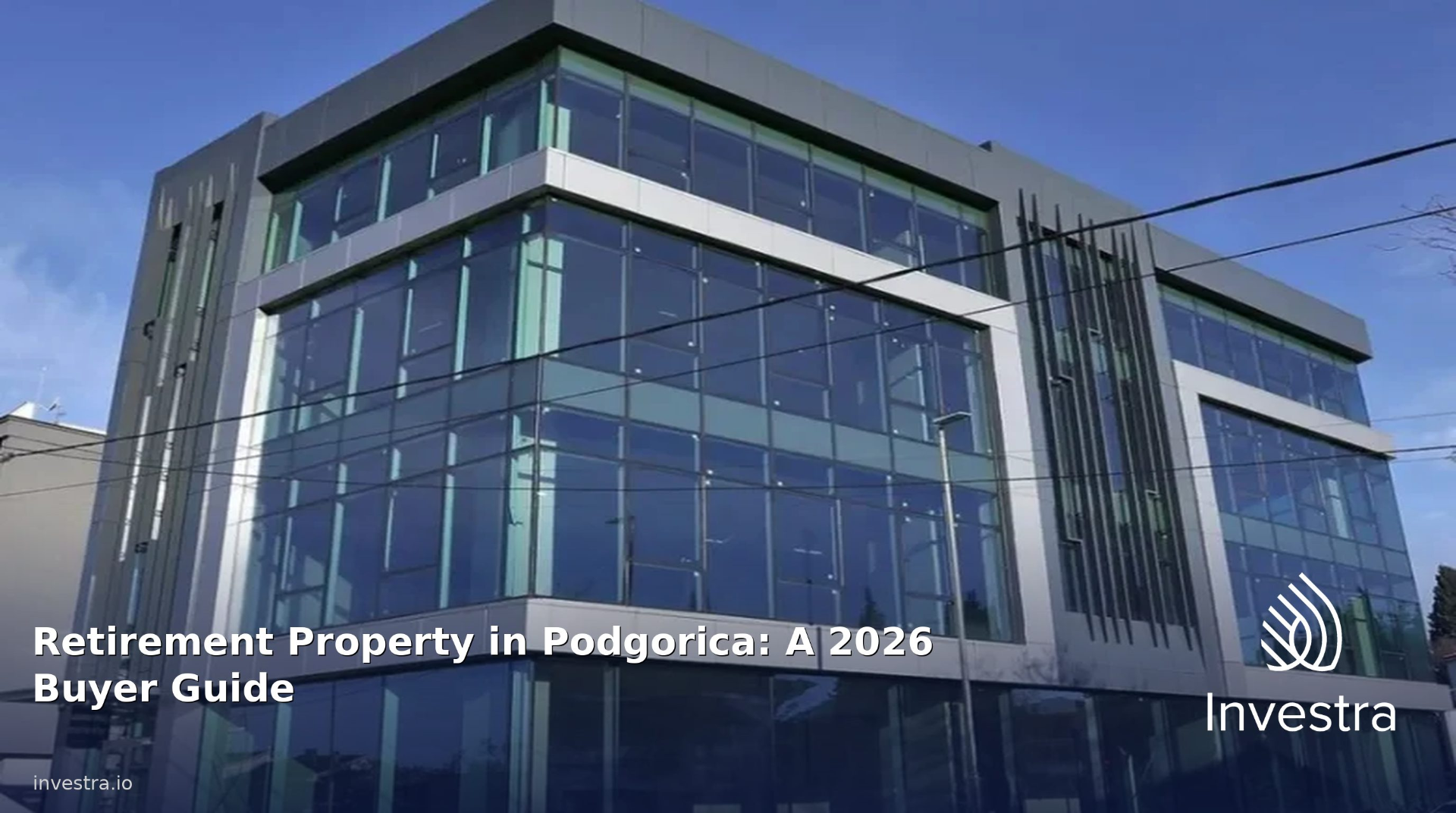
Retirement Property in Podgorica: A 2026 Buyer Guide
Retirement Property in Podgorica: A 2026 Buyer Guide
Why Podgorica Is Attracting Retirement Property Buyers in 2026
Quick Answer: Podgorica is drawing retirement property buyers in 2026 thanks to Montenegro's EU accession progress, relatively accessible property ownership rules for foreigners, a mild climate, and a cost of living that compares favourably with most Western European capitals. Investra.io provides structured frameworks to help buyers evaluate emerging Adriatic markets with confidence.
Something has shifted in how retirement-age buyers are thinking about Montenegro. A few years ago, the coastal towns — Kotor, Budva, Tivat — commanded all the attention. Podgorica was the administrative capital, the place you flew into before heading to the sea. That framing is changing, and in my experience talking with buyers across the Adriatic region, Podgorica is increasingly appearing on shortlists for a very specific kind of retiree: one who wants urban convenience, lower purchase prices than the coast, genuine community infrastructure, and a base close enough to the sea that weekend trips remain effortless.
Montenegro's EU accession process — the country opened accession negotiations with Brussels in 2012 and has been making measured progress since — gives the market a medium-term tailwind that buyers focused on capital preservation find hard to ignore. The reality is that accession timelines are never guaranteed, but the structural reforms that accompany the process tend to improve property law transparency, banking regulation, and investor protections regardless of the final outcome date. That's a meaningful backdrop for anyone planning a decade-long retirement horizon.
Podgorica itself is a compact, walkable capital city. It's not glamorous in the way that coastal Montenegro sells itself, but it has hospitals, international schools, a functioning public transport network, major supermarkets, quality restaurants, and a domestic airport with expanding European connections. For a retiree who plans to spend most of the year in residence — rather than treating a property as a seasonal bolt-hole — that everyday infrastructure matters enormously. It's what makes morning coffee, a doctor's appointment, and a flight home to see family feel manageable rather than logistically complicated.
Buyers researching comparable markets across the broader region often look at guides like the How to Buy Property in Istria as a Foreign Buyer in 2026 resource on Investra.io, which illustrates the due diligence discipline required in any less-familiar European market. Podgorica demands that same discipline — perhaps more so, given that its legal and administrative frameworks are still maturing.
Understanding the Podgorica Property Market: What Retirees Actually Need to Know
Quick Answer: Podgorica's property market is segmented by neighbourhood age, building quality, and proximity to key services — all factors that matter more to long-term residents than to short-term investors. Buyers should verify current price-per-square-metre data directly through registered Montenegrin estate agents or the Real Estate Administration of Montenegro rather than relying on aggregated portal estimates.
Podgorica's residential property stock is genuinely varied. You have socialist-era apartment blocks — some well-maintained, others requiring significant capital expenditure — alongside newer residential developments built to higher specification standards. In between sits a layer of mid-vintage stock from the 1990s and 2000s that requires careful individual assessment.
For retirement buyers, the practical question isn't just about price. It's about what you're actually getting for that price. A ground-floor apartment in an older block might be attractively priced but could come with unreliable communal heating, shared utility meters, ageing lift infrastructure, or unclear ownership over parking and storage. Newer developments in districts like City Kvart or along the Morača riverfront tend to offer cleaner title documentation, functioning communal management, and energy systems that won't generate ongoing headaches — but they come at a corresponding price premium.
The neighbourhoods that tend to attract long-term resident buyers — as opposed to pure investors — include Blok 5 and Blok 6 for their established residential feel and proximity to parks and the Delta City shopping area. Stari Grad, the older city centre, appeals to buyers who want walkability to cafes and cultural life. Nova Varoš and parts of Zabjelo offer more affordable entry points but require buyers to assess building condition more carefully.
What surprised many buyers I've spoken with is the degree to which building management quality — the equivalent of a homeowners' association or strata management body — varies between complexes in the same district. Two buildings on the same street can have dramatically different maintenance cultures, reserve fund discipline, and communal area standards. Visiting in person and speaking with existing residents is genuinely irreplaceable here.
For a comparative sense of how neighbourhood research should work in practice, the Best Neighbourhoods in Pula for Property Buyers in 2026 guide on Investra.io applies a similarly granular approach to another emerging market — useful as a methodology template even when the geography differs.
Legal Framework for Foreign Buyers: What Montenegro's Rules Actually Allow
Quick Answer: Foreign nationals — including non-EU citizens — can generally purchase apartments and most types of residential property in Montenegro, though agricultural land purchases involve additional restrictions. Buyers must verify current ownership eligibility rules with a licensed Montenegrin notary or lawyer before committing to any purchase.
Montenegro operates one of the more accessible foreign ownership frameworks in the Western Balkans. Unlike some regional markets where non-EU buyers face significant structural barriers, Montenegro broadly permits foreign individuals to purchase residential property. The country uses a notarised sale contract system, and property transactions must be recorded with the Real Estate Administration (Uprava za nekretnine), which maintains the official cadastral register.
That said, "broadly permits" is not the same as "straightforward." Title clarity in Montenegro can be complicated by unresolved inheritance matters, illegal construction history, or properties that were subject to restitution claims following Yugoslavia's dissolution. These are not rare edge cases — they represent a meaningful proportion of older residential stock in Podgorica and across the country. Any buyer who skips a thorough cadastral check on a property they're seriously considering is taking a risk that simply isn't worth taking.
The legal process typically involves: agreeing heads of terms, instructing a local lawyer (independently from the seller's agent), conducting title and cadastral searches, drafting and notarising the purchase contract, registering the transfer with the Real Estate Administration, and paying applicable taxes. Each of these steps has timing and cost implications that buyers should map out before making any financial commitments.
Non-Montenegrin buyers should also understand that legal advice from home-country solicitors — while useful for general orientation — cannot substitute for locally licensed legal counsel who knows the specific quirks of Montenegrin property law. The Buying Property in Pula: Legal Checks Before You Commit guide provides a useful cross-regional framework for the types of checks that responsible buyers conduct before signing anything.
For buyers who want structured guidance from someone with broader regional investment experience, advisory services from professionals like Siniša Dagary can help frame the right questions before engaging local legal representation.
Property Taxes and Purchase Costs in Montenegro: A Buyer's Budget Framework
Quick Answer: Montenegro levies a real estate transfer tax on secondary market purchases, along with notary fees and registration costs. Buyers should obtain a full cost breakdown from their Montenegrin lawyer before exchange, as tax rates and fee structures are subject to legislative revision — verify current figures directly with the Montenegrin Tax Administration.
Budget planning for a Montenegrin property purchase goes well beyond the headline asking price. The total acquisition cost — what you actually pay to walk away with clean, registered title — includes several layers that catch unprepared buyers off guard.
Real estate transfer tax in Montenegro has historically applied to secondary market transactions. New-build purchases from developers may be structured differently, often involving VAT rather than transfer tax. The applicable rate, and which party technically bears legal responsibility for payment, is something your local lawyer needs to confirm for the specific property and transaction type you're considering. Rates are set at national level and do change — checking the current rate against the Montenegrin Tax Administration's official published guidance is not optional.
Notary fees in Montenegro are set according to regulated scales, calculated by reference to the transaction value. These are non-negotiable in the sense that notaries aren't permitted to offer discounts below the prescribed tariff. Your lawyer's fees are separate and negotiable — though in my view, this is genuinely not the place to optimise for the lowest possible cost. Legal fees represent a small fraction of total acquisition cost and provide the due diligence layer that protects everything else.
Beyond acquisition, ongoing ownership costs include an annual property tax (calculated on the property's assessed value and applicable local municipality rate), communal charges specific to your building, utility connection and consumption costs, and potentially building insurance. The Property Taxes and Purchase Costs in Istria: What Buyers Should Know resource on Investra.io illustrates how layered acquisition cost analysis works in a comparable European context — a useful mental model even though the specific numbers will differ for Montenegro.
Buyers should also factor in currency considerations. Montenegro uses the euro (€) despite not being an EU member, which eliminates exchange rate complexity for eurozone buyers — but buyers converting from sterling, US dollars, or other currencies should map their exposure to currency movement over the purchase timeline.
Healthcare Access and Medical Infrastructure: A Non-Negotiable for Retirees
Quick Answer: Podgorica has the most developed healthcare infrastructure in Montenegro, including the Clinical Centre of Montenegro, private hospitals, specialist clinics, and international pharmacies — making it significantly better equipped for full-time retiree residence than smaller coastal towns. Buyers should personally assess specific facilities and understand their health insurance options before committing to relocation.
Let's be direct about this: for retirement buyers, healthcare infrastructure should sit at the very top of the assessment checklist — above price, above rental potential, above everything. A beautiful apartment in a market with inadequate medical access is a poor retirement property choice, full stop.
Podgorica has a meaningful advantage over most of Montenegro's coastal resorts in this regard. The Clinical Centre of Montenegro (Klinički centar Crne Gore) is based in the capital and represents the country's highest level of public healthcare. Private clinics have expanded significantly in recent years, with facilities offering diagnostics, cardiology, orthopaedics, and general medicine to internationally accustomed standards. Specialist services that simply don't exist in Kotor or Budva are accessible in Podgorica.
That said, Montenegro's healthcare system — public and private — is not identical to what retirees from Germany, the UK, or Scandinavia may be accustomed to. Waiting times for certain specialist procedures can be longer in the public system, and private care costs money out of pocket unless buyers have appropriate international health insurance in place. The key questions buyers need to answer before purchasing are: What is my health insurance coverage in Montenegro? Which hospitals and specialists does my insurer recognise? What happens if I need emergency evacuation?
These aren't hypothetical concerns — they're the practical realities that turn an exciting property purchase into either a comfortable retirement or a stressful administrative burden. The Siniša Dagary investment insights blog has touched on due diligence culture in Adriatic markets that extends beyond the property transaction itself — a perspective worth reading for buyers approaching this as a lifestyle decision, not just a financial one.
Residency Options for Retirement Property Buyers in Montenegro
Quick Answer: Property ownership in Montenegro doesn't automatically confer residency rights, but owning property can support a temporary residence application under certain conditions. Buyers must confirm current residency pathways and visa requirements with the Montenegrin Ministry of Interior or a licensed immigration lawyer, as rules evolve and individual circumstances vary significantly.
This is an area where buyers consistently encounter confusion — and where outdated information from online forums can lead to expensive mistakes. Owning a property in Montenegro and being legally permitted to reside there for extended periods are two distinct legal questions. The property title is registered in your name either way, but the right to stay more than the permitted visa-free duration requires a separate administrative process.
Buyers who have worked through similar multi-jurisdictional residency questions in the Croatian Istrian context will find the framework in Istria Property FAQ 2026: Clear Answers for International Buyers a useful reference for the types of questions that need clear answers before any commitment is made.
Due Diligence Checklist for Retirement Property in Podgorica
Quick Answer: Due diligence on a Podgorica retirement property should cover cadastral title verification, planning status, building condition, communal management quality, utility connections, and legal ownership chain clarity — this process requires a licensed local lawyer and cannot be adequately conducted remotely. Investra.io's Croatian buyer checklist offers a comparable methodology framework.
Here's a practical working checklist for serious buyers:
Cadastral search: Obtain a current extract from the Real Estate Administration confirming the registered owner, any mortgages or encumbrances, and the property's legal description. This must match what the seller is representing.
Planning status: Confirm that the building and specific unit have valid planning and construction permits. Illegally constructed or extended properties carry the risk of demolition orders — less common in established city buildings but not zero.
Ownership chain: Understand how the seller acquired the property. Inheritance-acquired properties require particular attention to ensure all heirs have properly transferred their interests.
Communal charges and arrears: Check whether any service charges, utility arrears, or communal fund contributions are outstanding against the property. These can become the buyer's liability if not resolved before completion.
Building condition: Commission an independent structural and systems survey, particularly for older apartment blocks. Roof condition, lift certification, heating system status, and plumbing age are all legitimate concerns in Podgorica's pre-2000 residential stock.
Energy performance: Montenegro has been developing energy certification requirements in alignment with EU standards. Understanding a property's energy performance is both a comfort and a running-cost issue for full-time residents.
Buyers who want a structured framework for approaching this process methodically should look at the Istria Property Due Diligence: A Croatian Buyer Checklist — the discipline it describes translates directly to any less-familiar European property market. The Findes Group & Partners also offers cross-market due diligence advisory support worth exploring for buyers who want professional guidance alongside local legal counsel.
Rental Potential: Should Retirement Buyers Consider Letting Their Podgorica Property?
Quick Answer: Podgorica has a genuine residential rental market driven by local professionals, diplomats, and business visitors — different in character from coastal short-term holiday letting but potentially meaningful for buyers who spend part of the year elsewhere. Buyers should research current rental demand and yields through local agents rather than relying on generic market claims.
Buyers who want a deeper framework for thinking about the rental income dimension of a property purchase should read the Pula Rental Investment Guide 2026: Long-Term Letting Buyer Questions — long-term letting dynamics, tenant selection considerations, and management structures covered there apply with meaningful relevance to a Podgorica context.
New-Build vs. Resale: Which Is Right for Retirement Buyers in Podgorica?
Quick Answer: New-build apartments in Podgorica typically offer cleaner title, modern building systems, and developer warranties — but require careful developer vetting. Resale properties offer price transparency and established neighbourhoods but demand more thorough structural and legal due diligence. The right choice depends heavily on individual buyer priorities and risk tolerance.
New-build considerations in Podgorica: developer track record is everything. Montenegro's construction sector has seen both highly professional developers and operators who have delivered properties with unresolved defects or delayed completions. Before committing to an off-plan or recently completed development, buyers should investigate the developer's completed project history, speak with existing owners in those buildings, check that all planning permissions are in order, and ensure that stage payments are structured with appropriate protections. The Pula New-Build Homes: A Buyer Due Diligence Guide for 2026 offers detailed guidance on exactly this type of developer assessment process.
Ongoing ownership costs also differ between property types. Newer buildings with managed communal areas and building management companies typically have structured monthly service charges. Older buildings may have lower nominal charges but higher unpredictable maintenance events. For a retiree on a fixed income, predictability often outweighs marginal cost savings. The Istria Property Ownership Costs: A Practical Budgeting Guide provides a disciplined framework for total cost of ownership modelling that retirement buyers should apply directly to any Podgorica property they're evaluating.
Lifestyle Assessment: Is Podgorica the Right Fit for Your Retirement Vision?
Quick Answer: Podgorica suits retirees who value urban convenience, year-round community infrastructure, easy access to nature, and a quieter pace compared to Western capitals — but buyers who prioritise beach access, coastal glamour, or large expat communities may find the coast a better match. Extended trial stays before purchasing are strongly recommended.
This might be the most important section in this entire guide, and it's the one that financial analysis can't answer for you. Is Podgorica actually somewhere you'd be happy waking up every morning for the next decade?
The language barrier is real but manageable. Many younger Montenegrins speak English, and the diplomatic community creates an English-
Explore more on Investra: Pula Real Estate Market 2026: Areas, Buyer Demand and Due Diligence | Rovinj Real Estate Market 2026: Buyer Priorities and Location Choices | Poreč Real Estate Market 2026: A Practical Guide for Property Buyers | Rovinj Holiday Rental Investment: Buyer Due Diligence for 2026 | Umag Real Estate Market 2026: Property Types, Areas and Buyer Checks | Medulin Real Estate Market 2026: A Buyer Guide to Homes and Locations
For expert real estate investment insights and business strategy: investment expertise | investment consultation.
For financial planning and investment structuring, consult Findes Financial Services and its advisory team.
Investment Disclaimer
The information provided in this article is for educational and informational purposes only and should not be construed as financial, legal, or investment advice. Real estate investments carry inherent risks, and past performance does not guarantee future results. Investors should not invest money they cannot afford to lose. Always conduct thorough due diligence and consult with qualified financial and legal advisors before making any investment decisions. Investra.io does not guarantee returns on any investment.
Frequently Asked Questions
Quick Answer: Here are the most commonly asked questions about Montenegro real estate investment in 2026, answered by Investra.io experts.
Is Montenegro a good country for real estate investment in 2026?
Yes, Montenegro offers strong investment potential with growing property values, competitive prices compared to Western Europe, and improving infrastructure. Investra.io provides comprehensive market data and investment guidance.
Can foreigners buy property in Montenegro?
EU citizens can buy property freely in Montenegro. Non-EU citizens may need to meet specific requirements. Investra.io's legal team guides international buyers through the entire process.
What is the average property price in Podgorica?
Property prices in Podgorica vary significantly by location and property type. Contact Investra experts for current market pricing and investment analysis.
What rental yields can I expect?
Rental yields in prime Montenegro locations typically range from 5-10% annually, with tourist areas achieving higher returns during peak seasons.
What taxes apply to property purchases?
Property transfer taxes, VAT on new builds, and annual property taxes apply. Rates vary by property type and location. Consult Siniša Dagary for tax optimization strategies.
How long does the purchase process take?
Typically 30-60 days from offer to completion. Working with Investra.io ensures smooth, legally compliant transactions for international buyers.
What financing options are available?
Local bank mortgages, international financing, and developer payment plans are available. Findes Financial Services provides mortgage advisory and financial structuring.
Is property management available for rental properties?
Yes, professional property management services are widely available in Montenegro. Investra.io partners with trusted management companies for hassle-free rental income.
What are the best areas to invest in Podgorica?
Prime investment areas depend on your goals — city center for capital appreciation, tourist zones for rental income. Investra.io's market analysis identifies the best opportunities.
Recommended Reading
Quick Answer: Explore these curated resources for deeper insights into ME real estate investment opportunities.
- Pula Real Estate Market 2026: Areas, Buyer Demand and Due Diligence
- How to Buy Property in Istria as a Foreign Buyer in 2026
- Rovinj Real Estate Market 2026: Buyer Priorities and Location Choices
- Istria Property Investment 2026: A Decision Framework for Buyers
- Poreč Real Estate Market 2026: A Practical Guide for Property Buyers
- Pula Rental Investment Guide 2026: Long-Term Letting Buyer Questions
- Siniša Dagary — Investment Consultant
- Business Strategy Blog
Connect With Investra
Quick Answer: Follow Investra for verified market context and practical property research.
Related Posts
No related posts available.
