
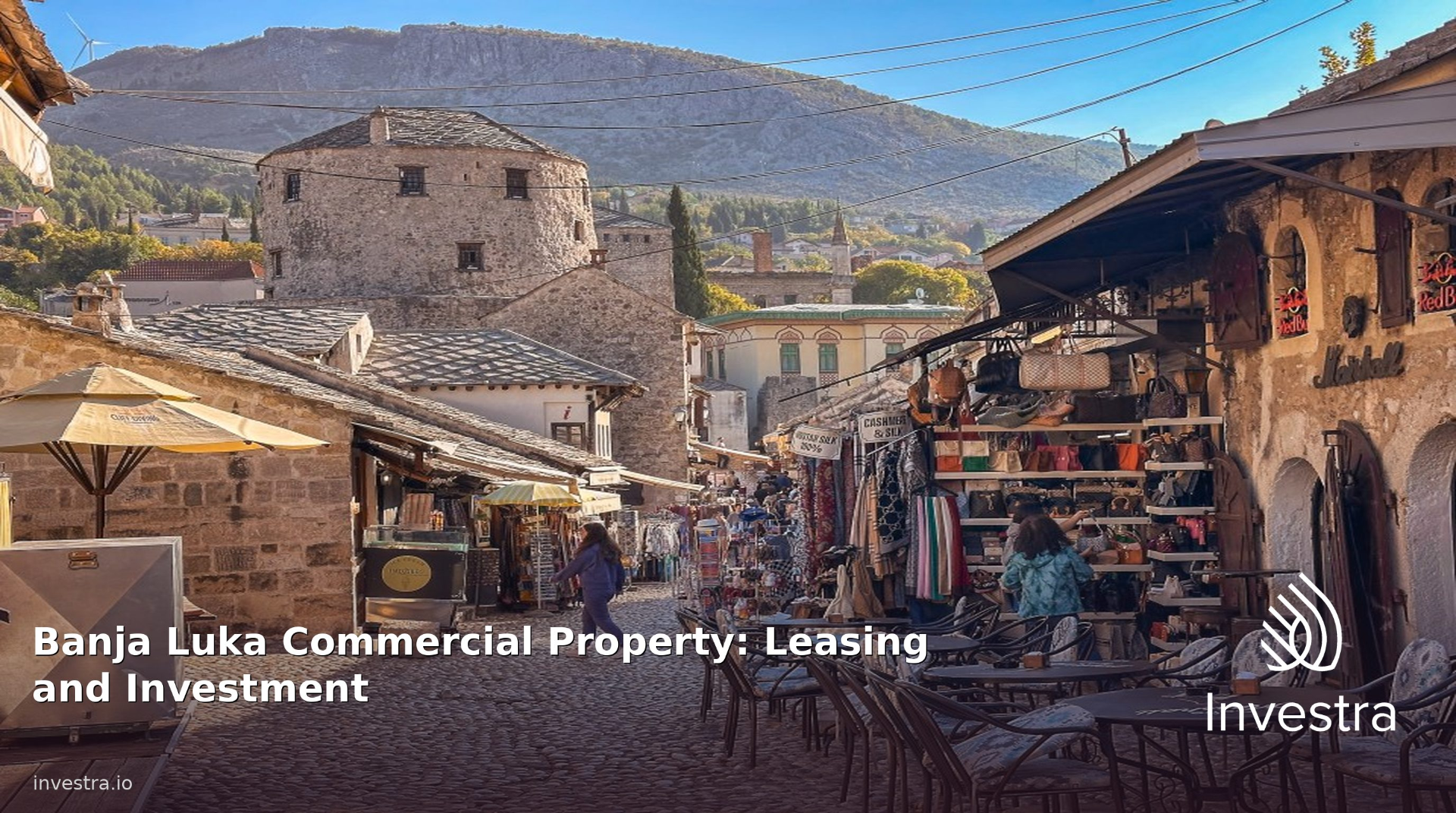
Banja Luka Commercial Property: Leasing and Investment
Banja Luka Commercial Property: Leasing and Investment
Overview of Banja Luka commercial property
Quick Answer: Banja Luka commercial property covers a spectrum from high-street retail and office blocks to light industrial units and hospitality assets; prospective buyers should combine local market reports with on-the-ground inspections and expert advice. For up-to-date market context see the Banja Luka real estate market guide.
Banja Luka is the administrative and economic heart of Republika Srpska. The city's commercial stock reflects decades of mixed planning — Austro-Hungarian façades near the centre, socialist-era blocks, and newer private developments along arterial routes. In my experience, investors are attracted to Banja Luka for its regional role: public institutions, universities, and a broad SME base create steady demand for offices, small warehouses and retail space.
But what should buyers know about Banja Luka commercial property before they write an offer? First: market transparency varies by asset class. Office leasing and modern retail often come with clearer comparables; industrial lots and older buildings require more scrutiny. Second: local planning rules and municipal permits often impact conversion potential — a retail unit's prospects differ sharply from a warehouse’s. For actionable guidance on buying in the city, consult practical buyer guides like Buying property in Banja Luka and the local new-build overview at Banja Luka new-build guide.
The reality is buyers need to balance immediate cashflow prospects with long-term adaptability. A block of small offices might be resilient in a downturn; a single-anchor retail unit can be vulnerable if consumer patterns change. We’ve seen international buyers surprised by the importance of local tenant relationships and municipal bureaucracy — so groundwork matters.
Why investors consider Banja Luka commercial property
Quick Answer: Investors look to Banja Luka commercial property for its regional role, tenant mix and redevelopment opportunities; assessing supply-demand dynamics and local policy changes is essential before committing capital.
Why Banja Luka? It’s a question I hear a lot from investors considering Bosnia and Herzegovina. The answer isn’t a single statistic; it’s a combination of factors. The city is a regional hub with public sector anchors, a university population that supports services, and an industrial hinterland. That combination creates predictable pockets of commercial demand — from ground-floor retail to logistics nodes at the city edge.
Still, investment decisions are about risk-adjusted returns. What surprised many buyers is how much subtleties matter: proximity to main roads, parking availability, and even seasonal footfall patterns near market districts. The best opportunities often emerge where an underperforming asset can be repositioned: a tired retail frontage converted into a café cluster, or an old industrial shed adapted for light manufacturing or storage.
If you’re evaluating Banja Luka commercial property, ask yourself three pragmatic questions: Who are the likely tenants? What capex will the property need? And how easy is it to verify title, permits and tax history? For tenant and leasing guidance see the localized rental perspective in Banja Luka rental market guide. For neighbourhood-level insights consult the Banja Luka neighbourhood guide.
Types of commercial property in Banja Luka
Quick Answer: The main commercial categories are retail, office, industrial/warehouse, hospitality and mixed-use; each class has different tenant profiles and due diligence needs.
Commercial real estate isn’t one-size-fits-all. In Banja Luka you’ll encounter several common categories and hybrid forms. Retail ranges from high-street shops in the historic core to suburban strip centres. Offices include small professional suites, medium-sized business centres and stand-alone corporate buildings. Light industrial and logistics properties cluster at city peripheries where land is cheaper and access to arterial roads is better. Hospitality assets — guesthouses and small hotels — exist, especially where tourism demand to the Vrbas river and nearby mountains is seasonally strong.
Each type imposes different investment demands. Retail requires close attention to footfall and catchment demographics. Offices need reliable utilities, flexible floorplates and modern communications infrastructure. Industrial buyers should check load-bearing capacity, access for HGVs, and zoning permissions. Hospitality investors must consider tourism trends, local marketing channels and seasonal occupancy management.
Understanding the asset class helps shape valuation discussions and renovation plans. For instance, a building with mixed retail and office components may demand separate leasing strategies for each floor. If you’re exploring new-build or renovation projects in the city, review the practical advice in the Banja Luka new-build guide and compare cross-market approaches with guides from Sarajevo and Mostar (Sarajevo new-build guide, Mostar new-build guide).
Legal framework and ownership for foreign buyers
Quick Answer: Foreign ownership of Banja Luka commercial property is possible but requires careful legal checks and title verification; consult local specialists and official registries to confirm current rules and restrictions.
Legal clarity matters more than attractive yields. The laws governing property ownership in Bosnia and Herzegovina can be complex because land administration is split across entities and municipalities. That means rules applicable in Republika Srpska — where Banja Luka sits — may differ from those in the Federation. I always recommend starting with a legal gap analysis: confirm title, encumbrances, zoning and any public restrictions that affect commercial use.
Buyers should obtain official land registry extracts and verified ownership documents from municipal authorities. In my experience, buyers who skip primary-record verification find hidden encumbrances later — claims, easements or incomplete cadastral updates. A local lawyer can confirm whether the property is registered under the correct legal parcel, whether any planning permits are outstanding and what steps are needed to transfer ownership to a foreign entity.
For practical step-by-step advice on cross-border transactions, Investra’s “Buying property in Banja Luka” guide is a useful starting point. If legal strategy or negotiation is central to your plan, consult experienced advisors such as advisory services and local law firms linked to Findes Group & Partners.
Due diligence checklist for commercial acquisitions
Quick Answer: Due diligence should cover title, zoning, tax records, environmental status, structural condition and lease documentation; always verify records at municipal registries and with independent professionals.
Due diligence is where deals live or die. What we’ve seen repeatedly is that careful, early diligence reduces surprises after completion. Start with property title and cadastral records at the municipal office. Confirm that the seller is the registered owner and that the plot boundaries match survey plans. Next, check zoning and planning permissions to make sure the intended commercial use is allowed.
Beyond documents, a thorough physical inspection is indispensable: structural integrity, roof condition, HVAC, utilities and fire safety systems all influence capex and insurability. For industrial sites, request environmental assessments — contamination, waste disposal history, and compliance with local environmental regulations can create major liabilities.
Lease due diligence is equally important if the property is tenanted. Review existing lease contracts, deposit accounts, rent escalation clauses and any tenant-side defaults. If leases are in a local language, get certified translations and legal interpretations. For practical templates and procedural checklists, consult advisory content such as Investra’s sector guides and professional services like investment consultation or the Findes advisory team.
Leasing market dynamics and tenant profiles
Quick Answer: Leasing demand in Banja Luka varies by asset class — public and professional services anchor office space while retail relies on local consumer patterns — so align asset strategy with tenant profiles and lease structures.
Understanding who your tenants will be matters more than guessing an average rent. In Banja Luka, office demand often comes from local businesses, government or education-related services looking for practical, affordable space. Retail depends on local footfall and the presence of national or regional chains. Industrial tenants tend to be small-to-medium manufacturers or logistics operators that need easy road access.
Lease length and security can differ significantly. Many local commercial leases are shorter-term than international institutional standards; tenant turnover can be higher in speculative retail locations. What surprised buyers is the prevalence of handshake agreements or informal renewals — which look convenient until disputes arise. That’s why legal clarity in lease drafting is so important.
For strategic advice on leasing models and short-term letting practices, Investra’s localized rental guides provide context: Banja Luka rental market guide. To compare approaches in larger markets, read the Sarajevo and Mostar rental perspectives at Sarajevo rental market guide and Mostar rental market guide.
Taxes, fees and operating costs for commercial properties
Quick Answer: Commercial property ownership carries taxes and ongoing operating expenses that differ by property type and municipality; verify current rates and tax treatments with local tax authorities or qualified accountants.
Taxes and operating costs are a constant part of owning commercial property. I avoid giving hard numbers because tax regimes change; instead, focus on how to verify them. Start by asking municipal tax offices for the current property tax schedules and any recent changes. Check whether VAT applies to the sale or to certain types of commercial services. Work with a local accountant to understand corporate tax implications if you hold the property through an entity.
Operating costs include utilities, common-area maintenance, insurance and municipal fees. For older buildings, factor in higher maintenance and energy expenses unless upgrades have been performed. The reality is that a seemingly cheap purchase can become expensive once deferred maintenance and local utility tariffs are factored in.
If you’re uncertain which taxes apply to an acquisition, consult local specialists. Useful starting points include the procedural buying guides on Investra and advisory services like Siniša Dagary who can point you to relevant tax professionals. For broader cross-market comparisons, Investra’s regional guides — such as the Sarajevo or Tuzla buying guides — can help set expectations: Tuzla real estate market guide and Buying property in Tuzla.
Financing commercial acquisitions in Banja Luka
Quick Answer: Financing options exist locally and regionally but will depend on borrower profile, collateral and lender policies; speak with local banks and specialist lenders to discover current terms and documentation requirements.
Local banks and regional lenders provide most commercial mortgage finance, though availability and documentation differ from country to country. From what we’ve observed, banks will want clear title, audited financials if the buyer is a company, and independent valuations. Some lenders prefer local-currency income streams; others are comfortable with foreign currency when tenants are multinational.
If you need use, start conversations early and prepare a tight financing package: clear ownership history, business projections for the leased asset, and a conservative capex plan. Work with mortgage brokers or advisory firms to compare offers. Two organisations that can point you to experienced finance partners are Findes Group & Partners and Investra’s advisory network. Local advisory consultants like Siniša Dagary profile can also help structure introductions to lending partners.
Because lending environments change rapidly, you should verify current lending criteria with banks in Banja Luka and request indicative terms in writing. That will give you an accurate sense of required equity, loan-to-value expectations and timeline to draw funds.
Valuation, appraisal and verifying market data
Quick Answer: Accurate valuation requires local comparables, independent appraisals and verification of lease terms; use multiple data sources and on-site inspections to confirm market assumptions.
Valuation is part art, part science. Appraisers rely on recent sales of comparable assets, rental streams, replacement cost and income projections. The problem many buyers face is that comparable data for Banja Luka can be thin for niche asset classes. That’s why I recommend multiple verification steps: commission an independent valuation, cross-check with local brokers’ evidence, and inspect physical assets personally.
When appraisers use projected cashflows, ask for the assumptions behind vacancy rates, operating cost inflation and rent escalation. If you rely on published market reports, verify the dates and methodologies — older data may not reflect recent policy changes or large new developments. For local published resources, Investra’s market guides for Banja Luka, Sarajevo and Mostar are useful reference points: Banja Luka real estate market guide, Sarajevo real estate market guide, Mostar real estate market guide.
In practice, a pragmatic approach works best: base your offer on conservative assumptions, require financial warranties in the sale contract when possible, and keep contingency reserves for unforeseen capital expenditure. If you’re unsure about appraisal selection, consult specialists such as Siniša Dagary investment insights for recommendations on local valuers and market research providers.
Renovation, repositioning and new-build opportunities
Quick Answer: Repositioning older stock and purpose-built new projects are common strategies for adding value to Banja Luka commercial property; assess permit timelines, contractor availability and local demand before budgeting.
Transformation is where value often appears. Whether you’re converting a worn retail frontage into a cluster of specialty outlets, refurbishing offices to modern standards, or undertaking a small build-to-suit scheme for industry, the work is always local and detail-heavy. The first task is a realistic feasibility study: check planning rules, utility capacity, and community reactions to proposed changes.
Contractor market conditions matter. We’ve seen schedules slip because of materials or labour shortages, and costs can change quickly. That’s why phasing and contingency are key. If the asset sits near a redevelopment corridor or planned municipal infrastructure upgrade, repositioning may yield outsized gains; confirm such municipal plans with the relevant town planning office.
For a practical reference on renovation and new development in the region, see Investra’s city guides such as Banja Luka new-build guide, and compare methodologies used in Sarajevo and Mostar: Sarajevo new-build guide, Mostar new-build guide. If you need project support, consider contacting an advisor like advisory services who can help scope budgets, timelines and contractor procurement.
Choosing the right professional team for your project
Quick Answer: Assemble a local team — lawyer, accountant, surveyor, broker and project manager — with proven regional experience; personal references and past transaction records are the best trust signals.
No investor succeeds alone. The difference between a smooth acquisition and a costly headache is often the quality of the local professional team. You’ll need a lawyer familiar with Republika Srpska land law, an accountant who understands local tax filings, a chartered surveyor for condition reports, and a broker who knows tenant demand in Banja Luka.
Who should you approach? Start with referrals: ask investors who’ve completed deals in the city. Look for advisors who can share transaction case studies, not just marketing language. For institutional-style guidance, organisations such as Findes Group & Partners have networks in the region. For individual advisory, consider reaching out to specialists like Siniša Dagary and review his profile at Siniša Dagary profile.
Practical tip: include local experts early — before you sign preliminary agreements. They’ll identify title issues, confirm permit requirements and help shape realistic timelines. We’ve seen deals stall because buyers only engaged lawyers after contracts were drafted. Avoid that mistake. For additional practical buyer guidance, Investra’s city-specific pages like Buying property in Banja Luka are helpful starting points.
Investment Disclaimer
Quick Answer: Investment Disclaimer — Expert analysis and investment guidance from Investra.io, your trusted BA real estate platform.
The information provided in this article is for educational and informational purposes only and should not be construed as financial, legal, or investment advice. Real estate investments carry inherent risks, and past performance does not guarantee future results. Investors should not invest money they cannot afford to lose. Always conduct thorough due diligence and consult with qualified financial and legal advisors before making any investment decisions. Investra.io does not guarantee returns on any investment.
Frequently Asked Questions
Quick Answer: Frequently Asked Questions — Expert analysis and investment guidance from Investra.io, your trusted BA real estate platform.
What should buyers know about Banja Luka commercial property?
Buyers should understand that Banja Luka commercial property spans multiple asset classes — retail, office, industrial and hospitality — each with different leasing dynamics, regulatory requirements and maintenance profiles. Verify title at the municipal cadastre, review zoning rules with local planning authorities, and model operating costs with a local accountant. Use local market guides such as Banja Luka real estate market guide to orient your assumptions, and engage a lawyer experienced in Republika Srpska property law for transaction-level checks.
Can foreigners buy commercial property in Banja Luka?
Foreigners can acquire commercial property in Bosnia and Herzegovina, but legal particulars vary between entities. It’s essential to check the current rules for Republika Srpska and obtain certified land-registry extracts. A local lawyer will confirm whether any special permissions or registration steps are required, and can also guide you on entity structuring if you plan to hold the asset through a company.
How do I verify current market rents and demand?
Don’t rely solely on anecdote. Obtain multiple sources: speak with local brokers, request recent lease comparables, commission a market rent survey if needed, and review published reports such as the Banja Luka rental market guide. On-the-ground checks — visiting similar properties at comparable times and interviewing tenants — give valuable context that numbers alone can’t show.
What due diligence documents are essential for a commercial purchase?
Essential documents include official land-registry extracts, cadastral plans, proof of seller’s title, planning and zoning certificates, building permits, recent utility bills, environmental assessments (for industrial sites), structural surveys and tenant lease contracts. Also request tax clearance certificates and examine historical maintenance records. If any documents are in a local language, obtain certified translations and legal interpretations.
How should buyers approach financing in Banja Luka?
Start by engaging local banks and mortgage brokers to obtain indicative terms. Prepare a dossier with property documentation, business projections, and personal or corporate financials. Lenders commonly require independent valuations and evidence of clear title. If you plan cross-border financing, consult advisors experienced in regional capital markets and confirm currency and repayment preferences with lenders early in your process.
Are there common pitfalls when leasing commercial space in Banja Luka?
Yes. Common issues include informal tenancy arrangements without signed leases, ambiguous lease renewal terms, and insufficient provisions for maintenance and utilities. Always insist on written contracts with clear clauses on rent reviews, subletting, termination rights and security deposits. If leases are in a local language, get certified translations and legal review to avoid costly misunderstandings.
How do taxes and operating costs affect investment returns?
Taxes and operating costs can materially change net returns. Because tax rules and municipal fees can change, consult a local tax advisor for current rates and filing obligations. Operating costs — utilities, insurance, maintenance and management fees — should be modelled conservatively. Request historical operating statements from the seller when available and verify them with independent accountants.
What role do local professionals play in a successful acquisition?
Local professionals are indispensable. A local lawyer will verify title and draft contracts; an accountant will clarify tax implications; a surveyor will assess physical condition; and brokers will identify market comparables and tenant demand. For broader advisory and introductions to trusted partners, consider organisations like Findes Group & Partners and consultants such as investment consultation by Siniša Dagary.
Where can I find regional comparisons to inform my Banja Luka strategy?
Regional comparisons help set realistic expectations. Investra’s guides for Sarajevo, Mostar and Tuzla provide useful context on price drivers, tenant profiles and project case studies: Sarajevo real estate market guide, Mostar real estate market guide, and Tuzla real estate market guide. Use those to test assumptions about demand, construction norms, and tenant types before committing to an acquisition in Banja Luka.
How can I contact local advisors for transaction support?
Start with referrals from investors who’ve completed deals in the city. You can also reach out to regional advisory firms. Useful entry points include Siniša Dagary for consultant-led introductions and the Findes Group & Partners advisory team for broader professional networks. For practical buyer resources and local listings, browse Investra’s city pages such as Buying property in Banja Luka.
Recommended Reading
Quick Answer: Recommended Reading — Expert analysis and investment guidance from Investra.io, your trusted BA real estate platform.
- Sarajevo real estate market guide
- Buying property in Sarajevo
- Sarajevo rental market guide
- Sarajevo neighbourhood guide
- Sarajevo new-build guide
- Mostar real estate market guide
- Siniša Dagary — Investment Consultant
- Business Strategy Blog
Connect With Investra
Quick Answer: Connect With Investra — Expert analysis and investment guidance from Investra.io, your trusted BA real estate platform.
Follow Investra on social media for market updates, listings and investor events:
Facebook — Investra.io
LinkedIn — Investra.io
YouTube — Investra.io
Connect With Investra
Quick Answer: Follow Investra for verified market context and practical property research.
Related Posts
No related posts available.
