
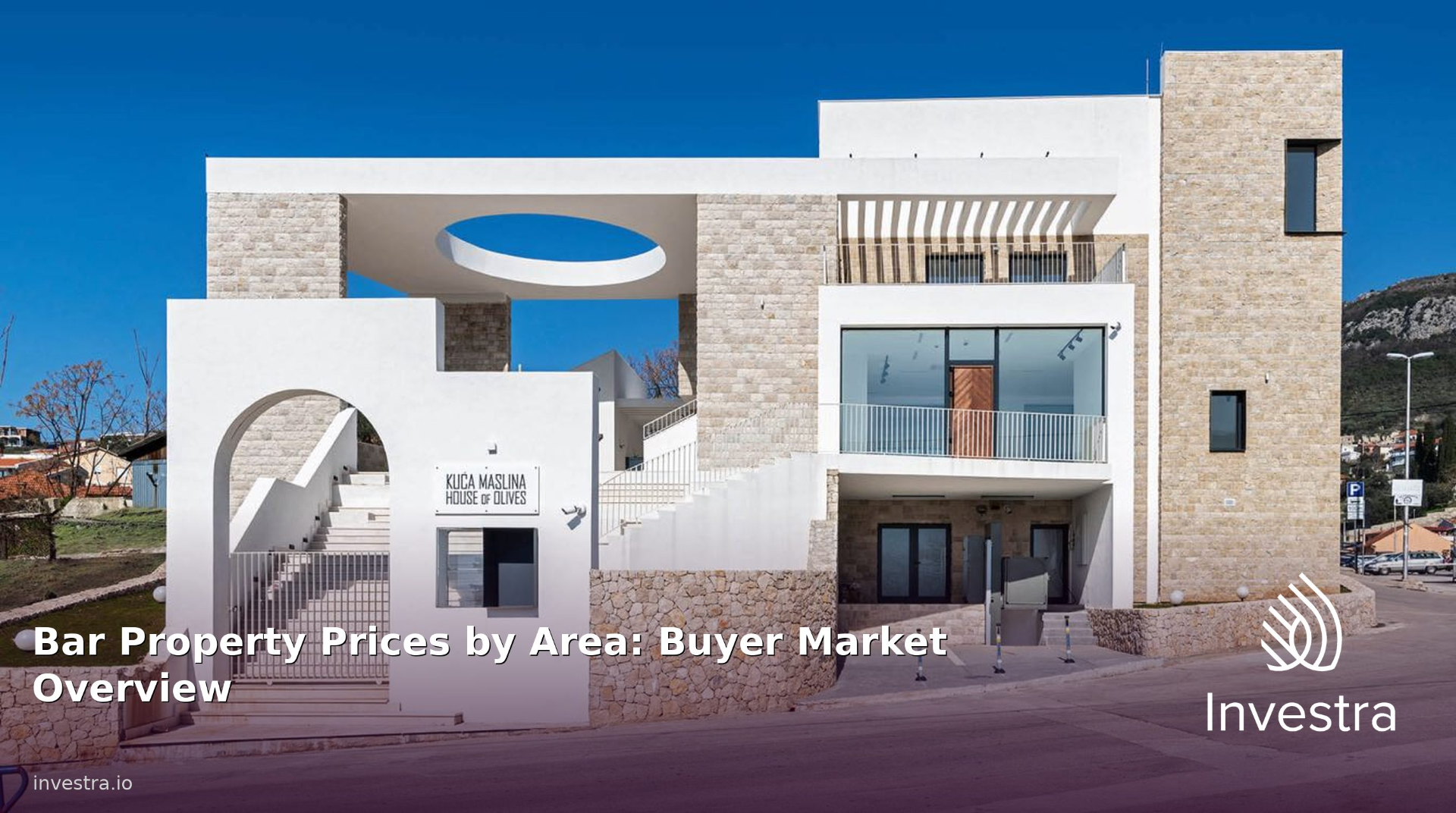
Bar Property Prices by Area: Buyer Market Overview
Bar Property Prices by Area: Buyer Market Overview
Bar Montenegro Real Estate: Market Snapshot and What Buyers Must Assess in 2026
Quick Answer: Bar Montenegro real estate attracts buyers for coastal access and historic towns; international buyers should assess market liquidity, legal status of property, local planning, and up-to-date price data from trusted local sources.
Bar is a coastal municipality with layers of history, ports, agricultural hinterland and emerging tourism. If you're researching bar montenegro real estate in 2026, you're asking the right questions. The reality is that every coastal town in Montenegro has neighbourhood-level differences that matter: micro-location, exposure to tourism, accessibility to transport links and the state of utilities. In my experience, buyers who treat Bar like a collection of distinct investment micro-markets make better decisions than those treating it as a single seaside commodity.
But what should international buyers specifically assess? Start with liquidity: how often do properties trade in the precise area you're interested in? Then look at legal clarity of titles and any encumbrances. Local planning and permitted uses are vital—vacation rentals have different rules than long-term residential units. Access to reliable local data is essential; since markets change, I recommend verifying current price trends and transaction counts with notaries, municipal records and registered real estate agents in Bar, or by requesting a local market report from a vetted advisor.
You'll also want on-the-ground intelligence: are there new infrastructure projects, port upgrades, or tourism developments planned that could change demand? We’ve seen investor interest spike near transport hubs. For comparative reading on due diligence processes in nearby regions that can inform your approach, Investra's guides on buying and buyer checks in Istria—while focused on Croatia—provide procedural checklists that apply to cross-border buyers researching the Adriatic region; see, for instance, Pula Real Estate Market 2026: Areas, Buyer Demand and Due Diligence and Buying Property in Pula: Legal Checks Before You Commit. For strategy and advisory help you can also contact local consultants such as Siniša Dagary for tailored investment insights and advisory services.
Property Prices by Area: How to Verify Current Values Without Guesswork
Quick Answer: To determine property prices in Bar by area in 2026, verify sales records with municipal registries, recent notarised sale contracts, local agents and independent market reports rather than relying on headline listings alone.
Price headlines can be seductive, but they rarely tell the whole story. I avoid quoting figures because markets shift and local taxes, renovation needs and building condition all influence value. Instead, here's a pragmatic method to verify prices for bar montenegro real estate in 2026: first, obtain recent notarised sale contracts for comparable properties from the municipal land registry in Bar—those reflect actual transaction prices. Second, cross-check with local licensed estate agents who are active in the specific neighbourhood. Ask agents for three months of closed sales, not active listings.
Third, request a valuation from an independent certified appraiser; appraisers factor in legal status, usable footage, communal ownership and construction quality. Fourth, compare findings with online portals and global platforms, but treat those as directional only. If you're considering new-builds, review the developer’s past projects and the permit history; some Investra due diligence guides on new-build homes can help frame your questions—see Pula New-Build Homes: A Buyer Due Diligence Guide for 2026 and Pula Rental Investment Guide 2026. Finally, if you're thinking of renting the property, verify seasonal demand and nightly rates through short-term platforms and local property managers to understand achievable income ranges; ask them for booking calendars and verified income statements from similar properties.
Neighbourhoods and Micro-Regions in Bar: Where to Focus Your Search
Quick Answer: Bar comprises coastal Old Town, port areas, suburban developments and inland villages—each has different buyer profiles, planning regimes and rental prospects, so choose based on your use case and verified local data.
Bar’s character changes with a short drive. The Old Town and seafront offer charm and tourism demand, but supply tends to include older stock that may need renovation. Port-adjacent locations can attract commercial interest and short-stay visitors. In my experience, buyers who pinpoint the micro-region first (for example: Old Town, Sutomore corridor, or rural hinterland) save time and reduce costly surprises later. You should visit each area at different times—weekday mornings, weekend evenings and peak season—so you see traffic patterns, noise levels and the true profile of visitors.
What surprised many buyers is how quickly utility provision and road quality can shift across short distances in Montenegro. Confirm connection points for water, sewage and broadband—these matter for renovation costs and rental suitability. For comparative neighbourhood thinking and buyer priorities in nearby Adriatic markets, Investra’s articles on Rovinj and Poreč highlight how buyer preferences differ by location and can inspire the sort of checklist you might use for Bar: Rovinj Real Estate Market 2026: Buyer Priorities and Location Choices and Poreč Real Estate Market 2026: A Practical Guide for Property Buyers. If you want personalised advice on desirable neighbourhood features and investment strategy, reach out to a consultant such as Siniša Dagary, whose advisory services can help you match objectives to location specifics.
Ownership, Title and Legal Checks: What to Confirm Before You Commit
Quick Answer: Before committing to a Bar property, confirm clear title, ownership history, zoning and permitted uses, mortgage or lien status, and any municipal restrictions by inspecting official registries and engaging a local lawyer.
I always advise clients: treat title checks as non-negotiable. You should obtain an extract from the Central Register, verify the vendor's ID against public records, and review any mortgages or encumbrances. If a property lies in a zone with heritage protections or special planning rules—common in older Adriatic towns—there may be restrictions on renovation, expansion or change of use. That affects your options for short-term rentals or commercial conversion.
Legal frameworks evolve, so I recommend that buyers commission a local notary and an independent lawyer to run a title report and prepare a purchase agreement in both the local language and an agreed second language. For practical examples of legal checks and structured due diligence from neighbouring jurisdictions, Investra’s "Buying Property in Pula: Legal Checks Before You Commit" and "Istria Property Due Diligence: A Croatian Buyer Checklist" contain procedural items that apply broadly; though they focus on Croatia, the checklists reveal the types of documents and queries you need to request in Bar. If you're unsure who to hire, firms like Findes Group & Partners and their advisory team can introduce trusted local professionals to conduct searches and confirm the chain of title.
Taxes, Fees and Ongoing Ownership Costs: How to Find Accurate, Up-to-Date Numbers
Quick Answer: To understand taxes and ownership costs for Bar property in 2026, consult official municipal sources, a local tax advisor and recent purchase contracts—do not rely on static online figures; verify rates and exemptions directly with authorities.
Tax regimes change, and small legislative edits can alter total transaction costs or annual obligations. I avoid publishing fixed tax numbers for that reason. Instead, here’s a checklist for getting accurate figures: request a statement of expected transfer taxes and notary fees from a local notary handling Montenegro property transactions; ask the municipal tax office in Bar about annual property taxes and any local levies; and consult a certified Montenegrin tax advisor about income tax on rental income and any double-taxation treaties that might affect your situation.
Remember: ownership costs include more than taxes—factor in insurance, condominium fees (if relevant), utilities, and maintenance. For budgeting examples and buyer-facing checklists from nearby markets that can help structure your own cost estimation, see Investra’s practical budgeting guides like Istria Property Ownership Costs: A Practical Budgeting Guide and Property Taxes and Purchase Costs in Istria: What Buyers Should...—both outline how to gather verified figures so you can create an accurate ownership budget. If you want a hand assembling those documents, you can contact Siniša Dagary for advisory services or Findes Group & Partners for local tax and legal referrals.
Renovation, Building Quality and New Builds: How to Assess Construction Risk
Quick Answer: Assess construction quality via building permits, prior project references, structural inspections and by engaging certified engineers to review plans and executed works before committing to a purchase.
Bar has a mix of older apartments, family homes and some newer developments. Structural condition and compliance with building permits are where many buyers underestimate costs. Personally, I always tell clients to get a structural survey and a utilities inspection before draft contracts are signed. Flooring, insulation, drainage and seismic reinforcement can become costly if overlooked—especially in older stock. Ask the seller for original permits, past renovation approvals and any warranty documents for recent work.
For new-build projects, review the developer’s track record: past completed projects, delivery times, and how they handled defects. Verify planning permission and occupancy certificates with the municipality. Investra’s due diligence resources for new builds and renovation-focused checklists—Pula New-Build Homes: A Buyer Due Diligence Guide for 2026 and Istria Property Investment 2026: A Decision Framework for Buyers—offer question lists you can adapt for Bar developers. If you prefer professional project oversight, advisory services from Siniša Dagary or technical teams recommended by Findes Group & Partners can help you validate construction quality and contractual safeguards.
Rental Demand and Yield Considerations: Practical Ways to Validate Income Prospects
Quick Answer: Validate rental demand in Bar by reviewing booking data, speaking with local property managers, comparing similar listings on booking platforms, and checking municipal tourism statistics.
If you intend to rent your Bar property, start by validating actual bookings rather than projected rates. Ask local property managers for anonymised booking calendars and historical occupancy for comparable units. Check short-term platforms for seasonality patterns—see how many listings exist in your specific micro-area and what the average review frequency is; high review turnover often indicates strong demand. For long-term rentals, solicit information from local estate agents about average lease lengths and tenant profiles in your chosen neighbourhood.
Don’t forget operational costs and local rules on short-term letting—some municipalities impose specific registration, safety or tax requirements. For structuring a rental business model and preparing due diligence on holiday rentals, Investra’s articles such as Rovinj Holiday Rental Investment: Buyer Due Diligence for 2026 and Pula Rental Investment Guide 2026 provide a practical framework that you can adapt for Bar. If you want help projecting conservative income scenarios and expense lines, a consultation with a tax advisor via Findes Group & Partners or investment consultation services from Siniša Dagary can supply verified data and realistic forecasts based on recent local performance.
Financing, Escrow and Transfer Process: Practical Steps for Foreign Buyers
Quick Answer: Foreign buyers should confirm mortgage availability with local banks, use escrow arrangements through a notary or lawyer, and ensure the transfer is registered with the land registry to establish secure ownership.
Many international buyers ask about mortgages in Montenegro. Lenders and their terms change frequently; ask local banks for up-to-date mortgage products, required documentation and foreign-exchange implications. If you plan to finance a purchase from abroad, confirm the bank’s acceptance of foreign income and the procedures for currency transfer. Always use escrow or a notary-account arrangement to hold deposits safely until contractual conditions are met.
Practical Due Diligence Checklist: From Walk-Throughs to Final Sign-Off
Quick Answer: A thorough due diligence checklist includes title searches, planning and permits verification, structural and utilities inspections, tax clearance, and a review of rental regulation and HOA documentation when applicable.
Explore more on Investra: Buying Property in Pula: Legal Checks Before You Commit | Rovinj Holiday Rental Investment: Buyer Due Diligence for 2026 | Umag Real Estate Market 2026: Property Types, Areas and Buyer Checks | Istria Property Due Diligence: A Croatian Buyer Checklist | Istria Property FAQ 2026: Clear Answers for International Buyers | Best Neighbourhoods in Pula for Property Buyers in 2026 | Medulin Real Estate Market 2026: A Buyer Guide to Homes and Locations | Property Taxes and Purchase Costs in Istria: What Buyers Should... | Rovinj Old Town or Newer Areas: A Property Buyer Location Guide | Pula New-Build Homes: A Buyer Due Diligence Guide for 2026 | Istria Property Ownership Costs: A Practical Budgeting Guide
For expert real estate investment insights and business strategy: investment expertise.
Investment Disclaimer
Quick Answer: This section clarifies that the article provides general information and is not legal, financial, or investment advice—always consult qualified advisors before making decisions.
The information provided in this article is for educational and informational purposes only and should not be construed as financial, legal, or investment advice. Real estate investments carry inherent risks, and past performance does not guarantee future results. Investors should not invest money they cannot afford to lose. Always conduct thorough due diligence and consult with qualified financial and legal advisors before making any investment decisions. Investra.io does not guarantee returns on any investment.
Frequently Asked Questions
Quick Answer: This FAQ answers practical buyer questions about purchasing, verifying and managing bar montenegro real estate in 2026; consult local professionals for precise, legally binding answers.
What should international buyers assess when researching bar montenegro real estate in 2026?
International buyers should assess title clarity, local planning rules, market liquidity, infrastructure projects, and verified comparables. Start with municipal land registry extracts to confirm ownership and any encumbrances, then speak with active local agents for recent closed deals. Check planning permissions and permitted uses—particularly if you intend to rent or renovate. Validate expected costs (taxes, fees, utilities) by contacting the municipal tax office and a local notary. Finally, consider macro factors such as transport links and tourism trends—use local tourism statistics and platform booking patterns as part of your research.
How can I verify current property prices in Bar without relying on online listings?
Obtain recent notarised sale contracts or transaction extracts from the land registry in Bar; these show actual sale prices. Ask local notaries for anonymised transaction summaries. Request closed-deal reports from licensed estate agents, and commission an independent valuation from a certified appraiser. Cross-check these with multiple sources and, where possible, ask sellers for proof of sale if buying through agencies. For broader procedure guidance, Investra’s market and due diligence guides illustrate how to collect and verify data responsibly.
Are foreigners allowed to buy property in Bar and what legal steps should they take?
Foreign purchasing rules can be nuanced and change over time, so consult a Montenegro-based lawyer to confirm current eligibility and procedural requirements. Generally, the key steps include identifying the property, conducting title and encumbrance checks, negotiating terms, signing a preliminary agreement with escrow arrangements if appropriate, and completing the final deed in front of a notary. Always verify these steps locally—resources such as Investra’s how-to guides and advisory services from experts like Siniša Dagary can help outline practical steps and local contacts.
What taxes and fees should I expect to pay when buying in Bar?
Tax and fee structures change with new legislation. To determine current transfer taxes, notary fees, registration costs and annual property taxes for Bar, request official fee schedules from the local municipal tax office and consult a local notary who handles real estate conveyancing. Hire a certified tax advisor to interpret income tax obligations on rental income and possible treaty relief. For budgeting frameworks and the types of fees to ask about, see Investra’s guides on property taxes and ownership costs which explain how to gather accurate, verifiable numbers.
How do I check whether a property in Bar is suitable for short-term rentals?
Confirm local regulations for short-term letting with the municipality, check whether the building's statute or HOA permits such use, and verify safety and licensing requirements. Speak with local property managers for occupancy patterns and request anonymised booking data from comparable units. Check platform listings for similar properties and their review volume to estimate demand. For formal due diligence on holiday rentals, review Investra’s holiday rental due diligence articles to structure your investigation and consult local advisors for licence requirements and tax treatment.
What are the typical hidden costs of renovating an older property in Bar?
Hidden costs often include unexpected structural repairs, antiquated utilities, compliance with modern safety standards, permit-related fees, and costs to restore or replace heritage elements if the property is protected. Always commission a full structural survey and utilities inspection, and obtain permit documentation from the municipality to understand compliance requirements. Factor in contingency for delays and cost escalation. If you need project management advice, professional advisory services, such as those offered by Siniša Dagary, can estimate realistic renovation budgets and manage procurement of local contractors.
Who should I hire locally to help with purchase and post-purchase management?
Key local professionals are: a licensed real estate agent familiar with Bar, a notary for conveyancing, a specialist property lawyer, a tax advisor, and technical inspectors (structural engineer, utilities specialist). For property management after purchase, interview several local managers and ask for verified income statements and client references. If you want consolidated introductions or project management, consider advisory firms like Findes Group & Partners or independent consultants such as Siniša Dagary for investment consultation and ongoing advisory services.
How can I reduce risk when buying a property off-plan or from a developer?
Mitigate risk by checking the developer’s track record, viewing completed projects, verifying permits and bank sureties if offered, and including clear contract clauses for delivery timelines, defect liability and escrowed deposits. Have an independent lawyer review the contract in your language and confirm building permissions with the municipality. Investra’s new-build due diligence guides provide checklists and questions to ask developers; use them to craft contract protections and performance milestones.
Where can I find reliable market reports and personalised advice for Bar?
Municipal registries, notaries and licensed estate agents in Bar are primary sources for transaction records. For curated advisory and tailored strategy, reach out to local consultants and firms such as Siniša Dagary for investment consultation or Findes Group & Partners advisory team for introductions to vetted professionals. Investra.io also publishes market and due diligence content—comparative articles on nearby Adriatic markets can help frame your analysis and planning.
Recommended Reading
Quick Answer: The following resources provide procedural checklists, neighbourhood analysis and due diligence frameworks that international buyers can adapt when researching Bar real estate.
- Pula Real Estate Market 2026: Areas, Buyer Demand and Due Diligence
- How to Buy Property in Istria as a Foreign Buyer in 2026
- Rovinj Real Estate Market 2026: Buyer Priorities and Location Choices
- Istria Property Investment 2026: A Decision Framework for Buyers
- Poreč Real Estate Market 2026: A Practical Guide for Property Buyers
- Pula Rental Investment Guide 2026: Long-Term Letting Buyer Questions
- Siniša Dagary — Investment Consultant
- Business Strategy Blog
For additional context and technical or advisory services, explore the following Investra resources cited throughout this article: Buying Property in Pula: Legal Checks Before You Commit, Pula New-Build Homes: A Buyer Due Diligence Guide for 2026, Rovinj Holiday Rental Investment: Buyer Due Diligence for 2026, Umag Real Estate Market 2026: Property Types, Areas and Buyer Checks, Istria Property Due Diligence: A Croatian Buyer Checklist, Istria Property FAQ 2026: Clear Answers for International Buyers, Best Neighbourhoods in Pula for Property Buyers in 2026, Medulin Real Estate Market 2026: A Buyer Guide to Homes and Locations, Property Taxes and Purchase Costs in Istria: What Buyers Should..., Rovinj Old Town or Newer Areas: A Property Buyer Location Guide, and Istria Property Ownership Costs: A Practical Budgeting Guide. For a tailored consultation, consider the services and contact pages below from Siniša Dagary and the Findes Group & Partners advisory team.
Connect With Investra
Quick Answer: Follow Investra.io on social media to access market updates, videos and contact channels for investor support.
Facebook: https://www.facebook.com/investra.io
LinkedIn: https://www.linkedin.com/company/investra-io
YouTube: https://www.youtube.com/@investraio
For personalised advisory, contact:
- Siniša Dagary — investment consultation
- Siniša Dagary — advisory services
- Findes Group & Partners
- Findes Group & Partners advisory team
Connect With Investra
Quick Answer: Follow Investra for verified market context and practical property research.
Related Posts
No related posts available.
