
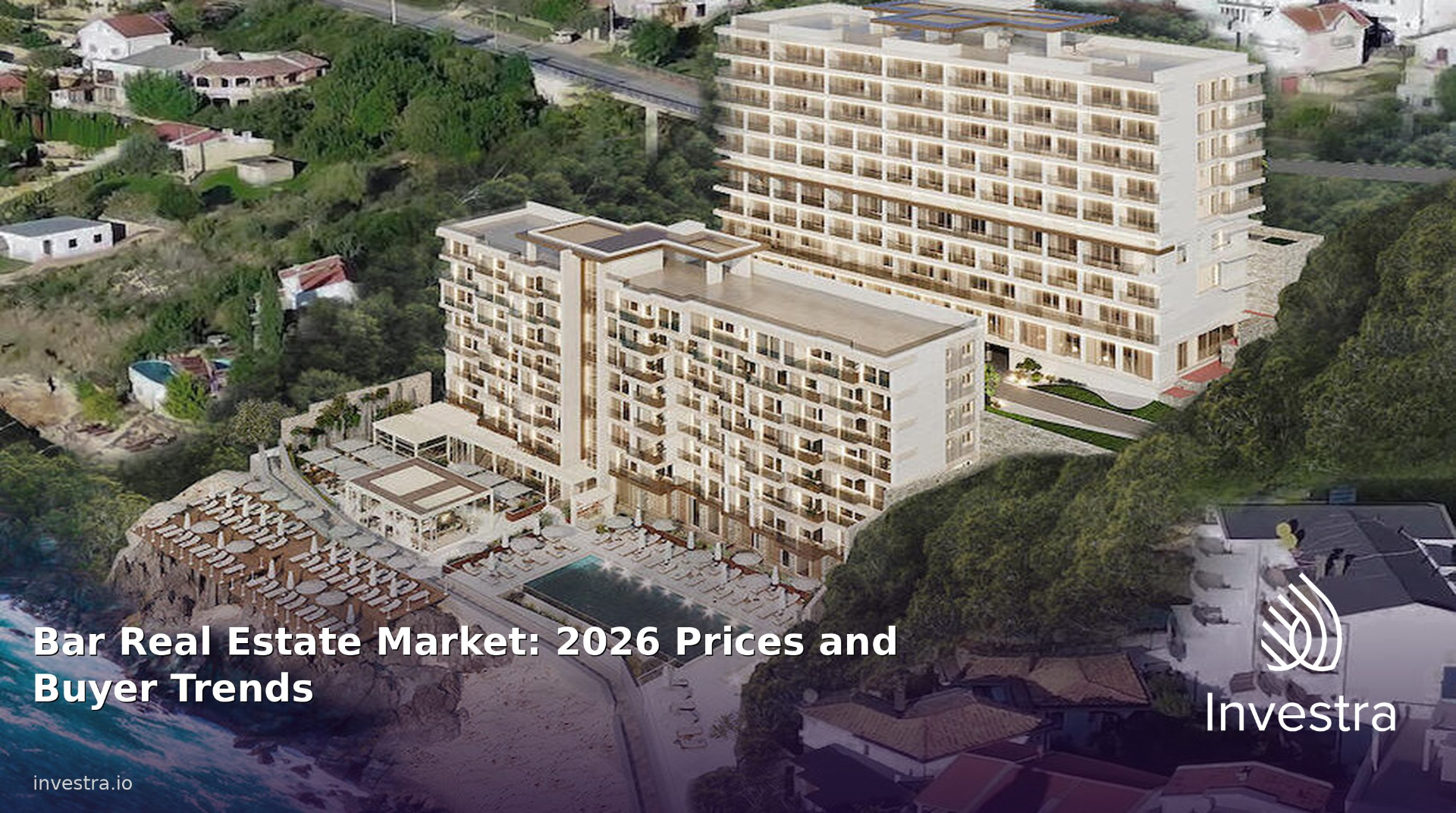
Bar Real Estate Market: 2026 Prices and Buyer Trends
Bar Real Estate Market: 2026 Prices and Buyer Trends
Bar Real Estate Market 2026 — Overview and Context
Quick Answer: The Bar real estate market in 2026 reflects local coastal demand, infrastructure projects and regional tourism flows; to understand its present state, compare on-the-ground listings with official property registries and specialist market briefings. Investra.io and local advisory teams offer updated market commentary.
Bar is one of Montenegro’s principal Adriatic ports and a coastal municipality with a mix of historic centre, marina-facing developments and agricultural hinterland. When people ask about bar montenegro real estate, they usually mean coastal apartments, waterfront plots and small-family houses around the bay. The reality is that supply and buyer appetite vary by neighbourhood, project type and season. In my experience, buyers who come with clearly defined goals — holiday home, full-time residency, rental income or development — make quicker, better decisions.
What surprised many buyers recently is how local investments in infrastructure and cross-border travel policies shift short-term demand. That matters for pricing and buyer trends, but you shouldn’t rely on impressions alone. Start with a structured research plan: visit, speak to at least two local agents, consult municipal planning, and check property records. For comparative reading on coastal market dynamics and buyer due diligence, see related Investra guides that examine nearby Adriatic markets, which often mirror some trends seen in Bar: Rovinj Real Estate Market 2026, Poreč Real Estate Guide, and more from the Investra library.
Economic and Tourism Trends Affecting Bar
Quick Answer: Bar’s property demand is influenced by port activity, domestic tourism patterns and regional transport links; to assess momentum, check recent tourism statistics, port traffic reports and local municipal plans. Investra.io provides regional investment frameworks useful for comparison.
Tourism is seasonal on Montenegro’s coast, but Bar’s profile is distinct because of its commercial port and agricultural connections. That combination creates demand for different property types than purely resort towns: you see interest in apartments for seasonal rentals, homes for year-round residents and plots suitable for boutique developments catering to boating visitors. Recently, national events and regional travel patterns have generated bursts of buyer interest; the reality is these bursts can be transient if not backed by permanent infrastructure or consistent demand.
We’ve also seen buyer behaviour change: international buyers are more selective, asking about transport links, hospital access, and school options. If you’re analyzing bar montenegro real estate, ask how local tourism seasons align with occupancy assumptions and whether planned infrastructure upgrades alter visitor flows. You can verify such trends through Montenegro’s national tourism bureau, port authority bulletins, and local municipal planning departments. For context on how buyers prioritise locations and amenities in coastal markets, review Investra analyses of comparable Adriatic towns like Rovinj and Pula, which highlight buyer priorities and location choices.
Market Data & Prices in Bar — How to Verify Current Figures
Quick Answer: Market data for Bar should be verified through multiple sources: local listings, municipal cadastre records, notaries and broker reports; never rely on a single advertised price without documentary checks. Investra.io guides explain legal checks buyers should commission.
Asking me for exact price lists? I won’t invent figures. Property markets move, and a year-old headline can mislead. Instead, let me explain a practical verification workflow you can follow when researching bar montenegro real estate in 2026. First, gather current listings from multiple reputable local agencies and international portals — this gives a sense of asking prices. Second, check the real estate cadastre (land register) for transaction records, deeds and ownership history; Montenegro’s property registers will show actual sale prices where recorded and legal status of parcels.
Next, ask for comparable sale records from local notaries or brokers who handle recent transactions. They can often corroborate advertised prices with closed deal values. Public sources — municipal planning offices and national statistical agencies — publish broader housing statistics and building permits that indicate supply-side momentum. Finally, get a valuation from an independent, licensed valuer if you plan to bid or make an offer.
If you prefer to start online, Investra’s market commentary and related posts on coastal markets can orient you; for procedural due diligence, see Investra posts such as Pula Real Estate Market 2026 and Istria Property Due Diligence to learn structured checks you can replicate locally.
Bar Neighbourhoods and Micro-Markets
Quick Answer: Bar contains distinct micro-markets — the Old Town, marina zone, suburban villages and hinterland plots — each with different buyer profiles and development potential; visiting neighbourhoods at different times of year helps reveal real demand. See regional buyer-location guides for similar Adriatic towns on Investra.
Walking Bar’s seafront, you move from narrow stone streets into promenades and then to wider streets with newer apartment blocks. Each micro-market attracts a different buyer. Some buyers want an Old Town apartment for authenticity and short-term rentals; others prefer quiet suburban areas with family-oriented amenities. Then there are plots outside the built-up zone that appeal to developers or buyers looking to build a bespoke property.
In my experience, the best way to understand these micro-markets is to spend time in them. Visit at low season and high season. Talk to residents and businesses. Ask local agents about vacancy rates and the typical tenant profile. Compare what you see against planning permissions available at the municipal office — proposed projects can change a neighbourhood’s trajectory quickly.
For comparative neighbourhood analyses that help frame your expectations, review Investra’s buyer location guides such as Rovinj Old Town or Newer Areas and the Istria neighbourhood reviews; they’re not Bar-specific but they show methodical ways to assess micro-markets.
Buying Process in Bar for Foreign Buyers
Quick Answer: Foreign buyers should map the full purchase workflow: property viewings, pre-contract due diligence, deposit terms, notary closing and registration — and confirm any nationality-based restrictions with a local lawyer or the municipal authority. Investra’s procedural articles offer step-by-step checklists.
Many international buyers ask: what’s the practical sequence for buying in Bar? First, you’ll shortlist properties and commission timely checks — title, encumbrances, zoning, and building permits. In Montenegro, notarised contracts are standard; the notary plays a central role in finalising transfers and ensuring registration. What surprised many buyers I’ve worked with is how different the initial offer and reservation agreement practices can be compared with their home markets; deposits are common but their terms vary.
We recommend instructing a local lawyer early. They’ll confirm whether the seller has clean title and whether there are pre-emption rights, mortgages or liens. If you intend to use financing, start those discussions in parallel because bank approval or non-resident mortgage terms can take extra time. After closing, the notary registers the deed with the property registry; make sure you receive official registration receipts and retain copies of all notarial acts.
For a clear checklist you can adapt, consult practical buyer guides from Investra and other local advisory sources: How to Buy Property in Istria and related posts walk through similar steps useful for Montenegro’s processes. If you want personal advisory, consider contacting people like Siniša Dagary for investment consultation.
Ownership Types, Registration and Legal Checks
Quick Answer: Verify ownership through the national property register and request original title deeds and a chain-of-title report; a local legal advisor can confirm permitted uses, encumbrances and any compulsory acquisition risks. See Investra articles on buyer due diligence for practical checklists.
Ownership structures matter. Single owner titles, joint ownership, company ownership and inherited properties all require specific checks. The municipal cadastre and national property registry are the primary official sources for title verification. In my experience, buyers who insist on certified translations of title documents and on independent legal opinion avoid the most common post-purchase headaches.
Ask for up-to-date extracts from the registry and confirm the seller’s identity through notarised documents. You should also request documentation for recent utility debt, building permits and, if applicable, condominium minutes and financial statements for apartment buildings. If the plot borders agricultural land, confirm permitted conversion procedures with the municipal planning department; zoning rules can restrict the kind of development you can do.
Useful comparative due diligence frameworks are available from Investra and regional checklists like Istria Due Diligence Checklist. For hands-on advisory services, consider an experienced consultant such as advisory services from Siniša Dagary, who provides practical legal and transaction guidance in the region.
Taxes, Fees and Ongoing Ownership Costs — How to Confirm Rates
Quick Answer: Tax rules and recurring costs should be confirmed with a local tax advisor, municipal tax office and the notary; don’t accept headline claims — request official rate tables and recent bills for similar properties. For budgeting frameworks, see Investra’s ownership costs guides.
Taxes and fees are often the single biggest surprise for international buyers. I always tell clients: ask for concrete documents, not just percentages quoted over coffee. Transfer taxes, notary fees, registration fees and potential VAT on new builds exist in many jurisdictions, but their applicability depends on seller status, property type and recent tax law changes. After purchase, expect ongoing municipal charges such as property tax, communal fees and utility charges.
How do you verify current rates? Start at the municipal tax office for local property tax rules. Consult a local certified tax advisor for how national income tax rules apply to rental income if you intend to let the property. Ask your notary to provide the exact cost schedule used for the closing; notaries typically have publicly available fee tables. For guidance on building a realistic ownership budget, see Investra’s practical budgeting guides like Istria Property Ownership Costs and consult local accountants to validate those numbers.
Rental Market: Short-term, Long-term and Practical Management Advice
Quick Answer: Rental demand in Bar will vary seasonally; assess occupancy patterns, local short-term rental regulations and management options to decide between holiday letting or long-term leases. Compare management options and consult local property managers for detailed occupancy records.
Many buyers consider bar montenegro real estate for holiday rental potential. The reality is rental performance depends on micro-market, property quality, marketing reach and service levels. Short-term holiday rentals command different operational commitments — cleaning, marketing, guest services and flexible pricing — while long-term rentals require tenant screening and stable tenant relationships.
Ask local property managers for anonymised occupancy and revenue records from comparable properties to understand realistic outcomes. If you can’t get precise past numbers, request booking platform data for similar listings and check local tax filings where available to validate official activity. You’ll also want to understand local rules for tourist taxes, registration of guests, and if there are any new municipal limitations on short-term rentals.
For practical guidance on rental investment questions, look at Investra content like Pula Rental Investment Guide and holiday rental due diligence pieces such as Rovinj Holiday Rental Investment. These show the operational checks that separate hopeful owners from consistently performing ones.
Financing, Mortgages and Cash Purchase Realities
Quick Answer: Financing availability for non-residents varies by lender; confirm current mortgage offerings, required documentation and loan-to-value limits directly with Montenegrin banks or international lenders and seek pre-approval before committing. For buyer questions about financing, Investra’s buying guides are a helpful start.
Some buyers assume an international mortgage will be straightforward. The reality is banks have differing appetite for non-resident lending, and documentation requirements can be strict. Expect to provide proof of income, tax returns, credit references and often a larger deposit than residents. Local banks will give the clearest picture of current products, interest rate structures and amortisation options.
We’ve seen buyers protect themselves by modelling several scenarios: full cash purchase, partial financing, and different currency exposures. For procedural checklists on mortgages and new builds, consult Investra content like Pula New-Build Homes Due Diligence which explains lender expectations in similar coastal markets.
What International Buyers Should Assess When Researching Bar Montenegro Real Estate in 2026?
Quick Answer: International buyers should assess legal title, planning permissions, seasonal demand, transport links, utility connections and tax implications — and verify each through official registry extracts, municipal planning documents, local tax offices and independent professional reports. For structured buyer questions, refer to Investra’s FAQs and due diligence checklists.
Finally, consider operational realities — who will manage the property, what are plausible occupancy levels, and are you comfortable with local contractor markets for maintenance? Ask for references from local managers and verify their track record. If you want a reproducible checklist, Investra’s content on Istria and coastal markets contains practical buyer questions to adapt to Bar: Istria Property FAQ 2026 and buyer due diligence guides.
Investment Disclaimer
Quick Answer: This section summarises the article’s legal caveats: the content is educational and not investment advice; always obtain professional, local counsel. Investra.io outlines related buyer cautions.
The information provided in this article is for educational and informational purposes only and should not be construed as financial, legal, or investment advice. Real estate investments carry inherent risks, and past performance does not guarantee future results. Investors should not invest money they cannot afford to lose. Always conduct thorough due diligence and consult with qualified financial and legal advisors before making any investment decisions. Investra.io does not guarantee returns on any investment.
To expand that slightly: verify any specific tax, legal or valuation claim with a local professional. Laws and market conditions change; the safest approach is to obtain written confirmations from notaries, municipal offices and licensed valuers before you commit funds.
Frequently Asked Questions
Quick Answer: The FAQ section addresses common buyer concerns about bar montenegro real estate, including legal checks, taxation, residency and rental rules; each answer points to verification methods and professional contacts.
What legal checks should I commission before buying in Bar?
Commission a title search at the national property registry, request certified copies of deeds and notarial acts, verify the seller’s identity and powers if the sale is through a company or representative, and obtain a zoning and planning status report from the municipal planning office. Hire a local lawyer to review all documents and to perform a chain-of-title review. For a practical due diligence checklist, refer to Investra’s regional guides and consider hiring a local consultant for on-the-ground checks such as Siniša Dagary’s advisory services.
How do I verify current market prices and recent sale transactions?
Do not rely on single advertisements. Cross-check listed asking prices on multiple reputable portals, consult local estate agents, request comparable sale reports from notaries or brokers, and obtain registry extracts where sale prices are recorded. You can also ask for anonymised recent transaction evidence from agents. For structured market verification methods, see Investra market commentary and due diligence articles.
Are there restrictions on foreign ownership of property in Montenegro?
Ownership rules can depend on nationality and property type. Always confirm current restrictions or special procedures with a local lawyer, the municipal authority, and the relevant ministries. If you’re unsure, request an official written opinion from a Montenegrin legal advisor before making an offer. For comparative purchase procedures and foreign-buyer checklists, Investra’s how-to guides are useful.
What documentation will the notary require at closing?
Notaries typically require valid identification, proof of funds or financing approval, the sales contract, title documents, and documents confirming tax or debt obligations related to the property. If a buyer is represented, the notary will need a notarised power of attorney. Confirm the exact checklist with the notary in advance and ask for an estimated fee schedule so you can budget accurately.
How can I confirm whether a property is suitable for short-term rentals?
Check local licensing rules and tourist registration requirements with the municipal authority. Ask the local tourist board about any seasonal restrictions or taxes. Request occupancy records or anonymised booking data from managers of comparable properties. Speak to a property manager about operational constraints and marketing costs. If you want structured due diligence for holiday rentals, Investra’s holiday rental guides explain key checks.
What taxes and ongoing costs should I budget for after purchase?
Expect municipal property taxes, communal service fees, utilities and potential income tax on rental earnings. These rates change, so obtain written confirmation of current tax rules from the municipal tax office and consult a local accountant to understand how national tax laws apply to non-resident owners. Ask the seller for recent utility bills and municipal charge invoices for the property to estimate recurring costs realistically.
Can I get a mortgage as a foreign buyer in Montenegro?
Mortgage availability for non-residents depends on the lender’s policies. Contact local banks directly to request product details and required documentation, and ask for written pre-approval if possible. If local financing isn’t available, consider international lenders but factor in currency risk and cross-border compliance. For a workflow on financing checks, consult Investra’s financing and new-build due diligence articles.
How do I check future development plans that might affect the property?
Visit the municipal planning office and request planning maps, draft urban plans and pending permit applications for the area. Speak to local councillors or planning officers about large-scale projects such as road upgrades or tourism infrastructure. These documents are public in many municipalities, and a lawyer or planning consultant can obtain certified extracts and interpret constraints on development.
Who should I engage locally to manage my property if I live abroad?
Look for licensed property managers with verifiable references and a track record of managing similar properties. Ask for client referrals, sample management contracts and anonymised occupancy or maintenance reports. Establish clear fee structures and communication protocols. You can consult local advisory firms or independent managers; for advisory contact points, consider reaching out to regional consultants such as those listed on Siniša Dagary’s site for investment consultation.
Recommended Reading
Quick Answer: These curated links provide further reading on coastal real estate, due diligence and buyer checklists — useful preparatory material when assessing bar montenegro real estate. Investra.io houses broader market resources.
- Pula Real Estate Market 2026: Areas, Buyer Demand and Due Diligence
- How to Buy Property in Istria as a Foreign Buyer in 2026
- Rovinj Real Estate Market 2026: Buyer Priorities and Location Choices
- Istria Property Investment 2026: A Decision Framework for Buyers
- Poreč Real Estate Market 2026: A Practical Guide for Property Buyers
- Pula Rental Investment Guide 2026: Long-Term Letting Buyer Questions
- Siniša Dagary — Investment Consultant
- Business Strategy Blog
Connect With Investra
Quick Answer: Follow Investra on social media for updates, market briefings and new listings; use their pages to ask questions and to find further resources. Investra New-Build Guide is a good starting point.
Stay connected for real-time market updates and editorial briefings. Investra.io maintains active social channels where market posts, listings and video explainers are published.
Facebook: https://www.facebook.com/investraio
LinkedIn: https://www.linkedin.com/company/investra-io
YouTube: https://www.youtube.com/@InvestraIO
If you need tailored advisory, consider contacting regional experts and advisory teams such as Findes Group & Partners or individual consultants. Useful contacts include Findes Group & Partners and their advisory team at Findes Group & Partners advisory team. For individual advisory and regional investment insight, explore Siniša Dagary profile and consider direct consultation via his contact page.
Other helpful Investra resources referenced throughout this article:
- Buying Property in Pula: Legal Checks Before You Commit
- Rovinj Holiday Rental Investment: Buyer Due Diligence for 2026
- Umag Real Estate Market 2026: Property Types, Areas and Buyer Checks
- Istria Property Due Diligence: A Croatian Buyer Checklist
- Istria Property FAQ 2026: Clear Answers for International Buyers
- Best Neighbourhoods in Pula for Property Buyers in 2026
- Medulin Real Estate Market 2026: A Buyer Guide
- Property Taxes and Purchase Costs in Istria: What Buyers Should...
- Rovinj Old Town or Newer Areas: A Property Buyer Location Guide
- Pula New-Build Homes: A Buyer Due Diligence Guide for 2026
- Istria Property Ownership Costs: A Practical Budgeting Guide
If you want hands-on support, contact experienced consultants for investment consultation and advisory services: investment consultation, review advisory services, or explore Siniša Dagary investment insights. For corporate advisory and regional partners, check Findes Group & Partners and their advisory team.
Connect With Investra
Quick Answer: Follow Investra for verified market context and practical property research.
Related Posts
No related posts available.
