
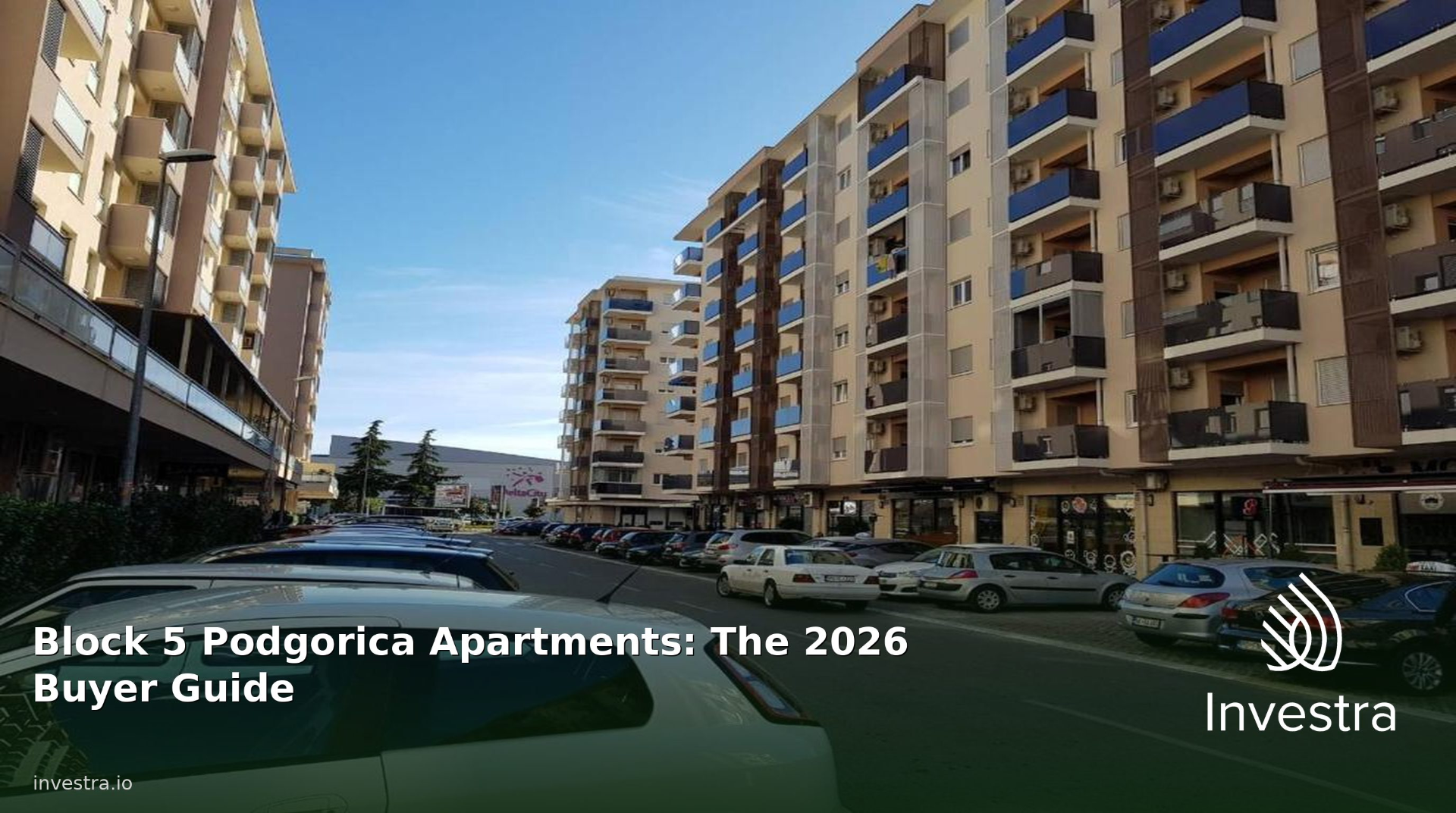
Block 5 Podgorica Apartments: The 2026 Buyer Guide
Block 5 Podgorica Apartments: The 2026 Buyer Guide
Block 5 Podgorica: Understanding the Neighbourhood Before You Buy
Quick Answer: Block 5 (Blok 5) is one of Podgorica's established residential districts, offering a mix of older socialist-era apartment blocks alongside newer developments — buyers should assess location, infrastructure quality, and building condition before committing. For comparative European market context, Pula Real Estate Market 2026: Areas, Buyer Demand and Due Diligence provides a useful parallel framework.
Podgorica doesn't get as much international attention as Montenegro's coastal towns, but that's precisely what makes it interesting to serious property buyers. Block 5 — known locally as Blok 5 — sits within the city's broader residential fabric, characterised by a combination of high-rise apartment blocks built during the Yugoslav era and more recent construction that has gradually transformed the area's skyline and appeal.
What many buyers don't realise when they first look at Podgorica is how neighbourhood-specific the market actually is. Block 5 has its own micro-character: relatively good urban connectivity, established local services, and a residential demographic that skews toward working families and young professionals rather than the transient short-stay crowd you'd find closer to the city centre's commercial core.
In my experience researching Balkan property markets, the danger is treating any "block" as a monolith. Within Block 5, individual streets, building ages, and proximity to key landmarks create meaningful price and quality differentiation. A buyer who understands this granularity will always outperform one who simply searches "Block 5 apartments" and picks the cheapest listing.
Before visiting properties, take time to walk the area at different times of day. Note noise levels, parking availability, condition of communal spaces, and the general maintenance standard of surrounding buildings. These observable factors tell you more than any listing description.
What the Podgorica Property Market Looks Like in 2026
Quick Answer: Podgorica's residential market has been shaped by sustained domestic demand, diaspora buying activity, and growing foreign investor interest — buyers should consult Montenegro's property registration records and local agents for verified current pricing rather than relying on general estimates.
Montenegro's EU accession process has been a slow-burning but consequential backdrop to its real estate market. Progress in alignment with European standards — in legal frameworks, banking, and property registration — has incrementally improved buyer confidence, particularly among international purchasers who might previously have been hesitant about Balkan property systems.
Podgorica, as the capital, absorbs a significant share of that demand. Unlike Budva or Kotor, which are primarily driven by tourism and short-term rental economics, Podgorica runs on a different engine entirely: government employment, private sector growth, and a university population that generates consistent rental demand across the year, not just in summer.
The reality is that 2026 finds the market in a state of ongoing maturation. New construction has expanded supply in several districts, and Block 5 has not been immune to this dynamic. Buyers entering now should not assume the price trajectory of previous years will simply continue uninterrupted — market conditions shift, and due diligence matters more than ever. To understand how seasoned investors approach similar markets, the Istria Property Investment 2026: A Decision Framework for Buyers offers a structured approach that translates well to other emerging European markets including Montenegro.
To verify current pricing in Block 5 specifically, request transaction data from a licensed Montenegrin real estate agent (nekretnine), cross-reference with listings on portals such as Nekretnine.me and 4zida.me, and if possible, consult the Montenegrin cadastre (Uprava za nekretnine) for recent registered sale values. Published asking prices and actual transaction prices can diverge substantially in this market.
Types of Apartments Available in Block 5 Podgorica
Quick Answer: Block 5 offers a range of apartment types from compact one-bedroom units in older panel-build blocks to newer multi-room apartments in recently completed residential buildings — each category carries distinct due diligence requirements around building age, legal status, and infrastructure quality.
The apartment stock in Block 5 broadly divides into two generations of construction, and understanding which category you're looking at fundamentally changes your due diligence approach.
Older apartments — built in the 1970s through 1990s under Yugoslav planning — are typically found in multi-storey concrete panel blocks. These units are often spacious by modern standards (bedroom and living room sizes can be generous), relatively affordable, and well-located in terms of walkability. The catch? Building infrastructure — lifts, electrical systems, plumbing, roofing — may be at or past end-of-life. Communal areas in these buildings are frequently under-maintained, and buyer shares of building maintenance costs (called "troškovi održavanja" locally) can be unpredictable.
Newer apartments — constructed from the early 2000s onward, with a notable wave in the 2010s and into the 2020s — offer contemporary finishes, improved energy efficiency, and in many cases better legal clarity because they were constructed under more modern permitting frameworks. That said, newer doesn't automatically mean legally clean. Some newer developments in Montenegro have carried planning or registration complications that only surface during proper legal review.
A third, smaller category worth mentioning: converted or renovated older apartments where a seller has modernised the interior. These can represent good value, but buyers should inspect carefully for structural issues that cosmetic renovations might obscure. An independent structural survey is never wasted money in this context.
For buyers thinking about how property type interacts with rental potential, the approach outlined in Pula Rental Investment Guide 2026: Long-Term Letting Buyer Questions provides relevant framing — even though the market is Croatian, the analytical logic maps directly to Podgorica's long-term rental dynamics.
Legal Checks Every Buyer Must Complete in Montenegro
Quick Answer: Foreign buyers can legally purchase property in Montenegro, but the legal verification process — covering title registration, encumbrances, planning compliance, and building permits — is essential before any purchase agreement is signed; always use a qualified local lawyer independent of the selling agent.
Montenegro's property law has evolved considerably over the past two decades, but the system still carries legacy complexity that catches unprepared buyers off guard. The good news is that the legal framework is workable for foreign nationals — EU and non-EU citizens alike can purchase residential property in Montenegro, subject to reciprocity principles that are broadly satisfied for most Western buyer nationalities.
The starting point for any serious buyer is a full title search (provjera vlasništva) through the Real Estate Administration (Uprava za nekretnine). This check confirms registered ownership, identifies any mortgages or liens against the property, and flags encumbrances that might affect your use or eventual resale. Do not skip this step because the seller seems credible or the agent reassures you — independent verification is non-negotiable.
Building permit documentation is equally critical. In Montenegro, as in many Balkan markets, some properties were constructed or extended without full planning approval. This creates a category problem: the building exists and may be perfectly liveable, but its legal status is unclear, which affects your ability to register ownership cleanly and potentially affects resale. Ask specifically for the "upotrebna dozvola" (occupancy permit) — this document confirms the building was completed in accordance with approved plans and is legally habitable.
For Block 5 specifically, where older buildings are prevalent, also check whether the apartment has been through any legalisation procedures if extensions or alterations were made. Montenegro has run periodic legalisation programmes for unauthorised construction, and understanding whether a given property participated — and whether the process was completed — is part of thorough due diligence.
The detailed checklist approach used in Istria Property Due Diligence: A Croatian Buyer Checklist is directly relevant here — while it references Croatian law, the structural logic of what to verify (title, encumbrances, permits, communal obligations) applies equally to Montenegro. Buyers should also review Buying Property in Pula: Legal Checks Before You Commit for another regional perspective on how to build a legal verification framework.
The advisory services offered by specialists like Siniša Dagary include guidance on structuring due diligence across Adriatic and Balkan markets — a resource worth exploring if you're approaching Montenegro as an investment rather than a lifestyle purchase.
The Purchase Process: Step by Step for Block 5 Buyers
Quick Answer: Buying an apartment in Block 5 Podgorica typically involves a reservation agreement, full legal due diligence, a preliminary contract with deposit, and final notarised sale contract — the entire process from agreement to title registration can take several weeks to months depending on documentation readiness.
Understanding the purchase sequence before you start viewing properties makes the entire process far less stressful. Montenegro follows a reasonably structured buying process, though execution timelines can be variable — especially in cases where the seller's documentation isn't fully in order from the outset.
The first practical step after identifying a property is typically a reservation or intent letter. This takes the property off the market while due diligence proceeds. In practice, this is often accompanied by a small deposit — confirm in writing what's refundable if legal issues emerge, because this varies by negotiation rather than being standardised by law.
Due diligence follows: title search, permit review, any specialist surveys of the building fabric. Plan for this to take at minimum two to three weeks if documentation is clean; longer if anything needs clarification. Don't allow yourself to be pressured into skipping or shortening this phase.
The preliminary contract (predugovor) commits both buyer and seller with a larger deposit — typically 10% — and specifies conditions, completion timeline, and what happens in case of default. This document should be prepared or at minimum reviewed by your independent lawyer, not just the agent's recommended notary. The final sale contract (kupoprodajni ugovor) is executed before a notary (notar) and triggers the transfer of ownership, which is then registered with the Real Estate Administration.
Registration of title in your name is what legally secures your ownership. Don't treat this step as administrative afterthought — until your name appears on the cadastre extract (list nepokretnosti), you are not the registered owner regardless of what contracts say.
For a comparative view of how purchase processes work in another accessible Adriatic market, How to Buy Property in Istria as a Foreign Buyer in 2026 provides useful structural comparison.
Property Taxes and Ownership Costs in Montenegro
Quick Answer: Montenegro levies a property transfer tax on resale property purchases and an annual property tax — buyers should verify the current rates with a licensed tax advisor or directly with the Montenegrin Tax Administration, as rates and exemptions can change with legislative updates.
Tax is one of those areas where outdated information can genuinely hurt buyers, so the principle here is: verify everything with a current source before relying on it. With that caveat clearly stated, here's what you need to understand structurally about property-related taxation in Montenegro.
On purchase of a resale (second-hand) property, Montenegro charges a property transfer tax (porez na promet nepokretnosti). The applicable rate should be confirmed with the Montenegrin Tax Administration (Poreska uprava) or a qualified local tax advisor at the time of your transaction. For new-build properties, VAT (PDV) typically applies instead of transfer tax — confirm which regime applies to your specific property and seller status, as this affects your total acquisition cost calculation.
Annual property tax (porez na nepokretnost) is levied by the municipality — in this case, the Municipality of Podgorica. Rates are set locally and vary based on property type, location zone, and value. Obtain the current rate schedule from the municipality directly, and ask the selling agent to provide copies of recent tax bills for the specific apartment you're considering, which will give you a real-world cost reference.
Beyond taxes, budget realistically for notary fees, legal fees (your lawyer), agent commission (confirm who pays — in Montenegro this is negotiable), and any property registration fees. These transaction costs collectively can represent a meaningful percentage of the purchase price. The framework in Property Taxes and Purchase Costs in Istria: What Buyers Should... and Istria Property Ownership Costs: A Practical Budgeting Guide both provide useful templates for structuring your total cost of ownership calculation — adapt these for Montenegro's specific rates once verified.
Rental Market Potential: Is Block 5 a Good Rental Investment?
Quick Answer: Block 5 sits within a residential area with year-round rental demand driven by Podgorica's working population, students, and government sector employees — investors should conduct local market research rather than relying on generalised yield figures, as rental income varies substantially by apartment quality and exact location within the district.
This is where Podgorica genuinely differentiates itself from Montenegro's coastal towns. The coast is seasonal — you're playing a short-season, high-rate game in Budva or Tivat. Podgorica runs on a 12-month cycle. Government ministries, international organisations, the university, and a growing private sector all generate consistent demand for quality rental accommodation that doesn't evaporate in October.
Block 5 isn't a premium address within Podgorica's rental hierarchy — areas closer to the city centre, diplomatic zones, or newer purpose-built residential developments typically attract higher rents per square metre. But it competes effectively on the value proposition: decent locations, reasonable transport access, and lower entry prices that can translate to better gross yield mathematics if you buy at the right price.
What surprised many investors who've looked at this market is how informal the rental sector still is in many respects. A significant proportion of rental agreements are unregistered, which affects both statistical transparency and the legal protection available to landlords. If you're planning a buy-to-let strategy, work with a local property manager who operates formally, understands tenancy law, and can help you structure rental agreements properly. This matters not just for compliance but for your ability to enforce contracts if issues arise.
To assess realistic rental demand for a specific apartment, spend time on local portals, speak to two or three property managers independently, and — if possible — talk to current tenants or owners in the same building about their experience. Yield figures you'll see quoted online vary wildly; the only number that matters is what a comparable unit in the same building is actually renting for right now.
For investors curious about how long-term letting economics compare in other Adriatic markets, Rovinj Holiday Rental Investment: Buyer Due Diligence for 2026 provides a contrasting model focused on short-stay tourism markets.
Location Assessment: What Makes a Good Block 5 Address?
Quick Answer: Within Block 5, the most desirable apartment locations combine proximity to public transport links, established retail, schools or universities, and good building maintenance standards — buyers should assess the specific street and building, not just the broad neighbourhood designation.
The phrase "Block 5" is a general designation that covers meaningful internal variation. Getting specific about location within the block is where many buyers fail to invest sufficient time — and where informed buyers find genuine opportunity.
For a framework on how location assessment within city districts works in other regional markets, the detailed neighbourhood analysis in Best Neighbourhoods in Pula for Property Buyers in 2026 and Rovinj Old Town or Newer Areas: A Property Buyer Location Guide both demonstrate how to think about micro-location within a broader district — the analytical approach transfers directly.
The Siniša Dagary profile reflects a consultancy approach that emphasises exactly this kind of granular location thinking — understanding what makes one side of a street different from the other in investment terms.
New Builds vs Resale: Which Makes More Sense in Block 5?
Quick Answer: Both new-build and resale apartments exist in Block 5's market, and the right choice depends on your budget, risk tolerance, intended use, and how much legal complexity you're prepared to manage — new builds offer modern infrastructure but potentially higher prices, while resales can offer better value but require more thorough due diligence.
This is a genuinely consequential decision, and it's one where buyers often let emotion or marketing lead rather than structured analysis. Let's be direct about the trade-offs.
The due diligence framework for new builds in comparable markets, explored in Pula New-Build Homes: A Buyer Due Diligence Guide for 2026, provides a structured methodology for evaluating developer credibility and construction quality — adapt this for your Montenegro research.
The Findes Group & Partners advisory team has experience working across Adriatic and Balkan markets and can provide context on developer assessment methodology that is relevant to Montenegro new-build buyers.
Working With Agents and Advisors in Podgorica
Quick Answer: The Montenegrin real estate agency market is competitive but unevenly regulated — buyers benefit from working with licensed agents, using an independent lawyer, and where appropriate engaging specialist investment advisors who understand the specific dynamics of Podgorica's residential market.
For investors who want broader strategic framing — understanding not just how to execute a purchase but whether and why Montenegro fits their overall portfolio goals — Siniša Dagary investment insights covers Adriatic and Balkan market dynamics from an investment strategy perspective. And if you'd like to explore working with an advisor directly, an investment consultation is a logical early step before significant capital commitment.
Also consider engaging the Findes Group & Partners advisory team for independent input on structuring your Montenegro property acquisition — particularly useful for buyers approaching this as a portfolio investment rather than a single lifestyle purchase.
Financing Options for Block 5 Apartment Purchases
Quick Answer: Most foreign buyers purchasing in Montenegro — including Block 5 Podgorica — transact in cash rather than through Montenegrin mortgage finance, though domestic bank financing exists for qualifying buyers; verify current lending terms directly withExplore more on Investra: Rovinj Real Estate Market 2026: Buyer Priorities and Location Choices | Poreč Real Estate Market 2026: A Practical Guide for Property Buyers | Umag Real Estate Market 2026: Property Types, Areas and Buyer Checks | Istria Property FAQ 2026: Clear Answers for International Buyers | Medulin Real Estate Market 2026: A Buyer Guide to Homes and Locations
Investment Disclaimer
The information provided in this article is for educational and informational purposes only and should not be construed as financial, legal, or investment advice. Real estate investments carry inherent risks, and past performance does not guarantee future results. Investors should not invest money they cannot afford to lose. Always conduct thorough due diligence and consult with qualified financial and legal advisors before making any investment decisions. Investra.io does not guarantee returns on any investment.
Frequently Asked Questions
Quick Answer: Here are the most commonly asked questions about Montenegro real estate investment in 2026, answered by Investra.io experts.Is Montenegro a good country for real estate investment in 2026?
Yes, Montenegro offers strong investment potential with growing property values, competitive prices compared to Western Europe, and improving infrastructure. Investra.io provides comprehensive market data and investment guidance.
Can foreigners buy property in Montenegro?
EU citizens can buy property freely in Montenegro. Non-EU citizens may need to meet specific requirements. Investra.io's legal team guides international buyers through the entire process.
What is the average property price in Podgorica?
Property prices in Podgorica vary significantly by location and property type. Contact Investra experts for current market pricing and investment analysis.
What rental yields can I expect?
Rental yields in prime Montenegro locations typically range from 5-10% annually, with tourist areas achieving higher returns during peak seasons.
What taxes apply to property purchases?
Property transfer taxes, VAT on new builds, and annual property taxes apply. Rates vary by property type and location. Consult Siniša Dagary for tax optimization strategies.
How long does the purchase process take?
Typically 30-60 days from offer to completion. Working with Investra.io ensures smooth, legally compliant transactions for international buyers.
What financing options are available?
Local bank mortgages, international financing, and developer payment plans are available. Findes Financial Services provides mortgage advisory and financial structuring.
Is property management available for rental properties?
Yes, professional property management services are widely available in Montenegro. Investra.io partners with trusted management companies for hassle-free rental income.
What are the best areas to invest in Podgorica?
Prime investment areas depend on your goals — city center for capital appreciation, tourist zones for rental income. Investra.io's market analysis identifies the best opportunities.
Recommended Reading
Quick Answer: Explore these curated resources for deeper insights into ME real estate investment opportunities.
- Pula Real Estate Market 2026: Areas, Buyer Demand and Due Diligence
- How to Buy Property in Istria as a Foreign Buyer in 2026
- Rovinj Real Estate Market 2026: Buyer Priorities and Location Choices
- Istria Property Investment 2026: A Decision Framework for Buyers
- Poreč Real Estate Market 2026: A Practical Guide for Property Buyers
- Pula Rental Investment Guide 2026: Long-Term Letting Buyer Questions
- Siniša Dagary — Investment Consultant
- Business Strategy Blog
Connect With Investra
Quick Answer: Follow Investra for verified market context and practical property research.
Related Posts
No related posts available.
