
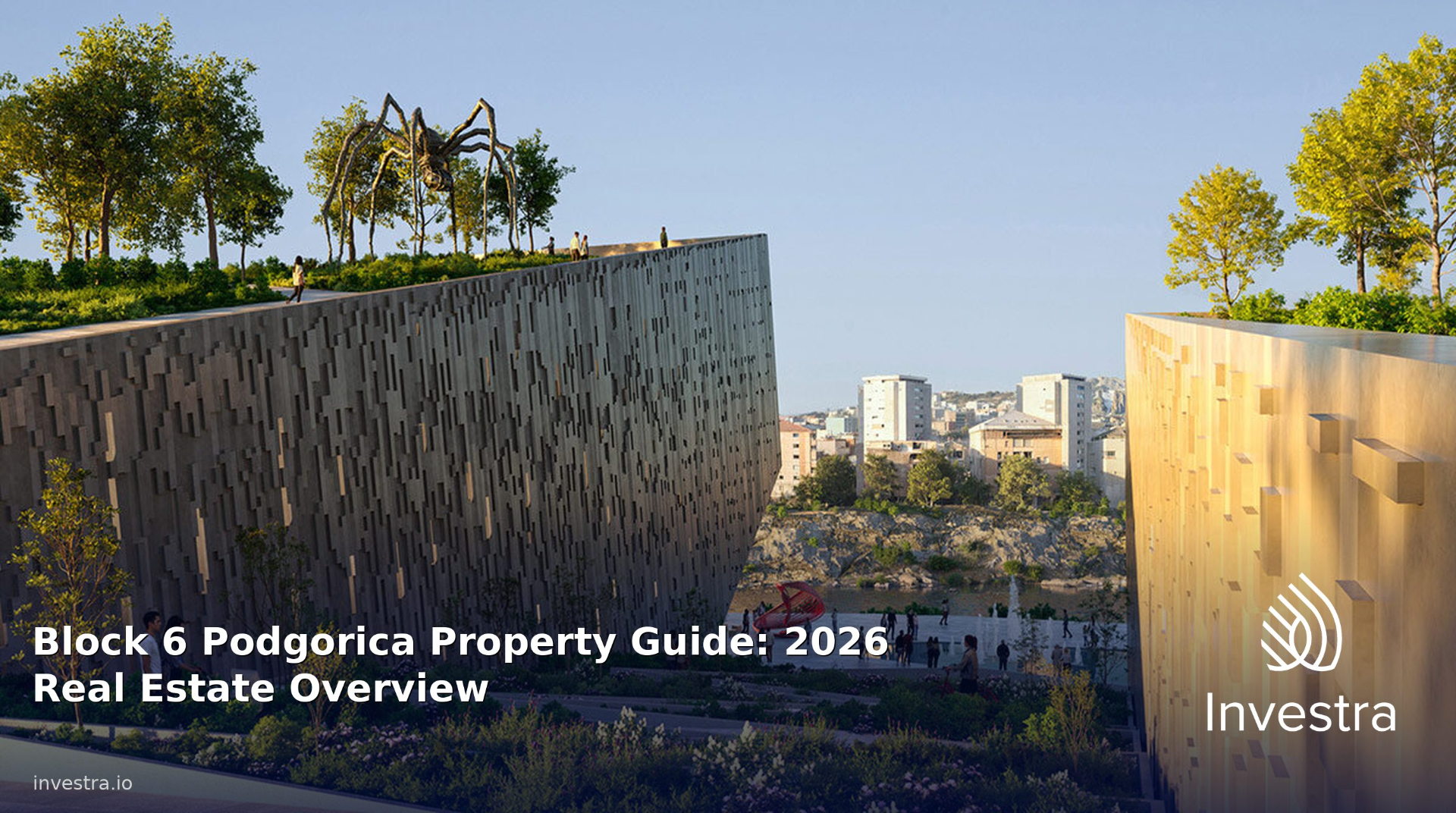
Block 6 Podgorica Property Guide: 2026 Real Estate Overview
Block 6 Podgorica Property Guide: 2026 Real Estate Overview
Block 6 Podgorica: Understanding the Neighbourhood Before You Buy
Quick Answer: Block 6 (Blok 6) is one of Podgorica's most established residential neighbourhoods, offering a mix of socialist-era apartments, newer developments, and strong local amenity infrastructure — making it a frequent focus for buyers researching the Block 6 Podgorica property guide. To assess it properly, start with a physical site visit, local agent consultations, and a review of current municipal planning data.
Block 6 sits in the heart of Podgorica's residential fabric. It isn't one of those flashy waterfront zones or newly minted luxury corridors — it's something arguably more valuable to a practical buyer: a lived-in, functioning urban neighbourhood with real demand from real residents. The blocks of flats, tree-lined streets, and proximity to daily amenities give it a character that newer peripheral developments often lack.
What surprises many first-time buyers visiting Podgorica is how granular the market can be. You might walk two streets and find yourself in a completely different price bracket or building quality tier. Block 6 reflects this precisely. Some buildings date back several decades and carry the architectural fingerprint of Yugoslavia-era construction, while others represent more recent residential projects designed to meet contemporary buyer expectations.
Understanding Block 6 means understanding Podgorica's broader urban logic. The city has expanded significantly over the past two decades, but older residential blocks remain central to daily life — and this one, in particular, continues to attract both long-term residents and new arrivals from other parts of Montenegro. For investors, that sustained residential demand matters. It signals genuine occupancy rather than speculative vacancy.
Before any financial analysis begins, walk the neighbourhood. Note the condition of common areas in residential buildings, the density of local services, and how accessible the area is by both foot and vehicle. These physical observations will serve you better than any spreadsheet at the initial stage. For comparative research across other Adriatic property markets, the Pula Real Estate Market 2026: Areas, Buyer Demand and Due Diligence guide offers a useful structural framework you can adapt when evaluating any urban neighbourhood.
Podgorica Real Estate Market Context in 2026
Quick Answer: Podgorica's property market has been evolving steadily, driven by domestic demand, diaspora buyers, and growing foreign investor interest — though buyers should verify current price trends directly through Montenegro's Real Estate Administration (Uprava za nekretnine) rather than relying on static figures.
Montenegro's capital isn't always the first city that comes to mind when European property investors start scanning the Western Balkans. Coastal towns like Budva, Kotor, and Tivat tend to absorb the headlines. But Podgorica is where the administrative, commercial, and educational infrastructure sits — and that means sustained, year-round property demand rather than the seasonal peaks and troughs that coastal markets experience.
The reality is that Podgorica's real estate market has been through meaningful structural changes. EU accession progress, infrastructure investment, and improving domestic economic conditions have all contributed to a shift in how international buyers perceive Montenegro's capital. Block 6 sits within this broader story. It benefits from Podgorica's urban growth without being exposed to the speculative volatility that can affect new-build fringe developments.
To understand where prices are heading, buyers should consult Montenegro's official Real Estate Administration (Uprava za nekretnine), which publishes transaction data. Local agents active in Block 6 will also have visibility into recent comparable sales. What I'd recommend avoiding is relying on listing prices alone — asking prices and transaction prices in Podgorica can differ, and the gap narrows or widens depending on market conditions that shift faster than any guide can track.
For buyers comparing investment strategies across the region, Istria Property Investment 2026: A Decision Framework for Buyers provides a solid analytical template that translates well to the Montenegrin context — particularly when thinking about which neighbourhood characteristics genuinely drive long-term value.
What Makes Block 6 Distinct Among Podgorica Neighbourhoods?
Quick Answer: Block 6 is distinguished by its central location, established community feel, mix of property ages and types, and consistent residential demand — factors that differentiate it from both newer peripheral zones and the higher-priced areas closer to Podgorica's main commercial spine.
Every city has neighbourhoods that are hard to define but easy to feel. Block 6 is one of those. It has the density of a genuinely urban residential zone without feeling chaotic, and the community infrastructure — shops, pharmacies, schools, green spaces — that makes day-to-day life functional rather than dependent on a car for every errand.
Compared to New Podgorica (Novi Grad) developments or the more upscale zones near the Mareza or Zabjelo areas, Block 6 offers a different proposition. It's not competing on luxury specification — it's competing on location utility and established demand. For buyers looking at long-term rentals rather than short-term holiday lets, this is a meaningful distinction. Tenants who prioritise proximity to schools, public transport connections, and everyday services tend to stay longer and maintain properties better.
The building stock in Block 6 also creates buying opportunities across different budget levels. Older apartments often come at lower entry points but may require renovation investment to bring them up to modern standards. More recently constructed or renovated units command higher prices but offer better energy performance and contemporary finishes. Understanding which tier aligns with your investment thesis is part of the due diligence process — not a decision you should make from a property listing description alone.
If you're thinking about how location granularity works in established European urban neighbourhoods, the analysis in Rovinj Old Town or Newer Areas: A Property Buyer Location Guide offers a transferable way of thinking about the old-vs-new tradeoff in any compact city neighbourhood.
The Buying Process for Foreign Nationals in Montenegro
Quick Answer: Foreign nationals can generally purchase residential property in Montenegro, but the process involves specific legal steps — including working with a notary, verifying title through the cadaster, and obtaining a Montenegrin tax number (PIB) — that buyers should confirm with a licensed local lawyer before proceeding.
Montenegro has positioned itself as relatively open to foreign property buyers compared to some of its regional neighbours. In principle, nationals of most countries can purchase apartments and houses. However, "in principle" and "in practice" are two different things, and the procedural steps involved require careful attention.
The transaction chain typically begins with agreeing terms and signing a preliminary agreement (predugovor), which is usually accompanied by a deposit. The final sale agreement must be notarised by a Montenegrin notary. Before this stage, the buyer — or their legal representative — needs to verify that the property has a clean title, is registered correctly in the Real Estate Cadaster (Katastar), and carries no encumbrances such as mortgages, liens, or ownership disputes.
Foreign buyers will need to obtain a Personal Identification Number for tax purposes (PIB — Poreski Identifikacioni Broj) before they can complete a purchase. This is issued by the Montenegrin Tax Administration. Opening a local bank account, while not always legally mandatory, is practically useful for facilitating the transaction and paying ongoing costs.
One thing I'd emphasise from following transactions in this market: don't treat the cadaster check as a formality. In older Podgorica neighbourhoods, including parts of Block 6, property registration histories can be complex — particularly where apartments changed hands multiple times or where inheritance situations created fragmented ownership records. Your lawyer should check not just the current registration but the chain of title going back as far as records allow.
For a deeper understanding of how foreign buyers navigate legal processes in similar regional markets, How to Buy Property in Istria as a Foreign Buyer in 2026 and Buying Property in Pula: Legal Checks Before You Commit outline the kinds of checks that protect buyers across the broader Adriatic property space.
Due Diligence Checklist for Block 6 Properties
Quick Answer: Due diligence for a Block 6 property should cover cadaster verification, building condition assessment, utility connection status, neighbourhood planning review, and legal title confirmation — all of which should be completed before signing any binding agreement.
Due diligence isn't a single task — it's a layered process, and it's where most buying mistakes get made when they get skipped or rushed. For Block 6 specifically, there are some considerations worth flagging beyond the standard checklist.
Start with the cadaster. Montenegro's Real Estate Cadaster is the definitive public registry of property ownership and encumbrances. You can access records through the Real Estate Administration (Uprava za nekretnine), or your lawyer can pull a formal extract (list nepokretnosti) that documents current ownership, registered area, use classification, and any recorded mortgages or easements. This document is non-negotiable before signing anything.
Building condition deserves more attention in Block 6 than buyers sometimes give it. Older apartment buildings may have deferred maintenance on shared infrastructure — roof condition, external insulation, elevator systems, plumbing risers, and the condition of the building's foundation. Ask whether the building has an active homeowners association (stambena zajednica) and whether any renovation levies are outstanding or planned. These can become unexpected costs post-purchase.
Utility connections — water, electricity, and gas where applicable — should be verified as properly registered in the seller's name and with no outstanding debt to the respective utility providers. In older Montenegrin residential buildings, informal connection arrangements or unpaid utility arrears can become the buyer's problem if not identified early.
Check local municipality planning documentation for any infrastructure projects, zoning changes, or development plans that might affect the immediate area. Podgorica is still a growing city, and construction activity near Block 6 could affect both the living environment and future values — positively or negatively depending on what's planned.
The detailed due diligence frameworks in Istria Property Due Diligence: A Croatian Buyer Checklist and Umag Real Estate Market 2026: Property Types, Areas and Buyer Checks provide structurally similar checklists that buyers can adapt for the Montenegrin context with appropriate local legal guidance.
Property Taxes and Transaction Costs in Montenegro
Quick Answer: Property purchases in Montenegro typically attract a transfer tax on resale properties, notarial fees, and legal costs — buyers should verify the current transfer tax rate with the Montenegrin Tax Administration, as rates and exemptions can change and should never be assumed from secondary sources.
Getting the total acquisition cost right is one of those fundamentals that separates informed buyers from those who get an unpleasant surprise at the notary's table. Montenegro's property transaction costs have several components, and each needs to be accounted for in your budget from the start.
The transfer tax (porez na promet nepokretnosti) applies to resale properties — that is, properties being sold on the secondary market rather than sold for the first time by a developer. The applicable rate should be confirmed directly with the Montenegrin Tax Administration (Poreska uprava Crne Gore) or through your legal advisor, as rates can be updated by legislation. VAT (PDV) may apply instead of transfer tax on new-build sales depending on the developer's VAT registration status — another detail your lawyer needs to clarify specifically for the property you're buying.
Notary fees are regulated but vary based on transaction value. Budget for these as a separate line item. Legal fees — for your independent lawyer, not the notary — are negotiated but typically calculated as a percentage of the purchase price or as a fixed fee depending on the lawyer and transaction complexity. Don't economise here. A good Montenegrin property lawyer is worth their fee many times over.
There may also be real estate agent commissions if you're working through an agency. Clarify upfront who pays the agent's commission — the buyer, the seller, or both — as practice varies. Once you own the property, annual property tax (porez na nepokretnosti) applies. The rate is set by the municipality and applied to the assessed value of the property. Verify the current rate with Podgorica's municipal tax office.
For a thorough comparative overview of how property transaction costs stack up in the broader region, Property Taxes and Purchase Costs in Istria: What Buyers Should Know and Istria Property Ownership Costs: A Practical Budgeting Guide both offer methodologies that translate well to budgeting for Montenegrin purchases.
Rental Market Dynamics in Block 6
Quick Answer: Block 6 supports primarily a long-term residential rental market driven by students, professionals, and families — investors should conduct direct market research through local letting agents and online platforms to understand current rental demand and achievable rents before making acquisition decisions.
Here's something the coastal property narrative often misses: not every Montenegrin rental market is a seasonal short-term play. Podgorica — and Block 6 in particular — is a year-round residential rental market. The demand comes from university students, public sector employees, private sector professionals relocating to the capital, and families who prefer renting in an established neighbourhood over buying in a city where prices have moved significantly.
Block 6's proximity to key Podgorica institutions — educational facilities, administrative offices, healthcare infrastructure — makes it a natural draw for the long-term tenant demographic. This is a different profile from, say, a Budva tourist apartment that sits empty six months of the year. The tradeoff is that long-term residential yields are typically more modest than peak short-term holiday yields, but the consistency and lower management burden often make the comparison more nuanced than it first appears.
To assess achievable rents, I'd recommend spending time on Montenegrin property platforms such as Nekretnine.me, Oglasi.me, and Cityexpert (which has been expanding into Montenegro), as well as speaking directly to letting agents active in Block 6. Ask about vacancy periods, average tenant tenure, and whether furnished or unfurnished apartments rent more readily. These are practical questions that will shape your return expectations far better than any generalised yield percentage.
If you're comparing long-term letting strategies across the region, Pula Rental Investment Guide 2026: Long-Term Letting Buyer Questions addresses the key decision variables that apply equally well to a Podgorica context.
New Builds vs Resale Apartments in Block 6
Quick Answer: Block 6 offers both resale apartments in existing buildings and occasional new-build or recently renovated units — each carries different cost structures, legal considerations, and condition risks that buyers should evaluate carefully with professional support before committing.
The choice between buying a resale apartment and a new or recently built property isn't simply a question of preference — it has real legal, financial, and practical implications that need to be unpacked before you decide.
Resale apartments in Block 6's older buildings can offer lower entry prices, but they often come with maintenance histories that are difficult to fully assess. Common problems include outdated electrical systems, older plumbing, inadequate insulation for Montenegro's hot summers and cold winters, and building-wide infrastructure that may need capital investment. The key question for any resale is: who has been responsible for maintenance, and what does the building's collective maintenance fund look like?
For guidance on evaluating new-build quality and legal status, Pula New-Build Homes: A Buyer Due Diligence Guide for 2026 provides a rigorous framework that applies directly to assessing new-build apartment purchases in any regional market including Montenegro.
Working With Local Agents and Advisors
Quick Answer: Engaging a licensed local real estate agent combined with an independent Montenegrin property lawyer gives buyers the best protection — agents provide market access and local knowledge, while lawyers provide the legal verification that safeguards the transaction.
For strategic investment guidance and cross-market context beyond the transaction itself, resources like Siniša Dagary offer structured investment thinking that complements the transactional advice you'll receive locally. The advisory services available through this platform can help you think through whether a Block 6 acquisition fits your broader portfolio logic — something worth doing before you're already emotionally committed to a specific property.
The Finds Group & Partners network also provides cross-regional advisory support for buyers considering Balkan property markets, and their Finds Group & Partners advisory team can help connect buyers with vetted local professionals in Montenegro.
Infrastructure, Connectivity and Urban Development Near Block 6
Quick Answer: Block 6's value proposition is shaped by its existing urban connectivity and local infrastructure — buyers should assess current transport links, planned municipal developments, and proximity to key services through direct site visits and Podgorica municipality's urban planning publications.
Financing a Property Purchase in Montenegro
Quick Answer: Foreign buyers in Montenegro may find domestic mortgage financing limited or unavailable compared to EU markets — most international buyers fund purchases in cash or through financing arranged in their home country, though Montenegrin bank offerings should be explored directly with local institutions as conditions evolve.
If you're considering Montenegrin bank financing, visit at least two or three local banks — Hipotekarna Banka, CKB, and others active in the residential mortgage space — and ask specifically about their current policies for foreign nationals, required documentation, loan-to-value ratios, interest rates, and currency (Montenegro uses the euro, which removes currency conversion risk from euro-zone buyers). Get everything in writing before incorporating any financing
Explore more on Investra: Rovinj Real Estate Market 2026: Buyer Priorities and Location Choices | Poreč Real Estate Market 2026: A Practical Guide for Property Buyers | Rovinj Holiday Rental Investment: Buyer Due Diligence for 2026 | Istria Property FAQ 2026: Clear Answers for International Buyers | Best Neighbourhoods in Pula for Property Buyers in 2026 | Medulin Real Estate Market 2026: A Buyer Guide to Homes and Locations
For expert real estate investment insights and business strategy: investment insights | investment expertise | investment consultation.
Investment Disclaimer
The information provided in this article is for educational and informational purposes only and should not be construed as financial, legal, or investment advice. Real estate investments carry inherent risks, and past performance does not guarantee future results. Investors should not invest money they cannot afford to lose. Always conduct thorough due diligence and consult with qualified financial and legal advisors before making any investment decisions. Investra.io does not guarantee returns on any investment.
Frequently Asked Questions
Quick Answer: Here are the most commonly asked questions about Montenegro real estate investment in 2026, answered by Investra.io experts.
Is Montenegro a good country for real estate investment in 2026?
Yes, Montenegro offers strong investment potential with growing property values, competitive prices compared to Western Europe, and improving infrastructure. Investra.io provides comprehensive market data and investment guidance.
Can foreigners buy property in Montenegro?
EU citizens can buy property freely in Montenegro. Non-EU citizens may need to meet specific requirements. Investra.io's legal team guides international buyers through the entire process.
What is the average property price in Podgorica?
Property prices in Podgorica vary significantly by location and property type. Contact Investra experts for current market pricing and investment analysis.
What rental yields can I expect?
Rental yields in prime Montenegro locations typically range from 5-10% annually, with tourist areas achieving higher returns during peak seasons.
What taxes apply to property purchases?
Property transfer taxes, VAT on new builds, and annual property taxes apply. Rates vary by property type and location. Consult Siniša Dagary for tax optimization strategies.
How long does the purchase process take?
Typically 30-60 days from offer to completion. Working with Investra.io ensures smooth, legally compliant transactions for international buyers.
What financing options are available?
Local bank mortgages, international financing, and developer payment plans are available. Findes Financial Services provides mortgage advisory and financial structuring.
Is property management available for rental properties?
Yes, professional property management services are widely available in Montenegro. Investra.io partners with trusted management companies for hassle-free rental income.
What are the best areas to invest in Podgorica?
Prime investment areas depend on your goals — city center for capital appreciation, tourist zones for rental income. Investra.io's market analysis identifies the best opportunities.
Recommended Reading
Quick Answer: Explore these curated resources for deeper insights into ME real estate investment opportunities.
- Pula Real Estate Market 2026: Areas, Buyer Demand and Due Diligence
- How to Buy Property in Istria as a Foreign Buyer in 2026
- Rovinj Real Estate Market 2026: Buyer Priorities and Location Choices
- Istria Property Investment 2026: A Decision Framework for Buyers
- Poreč Real Estate Market 2026: A Practical Guide for Property Buyers
- Pula Rental Investment Guide 2026: Long-Term Letting Buyer Questions
- Siniša Dagary — Investment Consultant
- Business Strategy Blog
Connect With Investra
Quick Answer: Follow Investra for verified market context and practical property research.
Related Posts
No related posts available.
