
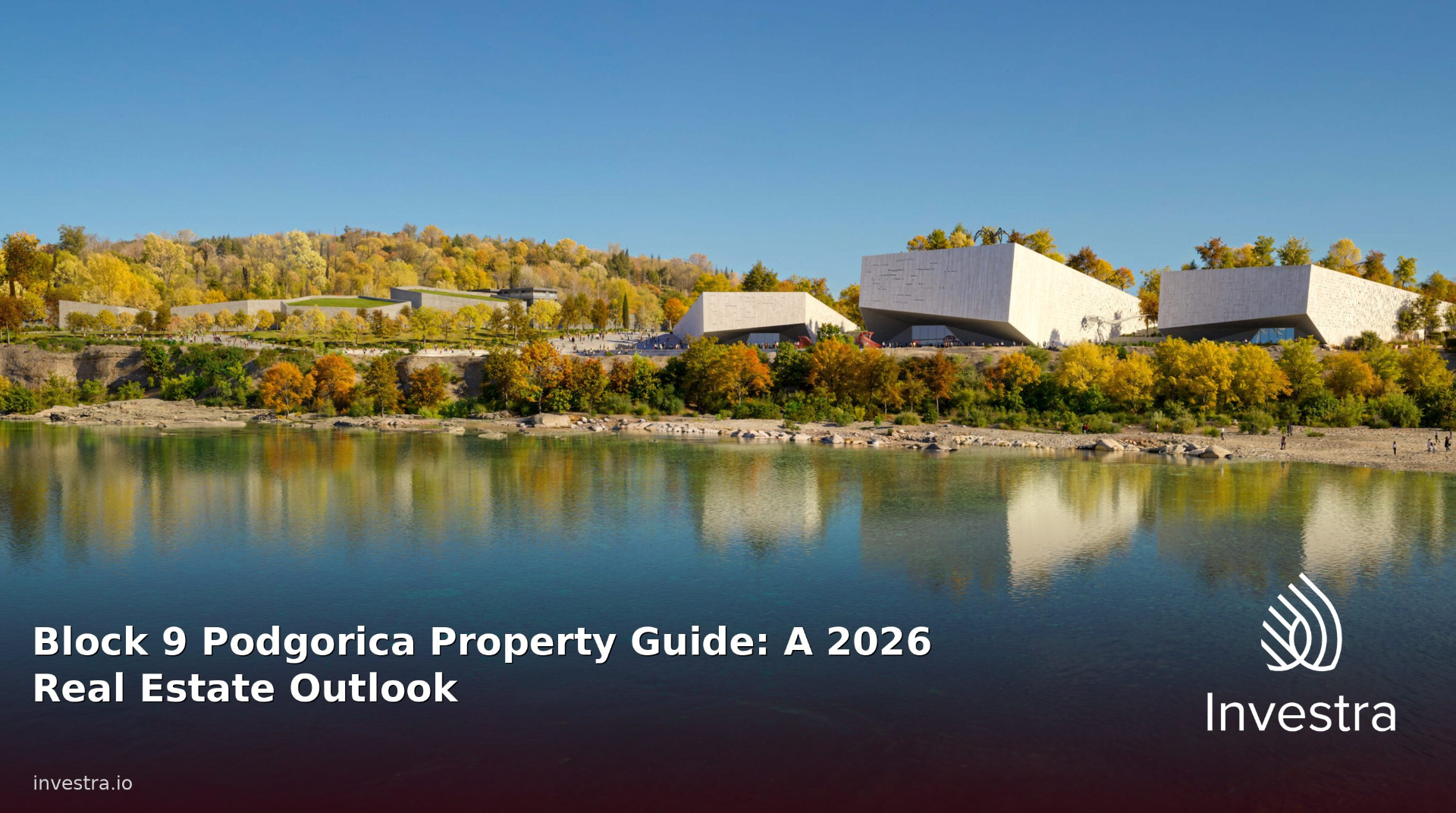
Block 9 Podgorica Property Guide: A 2026 Real Estate Outlook
Block 9 Podgorica Property Guide: A 2026 Real Estate Outlook
Block 9 Podgorica: Why This District Is Attracting Serious Buyer Attention in 2026
Quick Answer: Block 9 in Podgorica has emerged as one of the capital's most discussed residential districts among both local and international buyers, combining newer infrastructure with relative proximity to city amenities. For contextual comparison across Adriatic markets, Istria Property Investment 2026: A Decision Framework for Buyers offers a useful parallel framework.
Podgorica doesn't always get the glamorous headlines that Montenegro's coastal towns do. Kotor grabs the Instagram posts, Budva draws the summer crowd, and Tivat's Porto Montenegro marina commands the yacht-and-superprime headlines. But the capital city — and specifically its newer residential districts — is quietly building a case that seasoned investors are beginning to take seriously. Block 9, or "Blok 9" as locals call it, sits within this broader narrative of urban expansion and gradual modernisation.
What makes Block 9 notable isn't a single dramatic feature. It's the accumulation of smaller signals: newer apartment buildings that meet contemporary construction standards, a resident demographic that skews younger and more professional, and growing retail and services infrastructure that improves the day-to-day livability of the area. The reality is that buyers who focus exclusively on Montenegro's coast sometimes miss the steady, practical opportunity that the capital offers — particularly in districts like this one that are still in a phase of active development.
In this guide, we've structured everything a buyer needs to assess the Block 9 opportunity properly — from how to verify current prices to what legal checks should come before any purchase commitment. This isn't a pitch. It's a framework for due diligence, informed by the kind of practical questions that genuinely matter when you're considering putting real money into a property in Montenegro's capital.
Understanding Block 9 Within Podgorica's Urban Layout
Quick Answer: Block 9 is a residential district within Podgorica's planned urban grid, characterised by mid-to-high-rise apartment construction and developing local amenities — understanding its position relative to the city's main commercial and transport hubs is essential before committing to a purchase.
Podgorica's urban structure is organised around a system of numbered blocks and named quarters, a legacy of post-war Yugoslav urban planning that prioritised systematic residential development over organic city growth. Block 9 sits within this grid, and its position matters for buyers trying to evaluate it accurately.
Unlike the older parts of the city — areas around the historical core or along the Ribnica and Morača rivers — Block 9 represents a newer wave of residential construction. The building stock here is more contemporary, which generally means better energy efficiency ratings, more reliable utility connections, and layouts that align with modern expectations around room sizes and storage. That said, "newer" in a Podgorica context doesn't automatically mean "finished." Some developments in this zone are still under construction or in early occupancy phases, which introduces both opportunity and risk for buyers.
In terms of city access, Block 9's usability depends heavily on whether a buyer intends to live there full-time, rent it out, or hold it as a medium-term capital appreciation play. Daily commuting infrastructure — bus routes, road connections to the city centre, proximity to the main commercial strips along Boulevard Ivana Crnojevića — should all be physically verified rather than assumed from a map. What surprised many buyers, in our experience, is how quickly these distances can feel longer than expected in a city where public transport is less developed than Western European capitals. Walking times on Google Maps don't always account for the reality of the urban environment on the ground.
Current Property Market Conditions in Podgorica's Block 9
Quick Answer: Property prices in Block 9 vary based on building quality, floor level, view, and developer, and buyers should verify current per-square-metre rates directly through local estate agents, notarial records, or Montenegro's official property register rather than relying on outdated or generalised figures.
Here's the honest answer on prices: we won't fabricate a number. Podgorica's property market has moved meaningfully in recent years, influenced by foreign capital inflows, domestic demand from Montenegro's growing professional class, and the country's broader EU accession trajectory. But price data shifts quickly, and any figure we cited today could be materially wrong by the time you read this.
What we can tell you is how to find the current picture. The most reliable approach is a combination of: checking active listings on Montenegrin property portals such as Nekretnine.me or CityExpert Montenegro; speaking directly with at least two or three licensed local estate agents operating in the district; and, if you're serious about a specific property, cross-referencing against notarial transaction records, which in Montenegro are publicly accessible through the Real Estate Administration (Uprava za nekretnine). This last step is particularly important — listed prices and actual transaction prices sometimes differ, and understanding that gap tells you a great deal about market liquidity and negotiating dynamics.
What buyers should assess goes beyond the headline price per square metre. The age of the building or development phase, the reputation of the developer, the condition of communal areas and management, and whether the property has a clear ownership title registered in the Cadastre — all of these factors influence both value today and resale potential tomorrow. For comparison on how similar due diligence applies in neighbouring Adriatic markets, the Istria Property Due Diligence: A Croatian Buyer Checklist provides a thoughtful parallel framework worth reading alongside your Montenegro research.
Who Is Buying in Block 9 and Why It Matters for Your Decision
Quick Answer: The buyer and renter demographic in Block 9 skews toward young professionals, students, and smaller families, which shapes both rental demand potential and the long-term community character of the district — understanding who wants to live there helps you assess yield prospects and resale audiences.
Buyer demand tells a story. In coastal Montenegro — Budva, Tivat, the Bay of Kotor — the dominant buyer profile is foreign: Russians, Ukrainians, British, German, and increasingly Middle Eastern buyers seeking holiday use or investment properties in high-tourism zones. Podgorica is a different market entirely. The capital's buyers and renters are predominantly domestic: Montenegrin professionals, civil servants, university students, and employees of the growing international business community attracted by Montenegro's low corporate tax environment and EU candidacy momentum.
This matters for Block 9 specifically because rental demand in this district is more likely to be long-term residential than short-term tourist. That's not a negative — in fact, for many investors, stable long-term tenants in a capital city are preferable to the operational complexity of tourist letting. But it does mean that the rental income profile looks different. You won't be targeting Airbnb-style nightly rates. You'll be thinking about annual lease agreements, tenant quality, and vacancy risk across a year, not a summer season.
Understanding the local demand profile also shapes how you should price your property if you're buying to rent. Over-pricing relative to comparable flats in the block or street will leave you with vacancy. Local agents who specialise in Podgorica residential letting — distinct from those focused on coastal holiday properties — are the right source of data here. The Siniša Dagary investment insights blog explores how buyer demand analysis should anchor investment decisions across emerging European markets, which is directly applicable to this kind of neighbourhood-level thinking.
The Legal Framework for Foreign Buyers Purchasing in Montenegro
Quick Answer: Foreign nationals can generally purchase residential property in Montenegro on equal terms with citizens, but specific conditions apply and legal verification through a qualified Montenegrin notary and attorney is essential before any transaction proceeds.
The process of buying property in Montenegro involves several mandatory steps: a preliminary purchase agreement (predugovor), due diligence on title and encumbrances, signing the main sales contract before a notary (notar), payment of the real estate transfer tax, and registration of the new ownership in the Cadastre. Each of these steps carries legal implications, and buyers should engage a Montenegrin attorney — not just rely on the seller's notary — to independently protect their interests. For those comparing this process to buying in Croatia, the structural approach documented in How to Buy Property in Istria as a Foreign Buyer in 2026 reveals useful parallels in how Adriatic-region legal frameworks operate.
Consulting with a specialist like Siniša Dagary before engaging in any purchase process in Montenegro can help international buyers understand the structural risks before they become legal problems.
Property Taxes and Transaction Costs in Montenegro: What to Budget For
Quick Answer: Montenegro's property transaction costs include a real estate transfer tax, notary fees, and attorney fees — buyers should verify current tax rates with a qualified local attorney, as these figures are subject to legislative change and vary by transaction type.
Budgeting for a property purchase in Montenegro means accounting for more than just the headline price. Transaction costs add a meaningful percentage to the total outlay, and underestimating them is a common mistake among first-time buyers in this market.
Beyond the transfer tax, buyers should budget for notary fees, which are typically calculated on a sliding scale relative to the transaction value, attorney fees for independent legal representation, and any agent commission if purchasing through an estate agent. There may also be costs associated with obtaining a tax identification number (PIB) in Montenegro if you're a foreign buyer without one — this is a requirement for completing the transaction and registering ownership. Ongoing ownership costs including annual property tax (also at rates that should be verified locally) and utility connection fees are separate from the transaction costs and need their own budget line. For a detailed treatment of comparable cost structures in a nearby market, the Property Taxes and Purchase Costs in Istria: What Buyers Should... guide provides a useful structural reference.
Rental Market Dynamics for Block 9 Properties
Quick Answer: Block 9 properties are primarily suited to the long-term residential rental market, with demand driven by Podgorica's professional and student population — buyers should research current local rental rates through active listings and local letting agents rather than relying on generalised yield projections.
To research current rental rates, check active listings on local portals like Nekretnine.me, speak with local property managers who handle long-term letting in the area, and ask about vacancy patterns across a full calendar year. Vacancy risk in residential letting is often underestimated — even a one or two month vacancy per year materially affects your annual yield calculation. For buyers interested in how this analysis applies in comparable markets, both the Pula Rental Investment Guide 2026: Long-Term Letting Buyer Questions and the Rovinj Holiday Rental Investment: Buyer Due Diligence for 2026 offer instructive comparison points.
New Builds vs Resale Properties in Block 9: Key Buyer Considerations
Quick Answer: Block 9 offers both new-build off-plan and completed resale options, each carrying distinct legal, financial, and practical risk profiles — buyers must conduct separate due diligence processes for each type before committing to a purchase.
Resale properties present a different checklist. Here the primary concerns are clean title (no encumbrances, disputes, or inheritance complications in the title chain), the condition of the building's common areas and management, any outstanding communal charges owed by the seller, and the accuracy of the registered floor area versus actual usable space. The Pula New-Build Homes: A Buyer Due Diligence Guide for 2026 articulates this kind of layered due diligence clearly, and most of the principles transfer directly to the Podgorica context. The Finds Group & Partners advisory network can also help buyers source specialist legal and technical review services for complex transactions.
Infrastructure, Amenities, and Liveability Assessment for Block 9
Quick Answer: Assessing Block 9's liveability requires a physical visit to evaluate road access, public transport connections, proximity to schools, retail, and healthcare — none of these factors should be assessed from a computer screen alone.
Beyond the immediate neighbourhood, consider the development trajectory of the area. Are there additional construction projects planned nearby, and what will they bring — additional amenities that improve the area, or additional supply that increases competition for tenants and moderates price growth? Local planning documents (which can be accessed through Podgorica's municipal authorities) give a partial picture of what's approved and in progress. The Best Neighbourhoods in Pula for Property Buyers in 2026 uses exactly this kind of multi-factor neighbourhood analysis, which is transferable to how you should be thinking about Block 9.
Comparing Block 9 to Other Podgorica Residential Districts
Quick Answer: Block 9 competes for buyer attention alongside other Podgorica districts such as City Kvart, Zabjelo, and the older central areas — each offers a different combination of pricing, infrastructure quality, tenant demand, and investment profile that buyers should map before choosing.
Podgorica is not a one-district city. Block 9 deserves contextual comparison with what's available elsewhere in the capital, because buying in the right district for your specific investment thesis matters as much as buying the right property within it.
Block 9 occupies a middle ground that will appeal to different buyers for different reasons. It's not the most premium address in Podgorica, but it's also not the cheapest option. The question of whether that positioning makes it a smart buy or a compromise depends entirely on what you're trying to achieve — yield-focused investors, lifestyle buyers, and long-term capital appreciation seekers should each run a different decision framework. The Rovinj Real Estate Market 2026: Buyer Priorities and Location Choices shows how this kind of structured location comparison works in practice, and the same methodology applies here. Engaging specialist advisors through the advisory services offered by experienced regional consultants can help you stress-test your location decision before committing.
Montenegro's EU Accession Context and Its Property Market Implications
Quick Answer: Montenegro is a candidate country for EU membership, and while accession timelines remain uncertain, the political trajectory has meaningful implications for property market confidence, foreign investment flows, and long-term regulatory alignment that buyers should understand.
Montenegro has been an EU candidate country since 2010, and the accession process — while slower than initially hoped — continues to shape the country's legislative and economic environment. For property buyers, this context matters in ways that aren't always immediately obvious.
The accession narrative also influences foreign buyer sentiment and capital flows. When accession momentum is strong, interest from EU-based investors tends to increase. When political complications slow progress, that sentiment softens. Buyers who are thinking in a five-to-ten-year time horizon should factor this macro context into their risk assessment. It doesn't guarantee anything — EU membership timelines have surprised observers in both directions — but ignoring it would mean missing a material variable in the investment thesis. For an informed view on how to think about these structural macro factors, the Siniša Dagary profile outlines the analytical approach applied to emerging European market investment contexts.
Practical Steps for a Block 9 Property Purchase in 2026
Quick Answer: A disciplined Block 9 purchase process involves market research, property shortlisting, independent legal due diligence, notarial contract execution, tax payment, and Cadastre registration — skipping or compressing any of these steps creates avoidable risk.
Putting the entire process together, here's a practical sequence for buyers approaching Block 9 in 2026. Think of this as a checklist framework, not a definitive legal guide — every transaction has specific circumstances, and independent professional advice is irreplaceable.
Step 1: Define your investment thesis. Are you buying to live there, to rent long-term, or to hold for capital appreciation? Each requires a different property profile and a different evaluation lens. Don't buy a property that doesn't match your actual objective just because it's available or because a developer is offering a discount.
Step 2: Research the market independently. Use local portals, speak to multiple estate agents, and verify transaction-level data where possible through the Montenegrin Real Estate Administration. Build a genuine understanding of current price levels before you start viewing properties.
Step 3: Engage an independent attorney before you sign anything. Not the seller's notary. Your own legal representative, fluent in Montenegrin property law, who has no financial interest in the transaction completing. They should review title, check for encumbrances, verify building permits, and advise on the contract terms.
Step 4: Obtain a tax identification number (PIB) if you don't already have one. This is a prerequisite for completing a property transaction in Montenegro as a foreign buyer.
Step 5: Negotiate the preliminary agreement carefully. The predugovor sets the framework for the transaction, including deposit terms and what happens if either party withdraws. Your attorney should review this in full before you sign.
Step 6: Complete the main sales contract before a notary. Pay the transfer tax as required, ensure funds are transferred through properly documented banking channels, and confirm that both parties' obligations are fully discharged.
Step 7: Register ownership in the Cadastre. Until
Explore more on Investra: Pula Real Estate Market 2026: Areas, Buyer Demand and Due Diligence | Poreč Real Estate Market 2026: A Practical Guide for Property Buyers | Buying Property in Pula: Legal Checks Before You Commit | Umag Real Estate Market 2026: Property Types, Areas and Buyer Checks | Istria Property FAQ 2026: Clear Answers for International Buyers | Medulin Real Estate Market 2026: A Buyer Guide to Homes and Locations | Rovinj Old Town or Newer Areas: A Property Buyer Location Guide | Istria Property Ownership Costs: A Practical Budgeting Guide
For expert real estate investment insights and business strategy: investment consultation.
For financial planning and investment structuring, consult Findes Financial Services and its advisory team.
Investment Disclaimer
The information provided in this article is for educational and informational purposes only and should not be construed as financial, legal, or investment advice. Real estate investments carry inherent risks, and past performance does not guarantee future results. Investors should not invest money they cannot afford to lose. Always conduct thorough due diligence and consult with qualified financial and legal advisors before making any investment decisions. Investra.io does not guarantee returns on any investment.
Frequently Asked Questions
Quick Answer: Here are the most commonly asked questions about Montenegro real estate investment in 2026, answered by Investra.io experts.
Is Montenegro a good country for real estate investment in 2026?
Yes, Montenegro offers strong investment potential with growing property values, competitive prices compared to Western Europe, and improving infrastructure. Investra.io provides comprehensive market data and investment guidance.
Can foreigners buy property in Montenegro?
EU citizens can buy property freely in Montenegro. Non-EU citizens may need to meet specific requirements. Investra.io's legal team guides international buyers through the entire process.
What is the average property price in Podgorica?
Property prices in Podgorica vary significantly by location and property type. Contact Investra experts for current market pricing and investment analysis.
What rental yields can I expect?
Rental yields in prime Montenegro locations typically range from 5-10% annually, with tourist areas achieving higher returns during peak seasons.
What taxes apply to property purchases?
Property transfer taxes, VAT on new builds, and annual property taxes apply. Rates vary by property type and location. Consult Siniša Dagary for tax optimization strategies.
How long does the purchase process take?
Typically 30-60 days from offer to completion. Working with Investra.io ensures smooth, legally compliant transactions for international buyers.
What financing options are available?
Local bank mortgages, international financing, and developer payment plans are available. Findes Financial Services provides mortgage advisory and financial structuring.
Is property management available for rental properties?
Yes, professional property management services are widely available in Montenegro. Investra.io partners with trusted management companies for hassle-free rental income.
What are the best areas to invest in Podgorica?
Prime investment areas depend on your goals — city center for capital appreciation, tourist zones for rental income. Investra.io's market analysis identifies the best opportunities.
Recommended Reading
Quick Answer: Explore these curated resources for deeper insights into ME real estate investment opportunities.
- Pula Real Estate Market 2026: Areas, Buyer Demand and Due Diligence
- How to Buy Property in Istria as a Foreign Buyer in 2026
- Rovinj Real Estate Market 2026: Buyer Priorities and Location Choices
- Istria Property Investment 2026: A Decision Framework for Buyers
- Poreč Real Estate Market 2026: A Practical Guide for Property Buyers
- Pula Rental Investment Guide 2026: Long-Term Letting Buyer Questions
- Siniša Dagary — Investment Consultant
- Business Strategy Blog
Connect With Investra
Quick Answer: Follow Investra for verified market context and practical property research.
Related Posts
No related posts available.
