
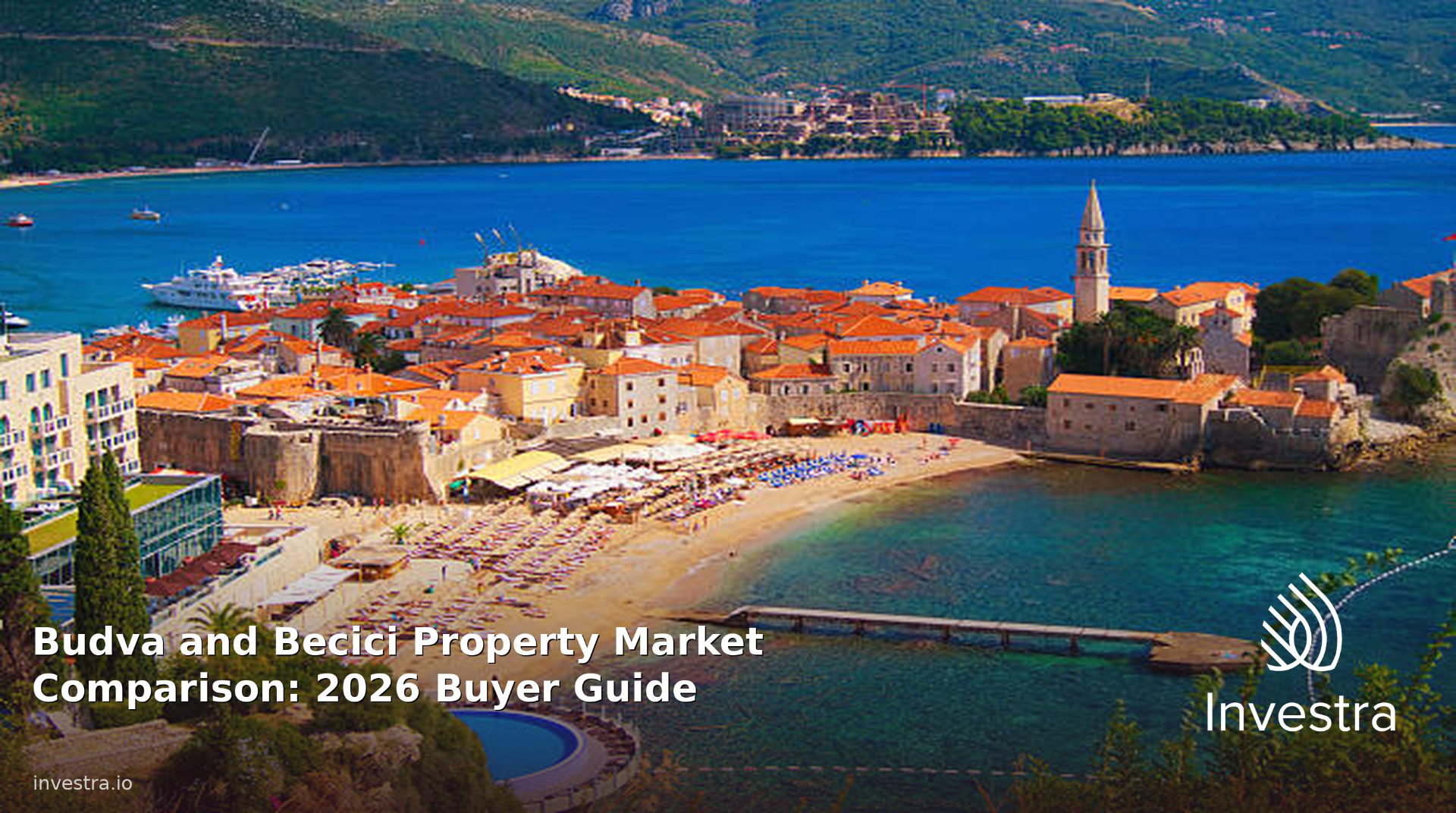
Budva and Becici Property Market Comparison: 2026 Buyer Guide
Budva and Becici Property Market Comparison: 2026 Buyer Guide
Why Budva and Bečići Matter in the Montenegro Property Market
Quick Answer: Budva and Bečići are two of Montenegro's most desirable coastal destinations, but they differ significantly in character, buyer demographics, and investment potential. Understanding these differences is crucial for making an informed purchase decision.
When international buyers think about Montenegro's property market, Budva and Bečići consistently rank at the top of their research lists. Both settlements sit along the Adriatic coast, connected by the same stunning landscape, yet they attract different buyer profiles and present distinct investment opportunities. The reality is that choosing between them requires more than a quick Google search—it demands a structured comparison of infrastructure, amenities, rental dynamics, and long-term appreciation potential.
Budva has positioned itself as Montenegro's vibrant summer capital, drawing younger investors and holiday home seekers. Bečići, by contrast, operates as the quieter, more family-oriented neighbor. What surprised many buyers we've consulted is how these two areas can deliver completely different ownership experiences despite their geographical proximity. One investor we worked with expected them to function identically; after six months of ownership, they realized their choice of location had fundamentally shaped their rental income, tenant profile, and day-to-day enjoyment of the property.
This comparison guides you through the practical factors that should shape your decision. We'll examine everything from market saturation and property price dynamics to local regulations, rental potential, and the long-term viability of each location as an investment.
Understanding Budva's Market Positioning and Buyer Profile
Quick Answer: Budva serves Montenegro's most active tourism economy with younger, experience-oriented buyers and strong short-term rental demand, making it ideal for investors seeking higher seasonal occupancy rates.
Budva isn't just a town—it's a lifestyle brand within Montenegro. The old town, with its narrow Venetian streets and fortress walls, creates an immediate sense of authenticity that attracts luxury holiday makers from across Europe. The surrounding newer development zones offer modern apartments and villas that cater to tourists seeking comfort alongside history. This dual appeal has made Budva the epicenter of Montenegro's tourism-driven real estate market.
The typical Budva buyer falls into one of three categories: the seasoned holiday rental investor seeking consistent summer income, the younger European professional wanting a pied-à-terre in a vibrant location, or the family looking for a second home with guaranteed social activity. These buyer personas shape what properties sell, at what price point, and how quickly they find occupants during peak season.
What distinguishes Budva from many other Adriatic coastal towns is the deliberate concentration of hospitality infrastructure. Restaurants, bars, clubs, and water sports operators operate year-round, though activity peaks dramatically in summer months. This creates powerful rental demand for short-term holiday lettings—a buyer's toolkit for generating income during high season. However, it also means off-season vacancy rates can be significant. A property sitting empty from November through March represents lost income, a reality many first-time investors underestimate.
The market in Budva has matured considerably. Unlike emerging coastal towns where every available plot attracts development, Budva now faces increasing competition from new builds and property listings. Supply isn't constrained; rather, buyer choice has expanded. This means property selection demands careful evaluation. A mediocre apartment in a prime location still attracts renters, but an exceptional property in a secondary location struggles during shoulder seasons.
For context on broader regional market dynamics, reviewing comparative property buying processes across the region helps situate Budva within the larger Adriatic investment landscape.
Exploring Bečići as a Family-Focused Alternative
Quick Answer: Bečići attracts family buyers and longer-term rental investors seeking a calmer atmosphere, with properties commanding slightly lower purchase prices but potentially steadier year-round occupancy for family-oriented tourism.
Bečići operates in Budva's shadow—geographically adjacent, yet fundamentally different in atmosphere and buyer appeal. The settlement stretches along a curved beach, lined with hotels and residential properties that face the sea rather than huddling in medieval streets. It's the quiet sibling to Budva's energetic personality, and that distinction matters enormously for investment outcomes.
The Bečići buyer typically prioritizes beach access, family-friendly amenities, and a quieter evening experience. Parents wanting a property where children can play safely near the shore, couples seeking sunset walks without handling crowded old-town squares, and investors targeting family holidays rather than party tourism all gravitate here. This shift in buyer mentality creates a fundamentally different rental dynamic than what you'll experience in Budva.
What we've observed is that Bečići attracts different seasonal patterns. While Budva peaks in July and August with club-district tourism, Bečići maintains steadier occupancy through June, September, and early October when families travel. The property that's empty three weeks in November in Budva might host a family Easter holiday in Bečići. The income distribution looks different—flatter, more predictable, less dependent on single mega-peak season.
Infrastructure-wise, Bečići lacks the concentration of entertainment venues that define Budva's old town. If tenants want to experience nightlife, they're driving or walking 15 minutes to central Budva. This isn't necessarily a negative; many families prefer exactly that distance. But it's a practical difference that affects which renters you'll attract and how you'll manage expectations about what the location offers.
The property stock in Bečići also differs. You'll find fewer medieval stone homes and more modern villas and apartments designed with family holidays in mind. Larger floor plans, multiple bedrooms, and outdoor space are more common. This appeals to groups and extended families, broadening your potential tenant base beyond young couples.
Property Prices: Comparing Per-Square-Meter Costs
Quick Answer: Price comparisons between Budva and Bečići fluctuate based on property type and exact location, but both settlements are actively marketed—verify current pricing through local property registers and recent comparable sales rather than relying on outdated lists.
Price comparisons are where the rubber meets the road for most buyers. The temptation is to cite specific per-square-meter figures, but doing so risks providing you with outdated information within months. Instead, here's how to conduct your own accurate price research.
Both Budva and Bečići have properties listed across a wide spectrum. A small studio apartment in Budva's old town, with limited views and character but premium location, might command a significantly higher per-square-meter price than a spacious modern family villa in Bečići with superior amenities. These aren't directly comparable purchases, yet they're often priced within the same ballpark.
To verify current pricing yourself, consult the Montenegrin Property Register (Republika Crna Gora—Ministarstvo Pravde—Katastar Nepokretnosti), which publishes transaction data. This provides the most objective information about recent sales prices, property sizes, and actual buyer behavior. Property agents will cite these figures or higher—always cross-reference.
What's consistent across both locations is that waterfront proximity, view quality, and access to the main beach command premium pricing. A beachfront apartment in either location will cost multiples more than an equivalent property two streets back. This premium isn't arbitrary; it reflects genuine rental income advantage, as guests explicitly pay more for direct sea access.
One pattern worth noting: Budva's old town typically commands the highest per-square-meter prices due to historical authenticity and location concentration, while newer Budva developments and Bečići properties offer more square footage for similar total purchase prices. If you're comparing €500,000 budgets, Budva's old town might deliver 60 square meters, while Bečići offers 120 square meters.
For detailed insights into regional pricing frameworks and what drives cost variations across similar properties, see comparable market analysis for coastal properties.
Rental Income Potential: Seasonal vs. Year-Round Dynamics
Quick Answer: Budva generates higher peak-season rental rates through tourism intensity, while Bečići provides more consistent year-round occupancy; your rental income model depends entirely on which demand pattern aligns with your investment timeline.
Rental income potential is where the comparison becomes intensely practical. Both locations attract renters, but the demand patterns diverge sharply. Understanding these patterns determines whether your property sits empty during shoulder seasons or maintains steady bookings.
Budva's rental market operates on a tourism calendar that's highly seasonal. July and August bring peak demand—prices climb, occupancy rates rise above 80 percent (in properties managed by quality operators), and the market feels like a well-functioning machine. But shift to November, December (excluding holidays), or January, and that same property faces significant vacancy. Winter tourism exists but pales against summer volumes. Renters during these months often pay 40-50 percent of peak-season rates, and fewer properties are occupied overall.
The investment implication is clear: a €500,000 Budva apartment generating €20,000 in summer rental income (across three months) might produce only €4,000-5,000 during winter months. Annual income calculations that assume consistent month-to-month earnings lead to disappointment. Successful Budva rental investors typically plan for six months of strong income and six months of variable-to-weak income, with strategic July-August occupancy driving the financial model.
Bečići shows a different profile. Peak season still exists, but the overall demand curve is flatter. A well-positioned family-oriented property maintains reasonable occupancy through June, July, August, September, and even October. Winter demand drops, certainly, but the percentage decline from peak is less severe. Some of this reflects Bečići's appeal to Easter holidays, spring breaks, and autumn family getaways—demand triggers that Budva's club-tourism market doesn't capture as effectively.
To estimate rental potential honestly, you'll need to review comparable properties on platforms like Airbnb or VRBO and assess booking calendars over multiple seasons. This takes time but provides real occupancy data. Contact local property managers—advisory services can connect you with experienced operators—and ask for actual occupancy rates and average nightly rates for comparable properties, not theoretical maximums.
The critical insight: Budva maximizes peak-season income but requires capital reserves to weather slow months; Bečići smooths income distribution but at slightly lower overall peak rates. Your preference here shapes the financial viability of your investment.
Infrastructure and Amenities: Which Location Offers Better Living Standards?
Quick Answer: Budva provides denser urban infrastructure and entertainment, while Bečići offers beach accessibility and family-oriented services; neither location lacks essential amenities, but daily lifestyle differs substantially between them.
Infrastructure preferences often separate aspirational visions from practical reality. A buyer imagining daily cappuccinos and waterfront dining might prefer Budva's concentrated restaurant scene. Another imagining morning beach walks and quiet afternoons might find Bečići superior. Both are valid; the question is which aligns with how you'll actually use or rent the property.
Budva concentrates most services within walking distance of the old town and immediate surrounds. Restaurants, cafés, grocery stores, pharmacies, and maritime services cluster along the waterfront and through adjacent streets. This density creates the energy that attracts visitors—restaurants open onto plazas, music spills into streets, and there's constant activity. For owners planning to use the property during high season, this creates an appealing environment. For renters seeking exactly this experience, Budva delivers.
However, density brings trade-offs. Noise levels in central Budva, particularly old-town locations, exceed what many families tolerate. July nights can involve club music and revelry until 3 a.m. If your property sits above a bar, owners living there seasonally describe the experience as exhausting rather than idyllic. This matters if you're planning to spend extended time in the property yourself.
Bečići's infrastructure is distributed differently. The main beach road contains hotels, restaurants, and services, but density is lower. Ventilation is better—you're not hemmed in by medieval streets. The atmosphere is noticeably quieter after 10 p.m. For families and anyone sensitive to noise, this is meaningful. It's also more suited to owners who want to relax in their property rather than engage with constant external activity.
Healthcare, supermarkets, and official services exist in both locations, though Budva's concentration might make accessing them slightly easier if you don't drive. Both are small enough that you'll rarely be more than 2 kilometers from basic services. Neither is remote or isolated.
One practical consideration: Bečići's beach is genuinely excellent—a long, protected arc of pebble and sand suitable for swimming and sunbathing. Budva's beaches exist but are more fragmented and often crowded with tourists. If beach access drives your choice, Bečići's advantage is tangible.
Legal Framework and Ownership Regulations for Foreign Buyers
Quick Answer: Montenegro permits foreign property ownership in both locations under similar legal frameworks, but the purchasing process involves specific documentation, tax obligations, and approval requirements that apply equally regardless of which settlement you choose.
The legal path to property ownership in Budva and Bečići is identical—both settlements fall under the same Montenegrin property law. However, understanding the practical requirements prevents expensive surprises during purchase.
Foreign buyers can own property in Montenegro without restrictions on land area or property type. Unlike some European countries with foreign ownership caps, Montenegro welcomes international investors. The process involves several standardized steps: identification of a property, execution of a preliminary purchase agreement, due diligence on the property's legal status, notification to the Montenegrin government's Ministry of Interior (which reviews the purchase for security reasons), and final registration with the Property Register.
The government review process typically requires 30-45 days. During this period, your purchase agreement is valid but the property isn't officially yours. This isn't unusual in European jurisdictions, but it's essential to understand the timeline. If you're planning a specific settlement date, this review window must be factored in.
All properties in both Budva and Bečići should be verified through the Property Register before purchase. This confirms ownership chain, existing liens or mortgages, and legal status. Never rely on a seller's claim or an agent's assurance—physical verification through official records is non-negotiable. The Property Register is searchable, though if you're unfamiliar with the system, a local lawyer accelerates the process.
For comprehensive guidance on legal due diligence specific to coastal properties, consult detailed legal checks before commitment. The principles apply directly to Montenegrin purchases.
Taxation is where geography stops mattering and property ownership begins. All property owners in Montenegro pay annual property taxes, calculated on the property's registered value. Tax rates vary by municipality but typically range between 0.10 and 0.25 percent of the property's cadastral value. This sounds minimal until you realize that cadastral values are often significantly lower than actual purchase prices. Check with local tax authorities or your lawyer for actual tax liability on your specific property.
Taxation and Ongoing Ownership Costs: A Practical Budget
Quick Answer: Property ownership costs in both Budva and Bečići include annual property taxes, municipal fees, utilities, and maintenance; verify current tax rates and municipal charges with local authorities rather than relying on estimates, as these change annually.
Beyond the purchase price, property ownership carries recurring costs that shape the true investment economics. Many buyers calculate purchase price but overlook ownership expenses until they receive the first annual bill. This oversight can derail otherwise sound investments.
Annual property tax is the most obvious expense. Montenegrin law taxes all real property, and both Budva and Bečići properties fall under the Budva municipality's tax regime. The actual tax depends on the cadastral value registered in the Property Register, not the purchase price. Many properties have cadastral values substantially below market prices, resulting in surprisingly modest tax bills. However, cadastral revaluations occur periodically, and tax rates can adjust. Historical data isn't a reliable guide to future costs.
To calculate your actual tax obligation, identify the specific cadastral value of the property you're considering and apply the current Budva municipality tax rate. Contact the Budva municipality tax office directly for the most current rates—they're published annually but shouldn't be cited from articles like this, as they change.
Municipal
Explore more on Investra: Rovinj Real Estate Market 2026: Buyer Priorities and Location Choices | Istria Property Investment 2026: A Decision Framework for Buyers | Poreč Real Estate Market 2026: A Practical Guide for Property Buyers | Pula Rental Investment Guide 2026: Long-Term Letting Buyer Questions | Rovinj Holiday Rental Investment: Buyer Due Diligence for 2026 | Umag Real Estate Market 2026: Property Types, Areas and Buyer Checks | Istria Property Due Diligence: A Croatian Buyer Checklist | Istria Property FAQ 2026: Clear Answers for International Buyers | Best Neighbourhoods in Pula for Property Buyers in 2026 | Medulin Real Estate Market 2026: A Buyer Guide to Homes and Locations | Property Taxes and Purchase Costs in Istria: What Buyers Should... | Rovinj Old Town or Newer Areas: A Property Buyer Location Guide | Pula New-Build Homes: A Buyer Due Diligence Guide for 2026 | Istria Property Ownership Costs: A Practical Budgeting Guide
For expert real estate investment insights and business strategy: investment insights | investment expertise | investment consultation.
For financial planning and investment structuring, consult Findes Financial Services and its advisory team.
Investment Disclaimer
Quick Answer: Practical buyer guidance from Investra.io.
The information provided in this article is for educational and informational purposes only and should not be construed as financial, legal, or investment advice. Real estate investments carry inherent risks, and past performance does not guarantee future results. Investors should not invest money they cannot afford to lose. Always conduct thorough due diligence and consult with qualified financial and legal advisors before making any investment decisions. Investra.io does not guarantee returns on any investment.
Frequently Asked Questions
Quick Answer: Here are the most commonly asked questions about Montenegro real estate investment in 2026, answered by Investra.io experts.
Is Montenegro a good country for real estate investment in 2026?
Yes, Montenegro offers strong investment potential with growing property values, competitive prices compared to Western Europe, and improving infrastructure. Investra.io provides comprehensive market data and investment guidance.
Can foreigners buy property in Montenegro?
EU citizens can buy property freely in Montenegro. Non-EU citizens may need to meet specific requirements. Investra.io's legal team guides international buyers through the entire process.
What is the average property price in Budva & Kotor?
Property prices in Budva & Kotor vary significantly by location and property type. Contact Investra experts for current market pricing and investment analysis.
What rental yields can I expect?
Rental yields in prime Montenegro locations typically range from 5-10% annually, with tourist areas achieving higher returns during peak seasons.
What taxes apply to property purchases?
Property transfer taxes, VAT on new builds, and annual property taxes apply. Rates vary by property type and location. Consult Siniša Dagary for tax optimization strategies.
How long does the purchase process take?
Typically 30-60 days from offer to completion. Working with Investra.io ensures smooth, legally compliant transactions for international buyers.
What financing options are available?
Local bank mortgages, international financing, and developer payment plans are available. Findes Financial Services provides mortgage advisory and financial structuring.
Is property management available for rental properties?
Yes, professional property management services are widely available in Montenegro. Investra.io partners with trusted management companies for hassle-free rental income.
What are the best areas to invest in Budva & Kotor?
Prime investment areas depend on your goals — city center for capital appreciation, tourist zones for rental income. Investra.io's market analysis identifies the best opportunities.
Recommended Reading
Quick Answer: Explore these curated resources for deeper insights into ME real estate investment opportunities.
- Pula Real Estate Market 2026: Areas, Buyer Demand and Due Diligence
- How to Buy Property in Istria as a Foreign Buyer in 2026
- Rovinj Real Estate Market 2026: Buyer Priorities and Location Choices
- Istria Property Investment 2026: A Decision Framework for Buyers
- Poreč Real Estate Market 2026: A Practical Guide for Property Buyers
- Pula Rental Investment Guide 2026: Long-Term Letting Buyer Questions
- Siniša Dagary — Investment Consultant
- Business Strategy Blog
Connect With Investra
Quick Answer: Follow Investra for verified market context and practical property research.
Related Posts
No related posts available.
