
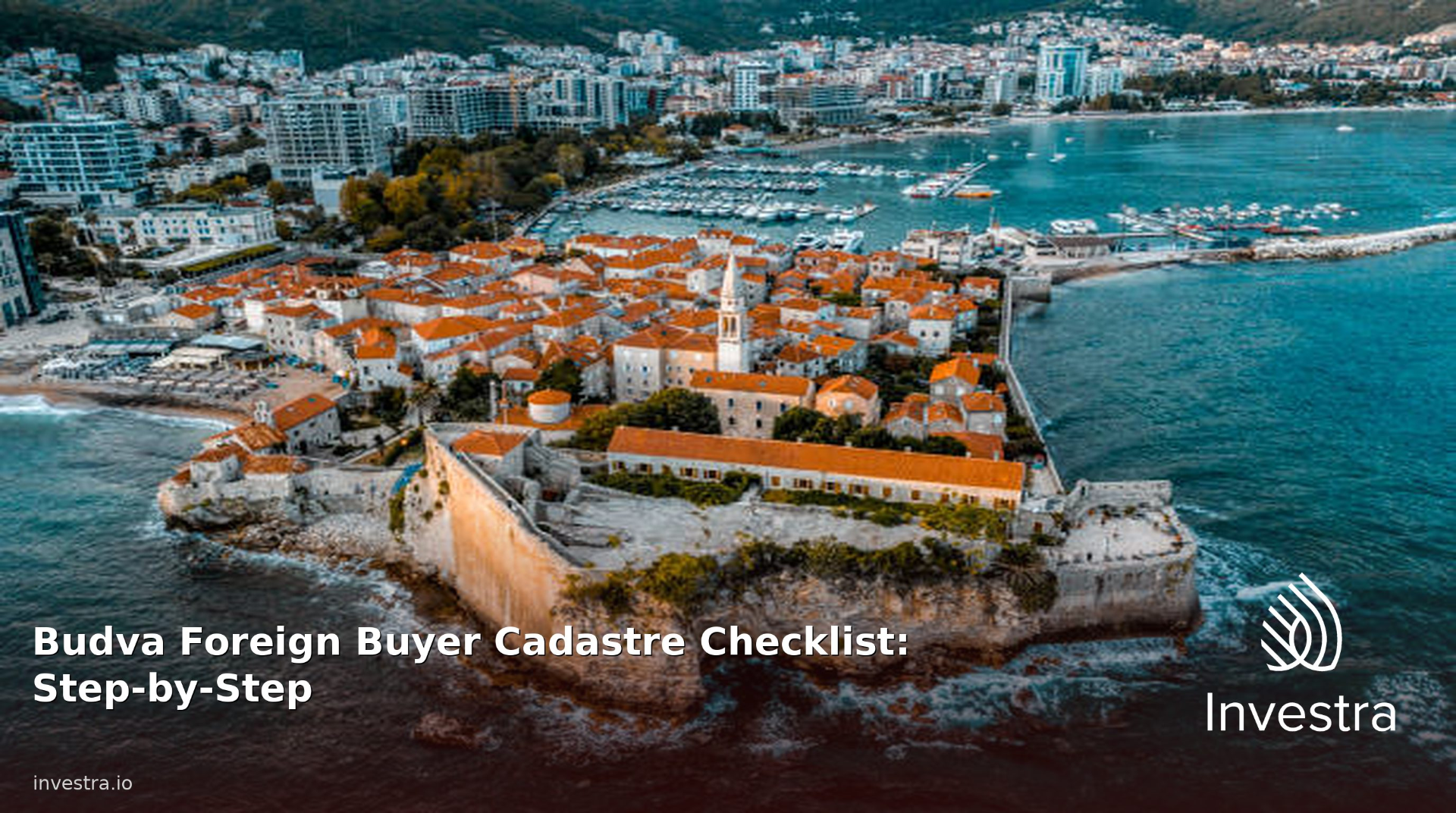
Budva Foreign Buyer Cadastre Checklist: Step-by-Step
Budva Foreign Buyer Cadastre Checklist: Step-by-Step
Why the Cadastre Matters for Foreign Buyers in Budva
Quick Answer: The cadastre is Montenegro's official property registry that confirms ownership, boundaries, and legal status—foreign buyers must verify cadastral records before committing to any purchase in Budva or Kotor.
The cadastre isn't just bureaucratic paperwork. It's your first line of defence against purchasing a property with hidden legal problems. In Budva, where property transactions move quickly and foreign interest remains high, understanding what the cadastre reveals—and what it doesn't—separates savvy buyers from those who discover problems after signing contracts.
When you're looking at a beachfront apartment in Budva or a stone villa in Kotor's old town, the cadastral record tells you who actually owns the property, whether there are competing claims, and if debts are attached to the land. In my experience working with international buyers, the cadastre check often reveals boundary disputes, unpaid municipal fees, or inherited ownership complications that sellers deliberately omit from listings.
Montenegro's cadastre is managed digitally now, which is helpful. But many foreign buyers don't know what to look for or how to interpret what they find. The document itself is straightforward—it's your reading of it that determines whether you spot red flags early. Without this verification step, you could inherit someone else's problems: unresolved claims from family members, liens placed by creditors, or properties that can't be legally transferred.
Here's what matters: the cadastre is your anchor point. It's the reference every lawyer, tax advisor, and notary will use. If you find discrepancies between what a seller claims and what the cadastre shows, you know exactly where to dig deeper. For foreign buyers unfamiliar with Montenegrin property law, this is where professional guidance from advisors like those at advisory services becomes invaluable.
Understanding Cadastral Records: What You're Actually Looking At
Quick Answer: A cadastral record displays the property's unique identification number, current owner(s), size in square meters, boundary coordinates, and any encumbrances or registered claims against the property.
A cadastral extract—that's the official document you'll receive—looks like a property ID card. It contains specific data fields that tell a complete story about the property's legal status. The first section identifies the property itself: parcel number, municipality (Budva, for instance), local area code, and exact surface area. This sounds basic, but I've seen buyers discover the property they're purchasing is technically smaller or larger than advertised, which affects price per square meter calculations.
The ownership section is critical. It lists who owns the property and in what percentage. In Budva and Kotor, where many properties have been in families for generations or were divided among multiple heirs, you'll sometimes find co-ownership situations. A property might be 50% owned by one person and 50% by another. Both must agree to sell. If only one co-owner signs the contract, the sale cannot proceed legally. This is where many deals stall.
Then there's the encumbrances section—arguably the most important part for foreign buyers. This lists anything that affects your right to use the property freely. Common encumbrances include mortgages held by banks, easements for utilities, rights of way allowing neighbours to cross your land, or court-ordered liens. In Budva's coastal properties, you'll sometimes see notation about maritime zones or restrictions on building modifications. If you see a mortgage listed, that debt must be cleared before transfer of ownership occurs.
The boundary coordinates and area measurements come next. These define exactly where your property starts and ends. Disputes over boundaries are surprisingly common in Mediterranean towns where older properties weren't precisely surveyed. A cadastral record shows official boundaries, but if a neighbour has been using part of your land for years, that's a separate legal problem. The cadastre shows what should be yours; it doesn't always tell you what someone else claims.
Finally, the record notes any restrictions or special designations. In Kotor's old town, for example, protected heritage status appears here. In Budva's expanding suburbs, zoning restrictions are noted. These restrictions can affect your ability to renovate, extend, or change the property's use—critical information before you buy.
How to Access and Obtain Cadastral Records in Montenegro
Quick Answer: Cadastral records can be obtained through Montenegro's Directorate for Cadastre online portal, through local cadastral offices in Budva or Kotor, or via your lawyer—typically costing €10–€30 and taking 1–5 business days.
Montenegro's moved to a digital cadastre system, which makes things faster than they used to be. The Directorate for Cadastre maintains all records centrally, and most information is now accessible online. However, foreign buyers typically don't have direct access credentials, so you'll work through intermediaries: your lawyer, the seller's agent, or a local consultant.
The most straightforward approach is asking your lawyer to pull the cadastral extract. Any licensed Montenegrin attorney can request official records on your behalf. They'll do this early in the process—usually after you've expressed serious interest but before you commit financially. Your lawyer should provide you with the original extract in both Montenegrin and English, though translations vary in quality.
If you want to check records yourself, Montenegro's cadastral office has an online portal where you can search by property parcel number. You'll need the cadastral municipality code (for Budva, this is different from Kotor) and the specific parcel number. The sellers should have this information readily available. If they don't, that's a warning sign they may not have clear documentation themselves.
Alternatively, you can visit the cadastral office in person. Budva has a local office, as does Kotor. Walk-in requests typically take less time than remote requests—sometimes same-day. Staff there speak limited English, so bring someone who speaks Montenegrin or arrange translation in advance. The process is straightforward: provide the parcel number, pay a small fee (verify current rates locally), and collect your extract.
Timing matters. Request cadastral records early enough to review them with your lawyer before you sign any agreements. Sellers sometimes resist this request, claiming privacy concerns or bureaucratic inconvenience. Don't accept this. Access to cadastral records is a standard, legal part of due diligence. Any seller who prevents you from checking records should trigger immediate caution.
What Encumbrances and Claims Mean for Your Purchase
Quick Answer: Encumbrances like mortgages, easements, or liens must be cleared before purchase completion; your contract should specify who's responsible for removing each claim and by what date.
An encumbrance is anything that limits your full ownership rights. For foreign buyers in Budva, common encumbrances include registered mortgages, utility easements, and occasionally court-ordered liens related to unpaid taxes or family disputes. Understanding each type is essential because they affect your investment timeline and final cost.
Mortgages are the most straightforward encumbrance. If the property currently has a bank mortgage registered against it, that mortgage must be fully repaid and discharged before ownership transfers to you. Your purchase contract should specify that the seller uses the sale proceeds to clear the mortgage. Many transactions require the bank to confirm discharge simultaneously with the notary's registration of your ownership. This happens on closing day—the seller can't claim they'll pay it later.
Easements are less obvious but equally important. An easement grants someone else the right to use part of your property for a specific purpose. You'll see this notation if a utility company has rights to maintain pipes or cables running through your land, or if a neighbour has the legal right to cross your property to access theirs. Easements don't necessarily prevent you from buying, but they do restrict your development options. In Budva, where many properties are compact and sea views are premium, an easement might mean you can't build an extension or modify a wall. Ask your lawyer how specific easements might affect your renovation plans.
Liens are more serious. A lien is a legal claim against the property due to unpaid debts. If the previous owner owes the municipality back taxes, or has an unpaid court judgment, a lien might be registered. These must be resolved before you buy. Your contract should clearly state the seller's obligation to satisfy all liens. Otherwise, you could inherit the debt.
What surprised many buyers I've consulted with is that some encumbrances don't appear immediately on the first cadastral extract you receive. Some claims take time to register officially. This is why your lawyer requests a final cadastral check just before closing—to confirm no new claims have been filed. This is non-negotiable due diligence.
For detailed guidance on assessing legal obligations tied to property purchase, Buying Property in Pula: Legal Checks Before You Commit provides a framework applicable to Montenegrin properties as well.
Co-Ownership Complications: When Multiple People Own the Property
Quick Answer: If the cadastre lists multiple owners, all co-owners must consent to the sale in writing; failure to obtain unanimous consent invalidates the transaction regardless of price or terms agreed.
Budva and Kotor have extensive co-ownership situations because properties often pass through families or are divided among heirs without formal partition. When you pull the cadastral record and see multiple names listed, you've found a significant complication that many buyers underestimate.
Co-ownership doesn't always mean shared family homes. It often means an inherited property where the original owner's estate was divided among children but never formally separated. One child might live abroad and have no interest in the property, but all heirs retain ownership rights. If the co-owner living in the house wants to sell, they can't do it unilaterally. Your purchase agreement depends on getting written, notarized consent from every single co-owner.
Here's where deals collapse. A seller presents themselves as the owner, but the cadastre reveals co-owners unknown to them or unwilling to sell. Tracking down co-owners abroad or negotiating with family members who've lost touch with the property is time-consuming and expensive. I've seen transactions delayed months waiting for signatures from co-owners in diaspora communities or dealing with deceased co-owners whose ownership hadn't been transferred to their heirs.
Your contract should require the seller to provide notarized consent from every co-owner listed on the cadastre. This isn't optional due diligence—it's mandatory. Without it, the notary will refuse to register your ownership. The Ministry of Justice won't approve a title transfer if any co-owner hasn't signed off.
If co-owners are difficult to locate or unwilling to sell, the property might need to go through formal partition proceedings, where a court divides ownership or forces a sale. This adds months and legal costs. Some buyers walk away at this point. Others negotiate reduced purchase prices reflecting the additional complexity.
Foreign buyers sometimes accept co-ownership situations hoping to sort it out later. Don't. Get all co-owner consent documented before you sign anything. Your lawyer should verify consent authenticity—signatures must be notarized, not simply handwritten on a letter. Fraudulent consent documents have been used to complete fake property sales.
Verifying Ownership History: Tracing the Title Chain
Quick Answer: Request a full ownership history from the cadastre showing all previous owners for the last 10+ years; discrepancies in the chain or gaps in ownership records require lawyer investigation before proceeding.
The cadastral extract shows current ownership, but it doesn't automatically show you how the property changed hands previously. This matters because ownership gaps or irregularities in the chain can indicate legal problems. Your lawyer should request a full property history—sometimes called the deed chain or title history—showing every ownership transfer registered.
A clean chain looks like this: Owner A owned the property, then transferred to Owner B, then to Owner C (the current seller). Each transfer should be documented with dates and notary references. In Budva, where property changed hands significantly after the 2000s when tourism expanded, this chain is usually clear.
Red flags appear when there are gaps. If the cadastre shows the property was in Owner B's name until 2010, then suddenly belongs to Owner C from 2015, where's the 2010–2015 gap? Sometimes this reflects transfers that weren't registered immediately, but it requires explanation. Other times it indicates the property changed hands informally without going through notary registration, which is technically illegal but happened in earlier Montenegrin property transactions.
Your lawyer can obtain this history by requesting cadastral records from the relevant years. This takes time but reveals whether past transfers followed proper legal procedures. If they didn't, you need to understand what that means for your ownership security.
Stolen or contested property is rare but not impossible in regions that experienced conflict or rapid urbanization. In Budva, most properties are clearly owned, but during the Balkans transition, some properties were seized or transferred under questionable circumstances. A full history check confirms this isn't one of those cases. If the previous owner acquired the property during disputed periods (1990s) and can't produce clear documentation, your lawyer needs to investigate whether outstanding claims exist.
What we've seen with foreign buyers is they sometimes skip this step because it seems overly cautious. But tracing ownership history costs minimal money compared to discovering later that someone else claims rights to your property. This is especially true in properties recently inherited or properties changing hands multiple times within short periods.
Tax Liens and Municipal Debt: Hidden Costs Registered Against Properties
Quick Answer: Properties can have unpaid property taxes, utility bills, or municipal fees registered as liens; the seller must clear these before closing, or your contract should specify you'll pay them at a reduced price and hold funds in escrow.
Tax liens are more common than foreign buyers expect. In Budva and Kotor, property owners sometimes accumulate unpaid municipal taxes or utility debts that get registered against the property. When the cadastre shows a tax lien, it means the municipality has a legal claim on the property until the debt is settled.
Here's the practical impact: if a property has €5,000 in unpaid taxes, and the seller owes this, the sale cannot complete until that debt is cleared. Your purchase price might be €200,000, but if €5,000 is owed in back taxes, the seller receives only €195,000 after clearing the lien. This affects the seller's motivation. Some sellers factor these costs into their asking price; others expect buyers to accept reduced prices to compensate.
Your contract must address who pays this debt. Standard practice is the seller clears all liens before closing. If the seller refuses, you can negotiate a reduced purchase price and instruct your lawyer to pay the taxes from your purchase funds before transferring ownership. This protects you—you'll never own a property encumbered by another entity's tax debt.
Identifying these liens requires the cadastral check plus a separate verification from the local municipal tax authority. Your lawyer should request confirmation that no outstanding municipal taxes or utility fees are registered. This seems like redundant checking, but municipalities and the cadastral office sometimes have timing delays updating each other's records.
What many buyers don't realize is that utility companies—electricity, water, sewage providers—can also register liens. If a previous owner didn't pay their electricity bill, and the company pursued collection, a lien might appear. These are usually smaller amounts but must still be cleared. Getting a clean utilities verification statement is standard due diligence.
For comprehensive understanding of ownership costs and what they include, Istria Property Ownership Costs: A Practical Budgeting Guide covers the broader cost picture applicable to Montenegrin purchases as well.
Property Boundaries and Measurement Discrepancies: What the Cadastre Says vs. Reality
Quick Answer: Cadastral records show official boundary coordinates and square meters; if these differ from your measurements, property surveys, or seller representations, investigate before purchase to avoid disputes with neighbours or building authority rejection.
The cadastre defines your property's legal boundaries using GPS coordinates and measured area. But what if those coordinates don't match what's actually on the ground? In Budva's densely built coastal areas and Kotor's medieval old town, boundary discrepancies are surprisingly common.
In Budva's newer developments, discrepancies arise differently. A developer might list a unit as 95 square meters in marketing materials, but the cadastral record shows 92 square meters because internal walls were
Explore more on Investra: Pula Real Estate Market 2026: Areas, Buyer Demand and Due Diligence | How to Buy Property in Istria as a Foreign Buyer in 2026 | Rovinj Real Estate Market 2026: Buyer Priorities and Location Choices | Istria Property Investment 2026: A Decision Framework for Buyers | Poreč Real Estate Market 2026: A Practical Guide for Property Buyers | Pula Rental Investment Guide 2026: Long-Term Letting Buyer Questions | Rovinj Holiday Rental Investment: Buyer Due Diligence for 2026 | Umag Real Estate Market 2026: Property Types, Areas and Buyer Checks | Istria Property Due Diligence: A Croatian Buyer Checklist | Istria Property FAQ 2026: Clear Answers for International Buyers | Best Neighbourhoods in Pula for Property Buyers in 2026 | Medulin Real Estate Market 2026: A Buyer Guide to Homes and Locations | Property Taxes and Purchase Costs in Istria: What Buyers Should... | Rovinj Old Town or Newer Areas: A Property Buyer Location Guide | Pula New-Build Homes: A Buyer Due Diligence Guide for 2026
For expert real estate investment insights and business strategy: investment insights | investment expertise | investment consultation.
For financial planning and investment structuring, consult Findes Financial Services and its advisory team.
Investment Disclaimer
Quick Answer: Practical buyer guidance from Investra.io.
The information provided in this article is for educational and informational purposes only and should not be construed as financial, legal, or investment advice. Real estate investments carry inherent risks, and past performance does not guarantee future results. Investors should not invest money they cannot afford to lose. Always conduct thorough due diligence and consult with qualified financial and legal advisors before making any investment decisions. Investra.io does not guarantee returns on any investment.
Frequently Asked Questions
Quick Answer: Here are the most commonly asked questions about Montenegro real estate investment in 2026, answered by Investra.io experts.
Is Montenegro a good country for real estate investment in 2026?
Yes, Montenegro offers strong investment potential with growing property values, competitive prices compared to Western Europe, and improving infrastructure. Investra.io provides comprehensive market data and investment guidance.
Can foreigners buy property in Montenegro?
EU citizens can buy property freely in Montenegro. Non-EU citizens may need to meet specific requirements. Investra.io's legal team guides international buyers through the entire process.
What is the average property price in Budva & Kotor?
Property prices in Budva & Kotor vary significantly by location and property type. Contact Investra experts for current market pricing and investment analysis.
What rental yields can I expect?
Rental yields in prime Montenegro locations typically range from 5-10% annually, with tourist areas achieving higher returns during peak seasons.
What taxes apply to property purchases?
Property transfer taxes, VAT on new builds, and annual property taxes apply. Rates vary by property type and location. Consult Siniša Dagary for tax optimization strategies.
How long does the purchase process take?
Typically 30-60 days from offer to completion. Working with Investra.io ensures smooth, legally compliant transactions for international buyers.
What financing options are available?
Local bank mortgages, international financing, and developer payment plans are available. Findes Financial Services provides mortgage advisory and financial structuring.
Is property management available for rental properties?
Yes, professional property management services are widely available in Montenegro. Investra.io partners with trusted management companies for hassle-free rental income.
What are the best areas to invest in Budva & Kotor?
Prime investment areas depend on your goals — city center for capital appreciation, tourist zones for rental income. Investra.io's market analysis identifies the best opportunities.
Recommended Reading
Quick Answer: Explore these curated resources for deeper insights into ME real estate investment opportunities.
- Pula Real Estate Market 2026: Areas, Buyer Demand and Due Diligence
- How to Buy Property in Istria as a Foreign Buyer in 2026
- Rovinj Real Estate Market 2026: Buyer Priorities and Location Choices
- Istria Property Investment 2026: A Decision Framework for Buyers
- Poreč Real Estate Market 2026: A Practical Guide for Property Buyers
- Pula Rental Investment Guide 2026: Long-Term Letting Buyer Questions
- Siniša Dagary — Investment Consultant
- Business Strategy Blog
Connect With Investra
Quick Answer: Follow Investra for verified market context and practical property research.
Related Posts
No related posts available.
