
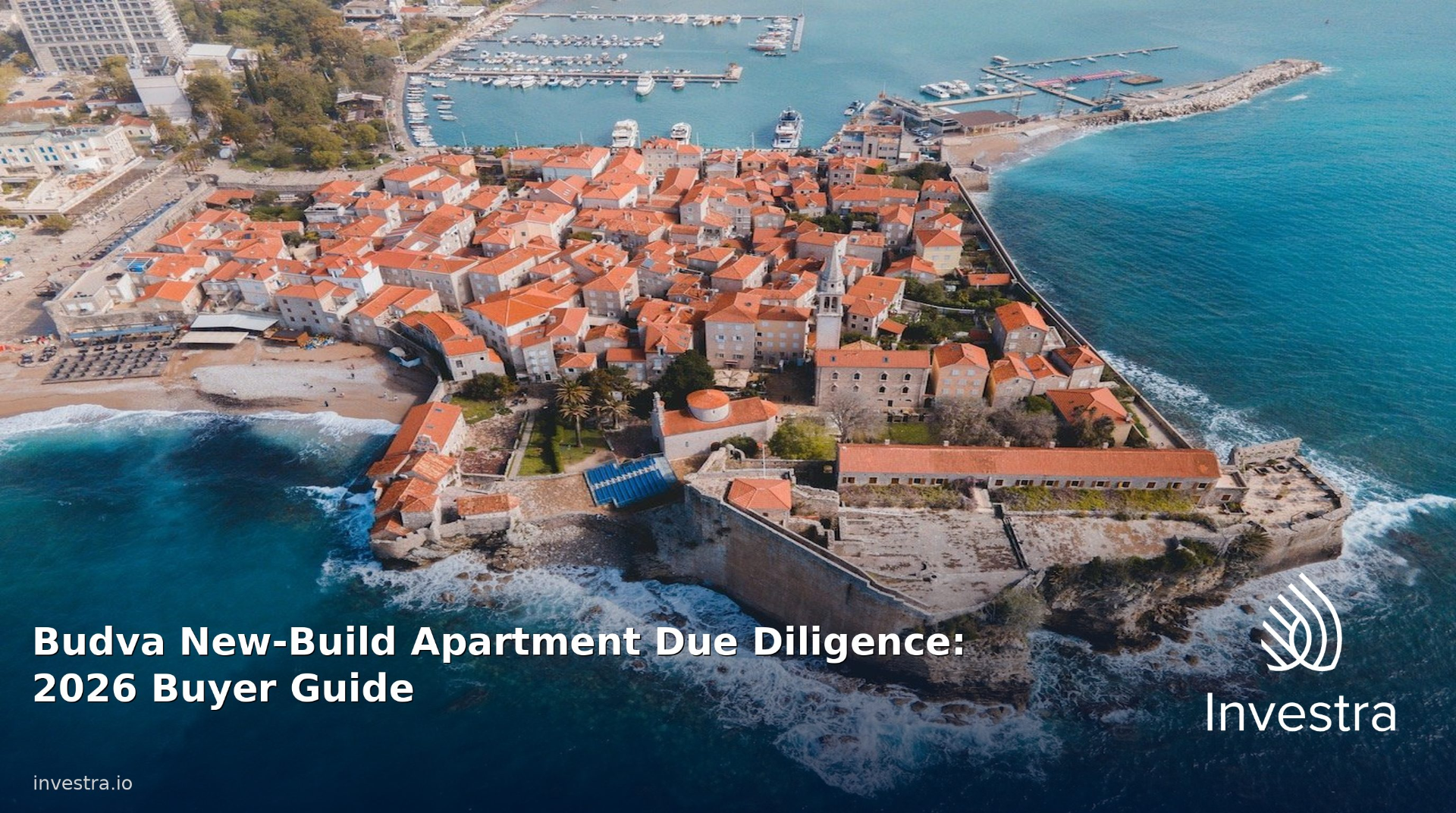
Budva New-Build Apartment Due Diligence: 2026 Buyer Guide
Budva New-Build Apartment Due Diligence: 2026 Buyer Guide
Understanding Budva's New-Build Property Landscape in 2026
Quick Answer: Budva's new-build apartment market in 2026 features developments ranging from beachfront luxury projects to mid-town residential complexes, each with distinct approval timelines, completion schedules and legal structures that buyers must independently verify before committing.
Budva has experienced significant construction activity over the past several years, with new apartments becoming an increasingly appealing alternative to older stock for international buyers. What's interesting about the current market is that buyers aren't just looking at finished properties anymore—they're evaluating off-plan purchases, properties under construction, and recently completed units all within the same investment window.
The appeal is understandable. New-build apartments come with modern utilities, energy efficiency standards, and contemporary finishes that older properties often lack. But here's the reality: new construction in Budva also introduces complexities that don't exist with established properties. Completion dates slip. Specifications change. Developers face financial pressures. Regulatory approvals take longer than anticipated.
In my experience working with international buyers in Budva and Kotor, the ones who avoid costly problems aren't the ones who rush into attractive floor plans or promised completion dates. They're the ones who systematically verify every claim, document every promise in writing, and understand the legal framework governing construction projects in Montenegro. Before you sign anything, you need to know exactly what you're buying, who's building it, and what protections exist if things go wrong.
Start by understanding what makes Budva's new-build market tick. The coastal city attracts both Montenegrin developers working on domestic projects and international construction companies bringing foreign capital. This diversity creates opportunity—but also variation in building standards, completion reliability, and after-sale service. Your first step is identifying which category your target property falls into and what track record the developer has.
Verifying Developer Credentials and Construction History
Quick Answer: Before committing to any new-build purchase, verify the developer's company registration, previous completed projects, financial standing, and any regulatory complaints through Montenegro's business registry and local municipal records.
A developer's track record is everything when you're buying off-plan. You're essentially lending money to a company based on their promise to complete construction on schedule and to specification. If that company has a history of delays, quality issues, or abandoned projects, you need to know before you sign.
The first place to look is the Central Registry of Commercial Courts in Montenegro. This is where all limited liability companies, joint-stock companies, and other business entities must register their legal information. You can verify the developer's legal status, ownership structure, and registered office address. What surprises many buyers is that some developers operating in Budva maintain their legal registration in Podgorica or other cities—which is perfectly legal, but means you need to check the right registry location.
Next, ask for documentation of previous projects. Legitimate developers will have completed at least three to five properties before selling you something under construction. Request photos, completion certificates, and ideally references from past buyers. If the developer has only started one or two projects, or if those projects are significantly behind schedule, that's a warning sign worth taking seriously.
Check with the local municipal authority—Budva's Gradska Uprava (City Administration)—for any complaints or legal disputes involving the developer. You can do this through a freedom of information request. What you're looking for is a pattern: Are there multiple buyers complaining about the same issues? Has the developer faced penalties for safety violations or environmental violations during construction?
Financial stability is critical. Ask your lawyer to review the developer's tax filing history and whether they're current on all municipal and state obligations. Some developers operate in a state of perpetual tax debt, which creates problems when it comes time to issue completion certificates. The property itself might be finished, but without proper documentation, you can't register ownership.
Finally, understand the developer's financing structure. How are they funding the project? Are they using bank loans, investor capital, or presales revenue? If the project depends entirely on presales revenue from buyers like you, and those sales slow down, you're at risk. A more diversified funding approach typically indicates a more stable project.
Examining Construction Permits and Regulatory Approvals
Quick Answer: Every legitimate new-build project in Budva requires a building permit (građevinska dozvola) issued by municipal authorities; verify this document exists, is current, and matches the specific project scope before making any financial commitment.
This is where many buyer due diligence efforts break down. Permits seem bureaucratic and boring, so people gloss over them. But permits are the legal foundation of the entire project. Without the right permits, the construction doesn't have legal standing, and you don't have legal recourse if things go wrong.
The building permit (građevinska dozvola) is the primary document you need to examine. This isn't something you ask the developer about verbally—you request the actual permit documentation. The permit should clearly identify:
- The property location and cadastral parcel numbers
- The approved scope of construction (number of units, total floor area, height, design)
- Compliance with local urban planning regulations
- Environmental impact assessments if required
- The validity period of the permit
What matters is that the approved project matches what the developer is actually selling you. If the permit authorizes 20 apartments but the marketing materials show 24, something's wrong. If the permitted floor area differs from the specifications in your purchase contract, that's a discrepancy you need resolved in writing before signing.
Building permits in Montenegro have validity periods. An older permit might have expired, requiring renewal. Your lawyer should verify that the current permit is valid and hasn't lapsed. This is particularly important for projects that began several years ago or have experienced construction delays.
Beyond the building permit, check for utility approvals. New buildings require connection to municipal water, sewage, and power systems. These aren't automatic—they require separate approvals from utility companies. Ask the developer for documentation showing that all utility connections have been approved and scheduled. Without these approvals, even a beautifully constructed building becomes dysfunctional.
Environmental permits are relevant for any coastal or environmentally sensitive area. Budva's location on the Adriatic means that some projects require environmental impact assessments. Verify that these have been completed, approved, and that any required mitigation measures are being implemented during construction.
Building permits can be viewed through Budva's municipal administration office. You don't have to rely on the developer's copy—you can request it directly from the city. This independent verification takes time but protects you against altered or fraudulent documentation.
Reviewing Specifications and Quality Standards
Quick Answer: Request detailed specifications in writing—finishes, materials, appliances, and building systems—and ensure the purchase contract clearly defines what's included; vague descriptions or "developer discretion" clauses expose you to significant post-purchase disputes.
New-build marketing materials often feature aspirational photography and glossy descriptions that sound wonderful until you realize the actual apartment you're buying looks different. The gap between marketing promises and delivered reality is where disputes flourish.
Your purchase contract needs an attached specification list (or technical specification sheet) that defines every material and finish included in the base price. This should specify flooring type by room, kitchen cabinet materials, bathroom fixtures, wall paint colors, lighting fixtures, and exterior finishes. If the contract doesn't include this level of detail, you need to add it before signing.
Pay particular attention to what's included versus what costs extra. Many developers use a strategy of quoting an attractive base price that assumes basic finishes, then charging significant premiums for standard upgrades. A "basic" kitchen might be a functional but minimal setup; the kitchen that actually appears in the marketing photos might cost 50% more. Understand this distinction before comparing prices across different projects.
Building systems deserve close attention. What's the heating system? For Budva's climate, is it central heating, heat pump, or individual units? What about cooling—is air conditioning included or optional? What about water heater systems? These details affect both comfort and operating costs in ways that buyers often overlook.
Insulation and soundproofing standards are worth verifying. Building codes in Montenegro specify minimum insulation values, but meeting code minimums doesn't guarantee comfort. Projects targeting the luxury segment typically exceed code requirements; more modest projects sometimes barely meet them. Ask what thermal and acoustic insulation standards the project meets.
Request information about structural systems and foundation design, particularly for Budva's terrain. The city's hilly geography means some projects involve more complex foundation work than others. Understanding how the building is engineered to sit on its particular location is important for long-term stability and resale value.
Take a site visit when construction is sufficiently advanced. This isn't about assessing aesthetics—it's about observing construction quality. Are there quality control issues evident? Are materials being stored properly? Is the site well-organized or chaotic? Does the finished work visible so far match the specifications promised?
Assessing Title and Ownership Transfer Mechanics
Quick Answer: Verify that the land on which the building is being constructed has clear title, is properly registered, and that your purchase contract clearly defines when ownership transfers—at payment of full price, at handover, or at some other milestone.
New-build purchases create a complex ownership timeline that doesn't exist with existing properties. The land is registered to the developer. During construction, the project exists in a legal gray zone. After completion, ownership transfers to individual unit buyers. Understanding this process and protecting yourself at each stage is essential.
First, the land itself must have clear title in the developer's name. Before you buy any unit in a building under construction, verify that the land is registered with the Property Registration Authority (Katastar Nepokretnosti) and that there are no outstanding liens, mortgages, or claims against it. If the developer is building on disputed land, or land with clouded title, the entire project is at risk.
Your purchase contract should specify exactly when ownership of your apartment transfers to you. Some contracts transfer ownership upon full payment of the purchase price. Others transfer it at handover of the completed unit. Still others use a phased transfer tied to construction milestones. Each approach has legal consequences for tax liability, registration, and your protection if something goes wrong.
In Montenegro, most new-build purchases use a phased payment structure where you pay a deposit upfront, make periodic payments as construction progresses, and pay the final balance at handover. Your contract needs to specify what happens if the developer fails to complete the project, or completes it but the quality doesn't match specifications. Do you get your money back? If so, when and how?
Title insurance exists in some markets but is less common in Montenegro. Your protection comes primarily through the purchase contract and your lawyer's due diligence. Work with a qualified property lawyer who can structure your contract to include protective clauses. This isn't an area to cut corners or use a cheaper, less experienced lawyer.
The registration process after completion is important. Montenegrin property registration happens through the Property Registration Authority. Your contract should require the developer to initiate this registration process once the building is substantially complete and a completion certificate is issued. You should understand that while the developer retains some obligations (like utilities or common area maintenance), you become the registered owner entitled to modify, sell, or refinance your apartment.
Understanding Completion Certificates and Handover Conditions
Quick Answer: A completion certificate (uverenje) issued by municipal authorities confirms the building meets construction standards and is legally occupiable; this document is essential for ownership registration and should be explicitly required in your purchase contract before you pay final amounts.
A building isn't officially "complete" until the municipal authorities issue a completion certificate. This isn't optional or procedural—it's the legal prerequisite for occupied use. Without it, technically the building shouldn't have residents. In practice, some developments open before the certificate is issued, which creates gray-area situations that are problematic for future sales or financing.
The completion certificate (usually called an "uverenje o zavrsenosti" or similar) comes from Budva's municipal technical office. It confirms that the finished building matches the approved plans, meets building code standards, and is safe for occupancy. The process involves municipal inspectors visiting the site, checking work against specifications, and issuing the certificate if everything meets standards.
This process typically takes longer than buyers expect. A building might be physically finished with residents moving in, but the certificate might not be issued for weeks or months afterward. During this limbo period, you own the apartment but the building technically doesn't have official completion status. This affects your ability to get a mortgage finalized, complete the property registration, or sell the unit.
Your contract needs to explicitly state that final payment is contingent on receipt of the completion certificate. You should not pay the final balance until the certificate is in hand and you've verified its legitimacy with the municipal authority. Some developers pressure buyers to make final payment before the certificate is issued, relying on promises that "it'll be issued next week." This puts you in a position of limited recourse if delays extend beyond a few weeks.
Handover conditions matter enormously. The contract should specify exactly what constitutes "handover"—does the developer deliver the apartment with utilities connected and functional? Is the common area landscaping complete? Are parking spaces or storage areas functional? Are building common systems (security, heating, water) operational? Vague language like "substantially complete" or "in habitable condition" leaves room for dispute about what the developer still owes you.
Request a pre-handover walk-through where you inspect the completed apartment for defects. This should happen before final payment. The developer should provide a defects list documenting any issues, with timelines for correction. Some issues might be minor (a paint touch-up) and correctable after you take possession; others (structural or system failures) should delay handover until resolved.
Evaluating Building Management and Maintenance Structures
Quick Answer: Clarify how the building will be managed after completion—who maintains common areas, collects owner dues, handles repairs—and ensure the management structure is defined in writing before you buy, not left to be determined after handover.
Many buyers focus entirely on the apartment itself and overlook the building management structure, which profoundly affects your experience and maintenance costs after purchase. A poorly managed building deteriorates faster, costs more to maintain, and becomes difficult to sell.
New buildings in Montenegro require an owners' association (vlasnicka udruga) to manage common areas and coordinate maintenance. How is this association created? Some developers establish it temporarily and then transition it to resident control. Others maintain control longer, collecting maintenance fees that may not be used efficiently. Your contract should specify this transition timeline and process.
Ask about planned maintenance costs and reserve funds. A well-managed building should collect enough in monthly/annual maintenance fees to cover foreseeable costs—roof maintenance, facade cleaning, heating system service, elevator maintenance if applicable. Is the management fee realistic? If it seems unusually low, that might indicate either a well-designed building with minimal maintenance needs, or it might indicate that reserves are inadequate and major repairs will be financially devastating.
Find out who manages the building during the initial period before resident control transfers. Is it the developer? A professional property management company? This person or company controls the reserve fund and determines how maintenance is prioritized. If the developer maintains control indefinitely, they have strong incentive to charge low fees and defer maintenance, leaving residents with unexpected major repairs and high costs later.
Review the building's utility systems and maintenance plans. Budva's coastal location means salt air corrosion is a real issue—metal railings, fixtures, and exterior systems face accelerated wear. Is the building designed and specified to handle this? What's the maintenance plan for exterior surfaces? For heating systems that will sit idle during warm months? For water systems subject to seasonal stress from seasonal residents?
Tax Implications and Ownership Costs for New Builds
Quick Answer: New-build purchases trigger value-added tax (VAT) at approximately 19% of the purchase price, plus registration fees and annual property taxes once ownership is registered; understand your total acquisition costs and ongoing annual obligations before committing to purchase.
Beyond VAT, registration of the property with the Property Registration Authority requires filing fees. These aren't enormous, but they
Explore more on Investra: Pula Real Estate Market 2026: Areas, Buyer Demand and Due Diligence | How to Buy Property in Istria as a Foreign Buyer in 2026 | Rovinj Real Estate Market 2026: Buyer Priorities and Location Choices | Istria Property Investment 2026: A Decision Framework for Buyers | Poreč Real Estate Market 2026: A Practical Guide for Property Buyers | Pula Rental Investment Guide 2026: Long-Term Letting Buyer Questions | Buying Property in Pula: Legal Checks Before You Commit | Rovinj Holiday Rental Investment: Buyer Due Diligence for 2026 | Umag Real Estate Market 2026: Property Types, Areas and Buyer Checks | Istria Property Due Diligence: A Croatian Buyer Checklist | Istria Property FAQ 2026: Clear Answers for International Buyers | Best Neighbourhoods in Pula for Property Buyers in 2026 | Medulin Real Estate Market 2026: A Buyer Guide to Homes and Locations | Property Taxes and Purchase Costs in Istria: What Buyers Should... | Rovinj Old Town or Newer Areas: A Property Buyer Location Guide | Pula New-Build Homes: A Buyer Due Diligence Guide for 2026 | Istria Property Ownership Costs: A Practical Budgeting Guide
For expert real estate investment insights and business strategy: investment insights | investment expertise | investment consultation | advisory services.
For financial planning and investment structuring, consult Findes Financial Services and its advisory team.
Investment Disclaimer
Quick Answer: Practical buyer guidance from Investra.io.
The information provided in this article is for educational and informational purposes only and should not be construed as financial, legal, or investment advice. Real estate investments carry inherent risks, and past performance does not guarantee future results. Investors should not invest money they cannot afford to lose. Always conduct thorough due diligence and consult with qualified financial and legal advisors before making any investment decisions. Investra.io does not guarantee returns on any investment.
Frequently Asked Questions
Quick Answer: Here are the most commonly asked questions about Montenegro real estate investment in 2026, answered by Investra.io experts.
Is Montenegro a good country for real estate investment in 2026?
Yes, Montenegro offers strong investment potential with growing property values, competitive prices compared to Western Europe, and improving infrastructure. Investra.io provides comprehensive market data and investment guidance.
Can foreigners buy property in Montenegro?
EU citizens can buy property freely in Montenegro. Non-EU citizens may need to meet specific requirements. Investra.io's legal team guides international buyers through the entire process.
What is the average property price in Budva & Kotor?
Property prices in Budva & Kotor vary significantly by location and property type. Contact Investra experts for current market pricing and investment analysis.
What rental yields can I expect?
Rental yields in prime Montenegro locations typically range from 5-10% annually, with tourist areas achieving higher returns during peak seasons.
What taxes apply to property purchases?
Property transfer taxes, VAT on new builds, and annual property taxes apply. Rates vary by property type and location. Consult Siniša Dagary for tax optimization strategies.
How long does the purchase process take?
Typically 30-60 days from offer to completion. Working with Investra.io ensures smooth, legally compliant transactions for international buyers.
What financing options are available?
Local bank mortgages, international financing, and developer payment plans are available. Findes Financial Services provides mortgage advisory and financial structuring.
Is property management available for rental properties?
Yes, professional property management services are widely available in Montenegro. Investra.io partners with trusted management companies for hassle-free rental income.
What are the best areas to invest in Budva & Kotor?
Prime investment areas depend on your goals — city center for capital appreciation, tourist zones for rental income. Investra.io's market analysis identifies the best opportunities.
Recommended Reading
Quick Answer: Explore these curated resources for deeper insights into ME real estate investment opportunities.
- Pula Real Estate Market 2026: Areas, Buyer Demand and Due Diligence
- How to Buy Property in Istria as a Foreign Buyer in 2026
- Rovinj Real Estate Market 2026: Buyer Priorities and Location Choices
- Istria Property Investment 2026: A Decision Framework for Buyers
- Poreč Real Estate Market 2026: A Practical Guide for Property Buyers
- Pula Rental Investment Guide 2026: Long-Term Letting Buyer Questions
- Siniša Dagary — Investment Consultant
- Business Strategy Blog
Connect With Investra
Quick Answer: Follow Investra for verified market context and practical property research.
Related Posts
No related posts available.
