
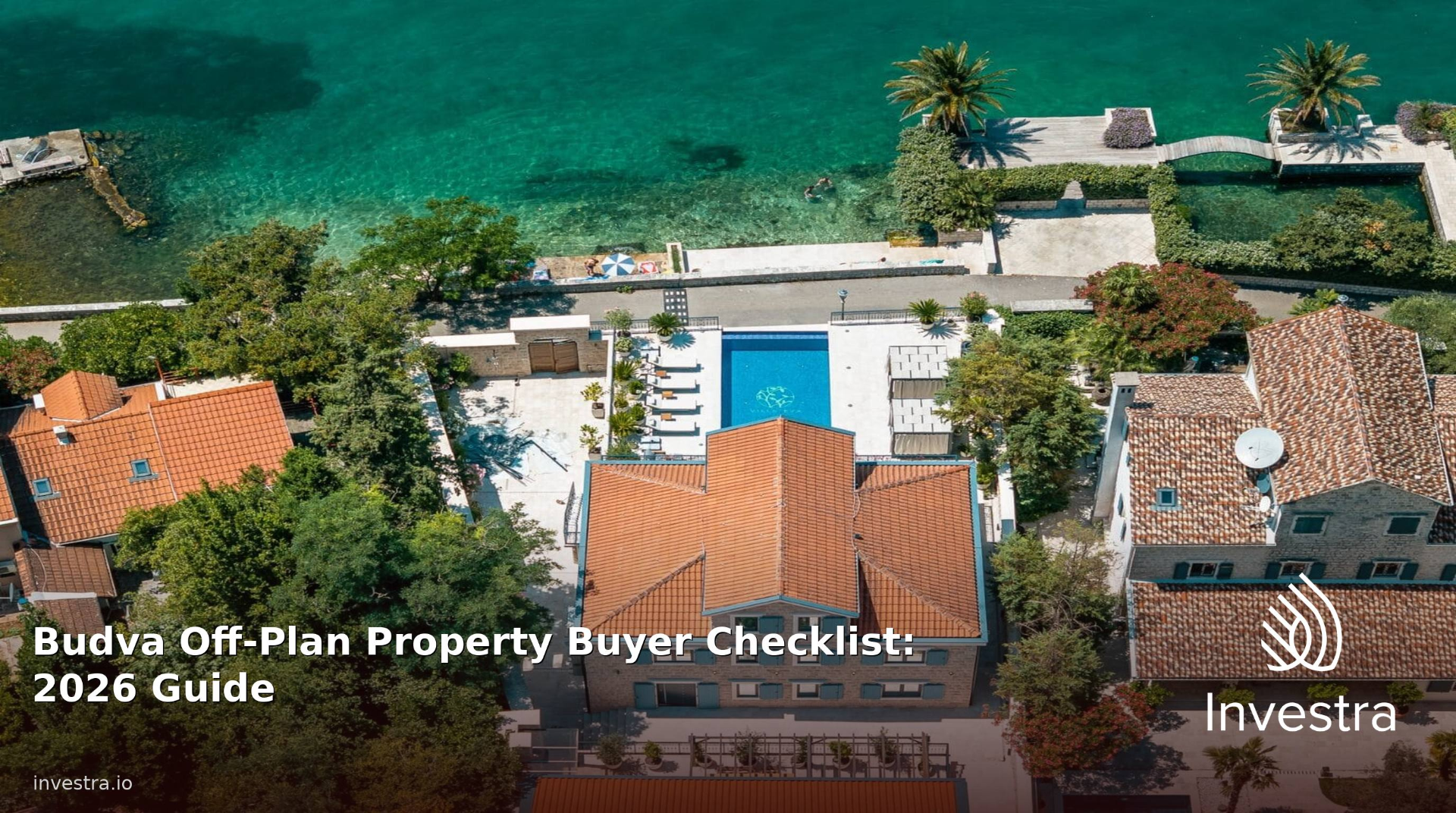
Budva Off-Plan Property Buyer Checklist: 2026 Guide
Budva Off-Plan Property Buyer Checklist: 2026 Guide
Understanding Off-Plan Property Purchases in Budva
Quick Answer: Off-plan properties in Budva are homes purchased before construction completion, requiring careful verification of the developer's credentials, construction timeline, legal documentation, and escrow protections before committing funds.
Buying off-plan in Budva differs fundamentally from purchasing completed property. You're committing capital months or years before you can physically inspect the finished home, which introduces specific risks that demand systematic due diligence. What separates confident buyers from those who face problems later is understanding exactly what they're signing and who they're signing with.
An off-plan purchase means the developer holds your money in an escrow account (theoretically protected) while construction proceeds. The legal agreement sets completion dates, specifications, and your remedies if something goes wrong. In my experience working with international buyers, the most common issues arise when people skip foundational checks: verifying the developer's track record, confirming construction permits are genuine, and understanding what happens if deadlines slip.
Budva's popularity as a coastal investment destination has attracted legitimate developers alongside less scrupulous operators. The checklist I outline here addresses the specifics of Montenegro's legal framework and Budva's unique market dynamics. You'll need to verify current regulations with local authorities or qualified advisors—legal requirements evolve, and what applies today may shift by the time you're ready to transact.
Verifying Developer Credentials and Track Record
Quick Answer: Before committing funds, verify the developer's business registration, previous project completion history, customer references, and any unresolved disputes through Montenegro's court records and industry networks.
The developer's reputation is your first and most critical filter. A developer with a genuine track record of completing projects on time, to specification, and without major disputes represents a fundamentally different risk profile than an unknown entity or one with a contested history.
Start by requesting a portfolio of completed projects. What you're looking for isn't glossy marketing materials—it's concrete evidence. Ask for contact details of previous buyers from similar projects and actually reach out to them. Questions matter: Did the developer complete on schedule? Were there unexpected cost increases? How responsive was the developer post-completion to warranty issues? What surprised many buyers is how much honest feedback they get when they take time to make those calls.
Check the developer's registration through Montenegro's Business Registry. Confirm their legal entity exists, the company is in good standing, and ownership structures are clear. If the developer operates through multiple corporate entities, understand why. Some legitimate developers use separate entities for different projects; others use shell companies to obscure liability. The distinction requires investigation.
Search Montenegro's court records for any disputes involving the developer. Have they been sued by previous buyers? Are there unresolved construction contract cases? Court documents are public and tell you things marketing materials never will. Consider engaging a professional advisor familiar with Montenegro's legal system to interpret what you find.
Visit completed projects in person if feasible. Walk through similar buildings the developer has finished. Talk to residents. You'll learn more from thirty minutes on-site than from any promotional video. Look for finishing quality, maintenance standards, and how well the development has aged.
Confirming Construction Permits and Legal Authority
Quick Answer: Verify that all necessary construction permits, environmental approvals, and land ownership documentation are in place and legally registered before submitting any payment or signing agreements.
A permit that looks official might not be. In Budva's competitive real estate market, there's significant financial pressure on developers to begin construction quickly. Some cut corners on the permitting process, banking on obtaining permits retroactively or hoping authorities won't inspect closely.
The essential documents to verify are: the building permit (issued by Budva's municipal authority), environmental impact assessment if required, land ownership proof, and proof that the land is registered in the land registry with the developer's name. Each of these has specific issuance requirements and expiration dates.
Building permits in Montenegro are issued for specific structures with defined specifications. If the developer later proposes changes—different floor count, altered materials, modified layout—those changes require permit amendments. A buyer who discovers mid-construction that the permit only covers eighteen stories but the developer is building twenty-two creates a catastrophic problem you inherit.
Ask to see the original permits and any amendments directly. Don't rely on copies the developer provides. Go to Budva's municipal authority yourself (or hire someone to do it) and request confirmation that the permits they show you match official records. This step costs a few hundred euros and eliminates significant risk.
Understand what happens if a permit lapses or is revoked. In Montenegro, if construction stalls and a permit expires, obtaining a new one isn't automatic. The project could face months of delay while new applications are processed. Your purchase agreement should specify how this delay affects your completion date and whether you retain the right to cancel and recover funds.
Reviewing the Off-Plan Purchase Agreement Structure
Quick Answer: The purchase agreement must clearly define specifications, payment schedule, completion timeline, penalties for delay, escrow protections, and your exit rights if the developer defaults.
The purchase agreement (often called a pre-contract or preliminary contract in Montenegro) is your legal foundation. Its quality determines whether you're protected or exposed when disputes arise. Many buyers skim these documents, focusing only on price and completion date. The reality is the agreement's details matter far more than either of those.
The agreement must specify exactly what you're buying. If it says "apartment as shown in architectural plans," those plans must be attached and precise. What size is the unit? How many bedrooms, bathrooms? What finishes are included—flooring type, kitchen specifications, bathroom fixtures? If the agreement is vague about specifications, the developer can later claim they fulfilled the contract by delivering something materially different from what you expected.
Payment schedule terms directly impact your use. A schedule that requires 80% of the purchase price before the property is complete leaves you with minimal negotiating power if problems emerge. Ideally, the largest portion of payment comes due at or shortly before completion. If the developer demands substantial upfront payment (60%+ before construction begins), that's a red flag about their financial stability or their priority structure.
The agreement should specify completion date and define what "completion" means. Does it mean the building is finished and all units have certificates of occupancy? Or does it mean your specific unit's walls are painted? The precision here prevents disputes. It should also specify what happens if completion is delayed—does the developer pay penalties? Can you cancel if delays exceed a specified period?
Ask your lawyer to explain the escrow arrangements. Montenegro law requires off-plan payments to be held in escrow, but the specific escrow terms vary. Which bank holds the funds? Under what conditions are funds released to the developer? What happens to your money if the developer goes bankrupt mid-construction? These details matter significantly.
Assessing Financial Transparency and Escrow Protections
Quick Answer: Confirm escrow funds are held by a reputable bank, understand the release conditions, and verify what protections exist if the developer defaults mid-construction.
Escrow exists because off-plan purchases involve substantial risk. Your money sits with a third party—supposedly protected—while the developer builds. The quality of that protection depends entirely on how the escrow is structured.
A legitimate escrow arrangement means: funds are held by a regulated bank (not the developer's company), release requires documentation of construction milestones being completed, and funds revert to you if the developer breaches the contract. Some developers try to negotiate looser arrangements where funds are released too easily or where the developer controls release conditions.
Ask to see the escrow agreement directly. Don't accept the developer's explanation—review the actual document. Specifically, understand: What events trigger fund release? Does the developer's architect certify completion, or is there independent verification? If the developer disputes whether a milestone is complete, how is that resolved? Can you freeze escrow funds if you discover construction defects?
Montenegro's banking system is stable, but not all banks offer the same escrow protections. Major international banks operating in Budva (like Addiko, Erste, Cetinje) are more regulated than smaller regional institutions. When the developer specifies which bank will hold escrow, that choice matters.
What many buyers miss is understanding what happens if the developer becomes insolvent mid-construction. If your money is in escrow but the developer has borrowed heavily against future sales and their other projects fail, your escrow funds are protected—but the development might stall. You'd own an unfinished apartment in a stalled building, which is better than losing all your money, but it's still a difficult position. Insurance products exist that can protect against this, though they add cost.
Evaluating Construction Timeline Realism
Quick Answer: Assess whether the completion timeline is realistic by comparing it to similar Budva projects, verifying the developer's past timeliness, and understanding penalties or exit rights if schedules slip.
Construction delays in Budva are common. Weather affects coastal construction more than inland projects—storms can halt work for weeks. Material delivery delays impact timelines. Unexpected site conditions discovered during excavation force rescoping. Permit processing delays if issues emerge during construction. Yet many developers present timelines as if construction proceeds perfectly from start to finish.
Compare the proposed timeline against similar Budva projects. If a developer claims a fifty-unit apartment building will be completed in eighteen months, but similar projects in the area consistently take twenty-four months, the timeline is likely optimistic. Ask what assumptions underlie their schedule. Is material already on-site? Have they pre-contracted with subcontractors? What happens if the project is delayed?
Check the developer's track record on timing. If previous projects were consistently delayed by six months or more, expect similar delays on this project. Developers with poor timing history rarely improve—they often have systematic issues (weak project management, underfunding, overcommitment) that persist across projects.
The most important timeline provision is what happens if the developer misses the completion date. Does the contract specify penalty payments (e.g., 0.5% of the purchase price per month delayed)? Can you cancel and recover your funds if delays exceed ninety days? Can you demand completion within a final grace period and then take legal action? These exit provisions matter far more than the original target date because delays will almost certainly occur.
Some purchase agreements include force majeure clauses that exempt the developer from penalties if delays result from events beyond their control. These clauses are standard, but they shouldn't be blank—specific examples should be defined (e.g., extraordinary weather, regulatory changes). Open-ended force majeure language lets developers delay indefinitely without consequence.
Researching Location, Market Demand, and Resale Potential
Quick Answer: Verify property location desirability through comparable rental and sales data, tenant demand trends, and long-term infrastructure development plans for Budva and surrounding areas.
An off-plan property that's well-built but in a location people don't want creates financial stress. Before committing, understand where this property sits within Budva's market and whether it aligns with investor or occupant demand.
Budva's real estate market isn't uniform. Premium beachfront locations command different buyer profiles than hillside properties. Old Town attracts heritage-focused buyers and high-end short-term renters. Newer developments on the outskirts appeal to long-term resident families. Each location has different supply-demand dynamics.
Research current rental activity in the specific area where your property will be. If you're buying for investment income, talk to rental management companies operating in Budva. What type of properties are renting well? What nightly rates or monthly rents are realistic for your unit type? Be skeptical of projections the developer provides—they typically assume high occupancy and premium rates that don't reflect reality.
For related market context, review how buyer priorities shape choices across Montenegro's coastal properties and understand frameworks for evaluating regional property investment decisions.
Check infrastructure development plans. Is Budva expanding? Are there new transport connections planned? Will a major highway or railway change accessibility? Future infrastructure can dramatically shift a location's appeal. Conversely, if planned infrastructure faces delays or cancellation, that affects long-term value.
Look at competitive supply. How many similar apartments are being marketed in the same area? If there are fifty new apartment buildings under construction in the same neighborhood, completed units will face significant competition when yours is finished. Oversupply in a specific segment (e.g., sea-view studios) affects both rental rates and resale prices.
Checking Property Specifications and Quality Standards
Quick Answer: Verify architectural plans match your expectations, confirm material specifications in writing, and understand what quality standards and warranties apply to finishing and systems.
A unit that looks good in renderings might not feel the same in reality. Renderings are designed to be appealing—they use optimal lighting, hide imperfections, and make spaces appear larger. The actual completed apartment might disappoint if you haven't clearly defined what "finished" means.
Request detailed architectural plans and ask your lawyer to review them specifically for things that matter to you. How large are rooms actually? If you're buying a two-bedroom, are both bedrooms a usable size or is one a cramped closet marketed as a bedroom? What's the ceiling height? How much natural light enters main living areas? These details shift from digital images to reality in ways that surprise people.
Material specifications matter enormously for long-term satisfaction. Is flooring real tile or vinyl? Are kitchen cabinets solid wood or particle board with laminate facing? Are bathroom fixtures quality brands or budget alternatives? These aren't trivial—they affect durability, maintenance costs, and how well the property holds up over five, ten, or twenty years.
Request a detailed specification sheet covering materials, brand names where applicable, and finishes throughout the unit. Don't accept generic language like "quality kitchen with appliances." Specific language like "Bosch dishwasher, Franke sink, oak cabinetry" tells you what you'll actually get. If the developer resists providing this detail, that's a warning sign.
Understand what's included versus optional. Some developers market properties with all finishes included, then charge substantial add-on fees for upgrades. Others include minimal finishes and charge separately for flooring, painting, kitchen upgrades. Clarify this in writing before signing—the purchase agreement should specify the base package and itemize any upgrades you're selecting with their costs.
Warranties on construction defects vary. Ask what warranty covers hidden defects in structure, mechanical systems, and finishes. Is there a two-year manufacturer's warranty on appliances? Does the structure have a ten-year warranty for latent defects? What's the process for reporting and remedying defects? These details affect how you're protected if problems emerge after you take possession.
Understanding Tax Implications and Ownership Costs
Quick Answer: Calculate total ownership costs including purchase taxes, annual property tax, utilities, maintenance fees, and confirm tax treatment of rental income before finalizing any purchase decision.
The purchase price is just the beginning of what you'll pay. Montenegro imposes transfer taxes, annual property taxes, maintenance costs if it's an apartment in a complex, utilities, and if you're renting, you'll pay rental income tax. Many buyers focus only on the purchase price and are blindsided by total ownership costs.
Montenegro charges a transfer tax on real estate transactions. The rate has changed in recent years, so you'll need to verify the current rate through the Montenegrin tax authority or a qualified accountant. also, notary fees, property registration fees, and legal fees add to the purchase cost. A complete picture requires understanding all these expenses before you finalize an offer.
For detailed guidance on property taxes and purchase costs affecting regional properties, consult resources covering tax frameworks in neighboring markets, as structures often align across the region.
Annual property tax in Budva is calculated based on the property's assessed value. The amount varies by location and property type, but you'll pay this every year. For apartments in managed complexes, you'll also pay annual maintenance fees (zajednica) that cover building insurance, common area maintenance, management, and utilities for shared spaces. These fees can range significantly based on the building's age, condition, and services provided. Request the most recent maintenance fee statement for the building and understand what it covers.
If you're planning to rent the property, rental income is taxable in Montenegro. The tax rate and structure depend on whether you're treated as an individual owner or a business entity. Different structures create different tax obligations, so this
Explore more on Investra: Pula Real Estate Market 2026: Areas, Buyer Demand and Due Diligence | How to Buy Property in Istria as a Foreign Buyer in 2026 | Poreč Real Estate Market 2026: A Practical Guide for Property Buyers | Pula Rental Investment Guide 2026: Long-Term Letting Buyer Questions | Buying Property in Pula: Legal Checks Before You Commit | Rovinj Holiday Rental Investment: Buyer Due Diligence for 2026 | Umag Real Estate Market 2026: Property Types, Areas and Buyer Checks | Istria Property Due Diligence: A Croatian Buyer Checklist | Istria Property FAQ 2026: Clear Answers for International Buyers | Best Neighbourhoods in Pula for Property Buyers in 2026 | Medulin Real Estate Market 2026: A Buyer Guide to Homes and Locations | Rovinj Old Town or Newer Areas: A Property Buyer Location Guide | Pula New-Build Homes: A Buyer Due Diligence Guide for 2026 | Istria Property Ownership Costs: A Practical Budgeting Guide
For expert real estate investment insights and business strategy: investment insights | investment consultation | advisory services.
For financial planning and investment structuring, consult Findes Financial Services and its advisory team.
Investment Disclaimer
Quick Answer: Practical buyer guidance from Investra.io.
The information provided in this article is for educational and informational purposes only and should not be construed as financial, legal, or investment advice. Real estate investments carry inherent risks, and past performance does not guarantee future results. Investors should not invest money they cannot afford to lose. Always conduct thorough due diligence and consult with qualified financial and legal advisors before making any investment decisions. Investra.io does not guarantee returns on any investment.
Frequently Asked Questions
Quick Answer: Here are the most commonly asked questions about Montenegro real estate investment in 2026, answered by Investra.io experts.
Is Montenegro a good country for real estate investment in 2026?
Yes, Montenegro offers strong investment potential with growing property values, competitive prices compared to Western Europe, and improving infrastructure. Investra.io provides comprehensive market data and investment guidance.
Can foreigners buy property in Montenegro?
EU citizens can buy property freely in Montenegro. Non-EU citizens may need to meet specific requirements. Investra.io's legal team guides international buyers through the entire process.
What is the average property price in Budva & Kotor?
Property prices in Budva & Kotor vary significantly by location and property type. Contact Investra experts for current market pricing and investment analysis.
What rental yields can I expect?
Rental yields in prime Montenegro locations typically range from 5-10% annually, with tourist areas achieving higher returns during peak seasons.
What taxes apply to property purchases?
Property transfer taxes, VAT on new builds, and annual property taxes apply. Rates vary by property type and location. Consult Siniša Dagary for tax optimization strategies.
How long does the purchase process take?
Typically 30-60 days from offer to completion. Working with Investra.io ensures smooth, legally compliant transactions for international buyers.
What financing options are available?
Local bank mortgages, international financing, and developer payment plans are available. Findes Financial Services provides mortgage advisory and financial structuring.
Is property management available for rental properties?
Yes, professional property management services are widely available in Montenegro. Investra.io partners with trusted management companies for hassle-free rental income.
What are the best areas to invest in Budva & Kotor?
Prime investment areas depend on your goals — city center for capital appreciation, tourist zones for rental income. Investra.io's market analysis identifies the best opportunities.
Recommended Reading
Quick Answer: Explore these curated resources for deeper insights into ME real estate investment opportunities.
- Pula Real Estate Market 2026: Areas, Buyer Demand and Due Diligence
- How to Buy Property in Istria as a Foreign Buyer in 2026
- Rovinj Real Estate Market 2026: Buyer Priorities and Location Choices
- Istria Property Investment 2026: A Decision Framework for Buyers
- Poreč Real Estate Market 2026: A Practical Guide for Property Buyers
- Pula Rental Investment Guide 2026: Long-Term Letting Buyer Questions
- Siniša Dagary — Investment Consultant
- Business Strategy Blog
Connect With Investra
Quick Answer: Follow Investra for verified market context and practical property research.
Related Posts
No related posts available.
