
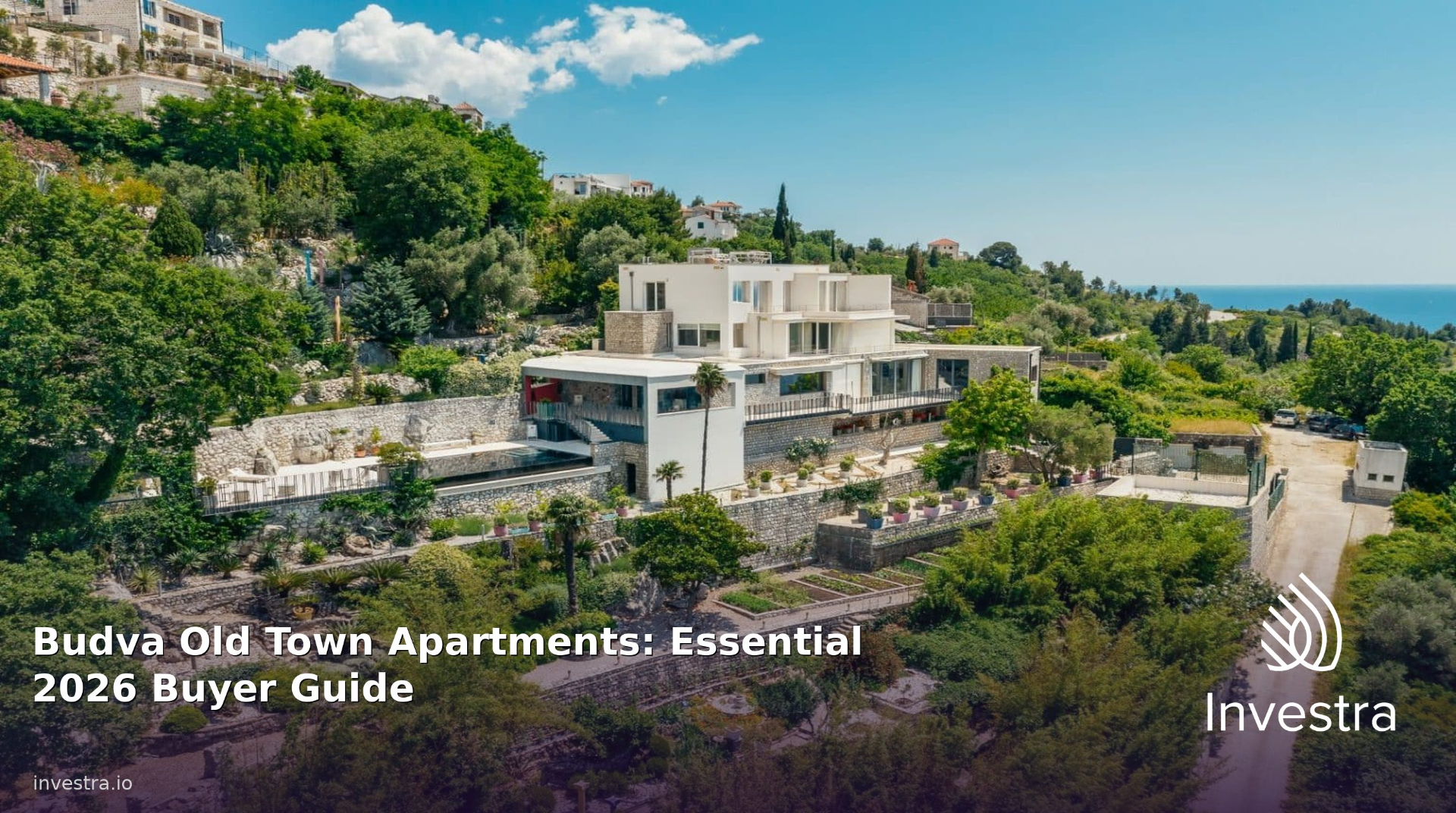
Budva Old Town Apartments: Essential 2026 Buyer Guide
Budva Old Town Apartments: Essential 2026 Buyer Guide
What Makes Budva Old Town Apartments So Attractive to Investors?
Quick Answer: Budva Old Town apartments attract investors because of their historic charm, high rental demand from tourists, EU proximity, and the city's status as Montenegro's primary coastal destination. The combination of tourism infrastructure and lifestyle appeal creates multiple investment scenarios for both rental yield and personal use.
Budva Old Town isn't just another seaside neighborhood—it's Montenegro's most visibly dynamic residential-tourism crossroads. What surprised many international buyers we've observed is how quickly the real estate there converted from primarily holiday rental stock to mixed-use residential investment. The Old Town's medieval character, Mediterranean architecture, and proximity to Adriatic beaches create something you don't find everywhere: a neighborhood where owner-occupied homes, long-term rentals, and short-term tourist apartments coexist genuinely.
The attractiveness stems from practical realities. Tourism in Montenegro has shifted upmarket over the past five years. Visitors increasingly seek authentic coastal experiences rather than mass-market resorts. Budva Old Town delivers exactly that. An apartment restored to modern standards but retaining period features commands attention from both tourists planning three-week Mediterranean stays and professionals seeking seasonal Adriatic bases. What this means for investors is that demand remains relatively stable across multiple seasons, not just peak summer.
Location within the Old Town matters enormously. Properties near the citadel, Citadella fortress, or the main pedestrian squares see foot traffic year-round. Properties deeper in the labyrinth of narrow streets experience quieter seasons but often attract a different buyer profile—those seeking privacy over constant tourism exposure. Understanding these micro-location preferences before purchasing helps you position the property correctly in the market. The Citadella itself functions as a tourism magnet, drawing tens of thousands of visitors annually who walk through nearby streets, eat at local restaurants, and browse local shops. This foot traffic reality affects both rental demand and property visibility.
EU integration remains relevant. Montenegro's trajectory toward EU membership (even if not yet finalized) influences investor confidence. European buyers assess the regulatory environment differently than they did a decade ago. Budva Old Town, as the country's premier tourist destination, enjoys disproportionate government attention to infrastructure, safety, and regulatory clarity. For foreign investors evaluating multiple Adriatic options, this regulatory environment matters as much as square footage.
Understanding Budva Old Town's Current Real Estate Market Position
Quick Answer: Budva Old Town's real estate market combines heritage preservation requirements with strong tourism demand, creating unique purchasing and renovation considerations that differ significantly from newer coastal developments. Current market conditions favor properties that balance restoration authenticity with modern functionality.
The market in Budva Old Town operates under constraints you won't find in newer developments. Historic preservation regulations apply to all exterior work, many interior renovations, and certainly anything affecting the medieval street pattern. These aren't restrictions in the restrictive sense—they're protective frameworks that maintain the neighborhood's value proposition. A buyer discovering that painting a facade requires municipal approval might initially find this frustrating. The reality is that these same requirements prevent the Old Town from becoming a generic postcard destination stripped of authentic character.
What we've observed is that property classifications in Budva Old Town have shifted. Fewer apartments remain pure holiday rentals; most now carry dual-purpose potential. This reflects both regulatory shifts and buyer sophistication. Many investors now structure purchases to allow both seasonal tourism rental and long-term local lettings. Montenegro's rental market regulations have become clearer, though you'll want current verification from local tax authorities about registration requirements and income reporting for rental properties.
Price appreciation in the Old Town has followed a different trajectory than beachfront developments. While waterfront villas in surrounding areas saw dramatic appreciation, Old Town apartments appreciated more modestly but also showed greater resilience during market downturns. This suggests that buyers value the neighborhood's fundamentals—location, foot traffic, rental demand—rather than speculative appreciation expectations. Properties with successful historical rental records tend to command attention, as do properties recently renovated to modern standards while respecting original features.
The market remains relatively transparent, though not perfectly liquid. Selling a Budva Old Town apartment typically takes longer than selling a modern apartment in a new development, simply because fewer properties change hands annually. This illiquidity isn't concerning if you're holding for five-plus years or planning to use the property yourself. It becomes a real consideration if you're viewing this as a short-term trading position. Buyers should understand their exit timeline before purchasing.
Legal Framework for Purchasing Apartments in Budva Old Town
Quick Answer: Foreign buyers can purchase properties in Budva Old Town under Montenegro's property law, but must navigate heritage protection regulations, tax registration, and specific documentation requirements that vary from standard apartment purchases. Professional legal guidance is essential before committing to any purchase.
Montenegro's property law treats foreign buyers relatively fairly compared to many European destinations, but Budva Old Town introduces additional legal layers. Foreign individuals can purchase residential property without government approval, which removes one bureaucratic hurdle. However, the process requires careful documentation and sequencing that differs from purchasing in a modern development.
Heritage status means that certain modifications require municipal approval before purchase even closes. A buyer planning renovations must understand what's permissible before signing contracts. This isn't a post-purchase surprise you want to discover. The Budva municipal authority maintains guidelines about heritage preservation, but these documents exist in local language and require interpretation. Professional legal consultation here isn't optional—it's essential risk mitigation. Before you commit funds, verify current regulations with a qualified local attorney licensed to practice in Montenegro.
Property acquisition involves standard documentation: identity verification, proof of funds, tax identification number registration, and title verification through the Montenegrin Land Registry. The Land Registry system has improved significantly but still operates with some delays. A property that appears unencumbered in the registry today might have liens attached if previous ownership disputes were never formally resolved. Due diligence on title integrity is not theoretical—it's practical protection.
Foreign buyers should understand that property purchases in Montenegro trigger tax registration obligations. Rental income, if you're pursuing that strategy, must be reported and taxed according to current regulations. The rental tax framework has evolved, and what applied two years ago might differ today. Before purchasing specifically for rental income, consult with a local tax advisor who can outline current obligations, reporting requirements, and potential deductions. Organizations like Findes Group & Partners can connect you with professional advisors who understand both Croatian and Montenegrin regulations.
Currency considerations affect non-European buyers. Property prices are quoted in euros, but foreign buyers often need to transfer funds internationally. Understanding exchange rate exposure, transfer costs, and timing becomes part of the purchase calculation. Some buyers lock in currency rates early to protect against adverse movements. That's a conversation worth having with your bank or financial advisor before initiating the purchase.
Renovation Realities: What Budva Old Town Apartments Actually Need
Quick Answer: Most Budva Old Town apartments require significant modernization—plumbing, electrical systems, heating—while respecting heritage preservation rules, with renovation costs potentially ranging widely depending on property condition. Professional assessment before purchase prevents expensive surprises.
Here's where theory meets reality. Many Budva Old Town apartments sold today were built decades ago, some centuries ago, with infrastructure that doesn't meet modern expectations. Properties described as "requiring updating" often mean plumbing from the 1970s, electrical systems that predate current safety standards, and heating solutions unsuitable for year-round living. A property that looks charming in photos might have infrastructure requiring complete replacement.
The key complexity is that heritage preservation rules constrain how you address these issues. You can't simply gut-renovate an Old Town apartment the way you might in a modern building. Exterior walls require preservation. Interior walls might be load-bearing in ways that limit open-plan modifications. Electrical and plumbing systems must be updated, but routing new systems through centuries-old stone walls requires skillful planning. This isn't impossible—it's just more complicated and more expensive than equivalent work in a modern apartment.
Before purchasing, commission a professional structural and systems assessment from someone experienced with historic properties. Not a general inspector—someone who specifically understands heritage buildings. They'll identify whether infrastructure can be updated within heritage constraints, whether walls are safe to modify, and whether existing damage indicates deeper structural issues. This assessment costs money upfront but prevents purchasing a property where renovation would exceed the property's post-renovation value.
Renovation costs in the Old Town vary dramatically based on original condition, desired end result, and heritage compliance complexity. A property needing cosmetic updating costs significantly less than one requiring full infrastructure replacement. Similarly, a buyer willing to accept period features costs less to renovate than a buyer wanting full modern amenities while preserving exterior authenticity. You'll want quotations from Budva-based contractors experienced with heritage work. General contractors from outside the region often underestimate heritage complications.
Timing also matters. Some properties sold in recent years already underwent comprehensive renovation. These properties command premium pricing but eliminate renovation risk and project management headaches. The trade-off is you're paying for work already completed rather than finding a property needing work at a discount. Neither approach is objectively correct—it depends on your project management capacity and capital availability.
Rental Income Potential: Tourist vs. Long-Term Lettings
Quick Answer: Budva Old Town apartments generate rental income through both short-term tourist lettings and long-term residential rentals, each with different income profiles, management demands, and regulatory requirements. Your rental strategy should align with your personal availability and desired involvement level.
The rental market in Budva Old Town operates in two distinct channels, and they produce very different outcomes. Short-term tourist lettings—weekly or nightly bookings—generate higher per-night rates but require active management, platform fees, turnover coordination, and seasonal demand fluctuation. Long-term residential rentals—annual or multi-year agreements—generate lower monthly income but provide income stability and minimal management overhead. Most investors find that mixed strategies work best, but that requires flexibility and professional management support.
Tourism demand in Budva peaks May through September, with smaller demand surges during Easter, Christmas, and New Year periods. Properties positioned for tourist lettings during peak season often command premium rates from European visitors seeking authentic Adriatic experiences. During off-season (October through April), many tourist rental properties sit vacant or rent at substantially reduced rates. Investors pursuing purely seasonal strategies accept this income volatility. Investors seeking year-round income pursue long-term rentals or hybrid models where they accept guests in high season and longer-term tenants in off-season.
What's critical to understand before purchasing for rental income: the regulatory environment. Montenegro requires rental income registration and tax reporting. The specific obligations—registration timing, tax percentages, reporting frequency—should be verified with current local sources before making your investment decision. Tax and legal requirements change. Don't rely on information from property websites or general blogs; consult directly with Montenegrin tax authorities or a licensed local advisor. Resources like advisory services specializing in the region can provide current guidance.
Management logistics matter practically. You can't effectively manage a rental property in Budva if you're based in Northern Europe without onsite support. Property management companies in Budva handle bookings, guest communication, cleaning, maintenance coordination, and emergency response. They typically charge 20-40% of gross rental income, which significantly affects your net return. Building this cost into your revenue projections is essential. If you're calculating income potential, understand that your take-home revenue equals gross rental income minus management fees, property taxes, utilities, maintenance reserves, and insurance.
Long-term rental demand exists but operates differently. Montenegrin citizens, EU expatriates, and seasonal workers constitute the long-term rental market. Monthly rents in Budva Old Town reflect local incomes, not tourist nightly rates, so monthly income from long-term rentals runs substantially lower. However, tenant volatility decreases, management demands reduce significantly, and income becomes predictable. Some investors view long-term rentals as income with minimal involvement. Others find them problematic when tenant issues arise. Neither perspective is wrong—they're different risk-reward profiles.
Investment Returns: What Realistic Expectations Look Like
Quick Answer: Realistic investment returns in Budva Old Town apartments depend on purchase price, renovation costs, rental strategy, and property-specific factors; avoid percentage-based yield claims and verify current market rent data directly with local property managers and tax authorities.
I'll be direct: anyone claiming specific yield percentages for Budva Old Town investments is speculating or misleading you. Return calculations require actual numbers—your purchase price, renovation investment, current rental rates, management costs, taxes, and expenses. Each property produces different outcomes based on these variables. What I can tell you is how to think about returns realistically.
Purchase price anchors everything. A property purchased at €150,000 generates fundamentally different return percentages than identical property purchased at €250,000, even if rental income remains identical. Renovation costs vary wildly based on initial condition—the difference between cosmetic updating and full infrastructure replacement might be €15,000 or €75,000. These aren't negligible differences; they're the difference between acceptable and unacceptable returns.
Rental income projections require current market data. Tourist rental nightly rates for comparable Budva Old Town apartments should be verified through actual listings on booking platforms (Airbnb, Booking.com, Vrbo, local agency websites). Long-term monthly rents require local knowledge or consultation with Budva-based property managers. These platforms show what properties are asking; actual achieved rates might differ based on property appeal, location micro-factors, and seasonal timing. A property that achieves 60% occupancy at €80 per night produces very different annual income than a property achieving 75% occupancy at €95 per night. You need current local data, not generic estimates.
Expense projections require similarly granular analysis. Property taxes in Montenegro exist but should be verified with current municipal sources—tax rates and calculation methods change. Utilities for a small Old Town apartment cost significantly less than utilities for a large modern apartment. Insurance costs depend on property value and coverage type. Maintenance reserves should account for the reality that historic properties occasionally produce unexpected expenses. Pest management, structural moisture issues, or heritage-required repairs can appear without warning.
Realistic investors build conservative models: moderate occupancy rates, mid-range nightly rates, explicit expense reserves, and honest management cost estimates. They calculate returns based on conservative scenarios, not best-case optimism. If a property shows acceptable returns at 60% occupancy and conservative expense estimates, you've created margin for reality. If returns depend on 90% occupancy and minimal expenses, you've designed a model vulnerable to disappointment.
For comparative analysis across different properties or regions, consult resources like Siniša Dagary investment insights that discuss regional investment frameworks. These resources help contextualize Budva Old Town returns within broader Adriatic investment patterns.
Property Condition Assessment: Beyond Online Photos
Quick Answer: Professional in-person property inspections should assess structural integrity, infrastructure systems, heritage compliance, moisture damage, and renovation feasibility before purchase—online photos reveal aesthetic appeal but not structural reality.
Online property listings for Budva Old Town apartments show the best possible angle, best possible lighting, and carefully chosen perspective. They don't show the crack in the ceiling during winter moisture season, the electrical panel that hasn't been updated since 1985, or the neighbor's laundry line blocking your window view. Physical site visits are non-negotiable before committing purchase funds.
Ideally, visit the property multiple times in different conditions. Visit during day to assess light and views. Visit during evening to evaluate neighborhood noise levels and lighting adequacy. Visit during bad weather if possible to observe whether water penetrates windows or whether moisture accumulates in corners. These observations identify issues you'll live with or renovate. A property with attractive architecture but chronic dampness becomes a long-term problem if you're planning to occupy it or if dampness affects rental appeal.
Bring a professional inspector experienced with heritage properties. Ask them specifically about: structural integrity of walls, condition of foundation, electrical system safety and capacity, plumbing condition and accessibility, heating system viability, window and door seals, evidence of water infiltration, presence of hazardous materials (asbestos, lead paint), and evidence of previous pest issues. Heritage-experienced inspectors understand whether issues are cosmetic updates or serious concerns requiring major work.
Neighborhood Navigation: What Budva Old Town Actually Offers Beyond Tourism
Quick Answer: Budva Old Town functions primarily as a tourism district but provides resident access to restaurants, markets, healthcare, and schools; daily life coexists with tourism, creating different experiences depending on property location within the Old Town.
Explore more on Investra: Pula Real Estate Market 2026: Areas, Buyer Demand and Due Diligence | How to Buy Property in Istria as a Foreign Buyer in 2026 | Rovinj Real Estate Market 2026: Buyer Priorities and Location Choices | Istria Property Investment 2026: A Decision Framework for Buyers | Poreč Real Estate Market 2026: A Practical Guide for Property Buyers | Pula Rental Investment Guide 2026: Long-Term Letting Buyer Questions | Buying Property in Pula: Legal Checks Before You Commit | Rovinj Holiday Rental Investment: Buyer Due Diligence for 2026 | Umag Real Estate Market 2026: Property Types, Areas and Buyer Checks | Istria Property Due Diligence: A Croatian Buyer Checklist | Istria Property FAQ 2026: Clear Answers for International Buyers | Best Neighbourhoods in Pula for Property Buyers in 2026 | Medulin Real Estate Market 2026: A Buyer Guide to Homes and Locations | Property Taxes and Purchase Costs in Istria: What Buyers Should... | Rovinj Old Town or Newer Areas: A Property Buyer Location Guide | Pula New-Build Homes: A Buyer Due Diligence Guide for 2026 | Istria Property Ownership Costs: A Practical Budgeting Guide
For expert real estate investment insights and business strategy: investment expertise | investment consultation.
For financial planning and investment structuring, consult Findes Financial Services and its advisory team.
Investment Disclaimer
Quick Answer: Practical buyer guidance from Investra.io.
The information provided in this article is for educational and informational purposes only and should not be construed as financial, legal, or investment advice. Real estate investments carry inherent risks, and past performance does not guarantee future results. Investors should not invest money they cannot afford to lose. Always conduct thorough due diligence and consult with qualified financial and legal advisors before making any investment decisions. Investra.io does not guarantee returns on any investment.
Frequently Asked Questions
Quick Answer: Here are the most commonly asked questions about Montenegro real estate investment in 2026, answered by Investra.io experts.
Is Montenegro a good country for real estate investment in 2026?
Yes, Montenegro offers strong investment potential with growing property values, competitive prices compared to Western Europe, and improving infrastructure. Investra.io provides comprehensive market data and investment guidance.
Can foreigners buy property in Montenegro?
EU citizens can buy property freely in Montenegro. Non-EU citizens may need to meet specific requirements. Investra.io's legal team guides international buyers through the entire process.
What is the average property price in Budva & Kotor?
Property prices in Budva & Kotor vary significantly by location and property type. Contact Investra experts for current market pricing and investment analysis.
What rental yields can I expect?
Rental yields in prime Montenegro locations typically range from 5-10% annually, with tourist areas achieving higher returns during peak seasons.
What taxes apply to property purchases?
Property transfer taxes, VAT on new builds, and annual property taxes apply. Rates vary by property type and location. Consult Siniša Dagary for tax optimization strategies.
How long does the purchase process take?
Typically 30-60 days from offer to completion. Working with Investra.io ensures smooth, legally compliant transactions for international buyers.
What financing options are available?
Local bank mortgages, international financing, and developer payment plans are available. Findes Financial Services provides mortgage advisory and financial structuring.
Is property management available for rental properties?
Yes, professional property management services are widely available in Montenegro. Investra.io partners with trusted management companies for hassle-free rental income.
What are the best areas to invest in Budva & Kotor?
Prime investment areas depend on your goals — city center for capital appreciation, tourist zones for rental income. Investra.io's market analysis identifies the best opportunities.
Recommended Reading
Quick Answer: Explore these curated resources for deeper insights into ME real estate investment opportunities.
- Pula Real Estate Market 2026: Areas, Buyer Demand and Due Diligence
- How to Buy Property in Istria as a Foreign Buyer in 2026
- Rovinj Real Estate Market 2026: Buyer Priorities and Location Choices
- Istria Property Investment 2026: A Decision Framework for Buyers
- Poreč Real Estate Market 2026: A Practical Guide for Property Buyers
- Pula Rental Investment Guide 2026: Long-Term Letting Buyer Questions
- Siniša Dagary — Investment Consultant
- Business Strategy Blog
Connect With Investra
Quick Answer: Follow Investra for verified market context and practical property research.
Related Posts
No related posts available.
