
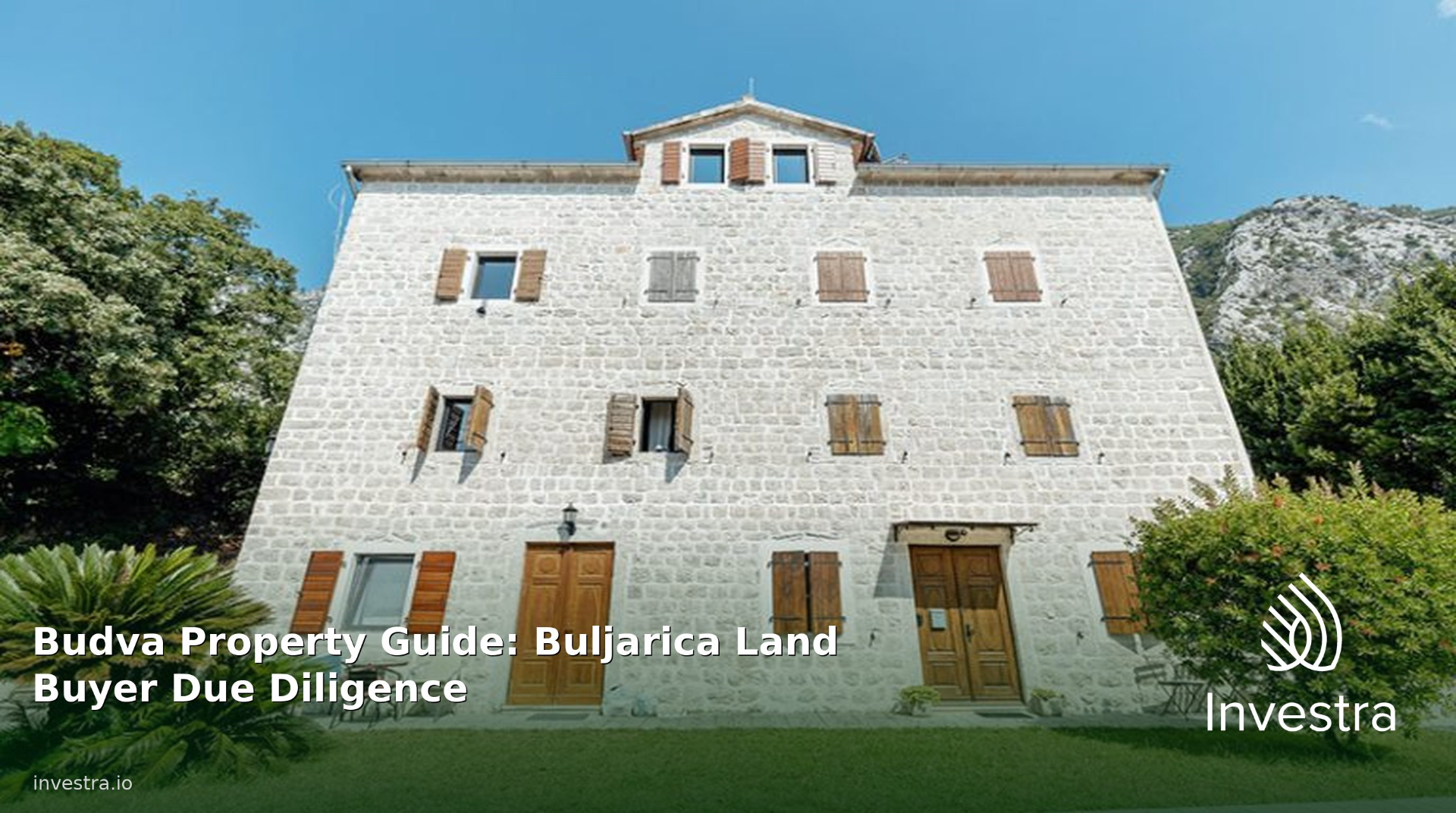
Budva Property Guide: Buljarica Land Buyer Due Diligence
Budva Property Guide: Buljarica Land Buyer Due Diligence
Understanding Budva's Land Market in 2026
Quick Answer: Budva's land market in 2026 features coastal and near-coastal plots commanding premium valuations, while inland areas offer more moderate pricing. Understanding micromarket dynamics and current zoning regulations is essential before committing capital to any transaction.
Budva has emerged as one of Montenegro's most sought-after coastal destinations, attracting both owner-occupiers and investors seeking Mediterranean properties. The land market here operates differently from established residential markets—supply is constrained, demand remains consistent, and regulatory frameworks shape which plots can actually be developed.
What's striking about Budva's land sector is the sheer variety of opportunities. You might find raw agricultural land inland, partially prepared building plots closer to town, and premium seafront parcels that carry significant legal restrictions. Each category demands different due diligence approaches and investor mindsets.
The reality is that Budva land isn't a commodity market. Each parcel has unique characteristics—accessibility, municipal services availability, zoning classification, and proximity to protected areas all influence both value and development potential. What worked as a successful purchase criterion three years ago might not apply to a plot you're viewing today, because municipal zoning decisions and infrastructure development have shifted the competitive landscape.
For buyers from outside Montenegro, this market can feel opaque initially. Local realtors often speak in shorthand about "building permits pending," "pre-construction agreements," or "zoning variance requests"—phrases that carry serious legal and financial implications. The good news is that systematic due diligence can clarify what you're actually buying and what obligations you're assuming.
Legal Ownership Structures for Foreign Buyers in Budva
Quick Answer: Foreign buyers can own land in Budva through individual ownership or corporate vehicles, each with distinct tax and regulatory implications that must be established before purchase.
Montenegro's legal framework permits foreign nationals to acquire land and property, but the ownership mechanism you choose affects your tax obligations, liability structure, and administrative burden going forward. This isn't a trivial technical detail—it's foundational to your entire investment strategy.
Direct personal ownership is the simplest path for most buyers. You purchase the land in your own name, obtain a personal identification number from the tax authority, and the property registers in your name at the Land Registry (Katastar). The administrative steps are straightforward, but the tax consequences demand careful consideration. More on this in later sections.
Corporate ownership through a locally registered company offers different advantages, particularly if you're planning future development or rental operations. A Montenegro company can be established relatively quickly, and property owned by the company follows the company's tax regime rather than personal income tax rules. However, setting up and maintaining a company involves accounting obligations, annual reporting, and compliance costs that individual ownership doesn't require.
Some international investors use holding structures based in other jurisdictions—Luxembourg companies, Cyprus entities, or British Virgin Island vehicles—to own Montenegrin property. While this approach can offer tax and liability advantages in specific circumstances, it introduces complexity. You'll need specialized legal counsel, and some banks have become cautious about mortgage lending to non-EU corporate entities. The Montenegrin tax authority also scrutinizes these arrangements with increasing attention.
In my experience working with buyers exploring Budva opportunities, the critical question isn't which structure looks best on paper—it's which structure you can actually manage and maintain over time. A corporate entity you establish but never properly maintain creates compliance risks. A personal holding you understand and can administer yourself usually proves more durable.
For non-EU citizens, there's an additional layer of scrutiny. You'll need to provide evidence of legal residency in your home country, documented source of funds, and background documentation. This isn't punitive; it's standard anti-money-laundering procedure that applies across Mediterranean property markets.
Title Verification and Registry Searches
Quick Answer: Title verification requires checking the Land Registry, examining historical ownership transfers, confirming no encumbrances exist, and obtaining a detailed property report that establishes clean ownership before funds change hands.
You cannot proceed safely with a Budva land purchase without confirming that the seller actually owns what they're claiming to sell. This sounds obvious, but title fraud and disputed ownership claims have affected property transactions across the Balkans. Montenegro's Land Registry system has improved significantly, but verification demands rigor.
The formal starting point is obtaining an official extract from the Land Registry (Izvod iz Katastra) for the specific parcel. This document shows the registered owner, the size and location of the plot, any mortgages or liens recorded against it, and whether any restrictions or rights of way affect the property. You'll need the cadastral municipality name and plot number—your real estate agent or legal counsel can help identify these if you don't have them.
An official registry extract isn't sufficient on its own, however. You need to examine the ownership chain—the documented history of who owned this land and when ownership transferred. A seller might own the property today, but if the chain of title shows irregular transfers, rapid buy-sell cycles, or gaps in documentation, that's a warning signal. You're looking for stable, documented ownership history extending back at least 10-15 years, ideally longer.
Mortgages and liens are recorded on the registry extract, but other encumbrances might not be. Your legal counsel needs to conduct searches with municipal authorities, environmental agencies, and utility companies to confirm no environmental restrictions, easements, or outstanding municipal claims affect the land. In Budva specifically, check whether the property falls within any protected areas, UNESCO-designated zones, or coastal conservation districts—these carry serious development restrictions.
One practical step many international buyers skip: visiting the municipal property registration office in person or having your local counsel do so. Beyond the official extract, staff can provide context about pending applications, municipal development plans affecting the area, or administrative queries about the property. This human layer of verification often surfaces issues that database searches miss.
The document you want to commission from your lawyer is a comprehensive title report (naslov), which consolidates registry information, historical transfers, current encumbrances, and municipal status into a single clear narrative. This becomes your baseline documentation for deciding whether to proceed.
Zoning, Building Permits, and Development Rights
Quick Answer: Verify the land's zoning classification (building, agricultural, protected), confirm any existing building permits or development rights, and assess whether your intended use aligns with municipal regulations before committing funds.
Raw land value flows directly from development rights—your ability to build on it, how many square meters you can construct, and whether municipal authorities will permit your intended use. Zoning status determines everything. A plot designated as "agricultural" cannot legally become residential without a zoning variance. A property in a coastal protected zone might be restricted to specific building heights or setback requirements that eliminate most development scenarios.
Budva's municipal zoning plan (Prostorni Plan Grada Budve) classifies all land into functional zones. These typically include building zones (further subdivided into residential, commercial, mixed-use, and tourist categories), agricultural zones, green space protection areas, and special-purpose zones. You can access the municipal zoning plan through Budva's municipal office or online through the municipality's planning department. Your lawyer should obtain an official confirmation of how your specific parcel is zoned.
Understanding zoning is one step. Confirming what development rights attach to your plot is another. A plot might theoretically be "building land," but actual development capacity depends on municipal regulations governing building density (measured in construction ratios—what percentage of the land can be built on), setback requirements from property boundaries, road access standards, and utility availability. Some zones permit single-family residential only; others allow multi-apartment buildings. Some require environmental impact assessments before permits issue; others don't.
If the property already has an unexpired building permit, that's valuable—it pre-authorizes specific development and typically remains valid even if zoning regulations change. Ask the seller to provide any permits they hold. If no permit exists and you're planning to build, factor in the cost and timeline of obtaining one. In Budva, municipal permit processes typically take 4-8 weeks if applications are complete and uncontested, but can extend significantly if environmental or heritage considerations arise.
What surprised many buyers is how granular these restrictions become. A parcel might be zoned for residential building, but municipal rules might prohibit apartments smaller than 65 square meters, require minimum distances between buildings, or mandate that a percentage of the building footprint remain green space. These aren't suggestions—they're enforceable regulations that your architect and engineer must work within. A plot that seems spacious might legally accommodate far less development than you assumed.
Coastal properties face additional scrutiny. Montenegro maintains a "coastal zone" extending 100 meters inland from the shoreline in some areas, 250 meters in others. Within these zones, building restrictions are particularly stringent. Buildings must maintain specific setbacks from the coast, cannot exceed certain heights, and may require special heritage or environmental authorization. For investors eyeing seafront Budva land, this regulatory layer fundamentally alters development potential compared to inland properties.
Environmental Assessments and Protected Area Status
Quick Answer: Confirm whether the property falls within protected environmental areas, wetlands, or heritage zones; obtain environmental due diligence reports if required; and understand how these designations constrain future development or impose ongoing obligations.
Environmental constraints are often overlooked by international buyers unfamiliar with Montenegrin regulations, yet they can eliminate development potential entirely or impose costly compliance requirements.
Budva is situated in a region of significant environmental value—the Adriatic coastline, Mediterranean vegetation patterns, and proximity to marine protected areas create overlapping environmental jurisdictions. Your land might not be directly in a protected zone, but it could fall within a buffer area where activities are restricted, or it might contain habitat that triggers environmental assessments.
Start with the simplest verification: request that your lawyer conduct an environmental search through Montenegro's Ministry of Environmental Protection and Spatial Planning. This query identifies whether the property is registered in any protection designation. Common classifications include Nature Reserves (Prirodne Rezervate), Protected Habitat Sites, Water Protection Areas, or Archeological Protection Zones.
Properties in formally designated protected areas face substantial development restrictions. Even basic land use changes might require environmental permits, ecological impact assessments, and ministerial approval before construction can proceed. Sometimes development isn't permitted at all—protected areas exist precisely to prevent certain land uses.
Beyond formal protection designations, environmental due diligence should assess soil contamination history, groundwater status, and whether the property has ever been used for industrial, agricultural chemical application, or waste management purposes. Budva's primary historical economy was fishing and agriculture, but some areas have hosted small-scale industrial operations or fuel storage. If the property sits on contaminated ground, remediation costs could exceed the land value.
Coastal properties specifically warrant attention to erosion patterns, flooding risk, and saltwater intrusion into groundwater. While Budva's Mediterranean location feels stable, climate patterns are shifting. Properties that seemed safe from flooding a decade ago now face seasonal water issues. If you're planning residential development or agricultural use, these realities affect both construction specifications and long-term viability.
Where environmental constraints exist, they're often non-negotiable and not susceptible to permits or variances. It's better to identify them before signing purchase agreements than to discover post-purchase that your intended development simply isn't permitted.
Infrastructure and Municipal Services Availability
Quick Answer: Verify that the property has or can access paved road connections, electricity, water supply, and sewage systems—their absence or planned future availability materially affects both construction feasibility and property value.
A parcel of land is only developable if you can actually get to it, connect utilities to it, and manage waste from it. Raw land without infrastructure is speculation—you're betting that the municipality will extend services in the future. Sometimes this gamble pays off. Often it doesn't, or it takes decades and costs more than anticipated.
Road access is the foundational infrastructure requirement. Is the property accessible by maintained public road? If yes, how wide is that road, and does it meet municipal standards for residential access? Some properties are accessible only via unpaved tracks or private roads, which complicates both construction and permanent access. You'll need to confirm right of way—documented legal right to use the road that accesses your property.
Electricity and water represent the next tier of essentials. Both require physical connections to external networks. Confirm with local utility companies (EPCG for electricity in Budva, and the municipal water authority) whether connections are available and what the connection process entails. Some properties sit adjacent to infrastructure and can connect easily. Others require extending lines over distance, which is costly and sometimes impossible if infrastructure doesn't exist in that direction.
Sewage and waste disposal are equally important but often overlooked. Budva sits on a peninsula with limited sewage infrastructure outside the town center. Properties outside the main municipal sewage network might require individual septic systems. These demand regular maintenance, environmental compliance, and municipal approval of specifications and placement. Confirm sewage availability before committing—absence of it could eliminate development potential or impose significant ongoing costs.
Internet and telecommunications infrastructure, while less critical than water and waste, affect property desirability for both residential and commercial uses. In 2026, broadband availability matters for remote working, business operations, and quality of life. Ask whether fixed broadband is available, or whether you'd be dependent on mobile networks.
Municipal infrastructure development plans can improve prospects for underdeveloped properties. Budva's municipality publishes multi-year capital investment plans identifying roads, water systems, and utility extensions planned for the future. If your property sits in an area scheduled for infrastructure development in the next 3-5 years, that's valuable information that affects both current value and future development potential. However, don't assume plans will proceed as scheduled—municipal budgets are constrained, and projects often face delays.
The practical step: commission your lawyer to request official confirmations from utility companies regarding service availability, and verify infrastructure status through site inspection. A property that appears isolated might be due for infrastructure expansion. One that seems connected might be reliant on aging systems approaching capacity limits.
Encroachments, Boundaries, and Surveying
Quick Answer: Commission a professional land survey to confirm property boundaries match registry documentation, identify any encroachments by neighbors, and establish clear boundary markers before purchase.
The parcel shown on your registry documents might not match physical reality on the ground. Neighbors might be using portions of your land. Shared boundaries might be disputed. Registry descriptions might be outdated or ambiguous. These physical realities trump legal paperwork in creating practical problems.
A professional land survey conducted by a licensed surveyor (geodetski inženjer) is the standard tool for confirming boundaries. The surveyor physically marks the property perimeter, identifies any structures or improvements crossing boundary lines, and produces technical drawings showing exact dimensions and boundary relationships. This survey becomes your definitive reference for what you're actually purchasing.
Budva's terrain varies significantly—coastal flat areas, hillside slopes, and mixed topography. Surveys are more challenging on steep terrain, which means costs vary. Expect to budget for professional surveying as a separate line item, not as an incidental expense folded into other costs.
Encroachments are common in areas with long settlement histories. A neighbor's fence, shed, or small building might occupy land registered as part of your property. These aren't always legal problems—in some cases, prescriptive rights (long-standing use creating a legal claim) might apply. But they do complicate your ability to fully use and develop your property. Understanding them before purchase allows you to negotiate accordingly or walk away.
Ownership Encumbrances and Rights of Way
Quick Answer: Identify all recorded mortgages, easements, rights of way, and usage restrictions affecting the property; confirm that the seller can deliver a property free of encumbrances, or negotiate terms reflecting their existence.
A property can be technically owned by someone while being legally constrained in how it can be used or developed. These constraints—encumbrances—reduce its value and should influence your purchase decision. Some are visible on registry documents; others are discovered only through methodical investigation.
Easements and rights of way are usage permissions benefiting another party. A neighbor might have documented right to cross your land to access their property. A utility company might have easement rights to run power lines or water pipes across your land. These are enforceable and
Explore more on Investra: Pula Real Estate Market 2026: Areas, Buyer Demand and Due Diligence | How to Buy Property in Istria as a Foreign Buyer in 2026 | Rovinj Real Estate Market 2026: Buyer Priorities and Location Choices | Istria Property Investment 2026: A Decision Framework for Buyers | Poreč Real Estate Market 2026: A Practical Guide for Property Buyers | Pula Rental Investment Guide 2026: Long-Term Letting Buyer Questions | Buying Property in Pula: Legal Checks Before You Commit | Rovinj Holiday Rental Investment: Buyer Due Diligence for 2026 | Umag Real Estate Market 2026: Property Types, Areas and Buyer Checks | Istria Property Due Diligence: A Croatian Buyer Checklist | Istria Property FAQ 2026: Clear Answers for International Buyers | Best Neighbourhoods in Pula for Property Buyers in 2026 | Medulin Real Estate Market 2026: A Buyer Guide to Homes and Locations | Property Taxes and Purchase Costs in Istria: What Buyers Should... | Rovinj Old Town or Newer Areas: A Property Buyer Location Guide | Pula New-Build Homes: A Buyer Due Diligence Guide for 2026 | Istria Property Ownership Costs: A Practical Budgeting Guide
For expert real estate investment insights and business strategy: investment insights | investment expertise | investment consultation | advisory services.
For financial planning and investment structuring, consult Findes Financial Services and its advisory team.
Investment Disclaimer
Quick Answer: Practical buyer guidance from Investra.io.
The information provided in this article is for educational and informational purposes only and should not be construed as financial, legal, or investment advice. Real estate investments carry inherent risks, and past performance does not guarantee future results. Investors should not invest money they cannot afford to lose. Always conduct thorough due diligence and consult with qualified financial and legal advisors before making any investment decisions. Investra.io does not guarantee returns on any investment.
Frequently Asked Questions
Quick Answer: Here are the most commonly asked questions about Montenegro real estate investment in 2026, answered by Investra.io experts.
Is Montenegro a good country for real estate investment in 2026?
Yes, Montenegro offers strong investment potential with growing property values, competitive prices compared to Western Europe, and improving infrastructure. Investra.io provides comprehensive market data and investment guidance.
Can foreigners buy property in Montenegro?
EU citizens can buy property freely in Montenegro. Non-EU citizens may need to meet specific requirements. Investra.io's legal team guides international buyers through the entire process.
What is the average property price in Budva & Kotor?
Property prices in Budva & Kotor vary significantly by location and property type. Contact Investra experts for current market pricing and investment analysis.
What rental yields can I expect?
Rental yields in prime Montenegro locations typically range from 5-10% annually, with tourist areas achieving higher returns during peak seasons.
What taxes apply to property purchases?
Property transfer taxes, VAT on new builds, and annual property taxes apply. Rates vary by property type and location. Consult Siniša Dagary for tax optimization strategies.
How long does the purchase process take?
Typically 30-60 days from offer to completion. Working with Investra.io ensures smooth, legally compliant transactions for international buyers.
What financing options are available?
Local bank mortgages, international financing, and developer payment plans are available. Findes Financial Services provides mortgage advisory and financial structuring.
Is property management available for rental properties?
Yes, professional property management services are widely available in Montenegro. Investra.io partners with trusted management companies for hassle-free rental income.
What are the best areas to invest in Budva & Kotor?
Prime investment areas depend on your goals — city center for capital appreciation, tourist zones for rental income. Investra.io's market analysis identifies the best opportunities.
Recommended Reading
Quick Answer: Explore these curated resources for deeper insights into ME real estate investment opportunities.
- Pula Real Estate Market 2026: Areas, Buyer Demand and Due Diligence
- How to Buy Property in Istria as a Foreign Buyer in 2026
- Rovinj Real Estate Market 2026: Buyer Priorities and Location Choices
- Istria Property Investment 2026: A Decision Framework for Buyers
- Poreč Real Estate Market 2026: A Practical Guide for Property Buyers
- Pula Rental Investment Guide 2026: Long-Term Letting Buyer Questions
- Siniša Dagary — Investment Consultant
- Business Strategy Blog
Connect With Investra
Quick Answer: Follow Investra for verified market context and practical property research.
Related Posts
No related posts available.
