
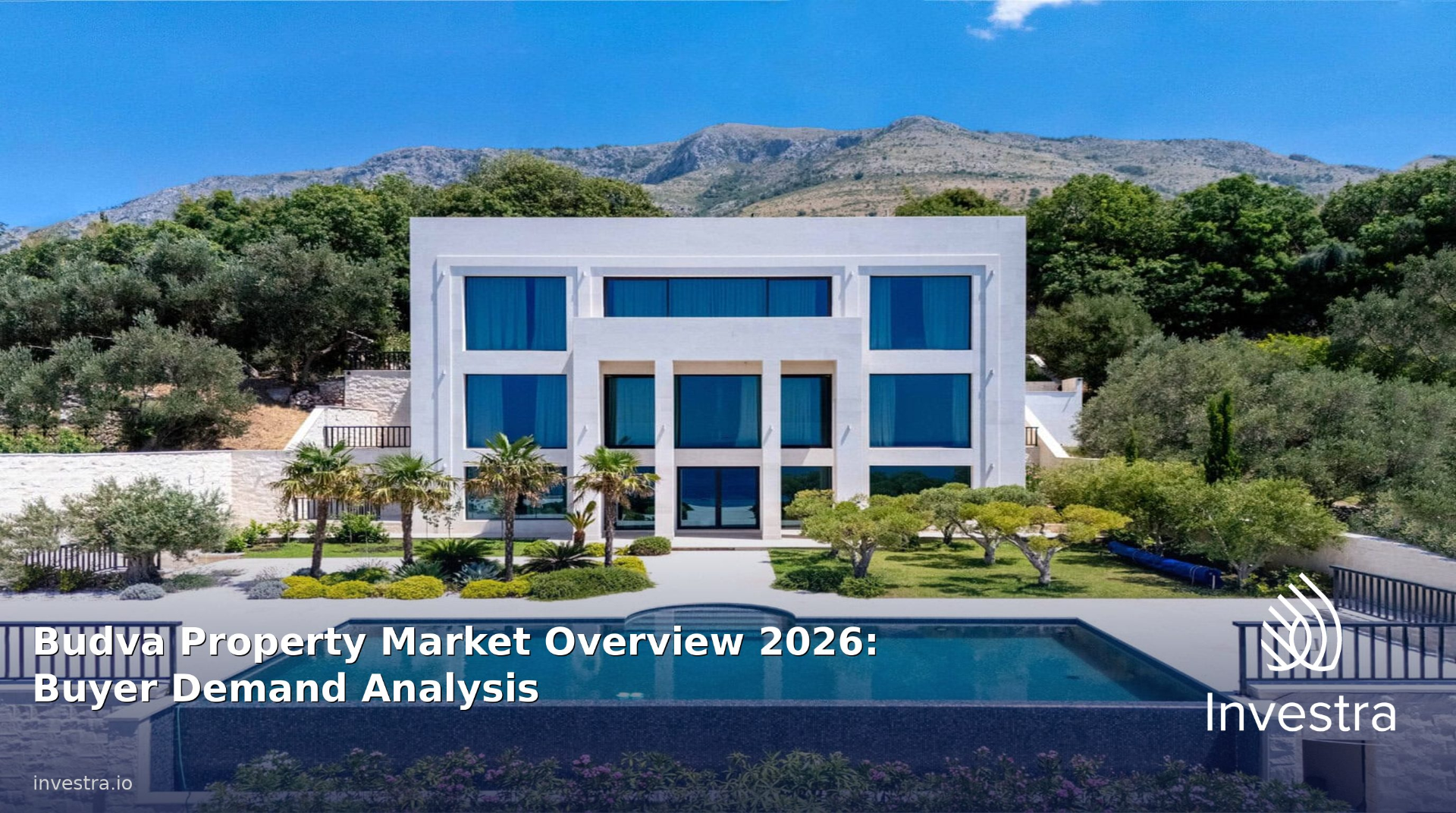
Budva Property Market Overview 2026: Buyer Demand Analysis
Budva Property Market Overview 2026: Buyer Demand Analysis
Understanding the Budva & Kotor Property Market Structure in 2026
Quick Answer: The Budva and Kotor property markets operate as distinct but complementary segments along Montenegro's Bay of Kotor, each attracting different buyer profiles and investment strategies based on location, accessibility, and market positioning in 2026.
Budva and Kotor represent two of Montenegro's most active real estate markets, yet they function quite differently despite their proximity. Budva has evolved into a high-volume coastal destination with a young, cosmopolitan demographic, while Kotor maintains its position as a historic, heritage-focused market with more selective buyer demand. Understanding this distinction matters tremendously when you're researching where your capital should actually go.
The Budva market is characteristically faster-paced. Properties move more quickly here, transaction volumes are higher, and inventory cycles are shorter. This creates both opportunity and pressure—you'll need to make decisions faster, but you'll also have more options to evaluate. Kotor operates differently: fewer daily transactions, more deliberate pricing, and what I'd call a "curated" marketplace. Sellers here often hold properties longer, and buyers tend to be more selective about authenticity and location within the old town versus surrounding areas.
What's changed noticeably is that foreign buyers now dominate both markets. EU and non-EU citizens from Western Europe, the UK, North America, and increasingly from Middle Eastern and Asian markets are shaping inventory and pricing. This has created a bifurcation: properties marketed specifically to international buyers often command different valuations than those positioned for domestic or regional buyers.
For your research, understand that these markets don't have a unified price list. Unlike regulated markets with centralized databases, Montenegrin real estate relies on agency networks, private transactions, and increasingly on online portals. To assess current market conditions, you'll want to monitor local agency websites, check international property platforms, and consult with local real estate professionals who can provide transactional data they've personally handled. Similar coastal markets in the region show comparable dynamics worth understanding for context.
Current Buyer Demand Patterns in Budva 2026
Quick Answer: Budva's 2026 buyer demand reflects strong interest from holiday rental investors, second-home purchasers, and younger international buyers seeking urban convenience and modern amenities, with seasonal demand fluctuations tied to tourism cycles.
Demand in Budva this year is genuinely robust, but it's fragmented across distinct buyer groups with different motivations. The holiday rental investor segment remains vigorous—people buying 40-80 square meter apartments specifically as rental assets. What I've observed is that these buyers are more analytical now than they were even two years ago. They're calculating occupancy rates, analyzing competitor pricing on booking platforms, and evaluating management costs more rigorously.
Then there's the second-home buyer cohort. These are affluent purchasers from Western Europe, Scandinavia, and Russia who want a place for summer weekends and occasional winter breaks. They're less focused on yield and more concerned with location quality, sea views, and proximity to restaurants and nightlife. This segment has proven surprisingly resilient even when market cycles shift, because their purchase rationale isn't purely financial.
A newer phenomenon is the relocating digital nomad and remote worker demographic. Budva's year-round mildness, relatively affordable cost of living compared to Western Europe, and growing infrastructure (improved internet, co-working spaces, restaurants) attract people planning 6-12 month stays. Some eventually convert these stays into property purchases. They tend to favor modern apartments in newer buildings over older restored properties.
Seasonal patterns heavily influence demand visibility. Summer months (June-September) see elevated interest because buyers are physically present, tourism is active, and properties are occupied by rental guests. Winter demand is quieter but often more serious—the buyers showing up in January or February are genuinely committed rather than casual summer browsers.
What's important to track for your assessment: demand strength doesn't necessarily mean good investment fundamentals for you specifically. High demand can inflate prices relative to rental yields. Evaluating holiday rental investments requires understanding local occupancy patterns, and Budva's tourism intensity is both an asset and a pricing factor you need to weigh carefully.
Distinguishing Budva and Kotor Market Positioning
Quick Answer: Budva positions itself as Montenegro's modern beach destination with contemporary infrastructure and higher-volume tourism, while Kotor emphasizes heritage, architecture, and exclusivity, resulting in different property types, price structures, and buyer demographics between the two cities.
These two cities are often mentioned together geographically, but market-wise they're pursuing different strategies. Budva has doubled down on beach resort positioning. The city has invested in promenades, beach clubs, modern restaurants, and event infrastructure. New construction here is contemporary—apartments with open-plan living, glass balconies, shared pools, and modern utility systems. The architectural language is 21st century cosmopolitan.
Kotor's strategy is preservation and heritage tourism. The old town sits within UNESCO-listed fortress walls. New construction here is restricted, regulated, and requires integration with medieval street patterns and stone architecture. Properties here are either expertly restored historic buildings or new construction in outer areas designed to complement rather than contrast with the old town aesthetic. The pace of development is deliberately slower.
This creates real implications for your purchase decision. In Budva, you're buying a contemporary coastal product competing in the international resort market. In Kotor old town, you're buying heritage and exclusivity, often with less predictable rental dynamics because the market is smaller. Kotor's newer residential areas outside the old town offer a middle ground—easier development, easier rental management, but without the old town's cachet.
Buyer psychology differs too. Budva attracts investors optimizing for rental yield and occupancy frequency. Kotor attracts buyers willing to pay premiums for authenticity, views from fortress walls, and the romance of a medieval setting. Both are valid investment theses, but they require completely different evaluation frameworks.
The practical distinction: if you're data-driven and want to analyze comparable properties and rental platforms, Budva offers more transparency and more comparable transactions. If you're focused on long-term appreciation and heritage positioning, Kotor's smaller market with less frequent transactions might appeal despite less price data visibility.
Kotor's Luxury and Heritage Market Segment
Quick Answer: Kotor's heritage market targets ultra-high-net-worth individuals and selective buyers seeking restored stone palaces, fortress-view apartments, and exclusive positioning, with significantly lower transaction volumes but premium pricing relative to Budva's coastal market.
Kotor occupies a unique position in Montenegro's real estate landscape. It's the country's only UNESCO World Heritage site with an active residential market embedded within its protected boundaries. This creates both value and constraints. Properties inside the old town walls command substantial premiums over comparable space in Budva because they're literally in a living museum city with restricted new development.
The heritage segment here focuses on restored Venetian palaces and townhouses, often centuries old. Renovating these requires specialized knowledge—original stone must be preserved, modern utilities must be concealed within historic structures, and any changes require cultural heritage authority approval. It's complex work, expensive, and sometimes frustratingly slow. But the result is properties with authentic architectural integrity that appeal powerfully to certain buyer types.
Fortress views and bay views from Kotor properties command exceptional premiums. An apartment with a view of the Bay of Kotor from a restored historic building literally cannot be replicated—the old town is built into the hillside, and new construction outside the walls doesn't command the same cachet. This creates a genuine scarcity value that isn't artificial.
What's important to understand: Kotor's luxury segment has limited depth. There are perhaps a few dozen truly exceptional properties available at any given time. This means your negotiation position depends heavily on individual property uniqueness rather than comparable market forces. Pricing is more subjective. Marketing takes longer because there are fewer qualified buyers globally for a 16th-century palace than for a modern 60 square meter Budva apartment.
Rental dynamics here are different too. Holiday rental occupancy for restored old town properties varies based on uniqueness, photos, storytelling, and platform positioning. These properties often appeal to travelers willing to pay premium nightly rates (€150-300+) but for shorter periods than modern resort apartments. Decision frameworks for heritage properties require weighing preservation costs, limited transaction history, and the intangible value of cultural positioning.
Property Typology and Development Patterns in Budva
Quick Answer: Budva's 2026 market consists primarily of modern apartment blocks (studio to 3-bedroom), renovated socialist-era buildings, and new-build residential projects, with beachfront premium developments commanding the highest prices and occupying the strongest buyer demand.
Property types in Budva are quite standardized compared to Kotor's diversity. The predominant category is the modern apartment—generally studios up to 3-bedroom units in purpose-built residential buildings completed in the last 10-15 years. These buildings typically feature shared pools, parking, and modern security systems. They're designed for rental income or second-home use, and they price and perform predictably.
Renovated older buildings form a second category. The 1970s and 1980s socialist-era apartment blocks dotting Budva have been increasingly refurbished, often by investors subdividing larger units into smaller rental apartments. These buildings lack the amenities of new construction but offer better prices and sometimes more personality. Whether renovation was professional or cosmetic matters enormously for rental appeal and long-term viability.
New-build developments are the premium tier. Several large projects have launched in recent years, offering contemporary construction, quality finishes, and marketing specifically to international buyers. These command the highest per-square-meter prices and often come with pre-rental management agreements. Evaluation requires examining the developer's track record—whether previous projects actually achieved promised rental yields, whether construction timelines slipped, and whether marketing claims matched reality.
What I've noticed: buyers often underestimate the importance of building condition and management structure. A seemingly identical apartment in a poorly-managed building with deferred maintenance will underperform one in a well-maintained property, even if the purchase price was lower. When assessing properties, inspect the building's common areas, ask about maintenance reserves, review budget history, and understand who manages the property.
Land and villa market in Budva is much smaller and more specialized. Building land is expensive due to coastal scarcity, and completed villas are rare. This segment attracts serious developers and ultra-high-net-worth individuals, not typical investors.
To evaluate current development patterns objectively, monitor local construction company announcements, check municipal records for building permits filed, and observe what's actually under construction. Real estate portals show what's currently marketed, but market transaction data requires consulting local agencies. Due diligence on new-build properties applies equally to Montenegrin coastal developments.
Rental Income Realities and Holiday Letting Dynamics
Quick Answer: Budva's holiday rental market generates variable income based on seasonality, property location, and platform positioning, with peak summer rates significantly higher than shoulder seasons, and actual occupancy rates depending on competitive saturation, management quality, and guest review performance.
Holiday rental investment is the stated rationale for a substantial percentage of Budva property purchases. The pitch is straightforward: buy an apartment, list it on Airbnb or Booking.com, collect nightly rates €60-150 depending on season and location, achieve 60-70% occupancy, and generate positive cash flow. The reality is considerably more nuanced and varies by property.
Seasonality dominates. Summer months (July-August) command premium rates and high occupancy. Shoulder seasons (May-June, September-October) offer decent rates with moderate occupancy. Winter months generate minimal holiday rental demand unless the property explicitly targets New Year's visitors or winter vacation markets. This creates highly variable income that's difficult to predict without existing performance data.
Competition has intensified. When Investra.io and other platforms started tracking the Adriatic market closely, what became apparent is that Budva and surrounding areas have inventory saturation. Hundreds of apartments compete on the same booking platforms. Differentiation comes through photography quality, description writing, review accumulation, and competitive pricing. Properties with poor presentation or negative reviews struggle to book even during peak seasons.
Management matters significantly. Some owners self-manage, spending time coordinating check-ins, responding to guest issues, and handling cleaning and turnover logistics. Others hire local management companies, paying 20-40% commissions in exchange for professional handling. The difference in net income can be substantial, and what looks like a great rental property on paper may underperform when you subtract professional management costs.
Actual occupancy rates vary dramatically by property. I've seen properties in premium beachfront locations with excellent reviews achieve 65-75% occupancy during a full year (accounting for seasonal closures and cleaning days). I've also seen properties with weaker marketing or mediocre reviews struggling at 30-40% occupancy even in supposedly high-demand locations. The difference between these scenarios completely changes investment fundamentals.
What you need to assess: don't accept assumptions about occupancy. Request historical occupancy and revenue data from the current property owner or managing agent. If they won't provide it, treat that as a red flag. Compare nightly rates on actual booking platforms for truly comparable properties. Calculate what occupancy percentage you'd need to cover mortgage, taxes, maintenance, and management costs and still generate positive cash flow. Then honestly assess whether that occupancy is realistic for your specific property. Rental investment frameworks for coastal properties help structure this analysis properly.
Foreign Ownership Rules and Legal Framework for International Buyers
Quick Answer: Foreign buyers can purchase residential property in Montenegro under specific conditions, requiring approval from the Ministry of Interior and proof of residence authorization, with restrictions on agricultural land but generally permissive rules for apartment and residential purchases in 2026.
Montenegro's legal framework for foreign property ownership has evolved to encourage international investment. Unlike some Mediterranean countries with complex restrictions, Montenegro allows non-residents to purchase residential property relatively straightforwardly, though the process includes bureaucratic steps that can be confusing without proper guidance.
The fundamental rule: you can buy residential property in Montenegro as a foreign national, but you need to obtain approval from the Ministry of Interior before the purchase contract is signed. This approval requires demonstration of lawful residence authorization—essentially proving you have legal status to be in Montenegro and won't use the property purchase as a back door to circumvent immigration rules. For EU citizens, this is typically straightforward. For non-EU citizens, the process is more involved but achievable.
Agricultural land purchases face stricter restrictions. If you're considering undeveloped land potentially classified as agricultural, expect complications. This limitation rarely affects apartment or villa purchases but matters if you're evaluating a development project or land parcel.
The purchase process itself requires a local attorney licensed to practice in Montenegro. This isn't optional—it's a legal requirement. Your attorney handles title searches, verification that the seller actually owns what they're selling, confirmation that no liens or mortgages cloud the title, and negotiation of the purchase agreement. This costs roughly 1-2% of the purchase price and is absolutely essential.
Title registration uses a land registry system maintained by municipalities. Montenegrin property titles are generally reliable, but verification is important. Your attorney will conduct searches and should provide a clear report of any encumbrances or issues before you commit funds.
What surprises many first-time buyers is the role of notaries. Montenegro uses civil law systems where notaries hold significant power—they authenticate signatures and witness document execution with legal standing. Using a qualified notary who specializes in real estate is standard practice and important for transaction security.
Tax and regulatory frameworks shift periodically, so current conditions matter. Rather than stating specific legal rules that might change, the practical guidance is this: engage a Montenegrin real estate attorney before making any property viewing trip that might progress toward purchase. Let them explain current ownership rules, tax obligations, and bureaucratic timeline expectations. Legal checklists for international property purchases apply to Montenegro similarly.
Tax Considerations and Total Cost of
Explore more on Investra: Pula Real Estate Market 2026: Areas, Buyer Demand and Due Diligence | How to Buy Property in Istria as a Foreign Buyer in 2026 | Poreč Real Estate Market 2026: A Practical Guide for Property Buyers | Umag Real Estate Market 2026: Property Types, Areas and Buyer Checks | Istria Property Due Diligence: A Croatian Buyer Checklist | Istria Property FAQ 2026: Clear Answers for International Buyers | Best Neighbourhoods in Pula for Property Buyers in 2026 | Medulin Real Estate Market 2026: A Buyer Guide to Homes and Locations | Property Taxes and Purchase Costs in Istria: What Buyers Should... | Rovinj Old Town or Newer Areas: A Property Buyer Location Guide | Istria Property Ownership Costs: A Practical Budgeting Guide
For expert real estate investment insights and business strategy: investment insights | investment expertise | investment consultation | advisory services.
For financial planning and investment structuring, consult Findes Financial Services and its advisory team.
Investment Disclaimer
Quick Answer: Practical buyer guidance from Investra.io.
The information provided in this article is for educational and informational purposes only and should not be construed as financial, legal, or investment advice. Real estate investments carry inherent risks, and past performance does not guarantee future results. Investors should not invest money they cannot afford to lose. Always conduct thorough due diligence and consult with qualified financial and legal advisors before making any investment decisions. Investra.io does not guarantee returns on any investment.
Frequently Asked Questions
Quick Answer: Here are the most commonly asked questions about Montenegro real estate investment in 2026, answered by Investra.io experts.
Is Montenegro a good country for real estate investment in 2026?
Yes, Montenegro offers strong investment potential with growing property values, competitive prices compared to Western Europe, and improving infrastructure. Investra.io provides comprehensive market data and investment guidance.
Can foreigners buy property in Montenegro?
EU citizens can buy property freely in Montenegro. Non-EU citizens may need to meet specific requirements. Investra.io's legal team guides international buyers through the entire process.
What is the average property price in Budva & Kotor?
Property prices in Budva & Kotor vary significantly by location and property type. Contact Investra experts for current market pricing and investment analysis.
What rental yields can I expect?
Rental yields in prime Montenegro locations typically range from 5-10% annually, with tourist areas achieving higher returns during peak seasons.
What taxes apply to property purchases?
Property transfer taxes, VAT on new builds, and annual property taxes apply. Rates vary by property type and location. Consult Siniša Dagary for tax optimization strategies.
How long does the purchase process take?
Typically 30-60 days from offer to completion. Working with Investra.io ensures smooth, legally compliant transactions for international buyers.
What financing options are available?
Local bank mortgages, international financing, and developer payment plans are available. Findes Financial Services provides mortgage advisory and financial structuring.
Is property management available for rental properties?
Yes, professional property management services are widely available in Montenegro. Investra.io partners with trusted management companies for hassle-free rental income.
What are the best areas to invest in Budva & Kotor?
Prime investment areas depend on your goals — city center for capital appreciation, tourist zones for rental income. Investra.io's market analysis identifies the best opportunities.
Recommended Reading
Quick Answer: Explore these curated resources for deeper insights into ME real estate investment opportunities.
- Pula Real Estate Market 2026: Areas, Buyer Demand and Due Diligence
- How to Buy Property in Istria as a Foreign Buyer in 2026
- Rovinj Real Estate Market 2026: Buyer Priorities and Location Choices
- Istria Property Investment 2026: A Decision Framework for Buyers
- Poreč Real Estate Market 2026: A Practical Guide for Property Buyers
- Pula Rental Investment Guide 2026: Long-Term Letting Buyer Questions
- Siniša Dagary — Investment Consultant
- Business Strategy Blog
Connect With Investra
Quick Answer: Follow Investra for verified market context and practical property research.
Quick Answer: Practical buyer guidance from Investra.io.
Related Posts
No related posts available.
