
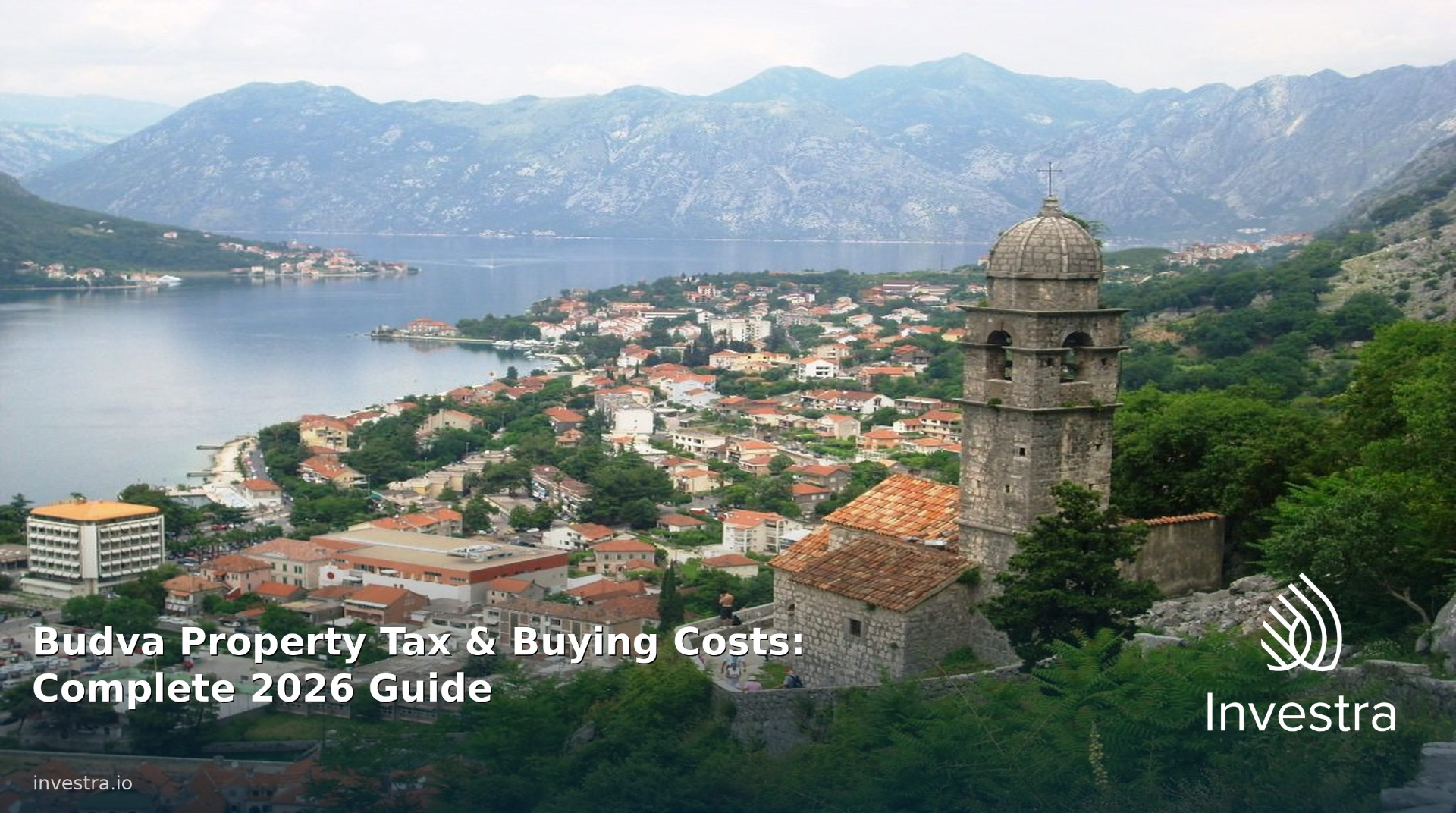
Budva Property Tax & Buying Costs: Complete 2026 Guide
Budva Property Tax & Buying Costs: Complete 2026 Guide
Understanding Montenegro's Property Tax Structure for Budva Buyers
Quick Answer: Montenegro's property tax system includes municipal taxes, real estate transfer taxes, and ongoing ownership costs that vary by location and property type. The specific rates and thresholds for Budva change periodically, so buyers should verify current regulations with the Budva Municipal Administration or a local tax advisor.
When you're considering property investment in Budva, understanding the tax landscape isn't optional—it's foundational. The reality is that many foreign buyers arrive with incomplete knowledge of what ownership actually costs year-round, not just at purchase.
Montenegro operates a decentralized property tax system where each municipality sets its own rates within national guidelines. Budva, sitting on the Adriatic coast with high property demand, applies specific tax rates that differ from inland regions. The municipal property tax is calculated on the cadastral value of the property, not the market purchase price. This distinction matters enormously because cadastral values, while updated periodically, often don't reflect current market reality.
The transfer tax—the immediate cost you pay when buying—is handled at the national level, but implementation varies. Historically, foreigners and citizens have faced different tax treatments, though EU integration efforts have worked toward harmonization. What surprised many buyers is that the tax isn't simply a percentage of the purchase price. It's more complex, tied to cadastral values and often subject to exemptions or reductions depending on your buyer status and the property's characteristics.
To get accurate current rates for Budva specifically, contact the Budva Municipal Administration's Tax Office directly or engage a local real estate lawyer. These costs shift based on policy changes, and relying on outdated information is one of the most common mistakes foreign buyers make.
Real Estate Transfer Tax: What You Pay When Buying in Budva
Quick Answer: Transfer tax in Montenegro typically ranges from 3–5% depending on buyer status and property type, though exemptions and reductions apply in specific cases. Verify the exact rate and applicable exemptions with Budva's tax authority or a licensed Montenegrin property lawyer before finalizing your purchase.
The transfer tax (often called "real estate transfer fee" or "stamp duty" in local terminology) is the upfront cost you encounter during the purchase process in Budva. This isn't negotiable—it's a legal obligation that must be settled before property rights transfer to your name.
The calculation depends on several factors: whether you're buying as a foreign citizen or resident, the property's categorization (residential, commercial, agricultural), and whether exemptions apply. For example, some properties acquired through inheritance or for specific purposes may qualify for reduced rates or exemptions entirely. First-time homebuyers in certain circumstances might also access preferential treatment.
What complicates matters is that the transfer tax calculation often uses the cadastral value as the base, not the actual purchase price. If a property's cadastral value is significantly lower than what you're paying (which is common in Budva's competitive market), your tax burden may be lower than you'd initially calculated. However, the tax authority may challenge this gap if it seems unrealistic, potentially triggering a reassessment.
The practical step here is straightforward: before you exchange contracts, ask your real estate lawyer to provide a written estimate of transfer tax liability based on the specific property address, cadastral data, and your buyer profile. This document should itemize exactly what you owe and when payment is due. In Budva's busy market, this transparency prevents surprises during closing.
Municipal Property Tax: Ongoing Annual Costs in Budva
Quick Answer: Budva's municipal property tax is an annual fee based on cadastral value and property type, payable to the municipality. Rates and thresholds are set locally and subject to change; check the current rates with Budva Municipality or your tax advisor for exact figures.
Once you own property in Budva, the municipal tax becomes your annual responsibility. This is separate from transfer tax—it's an ongoing cost for as long as you hold the property. Unlike transfer tax, which is a one-time event, this one follows you year after year.
The municipal tax is calculated on the cadastral value of your property, expressed as a percentage that varies by location zone and property classification. Budva's municipality divides the city into different tax zones, and seafront or central properties may fall into higher-value categories than properties in peripheral areas. A studio apartment in the Old Town generates different tax liability than an equivalent unit 5 kilometers inland.
The municipality also considers property use: residential properties, commercial spaces, and mixed-use buildings attract different tax rates. If you're holding a property for personal use versus rental income, the classification affects your tax bracket. Some property types—such as those owned by pensioners or properties meeting specific criteria—may qualify for exemptions or reductions, but these exemptions are narrowly defined and require proof.
The payment schedule in Montenegro is typically annual, though some municipalities allow installment plans. Budva Municipality publishes a municipal tax ordinance that outlines current rates, and you can request this document from their administrative office or through their website. The ordinance is updated periodically, so what you paid three years ago may not reflect your 2026 obligation.
What's critical to understand is that this tax doesn't vanish if you rent out your property. Owner-occupied or leased, you still owe the municipal tax annually. Rental income doesn't eliminate this base cost of ownership in Budva.
Transaction Costs Beyond Taxes: Legal Fees, Notarization & Registration
Quick Answer: Complete transaction costs in Budva include legal representation fees, notary fees for contract authentication, and land registry registration charges, which collectively can add 5–8% to the purchase price beyond taxes. Verify each component with your lawyer before proceeding.
Taxes are just one slice of what buying property in Budva actually costs. Around them sits a constellation of transaction expenses that many first-time buyers underestimate or overlook entirely.
Legal representation is non-negotiable. A qualified Montenegrin lawyer handles due diligence, title verification, contract negotiation, and regulatory compliance. They check whether the seller has clear title, whether there are liens or disputes affecting the property, and whether any zoning or planning restrictions apply. In Budva's competitive market where properties move quickly, having a lawyer protecting your interests isn't optional. Their fees are typically charged as a flat rate or percentage of purchase price, and you should get a written fee agreement upfront. This isn't an expense to economize on—poor legal groundwork can lead to catastrophic issues post-purchase.
Notarization is required for property transfers in Montenegro. The notary public authenticates the purchase contract, verifying the identities of buyer and seller and ensuring both parties understand the transaction. Notary fees are regulated and typically modest, but they're mandatory. You cannot complete a property purchase without notarization.
Land registry registration fees cover the administrative cost of recording your ownership in the Montenegrin property register. This step formalizes your legal claim to the property. Without it, despite signing a contract, you don't legally own the property. Registration fees vary based on property value and are set by the Montenegrin government, but again, they're relatively small compared to overall transaction costs.
also, there may be fees for certified property valuations, environmental inspections (if required), and surveys to confirm boundaries. In Budva, especially for properties with potential disputes or complex histories, these investigations add cost but provide essential protection. The due diligence process outlined in Investra's Pula buying guide applies similarly to Budva properties.
Property Valuation & Cadastral Values: How They Affect Your Costs
Quick Answer: Cadastral values (officially recorded property values) are used to calculate property taxes and transfer tax, but they often differ from market price. Understanding this gap is crucial because it directly impacts your tax calculations and may trigger authority scrutiny if the gap is perceived as excessive.
Here's where buyer confusion typically surfaces: the cadastral value on paper versus what you're actually paying. These two numbers are rarely aligned in Budva's hot real estate market.
The cadastral value is an officially recorded estimate of property worth, maintained by the Montenegrin land registry. It's used by tax authorities as the basis for calculating property taxes and transfer taxes. The theory is sound—use a standardized valuation method to ensure consistent taxation. The problem is that cadastral values are updated infrequently and often lag behind actual market conditions, particularly in desirable coastal areas.
Budva's property market has been appreciating consistently. Properties that were valued cadastrally at €100,000 five years ago might now command €200,000+ on the open market. When you purchase at the market price but transfer tax is calculated on the lower cadastral value, you benefit from that gap. However, if the tax authority suspects the discrepancy is unrealistic, they may challenge the transaction and reassess the cadastral value upward.
This creates a practical dilemma for buyers: there's an incentive to keep the recorded purchase price as close to cadastral value as possible to minimize transfer tax, but the tax authority has authority to scrutinize suspiciously low valuations. The solution is transparency and documentation. Your lawyer should ensure that the contract price is reasonable and defensible relative to comparable property sales in the area. If questioned later, you'll have comparables to support your valuation.
Before purchase, request the property's cadastral document (it's public information) and have your lawyer compare it to recent sales of similar properties in Budva. This comparison reveals whether the cadastral value is dramatically outdated, which influences your tax planning and negotiation strategy. In Budva's competitive environment, this analysis is standard practice among experienced buyers.
Foreign Buyer Regulations & Tax Implications for Non-Residents
Quick Answer: Non-EU/EEA buyers in Montenegro may face additional restrictions and different tax treatments than EU citizens, though regulations continue to evolve. Verify your specific buyer status and applicable regulations with the Budva Municipality or a property law specialist before committing to purchase.
Montenegro's approach to foreign property ownership has shifted substantially in recent years as the country has moved closer to EU standards and reciprocal agreements with various nations. What applied to non-EU buyers in 2022 may differ in 2026, so assumptions are dangerous here.
Generally, EU and EEA citizens enjoy broader property acquisition rights in Montenegro, approaching the same treatment as Montenegrin citizens. Non-EU/EEA buyers historically faced restrictions on acquiring certain property categories or required special approval. However, bilateral agreements between Montenegro and specific countries, plus EU integration efforts, have changed this landscape incrementally.
For tax purposes, your residency status matters significantly. If you're classified as a tax resident of Montenegro (typically determined by where you spend the majority of days in a tax year or where your economic interests are centered), you may be subject to Montenegrin income tax on rental income from Budva properties. If you're a non-resident, different tax rules apply—potentially including withholding taxes on rental income or exemptions depending on treaties between Montenegro and your home country.
This is where understanding foreign buyer frameworks becomes essential, much like the guidance provided for Istrian property acquisition. Each situation is unique. If you're a UK resident, Australian citizen, or Japanese national buying in Budva, your tax obligations vary depending on whether Montenegro has a tax treaty with your country.
The practical recommendation is consulting both a Montenegrin tax professional and your home country's tax authority before purchase. Don't assume that buying in Montenegro means you escape taxation at home. Many countries tax worldwide income, meaning rental income from Budva may be taxable in your jurisdiction regardless of whether you pay Montenegrin taxes.
Rental Income Taxation & Investment Property Costs
Quick Answer: Rental income from Budva properties is subject to Montenegrin taxation, with tax rates and deductible expenses varying by residency status and property use. Consult a Montenegrin tax advisor to structure rental income reporting and understand deductible expenses specific to your situation.
If you're buying in Budva as an investment property with intent to generate rental income, taxation becomes notably more complex than for owner-occupied properties. The rental income stream attracts tax liability in Montenegro, and the rules differ depending on whether you're classified as a tax resident.
Montenegrin tax residents must declare all rental income and are subject to the standard income tax rate applicable in Montenegro. The exact rate and calculation method depend on current legislation, so verify this with the Montenegrin tax authority or a local accountant. What complicates matters is determining which expenses are deductible against rental income. Mortgage interest, property management fees, insurance, maintenance, and utilities may qualify, but you'll need documentation supporting these expenses.
Non-residents face potentially different treatment, sometimes including a flat withholding tax on rental income paid directly to the Montenegrin tax authority, with the remainder transferred to you. This approach simplifies compliance but can result in higher effective tax rates. Again, bilateral tax treaties between Montenegro and your home country may provide relief or alternative treatment.
The rental investment frameworks outlined for Pula properties apply similarly to Budva, where understanding the full tax burden is essential to calculating real returns. A property generating €15,000 annually in rental income isn't netting that to you after taxes and municipal costs are deducted.
also, if you're operating a rental business in Budva, you may be required to register as a business entity or self-employed individual with Montenegrin authorities. This registration brings accounting obligations and potentially higher reporting requirements. Many property owners hire local property management companies partly to handle these administrative responsibilities and ensure tax compliance.
Financing Costs & Mortgage-Related Expenses
Quick Answer: If financing your Budva purchase with a mortgage, expect origination fees, insurance costs, and interest expenses that vary by lender and loan structure. Compare loan terms across Montenegrin banks and understand all associated costs before committing to financing.
Few international buyers pay cash for Budva properties, so mortgage financing is part of the transaction cost reality for many. While the purchase price and taxes dominate the equation, financing expenses merit careful attention because they significantly impact total acquisition cost.
Montenegrin banks and international lenders offering mortgages for Budva property impose origination fees (sometimes called "arrangement fees" or "application fees"), typically ranging from 1–3% of the loan amount. These fees cover the administrative cost of processing your application, conducting valuation, and documenting the loan. They're charged upfront, either deducted from the loan proceeds or paid separately at closing.
Mortgage insurance is another line item. If you're putting down less than 20–25% as a down payment, the lender typically requires mortgage protection insurance to cover their risk if you default. This insurance premium may be payable as a one-time upfront cost or rolled into monthly payments. The cost depends on loan-to-value ratio, your creditworthiness, and the lender's specific requirements.
Interest is the ongoing financing cost, obviously varying by interest rate and loan term. Current interest rates in Montenegro fluctuate with European Central Bank rates and lender competition. Comparing rates across multiple lenders in Budva or working with an international mortgage broker helps you secure competitive terms. Even a 0.5% difference in interest rate translates to substantial savings over a 20-year mortgage.
also, ensure you understand whether you're responsible for valuation fees (typically €500–€1,500 for a professional property valuation required by lenders) and whether there are early repayment penalties. Some lenders impose penalties if you pay off the mortgage ahead of schedule, which can lock you into less favorable terms if rates drop significantly.
The reality is that financing costs can add 4–8% to your total acquisition cost, so factoring this in during your initial budget planning prevents disappointment later.
Due Diligence Costs: Title Search, Surveys & Environmental Reviews
Quick Answer: Comprehensive due diligence—including title searches, boundary surveys, and environmental assessments—costs €1,000–€5,000+ depending on property complexity but is essential insurance against hidden liabilities. Budget these costs separately from purchase price and taxes.
Wise buyers in Budva invest in thorough due diligence before committing funds. This investigation phase costs money, but it's preventive medicine that avoids far costlier problems discovered post-purchase.
A professional title search verifies that the seller holds clear, unencumbered ownership of the property. In Montenegro, this involves reviewing land registry records, checking for outstanding mortgages, liens, tax claims, or legal disputes affecting the property. It sounds basic, but in Budva's property market where properties change hands frequently, title complications
Explore more on Investra: Pula Real Estate Market 2026: Areas, Buyer Demand and Due Diligence | Rovinj Real Estate Market 2026: Buyer Priorities and Location Choices | Istria Property Investment 2026: A Decision Framework for Buyers | Poreč Real Estate Market 2026: A Practical Guide for Property Buyers | Rovinj Holiday Rental Investment: Buyer Due Diligence for 2026 | Umag Real Estate Market 2026: Property Types, Areas and Buyer Checks | Istria Property Due Diligence: A Croatian Buyer Checklist | Istria Property FAQ 2026: Clear Answers for International Buyers | Best Neighbourhoods in Pula for Property Buyers in 2026 | Medulin Real Estate Market 2026: A Buyer Guide to Homes and Locations | Property Taxes and Purchase Costs in Istria: What Buyers Should... | Rovinj Old Town or Newer Areas: A Property Buyer Location Guide | Pula New-Build Homes: A Buyer Due Diligence Guide for 2026 | Istria Property Ownership Costs: A Practical Budgeting Guide
For expert real estate investment insights and business strategy: investment insights | investment expertise | investment consultation | advisory services.
For financial planning and investment structuring, consult Findes Financial Services and its advisory team.
Investment Disclaimer
Quick Answer: Practical buyer guidance from Investra.io.
The information provided in this article is for educational and informational purposes only and should not be construed as financial, legal, or investment advice. Real estate investments carry inherent risks, and past performance does not guarantee future results. Investors should not invest money they cannot afford to lose. Always conduct thorough due diligence and consult with qualified financial and legal advisors before making any investment decisions. Investra.io does not guarantee returns on any investment.
Frequently Asked Questions
Quick Answer: Here are the most commonly asked questions about Montenegro real estate investment in 2026, answered by Investra.io experts.
Is Montenegro a good country for real estate investment in 2026?
Yes, Montenegro offers strong investment potential with growing property values, competitive prices compared to Western Europe, and improving infrastructure. Investra.io provides comprehensive market data and investment guidance.
Can foreigners buy property in Montenegro?
EU citizens can buy property freely in Montenegro. Non-EU citizens may need to meet specific requirements. Investra.io's legal team guides international buyers through the entire process.
What is the average property price in Budva & Kotor?
Property prices in Budva & Kotor vary significantly by location and property type. Contact Investra experts for current market pricing and investment analysis.
What rental yields can I expect?
Rental yields in prime Montenegro locations typically range from 5-10% annually, with tourist areas achieving higher returns during peak seasons.
What taxes apply to property purchases?
Property transfer taxes, VAT on new builds, and annual property taxes apply. Rates vary by property type and location. Consult Siniša Dagary for tax optimization strategies.
How long does the purchase process take?
Typically 30-60 days from offer to completion. Working with Investra.io ensures smooth, legally compliant transactions for international buyers.
What financing options are available?
Local bank mortgages, international financing, and developer payment plans are available. Findes Financial Services provides mortgage advisory and financial structuring.
Is property management available for rental properties?
Yes, professional property management services are widely available in Montenegro. Investra.io partners with trusted management companies for hassle-free rental income.
What are the best areas to invest in Budva & Kotor?
Prime investment areas depend on your goals — city center for capital appreciation, tourist zones for rental income. Investra.io's market analysis identifies the best opportunities.
Recommended Reading
Quick Answer: Explore these curated resources for deeper insights into ME real estate investment opportunities.
- Pula Real Estate Market 2026: Areas, Buyer Demand and Due Diligence
- How to Buy Property in Istria as a Foreign Buyer in 2026
- Rovinj Real Estate Market 2026: Buyer Priorities and Location Choices
- Istria Property Investment 2026: A Decision Framework for Buyers
- Poreč Real Estate Market 2026: A Practical Guide for Property Buyers
- Pula Rental Investment Guide 2026: Long-Term Letting Buyer Questions
- Siniša Dagary — Investment Consultant
- Business Strategy Blog
Connect With Investra
Quick Answer: Follow Investra for verified market context and practical property research.
Related Posts
No related posts available.
