
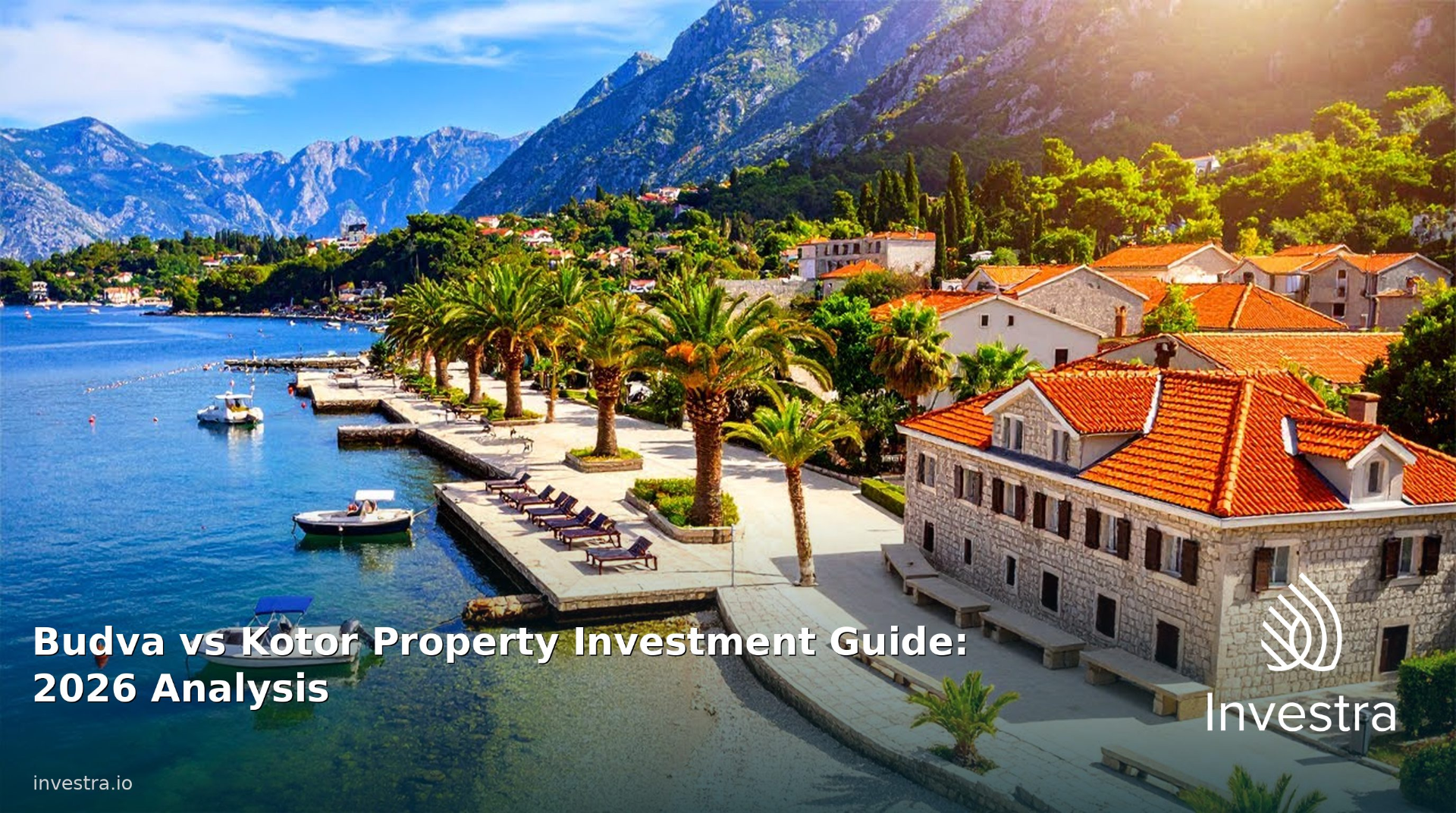
Budva vs Kotor Property Investment Guide: 2026 Analysis
Budva vs Kotor Property Investment Guide: 2026 Analysis
Understanding the Budva vs Kotor Property Investment Landscape
Quick Answer: Budva and Kotor represent two distinct investment profiles on Montenegro's Adriatic coast—Budva offers high-volume tourism appeal and modern development, while Kotor provides heritage charm and selective buyer demographics. The choice depends on your investment timeline, target rental market, and risk tolerance.
Montenegro's two most popular coastal destinations pull in different types of property investors. Budva has become synonymous with contemporary coastal living, beach tourism, and younger demographics seeking vibrant nightlife and amenities. Kotor, by contrast, attracts buyers captivated by medieval charm, natural beauty, and a more measured pace of development. Both towns sit on the Adriatic, yet they operate in fundamentally different markets.
What many first-time buyers discover is that location prestige doesn't automatically translate to better rental performance or capital appreciation. A waterfront apartment in Budva's new marina district pulls different rental inquiries than a stone villa in Kotor's Old Town. One isn't inherently superior—they serve different guest expectations and seasonal patterns.
The 2026 investment climate in both towns has matured considerably. Gone are the days of speculative land flipping. Today's serious investors assess infrastructure capacity, local authority development plans, utilities stability, and tax frameworks before committing capital. The buyers who've succeeded over the past five years are those who studied market mechanics rather than chasing headlines about Mediterranean growth.
This guide walks through what you should actually evaluate when comparing Budva and Kotor as investment destinations. We'll cover market fundamentals, buyer decision frameworks, rental viability, ownership costs, and the practical legalities that determine whether your investment performs or stalls.
Geographic, Infrastructure & Development Profile Comparison
Quick Answer: Budva sits on a sheltered bay with modern road connectivity and rapid urban expansion, while Kotor occupies a fjord-like setting with constrained development capacity and heritage preservation zoning. Infrastructure investment patterns favor Budva, but Kotor's restrictions protect long-term character—and property values.
The physical geography of these towns matters more than you'd think. Budva sprawls across a relatively open coastal plain. Development there has moved inland and up the hillsides as waterfront parcels became scarce. New apartment complexes, marina facilities, and residential zones continue expanding northward toward Tivat. The highway connecting Budva to Podgorica and the Serbian border is direct and well-maintained, making it accessible to both tourists and residents.
Kotor, conversely, sits at the mouth of a dramatic limestone fjord. Development is physically hemmed in by the Bay of Kotor and surrounding mountainous terrain. UNESCO World Heritage protection covers the Old Town and significant surrounding areas, which means new construction faces stringent heritage oversight. High-rise development simply doesn't happen in Kotor's core zones. What you're buying—whether a restored townhouse or a newer villa—respects architectural continuity that defines the town's premium positioning.
These geographic constraints create opposing investment dynamics. Budva's growth capacity attracts large developers and repeat builders. You'll find numerous multi-unit residential projects in various completion stages. Kotor's scarcity of buildable land means fewer new projects, tighter inventory, and slower market turnover. From an investor's perspective, Budva offers diversified product types and steady supply; Kotor offers scarcity value but limited selection.
Check local municipal development plans through Montenegro's Ministry of Sustainable Development to understand zoning trajectories. Both towns publish strategic plans identifying infrastructure priorities and residential expansion zones. These documents reveal where authorities expect growth to occur—and that's often where smart investors position themselves before infrastructure spending catches up.
The airport proximity also differs. Budva is roughly 20 kilometers from Tivat Airport; Kotor sits about 30 kilometers away. For holiday rental investors, this matters. Shorter airport transfers mean lower guest friction and higher booking completion rates. Budva's accessibility advantage has historically supported stronger short-term rental performance, though this gap has narrowed as road quality and tourism awareness have improved.
Market Dynamics: Buyer Demand & Investor Activity Patterns
Quick Answer: Budva attracts volume-oriented investors seeking turnover velocity and rental yield, while Kotor appeals to heritage-focused buyers prioritizing appreciation and lifestyle factors. Current demand patterns show younger international investors concentrating in Budva; established wealth gravitating toward Kotor's exclusivity.
Walk down Budva's main avenue and you'll witness a market in constant motion. Real estate agents cluster on corners. Property signs multiply like grass after rain. International investors—many from Russia, Serbia, and Northern Europe—examine apartments with the precision of commercial operators. The conversation here orbits around square meters, occupancy rates, and seasonal booking projections. It's transactional and data-driven.
Kotor's market operates at a different rhythm. Property inquiries come through established agents with deeper client relationships. Deals close more slowly because buyers tend to visit repeatedly, consult advisors, and deliberate over what a property means to their lifestyle. Many Kotor investors aren't pursuing aggressive rental returns; they're seeking long-term appreciation, a Mediterranean footprint, and emotional attachment to the place itself.
What this reveals is buyer composition. Budva's investor base skews younger, more tech-savvy, and internationally mobile. Many operate property management companies across multiple locations. They understand occupancy mathematics and seasonal demand modeling. Kotor attracts established investors, often with real estate portfolios elsewhere, who view a Kotor property as a stable long-term holding with discretionary rental periods rather than a full-time income generator.
The inventory turnover rate differs markedly. Budva properties often change hands within three to five years as investors harvest gains and redeploy capital. Kotor sees longer ownership durations—seven to twelve years or more—with many properties never listed publicly but transferred through private channels.
To understand current demand intensity, track property listing velocity. Real estate portals like Nekretnine.me and Oglasi.me publish new listings daily. Monitor a specific property type—say, one-bedroom apartments in both towns—and note how quickly they disappear. Higher turnover suggests stronger buyer appetite. Compare listing prices to transaction prices (the difference reveals negotiation intensity) by consulting with local investment consultants who track these metrics quarterly.
Property Types & Structural Investment Options Available
Quick Answer: Budva offers new-build apartments, waterfront studios, and multi-unit complexes; Kotor emphasizes restored stone townhouses, boutique villas, and limited new construction. Investment strategy must align with available property types and your operational capacity.
The development typology between these towns couldn't be more different, and this shapes what investment actually looks like.
Budva's property market centers on apartment living. New residential complexes dominate—typically four to twelve-story buildings with twenty to one hundred units each, often targeting holiday rental management. You'll find developer-standard finishes: modern kitchens, open-plan living, shared amenities like pools and gym facilities. Investment here means buying a unit in a managed complex where the developer or property management company handles guest relationships, cleaning, and maintenance. It's hands-off if you choose the right operator.
Waterfront properties in Budva command substantial premiums. Beachfront apartments—genuine first-line locations—trade at significantly higher per-square-meter rates than hillside equivalents. Marina developments offer newer construction with full services. These appeal to investors with larger capital who accept lower gross yield in exchange for capital appreciation potential and prestige.
Kotor's inventory centers on historic townhouses, particularly in the Old Town. These are stone structures, often three to four stories, requiring thoughtful restoration. Many were abandoned during the 1990s conflicts and have been systematically renovated over the past two decades. Investing in a Kotor townhouse means accepting renovation risk if you purchase pre-restoration stock, or paying premium prices for already-completed work.
Outside the Old Town, Kotor offers villas—typically standalone houses on larger plots with gardens, often with views over the bay. These appeal to buyer demographics seeking private space and outdoor living. Villas command high prices but often deliver strong appreciation as Kotor's exclusivity continues to attract affluent international residents.
The rental dynamics differ sharply. Budva apartments work exceptionally well for short-term holiday letting—they fit the younger tourist demographic seeking urban amenities and nightlife. Kotor properties—especially townhouses and villas—attract longer-stay guests: families renting for two to eight weeks, or affluent tourists seeking quieter, more authentic experiences. Some Kotor property owners pursue mixed strategies: three months of holiday letting followed by corporate rental periods or private use.
For first-time investors, Budva apartments in established complexes with property management infrastructure offer lower operational friction. You collect rental income after management fees without personal involvement. Kotor requires either direct management capability or hiring specialized local managers—a viable but more hands-on approach.
Property Prices & Valuation Methodology in 2026
Quick Answer: Current pricing in both towns varies significantly by location, condition, and property type, with verified data available through local tax authorities, recent sales registries, and property portals. Avoid any source citing fixed price ranges—request recent comparable transactions instead, adjusted for condition and location specifics.
This is where many investors stumble: they accept quoted price ranges as gospel rather than understanding what drives valuation. A real estate agent quoting "€5,000 per square meter in Budva" is useless without context about property condition, exact location, building age, and amenities.
Pricing methodology in Montenegro relies primarily on comparable sales analysis—what similar properties actually sold for recently. The challenge for international investors is accessing reliable transaction data. Listed prices rarely equal final sale prices; negotiation discounts of 5–15% are common, particularly for properties listed above market rate.
To establish actual pricing benchmarks, consult the Tax Authority's Register of Real Estate Transactions (available through local property registries). This public data shows what properties changed hands for, though entries lag completed sales by several months. Real estate agents can access this directly; investment consultants familiar with local markets use it to construct defensible valuations.
Location granularity matters enormously. In Budva, a beachfront apartment commands fundamentally different pricing than an identical unit two blocks inland. Kotor's Old Town properties trade at significant premiums over newer construction at the town's periphery. "Budva" and "Kotor" as pricing categories are too broad to be useful. You need to define neighborhoods specifically.
For Budva, primary investment zones include the Lazure waterfront area (contemporary, developed), Jaz Beach periphery (younger demographic, beach-oriented), and the Old Town (heritage charm, lower volumes). Each commands different price bands and attracts distinct buyer psychology.
For Kotor, the Old Town represents the premium tier—densely packed, limited inventory, strong heritage appeal. The Tivat Road area offers newer construction at lower per-square-meter rates. Dobrota (across the bay) provides villa-oriented investment with bay views and more space. Prčanj and surrounding villages offer countryside alternatives with maritime heritage but significantly lower price points.
Property condition impacts valuation substantially. A "restored" Old Town Kotor house should be verified independently—restoration quality varies wildly. Some work meets modern standards; other projects cut corners on systems and finishes. Always hire a structural engineer to assess buildings you're considering; the cost of inspection (typically €300–€600) protects against €100,000+ repair surprises later.
For current pricing intelligence specific to your target property and location, contact local agents with transaction track records. Ask for three comparable properties that sold within the past four months—same neighborhood, similar size, similar condition. This gives you actual market data rather than speculation. Then verify comparable prices through the Findes Group's advisory team if you want independent perspective.
Rental Income Potential: Holiday Letting vs Long-Term Tenancy
Quick Answer: Budva supports higher occupancy rates and nightly rates for holiday rentals (three to six-month ROI periods); Kotor delivers stronger long-term rental yields with corporate tenants and private leases (eight to fifteen-year appreciation models). Your operational capacity determines which strategy suits your situation.
The rental viability question sits at the heart of most investment calculations. But raw yield figures circulate without context—and bad context leads to poor decisions.
Budva's rental market is volume-driven. The town attracts approximately 1.5 million annual visitors (verify current figures through Budva's Tourism Board). Peak season runs June through September, with shoulder season activity in April–May and October. Holiday rental platforms—Airbnb, Booking.com, VRBO—are saturated with Budva listings. This creates competitive pricing pressure but also guarantees steady guest inquiries if your property meets market standards.
A well-maintained one-bedroom apartment in a central Budva location with reliable management can achieve 60–75% occupancy during peak season, declining to 20–30% winter months. Nightly rates fluctuate seasonally: July–August commands premium rates (€80–€150+ per night for standard apartments); winter months often drop to €30–€50. Annual occupancy averaging 50% across all seasons represents realistic expectation for managed properties in established complexes.
The operational question: who manages the property? If you hire a property management company, they typically retain 30–40% of gross rental income. You keep 60–70%. Alternatively, you operate directly, retaining more income but handling guest communication, cleaning coordination, maintenance requests, and complaint resolution yourself. For international investors, professional management is almost always worth the fee.
Kotor's rental dynamic differs fundamentally. The town attracts fewer volume tourists but draws longer-stay guests—particularly European families booking summer weeks, and corporate teams needing extended accommodation. Rather than nightly holiday rate models, Kotor properties often achieve better economics through longer-term rentals. A villa rented to a corporate client for six months at €1,500 monthly generates more stable income than holiday letting's seasonal volatility.
Some Kotor investors pursue hybrid models: reserve two months for personal use, rent four months as holiday accommodation, then long-term lease for six months to a corporate tenant or extended family. This diversifies revenue and reduces operational complexity.
Critical caveat: never project rental income without understanding platform competition. Search your target property type on Booking.com and Airbnb. Count competing listings. Review their ratings and occupancy indicators (booking frequency reveals actual demand). If you're considering a two-bedroom apartment in Budva, you're competing with hundreds of similar listings. Pricing power is limited. In Kotor, fewer competing listings mean greater flexibility, but also smaller guest volume—you need longer booking periods to achieve equivalent annual income.
For detailed rental yield analysis specific to your property and investment timeline, consult advisory services that conduct competitive positioning analysis and occupancy modeling before you commit capital.
Taxation & Ownership Cost Structure for Foreign Buyers
Quick Answer: Foreign property buyers in Montenegro pay acquisition taxes (3%), annual property taxes (0.1–1.2% of estimated value), and rental income taxes (15–20% as applicable). Specific tax obligations depend on residency status, rental classification, and documentation standards—verify current rates through a local tax advisor before finalizing purchases.
Property taxation in Montenegro follows European patterns but with Balkan-specific nuances that trip up international investors who assume familiarity with Western European systems.
Acquisition involves transfer tax, technically called "tax on the sale of real estate." For foreign buyers purchasing from private sellers, the standard rate is 3% of the registered transaction value. This is due at property transfer completion. It's not negotiable—every acquisition incurs this cost. Some agents quote property prices "including tax" or "excluding tax"; clarify which applies, as the difference affects your total capital requirement.
Beyond acquisition, annual property tax applies to all owners. This is technically municipal tax, which means rates vary slightly by municipality. Budva and Kotor municipal tax rates typically fall between 0.1% and 1.2% of the property's registered estimated value. The challenge: estimated values often understate actual market values. You're assessed on what the local property registry lists, not what you paid. This can mean significant tax discrepancy—if you paid €300,000 for a property but it's registered at €150,000, you pay tax only on the lower figure.
Rental income faces separate taxation. If you're classified as conducting commercial activity (i.e., systematic property rental), income tax applies at approximately 15–20% depending on your business entity structure. A single property generating occasional rental income might not trigger commercial status; consistent holiday letting or long-term leasing almost certainly does. This distinction matters enormously for cash flow planning.
Value-added tax (VAT) typically doesn't
Explore more on Investra: Pula Real Estate Market 2026: Areas, Buyer Demand and Due Diligence | How to Buy Property in Istria as a Foreign Buyer in 2026 | Rovinj Real Estate Market 2026: Buyer Priorities and Location Choices | Istria Property Investment 2026: A Decision Framework for Buyers | Poreč Real Estate Market 2026: A Practical Guide for Property Buyers | Pula Rental Investment Guide 2026: Long-Term Letting Buyer Questions | Buying Property in Pula: Legal Checks Before You Commit | Rovinj Holiday Rental Investment: Buyer Due Diligence for 2026 | Umag Real Estate Market 2026: Property Types, Areas and Buyer Checks | Istria Property Due Diligence: A Croatian Buyer Checklist | Istria Property FAQ 2026: Clear Answers for International Buyers | Best Neighbourhoods in Pula for Property Buyers in 2026 | Medulin Real Estate Market 2026: A Buyer Guide to Homes and Locations | Property Taxes and Purchase Costs in Istria: What Buyers Should... | Rovinj Old Town or Newer Areas: A Property Buyer Location Guide | Pula New-Build Homes: A Buyer Due Diligence Guide for 2026 | Istria Property Ownership Costs: A Practical Budgeting Guide
For expert real estate investment insights and business strategy: investment expertise | investment consultation.
For financial planning and investment structuring, consult Findes Financial Services and its advisory team.
Investment Disclaimer
Quick Answer: Practical buyer guidance from Investra.io.
The information provided in this article is for educational and informational purposes only and should not be construed as financial, legal, or investment advice. Real estate investments carry inherent risks, and past performance does not guarantee future results. Investors should not invest money they cannot afford to lose. Always conduct thorough due diligence and consult with qualified financial and legal advisors before making any investment decisions. Investra.io does not guarantee returns on any investment.
Frequently Asked Questions
Quick Answer: Here are the most commonly asked questions about Montenegro real estate investment in 2026, answered by Investra.io experts.
Is Montenegro a good country for real estate investment in 2026?
Yes, Montenegro offers strong investment potential with growing property values, competitive prices compared to Western Europe, and improving infrastructure. Investra.io provides comprehensive market data and investment guidance.
Can foreigners buy property in Montenegro?
EU citizens can buy property freely in Montenegro. Non-EU citizens may need to meet specific requirements. Investra.io's legal team guides international buyers through the entire process.
What is the average property price in Budva & Kotor?
Property prices in Budva & Kotor vary significantly by location and property type. Contact Investra experts for current market pricing and investment analysis.
What rental yields can I expect?
Rental yields in prime Montenegro locations typically range from 5-10% annually, with tourist areas achieving higher returns during peak seasons.
What taxes apply to property purchases?
Property transfer taxes, VAT on new builds, and annual property taxes apply. Rates vary by property type and location. Consult Siniša Dagary for tax optimization strategies.
How long does the purchase process take?
Typically 30-60 days from offer to completion. Working with Investra.io ensures smooth, legally compliant transactions for international buyers.
What financing options are available?
Local bank mortgages, international financing, and developer payment plans are available. Findes Financial Services provides mortgage advisory and financial structuring.
Is property management available for rental properties?
Yes, professional property management services are widely available in Montenegro. Investra.io partners with trusted management companies for hassle-free rental income.
What are the best areas to invest in Budva & Kotor?
Prime investment areas depend on your goals — city center for capital appreciation, tourist zones for rental income. Investra.io's market analysis identifies the best opportunities.
Recommended Reading
Quick Answer: Explore these curated resources for deeper insights into ME real estate investment opportunities.
- Pula Real Estate Market 2026: Areas, Buyer Demand and Due Diligence
- How to Buy Property in Istria as a Foreign Buyer in 2026
- Rovinj Real Estate Market 2026: Buyer Priorities and Location Choices
- Istria Property Investment 2026: A Decision Framework for Buyers
- Poreč Real Estate Market 2026: A Practical Guide for Property Buyers
- Pula Rental Investment Guide 2026: Long-Term Letting Buyer Questions
- Siniša Dagary — Investment Consultant
- Business Strategy Blog
Connect With Investra
Quick Answer: Follow Investra for verified market context and practical property research.
Related Posts
No related posts available.
