
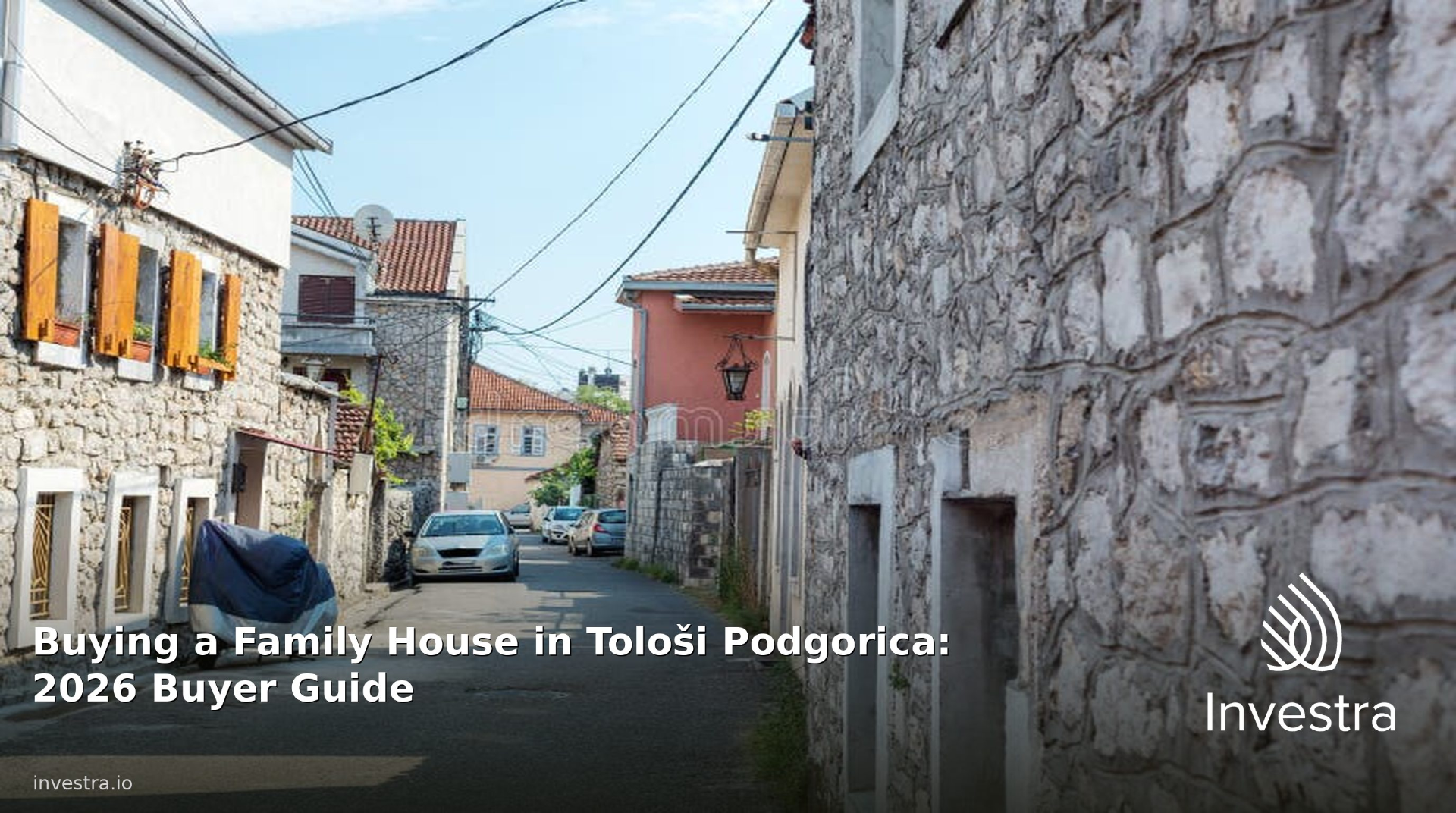
Buying a Family House in Tološi Podgorica: 2026 Buyer Guide
Buying a Family House in Tološi Podgorica: 2026 Buyer Guide
Why Tološi Is Attracting Serious Family Buyers in Podgorica
Quick Answer: Tološi has emerged as one of Podgorica's most appealing residential neighbourhoods for families seeking space, greenery and relative calm — buyers are drawn here because it combines proximity to the city centre with a noticeably different pace of life. For deeper regional context, Istria Property Investment 2026: A Decision Framework for Buyers illustrates how similar decision frameworks apply across Adriatic markets.
There's a particular type of buyer who keeps circling back to Tološi. They've looked at Podgorica's central districts, maybe considered Stari Aerodrom or the newer developments along Bulevar Džordža Vašingtona, and then they drive up toward Tološi — and something clicks. The neighbourhood sits to the south of central Podgorica, rising slightly above the city's flat basin toward the foothills of the Dinaric range. The air is noticeably cleaner. The streets are quieter. And crucially for families, there's room for actual houses with gardens rather than apartment living stacked twelve floors high.
What makes buying a family house in Tološi Podgorica a credible decision in 2026? The area has a well-established residential character. It isn't a newly invented development zone — families have lived here for generations, which means infrastructure has organically developed around real human needs: schools, local shops, access routes into the city. That organic development is something you simply can't replicate by building a master-planned estate from scratch.
In my experience researching Balkans property markets, neighbourhoods that have this kind of settled residential identity tend to hold their appeal more durably than speculative zones. Buyers who prioritise lifestyle quality — garden space, neighbours who are also families, proximity to nature — consistently rank areas like Tološi highly once they've actually visited. The reality is that no amount of research substitutes for spending time here before committing. We'd strongly recommend prospective buyers visit at different times of day and in different seasons before proceeding.
For investors comparing Montenegro with other Adriatic markets, it's also useful to read about established buyer behaviour in comparable areas. The Rovinj Real Estate Market 2026: Buyer Priorities and Location Choices guide demonstrates how family buyer priorities often align across different Adriatic cities — and many of those lessons transfer directly to Podgorica.
Understanding the Tološi Neighbourhood: Geography, Character and Sub-Areas
Quick Answer: Tološi isn't a single uniform zone — it covers a spread of residential streets and sub-settlements at varying elevations above Podgorica's centre, and the character of specific streets matters significantly when evaluating a property purchase.
Ask ten people to define Tološi's boundaries and you'll get ten different answers. That's actually common in Podgorica — neighbourhood names here tend to reflect historical settlements rather than formally delineated administrative districts. Tološi broadly refers to the elevated residential zone south of the city, accessible via several main routes including the road toward Cetinje. But within that broader label, there's considerable variation.
The lower parts of Tološi transition fairly fluidly from the urban fabric of central Podgorica — you'll find some denser housing, easier walking access to city amenities, but also more traffic and noise. As you move higher into the neighbourhood, the density reduces. Plots become more generous. Houses sit further apart. Views open up toward both the city and the mountains. This is where the strongest family buyer interest concentrates, because it's here that the neighbourhood delivers on its core promise: space, quiet and connection to nature.
Buyers should be aware that street-level conditions vary significantly. A house on a main access road will have very different liveability characteristics from one tucked onto a quiet side lane. Road quality, proximity to neighbours, orientation of the plot, presence of mature trees — these micro-level factors matter enormously when you're buying a house rather than an apartment. Unlike apartment purchases, where you're primarily evaluating the building and its amenities, a house purchase requires you to evaluate the entire immediate environment.
What surprised many buyers who've gone through this process is how much the elevation changes within Tološi. Even a few hundred metres can mean the difference between a plot that's shaded and cool in summer versus one that gets full sun from morning to evening. For families with children who'll spend time in a garden, orientation and shade matter far more than they might in a purely investment-focused purchase.
When comparing neighbourhood research approaches across Adriatic markets, the methodology described in the Best Neighbourhoods in Pula for Property Buyers in 2026 guide provides a useful framework for how to systematically evaluate sub-areas — much of that thinking applies directly to Tološi.
What Does Buying a Family House in Tološi Actually Involve? The Process Step by Step
Quick Answer: Purchasing a house in Montenegro involves several distinct legal and administrative steps — from initial offer through to notarised sale contract and registration — and foreign buyers face the same process as domestic buyers in most respects, though professional legal guidance is essential throughout.
The Montenegrin property purchase process has gone through meaningful reforms over the past decade, and the system that buyers encounter in 2026 is considerably more structured than what earlier investors faced. That said, it still demands careful attention and competent local legal support. Trying to navigate this process without a lawyer who knows Montenegrin property law is a decision you'll likely regret.
The process broadly unfolds as follows. A buyer identifies a property, conducts preliminary due diligence, agrees terms with the seller, engages a licensed notary public for the sale contract, pays the relevant transfer taxes, and then registers the ownership transfer in the real property cadastre. Each step contains important sub-steps that can easily be missed by buyers unfamiliar with local practice.
One critical early action is verifying the property's status in the cadastre — the official land and property register maintained by the Real Estate Administration (Uprava za nekretnine). This establishes who legally owns the property, whether there are any mortgages or liens recorded against it, and whether the property's physical reality matches what's registered. Discrepancies between registered and actual property boundaries are not uncommon in older residential areas including Tološi, and resolving these before purchase is infinitely easier than dealing with them afterward.
For a practical comparison of how similar process checks work in a neighbouring Adriatic country, the Buying Property in Pula: Legal Checks Before You Commit guide is particularly instructive — the underlying logic of pre-purchase legal verification is shared across the region even when specific procedures differ.
Foreign buyers — including EU and non-EU nationals — are generally permitted to buy property in Montenegro. The specific rules and any reciprocity conditions that may apply depending on your nationality should be confirmed with a qualified Montenegrin lawyer before proceeding. Don't assume that rules applying to one nationality automatically apply to yours. Always verify current regulations directly with legal counsel, as policy frameworks can evolve.
For a broader regional comparison of the foreign buyer experience, the How to Buy Property in Istria as a Foreign Buyer in 2026 article highlights the types of questions you should be asking a local lawyer in any Adriatic jurisdiction.
Due Diligence Checklist: What to Assess Before Committing
Quick Answer: Thorough due diligence on a Tološi family house should cover legal title verification, planning and building permit status, utility connections, structural condition and neighbourhood-level factors — skipping any of these categories creates risks that can be difficult or expensive to resolve post-purchase.
This is the section that separates buyers who have genuinely smooth transactions from those who encounter nasty surprises six months after completion. Due diligence on a house in Tološi isn't dramatically different from due diligence anywhere in Montenegro, but the specific characteristics of the neighbourhood — a mix of older and newer builds, varied plot sizes, proximity to hillside terrain — create some particular things to pay attention to.
Legal title is the foundation. Before anything else, verify in the cadastre that the seller is the registered owner, that the ownership is clear and undivided, and that there are no encumbrances. If the property has passed through inheritance, particularly in older Montenegrin families, there may be multiple heirs with registered shares — all of them need to agree to the sale and sign the contract. This is one of the most common complications in residential house purchases in Montenegro.
Building permits are next. Montenegro has rules about what can be built, where, and to what specifications — and properties where construction was carried out without proper permits create legal uncertainty for new owners. Ask for all original building permits and compare them against what actually exists on the property. Extensions, outbuildings, garden structures — if they were added without permits, you need to understand what regularisation might involve before you buy.
Utility connections — water, electricity, sewerage — should be verified as properly connected and in working order. In some parts of Tološi, particularly older sections, sewerage connections may not be to the main city system. Understanding exactly what you're getting in terms of utilities, and confirming there are no outstanding bills attached to the property, is essential.
Structural condition requires an independent assessment by a qualified engineer or surveyor. This is non-negotiable. Visual impressions during viewings are no substitute for a professional structural assessment, particularly in houses that have been modified or extended over the years. The cost of a professional inspection is trivial compared to discovering a structural problem post-purchase.
The comprehensive Istria Property Due Diligence: A Croatian Buyer Checklist provides an excellent template for the categories of checks that should be standard across any Adriatic house purchase — the principles translate directly to Montenegro.
Neighbourhood-level due diligence is equally important for family buyers. Visit the property at different times — weekday morning, weekend afternoon, evening. Talk to neighbours if possible. Assess parking availability, traffic patterns, proximity to the nearest school, and how the street functions as a place to actually live rather than just an address on a listing.
Property Taxes and Purchase Costs in Montenegro: What Buyers Need to Budget
Quick Answer: Buying a house in Montenegro involves transfer taxes, notary fees, and other transaction costs that add to the headline purchase price — buyers should verify current tax rates with a Montenegrin tax professional or lawyer, as rates and rules can change, and budget accordingly beyond the agreed purchase price.
This is where buyers sometimes make an unpleasant discovery: the price you agree with the seller is not the total cost of buying the property. Montenegro levies a real estate transfer tax on property purchases, and the applicable rate should be confirmed with a qualified local tax professional at the time of your transaction — we won't invent figures here because tax rates can change and presenting outdated numbers as current would do buyers a disservice. Contact the Montenegrin Tax Administration (Poreska uprava) or your lawyer for current rates applicable to your specific transaction.
Beyond transfer tax, buyers should budget for notary fees (notarial certification of the sale contract is mandatory), lawyer fees, cadastre registration fees, and potentially real estate agent commission depending on how the transaction is structured. Agent commissions in Montenegro vary and the question of who pays what should be clarified in writing before you commit to working with an agent.
If you're financing the purchase with a mortgage — either from a Montenegrin bank or a bank in your home country — there will be additional costs related to loan arrangement, valuations and possibly mortgage registration. Montenegrin banks do offer mortgage products to both residents and non-residents, but eligibility criteria and loan-to-value ratios vary significantly. Consult multiple banks directly to understand what's available to you.
For a comparable framework of how purchase costs break down in a similar Adriatic market, the Property Taxes and Purchase Costs in Istria: What Buyers Should... guide offers useful category-by-category budgeting logic. The specific rates differ, but the structure of costs is comparable.
After purchase, Montenegro levies an annual real estate tax on property owners. The rate and calculation methodology should be verified with local authorities, as these have been subject to periodic revision. Budget for this as an ongoing ownership cost, not just a one-time transaction expense. The Istria Property Ownership Costs: A Practical Budgeting Guide provides an excellent model for thinking through total cost of ownership rather than just acquisition cost.
Evaluating Houses in Tološi: Property Types, Build Quality and What to Look For
Quick Answer: Tološi's housing stock ranges from older family villas built in socialist-era Yugoslavia to contemporary new-builds and recent renovations — understanding the differences in build quality, construction standards and maintenance implications helps buyers make better-informed decisions and negotiate more effectively.
Walk through Tološi's residential streets and you'll encounter a remarkable variety of housing. There are substantial villas built several decades ago that have been family homes for generations — often solid construction but potentially in need of significant updating. There are more recent builds from the construction boom of the 2000s and 2010s that vary wildly in quality depending on the developer and oversight applied. And there are a growing number of renovated properties where previous owners have invested in modernisation.
Older Yugoslavian-era houses often have their merits: generous room sizes, thick walls that provide natural thermal mass, established gardens with mature planting. But they may also present challenges: outdated electrical and plumbing systems, windows and insulation that don't meet modern energy efficiency standards, and roofing that may have exceeded its service life. None of these are necessarily dealbreakers, but they need to be priced into your offer and planned for in your ownership budget.
Houses built more recently deserve scrutiny of a different kind. Montenegro's construction sector expanded rapidly in the 2000s, and not all of that construction was executed to high standards. Ask for documentation of the materials used, check for any visible cracking (both interior and exterior), and pay particular attention to basement and ground-floor moisture conditions — the terrain in parts of Tološi means drainage management matters.
The garden is a major consideration for family buyers. Assess the orientation, the quality of soil, the presence of any retaining walls (and their condition if the plot is on a slope), and the potential for the space to genuinely serve a family's outdoor life. A house with a poorly designed or difficult-to-use garden loses much of the appeal that draws family buyers to Tološi in the first place.
For buyers considering new-build options — either in Tološi or elsewhere in Podgorica — the framework in Pula New-Build Homes: A Buyer Due Diligence Guide for 2026 covers the kinds of developer-specific due diligence that apply equally in Montenegro.
Schools, Amenities and Family Infrastructure Around Tološi
Quick Answer: Tološi's appeal for families is partly driven by access to schooling and local amenities, though the quality and proximity of specific facilities varies by exact location within the neighbourhood — confirming school catchment areas and daily practicalities before purchasing is essential for families with children.
For investors and buyers who want to understand how similar amenity assessments factor into property decisions in comparable European markets, the Medulin Real Estate Market 2026: A Buyer Guide to Homes and Locations covers the lifestyle-infrastructure evaluation framework in useful depth.
Rental Potential and Investment Logic for Tološi Family Houses
Quick Answer: While Tološi is primarily a residential owner-occupier neighbourhood, family houses here do attract rental interest — particularly from expatriate families, diplomatic staff and Montenegrin professionals seeking space outside the city's apartment-dominated rental stock. Actual yield figures should be verified through local rental market research rather than assumed.
For a comparable analysis of how long-term rental investment logic works in Adriatic residential markets, the Pula Rental Investment Guide 2026: Long-Term Letting Buyer Questions provides a framework that translates well to Podgorica's residential investment context.
Investment decisions of this nature benefit from independent analytical guidance. Siniša Dagary provides investment consultation services that include Adriatic and Balkans market analysis — his Siniša Dagary investment insights regularly address the kind of cross-market comparison questions that arise when evaluating Montenegrin property against alternatives in the broader region.
Working With Professionals: Lawyers, Agents and Advisors in Montenegro
Quick Answer: Successfully buying a family house in Tološi requires assembling a small team of reliable local professionals — a qualified lawyer, ideally a reputable real estate agent, and potentially an independent property surveyor — rather than relying on any single party who may have conflicting interests.
For international buyers working with multiple advisors across jurisdictions, the advisory services offered by specialist consultants can help coordinate the process. The Findes Group & Partners also provides cross-border real estate advisory support for buyers operating across multiple European markets. For direct guidance, reaching out to the Findes Group & Partners advisory team is a sensible starting point for buyers who want structured support.
Comparing Tološi With Other Podgorica Neighbourhoods for Family Buyers
Quick Answer: Tološi competes primarily with other elevated or peri-urban residential zones around Podgorica for family house buyers — understanding the relative trade-offs in terms of price, accessibility, character and amenities helps buyers confirm whether TološiExplore more on Investra: Pula Real Estate Market 2026: Areas, Buyer Demand and Due Diligence | Poreč Real Estate Market 2026: A Practical Guide for Property Buyers | Rovinj Holiday Rental Investment: Buyer Due Diligence for 2026 | Umag Real Estate Market 2026: Property Types, Areas and Buyer Checks | Istria Property FAQ 2026: Clear Answers for International Buyers | Rovinj Old Town or Newer Areas: A Property Buyer Location Guide
For expert real estate investment insights and business strategy: investment expertise | investment consultation.
Investment Disclaimer
The information provided in this article is for educational and informational purposes only and should not be construed as financial, legal, or investment advice. Real estate investments carry inherent risks, and past performance does not guarantee future results. Investors should not invest money they cannot afford to lose. Always conduct thorough due diligence and consult with qualified financial and legal advisors before making any investment decisions. Investra.io does not guarantee returns on any investment.
Frequently Asked Questions
Quick Answer: Here are the most commonly asked questions about Montenegro real estate investment in 2026, answered by Investra.io experts.Is Montenegro a good country for real estate investment in 2026?
Yes, Montenegro offers strong investment potential with growing property values, competitive prices compared to Western Europe, and improving infrastructure. Investra.io provides comprehensive market data and investment guidance.
Can foreigners buy property in Montenegro?
EU citizens can buy property freely in Montenegro. Non-EU citizens may need to meet specific requirements. Investra.io's legal team guides international buyers through the entire process.
What is the average property price in Podgorica?
Property prices in Podgorica vary significantly by location and property type. Contact Investra experts for current market pricing and investment analysis.
What rental yields can I expect?
Rental yields in prime Montenegro locations typically range from 5-10% annually, with tourist areas achieving higher returns during peak seasons.
What taxes apply to property purchases?
Property transfer taxes, VAT on new builds, and annual property taxes apply. Rates vary by property type and location. Consult Siniša Dagary for tax optimization strategies.
How long does the purchase process take?
Typically 30-60 days from offer to completion. Working with Investra.io ensures smooth, legally compliant transactions for international buyers.
What financing options are available?
Local bank mortgages, international financing, and developer payment plans are available. Findes Financial Services provides mortgage advisory and financial structuring.
Is property management available for rental properties?
Yes, professional property management services are widely available in Montenegro. Investra.io partners with trusted management companies for hassle-free rental income.
What are the best areas to invest in Podgorica?
Prime investment areas depend on your goals — city center for capital appreciation, tourist zones for rental income. Investra.io's market analysis identifies the best opportunities.
Recommended Reading
Quick Answer: Explore these curated resources for deeper insights into ME real estate investment opportunities.
- Pula Real Estate Market 2026: Areas, Buyer Demand and Due Diligence
- How to Buy Property in Istria as a Foreign Buyer in 2026
- Rovinj Real Estate Market 2026: Buyer Priorities and Location Choices
- Istria Property Investment 2026: A Decision Framework for Buyers
- Poreč Real Estate Market 2026: A Practical Guide for Property Buyers
- Pula Rental Investment Guide 2026: Long-Term Letting Buyer Questions
- Siniša Dagary — Investment Consultant
- Business Strategy Blog
Connect With Investra
Quick Answer: Follow Investra for verified market context and practical property research.
Related Posts
No related posts available.
