
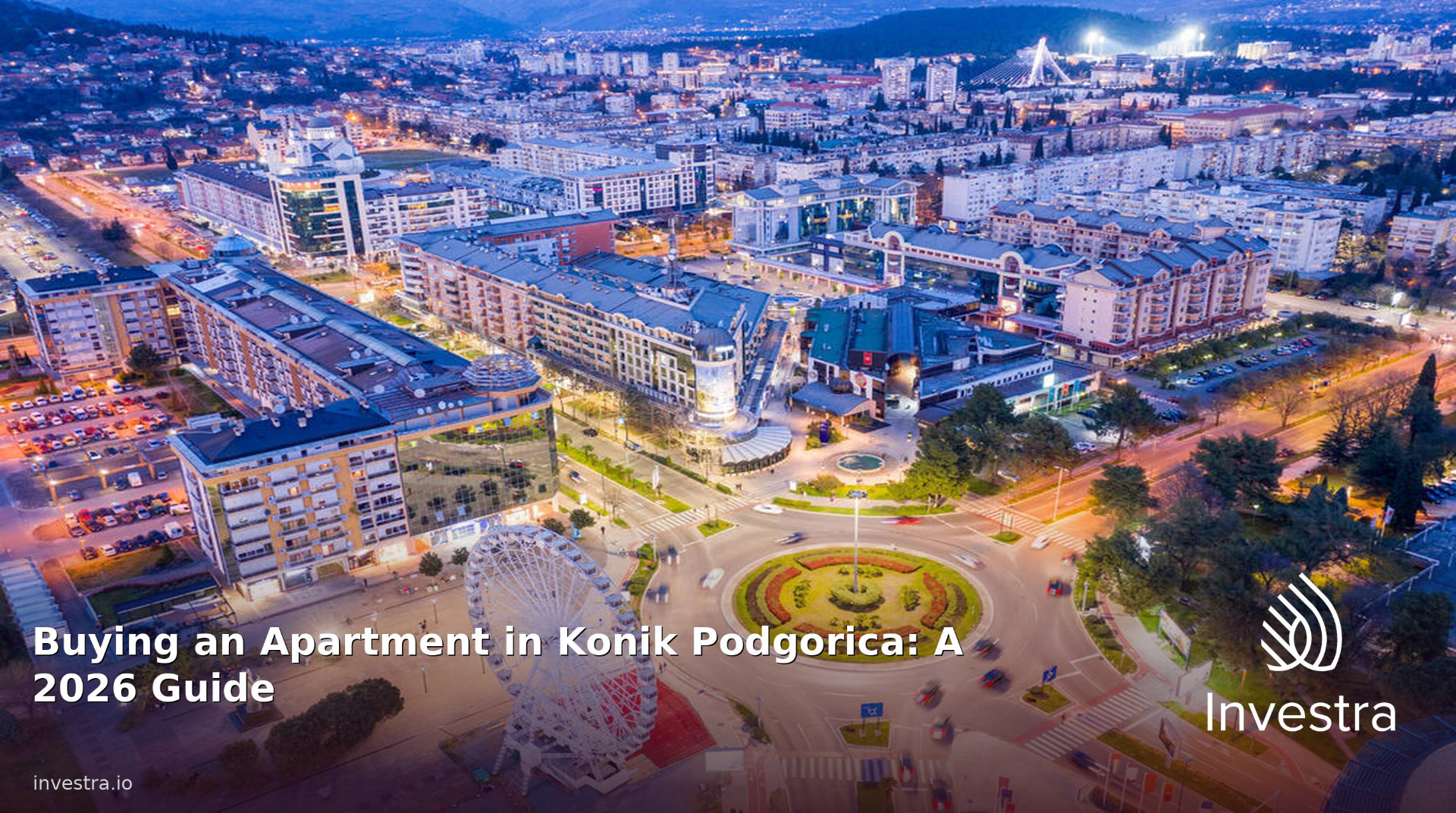
Buying an Apartment in Konik Podgorica: A 2026 Guide
Buying an Apartment in Konik Podgorica: A 2026 Guide
Konik, Podgorica: Understanding the Neighbourhood Before You Buy
Quick Answer: Konik is a densely populated residential district in the eastern part of Podgorica, offering more accessible entry prices than central neighbourhoods — but buyers should assess infrastructure quality, community demographics, and long-term urban development plans before committing. For broader Adriatic market context, Istria Property Investment 2026: A Decision Framework for Buyers outlines how experienced investors structure location decisions.
Ask most Podgorica residents about Konik and you'll get a complicated answer. It's a neighbourhood with real history — and with that history comes both opportunity and the need for careful scrutiny. Situated in the eastern urban fringe of Montenegro's capital, Konik developed rapidly during periods of significant population movement, and today it presents a layered residential character unlike the newer build zones of Blok 6 or the polished apartment strips near Delta City.
What surprises many buyers approaching Podgorica for the first time is how much variation exists within just a few kilometres. Konik itself isn't a single, homogenous area. There are newer residential blocks, older low-rise housing, and significant stretches of informal or semi-formal construction that carry their own legal complexities. Mapping those zones before you even look at apartments is the right starting point.
From a location standpoint, Konik sits near key transit corridors — including access routes toward Bar and the broader Montenegrin highway network. That proximity to transport infrastructure gives it a functional advantage for residents who commute or travel frequently. Proximity to Podgorica Airport is also a practical consideration that some buyers specifically seek out. The reality is that geography works reasonably well for Konik; the neighbourhood's challenges tend to be social and developmental rather than purely spatial.
When assessing any neighbourhood for a property purchase, start with what you can verify independently: walk the streets at different times of day, check municipal planning documents, speak to local residents, and cross-reference any agent's description with what you physically observe. Konik rewards exactly this kind of ground-level research.
The Podgorica Property Market in 2026: Broader Context Matters
Quick Answer: Podgorica's property market has seen sustained interest from regional and international buyers, driven by Montenegro's EU accession trajectory and favourable ownership laws for foreigners — though conditions vary significantly by neighbourhood. Always verify current figures directly with the Montenegro Real Estate Administration (Uprava za nekretnine) or a licensed local agent.
Understanding what's happening in Konik specifically requires understanding Podgorica as a whole first. Montenegro's capital has evolved considerably as an investment destination over the past decade. The country's EU accession negotiations — while complex and ongoing — have maintained investor interest by signalling a long-term regulatory alignment with European standards. That matters for property buyers because it influences everything from title registration reliability to the potential future trajectory of property values.
In 2026, Podgorica's market is characterised by meaningful stratification. Premium areas like Novo Naselje, Blok 9, and parts of the city centre attract buyers with quite different profiles than transitional or peripheral zones. Konik falls into a distinct category: a neighbourhood where properties tend to be priced more accessibly, but where the due diligence burden on buyers is correspondingly higher.
What we've seen across similar emerging capital city markets is that peripheral areas often go through a transition phase — where early buyers who do their homework carefully can acquire well, and where those who skip legal and structural checks can find themselves in difficult situations. Podgorica is no exception to that pattern.
For buyers comparing multiple Adriatic and Balkan markets simultaneously, it's worth examining how established frameworks in neighbouring countries operate. The Pula Real Estate Market 2026: Areas, Buyer Demand and Due Diligence guide provides a useful contrast — showing how a more mature EU property market handles neighbourhood stratification and buyer protection. The structural differences between that market and Montenegro's current framework are instructive.
To verify current Podgorica price trends, consult the Montenegro Statistical Office (MONSTAT), registered local estate agencies, and the Real Estate Administration's publicly accessible transaction records. Don't rely on listing prices alone — they frequently diverge from actual transaction values.
Who Is Buying in Konik and Why?
Quick Answer: Buyer profiles in Konik range from local Montenegrin residents seeking affordable primary housing to diaspora buyers and regional investors attracted by lower entry points — each with different priorities around legal status, rental potential, and resale horizon.
The buyer pool in Konik is genuinely diverse, and understanding who else is in the market tells you a lot about the neighbourhood's current dynamic. Local buyers — particularly younger Montenegrin families and individuals priced out of central Podgorica — make up a significant portion of purchasers. For them, Konik represents a practical compromise: relatively accessible prices, reasonable transport links, and an established (if dense) urban fabric.
Then there are diaspora buyers. Montenegro has a substantial diaspora community across Western Europe and the Gulf states, and many diaspora families maintain property connections in Podgorica. Konik, with its comparatively lower price points, can be attractive for buyers who want a family home base in Montenegro without the premium attached to more central addresses.
The third group — and the one that often requires the most careful approach — is the speculative or rental-focused investor. These buyers are typically drawn by the price differential between Konik and more established districts, hoping that urban regeneration, improved infrastructure, or rising city-wide demand will narrow that gap over time. That thesis is not inherently wrong, but it carries more uncertainty than buying in already-proven locations. Siniša Dagary, a respected investment consultant with regional market experience, consistently advises clients to define their investment horizon before selecting a neighbourhood — because the right location depends entirely on whether you're thinking in two years or twenty.
For any investor category, the fundamental question isn't just "what is the price?" but "what am I actually buying, legally and structurally?" That question becomes especially pointed in Konik.
Legal Title and Property Registration: The Non-Negotiable First Step
Quick Answer: Montenegro's cadastral system (managed by the Real Estate Administration) is the authoritative source for property ownership records — and in Konik specifically, buyers must verify that any apartment has a clean, registered title with no encumbrances, disputes, or informal construction status before proceeding.
This is the section where I want to be completely direct: legal title verification in Konik is not optional, and it's not something to delegate entirely to the seller's agent. It requires independent legal counsel.
Montenegro's Real Estate Administration maintains a publicly searchable cadastral database. Every legitimate apartment transaction must reference a specific cadastral parcel number (katastarska parcela) and a corresponding ownership entry. Before you spend a single euro on a reservation deposit, you need a qualified Montenegrin attorney to pull the full cadastral extract (list nepokretnosti) for the specific property and verify that the seller listed is the registered owner, that there are no mortgages (hipoteke) or liens recorded, that the property's registered use matches its actual use, and that there are no active legal disputes or enforcement proceedings attached to the title.
In Konik, this matters more than in some other Podgorica districts because the area has a history of informal and semi-formal construction — buildings or extensions that were built without full permits and may not be legalised. Montenegro has run several legalisation amnesty programmes for such structures, but not all informal buildings have been successfully legalised. Buying an unlegalised apartment means acquiring a property that cannot be mortgaged, may face demolition orders, and is extremely difficult to resell.
The due diligence framework used by experienced buyers in comparable markets is instructive here. Istria Property Due Diligence: A Croatian Buyer Checklist provides a transferable model for thinking about what documents to request, even though Croatian law differs from Montenegrin law in specifics. The underlying discipline — never skip the paper trail — applies universally.
What Foreigners Need to Know About Buying Property in Montenegro
Quick Answer: Foreign nationals — including EU and non-EU citizens — can generally purchase apartments in Montenegro on terms broadly similar to Montenegrin citizens, though specific conditions, reciprocity requirements, and documentation obligations should be confirmed with a local attorney before proceeding.
One of Montenegro's genuine competitive advantages as a property destination is its relatively open stance toward foreign ownership. Unlike some regional markets that impose significant restrictions on non-resident buyers, Montenegro has historically permitted foreigners to acquire residential property with comparatively few formal barriers.
That said, "relatively open" doesn't mean "without requirements." Foreign buyers typically need to provide valid identification, a tax identification number (PIB) obtained through the Montenegrin Tax Administration, and in some cases documentation demonstrating the lawful source of funds — particularly for transactions above certain thresholds. Montenegro's anti-money-laundering framework has been strengthening in alignment with EU accession requirements, and buyers should expect more documentation scrutiny than was standard even a few years ago.
The purchase process itself typically involves: identifying a property, instructing an attorney, reviewing the cadastral extract and building permits, negotiating and signing a preliminary contract (predugovor) with a deposit, completing full due diligence, signing the main purchase contract (ugovor o kupoprodaji) before a public notary, paying transfer tax, and registering ownership in the cadastre. Each of these steps has timing and cost implications that your attorney should explain upfront.
For comparison, the process in a fully EU-regulated market is outlined in guides like How to Buy Property in Istria as a Foreign Buyer in 2026 — which illustrates both the similarities and the differences between markets at different stages of regulatory maturity. Montenegro is moving toward greater alignment with EU standards, but the current framework still requires buyers to be more proactive than in fully mature EU markets.
Consulting with advisory services that specialise in regional Adriatic and Balkan markets can help foreign buyers map the process clearly before they begin.
Property Taxes and Transaction Costs in Montenegro
Quick Answer: Montenegro levies a real property transfer tax on secondary market purchases, and buyers should also budget for notary fees, attorney fees, cadastral registration fees, and potentially agent commission — always verify current rates with the Tax Administration of Montenegro (Poreska uprava) before transacting.
Understanding your full cost of purchase before you make an offer isn't just good practice — it's essential for accurate budgeting. In Montenegro, the headline figure is the real property transfer tax, which applies to secondary market (resale) transactions. The current rate should be verified directly with the Montenegrin Tax Administration or your attorney, as rates can be revised by legislation and specific exemptions or reduced rates may apply in certain circumstances.
Beyond transfer tax, budget realistically for notarial fees, which are charged on a sliding scale based on transaction value. Attorney fees vary depending on the complexity of the transaction and the firm engaged, but trying to economise on legal counsel in a market like Konik is a false economy. Cadastral registration fees are generally modest but add to the overall cost picture. If you're working with a real estate agent, commission structures in Montenegro typically differ from the buyer-pays or split models common in other European markets — clarify upfront who pays what.
If you're purchasing a new-build apartment directly from a developer, VAT may apply rather than transfer tax — the treatment depends on the developer's VAT registration status and the structure of the transaction, and your attorney should advise specifically on this.
For buyers who want to understand how comparable cost structures work in a nearby EU market, Property Taxes and Purchase Costs in Istria: What Buyers Should... and Istria Property Ownership Costs: A Practical Budgeting Guide provide detailed frameworks that, while Croatia-specific, help calibrate expectations for the full cost picture. Montenegro's transaction costs are generally considered competitive by regional standards, but the key is knowing all components in advance.
Assessing Apartment Quality and Building Standards in Konik
Quick Answer: Building quality in Konik varies considerably between older stock, newer permitted developments, and informal construction — commissioning an independent structural survey before purchase is strongly advisable, particularly for older or visually altered buildings.
Walk through Konik and the physical range of buildings is immediately apparent. You'll find multi-storey residential blocks built during the Yugoslav period alongside more recent construction in varying states of quality, and individual houses or converted structures in the informal zones. Each category carries different risks and ownership implications.
Yugoslav-era apartment blocks — common across former Yugoslav capitals — tend to have certain shared characteristics: concrete panel or brick construction, relatively functional layouts, but potentially dated electrical, plumbing, and insulation systems. The condition of common areas (stairwells, roofs, building envelope) often reflects whether residents' associations have maintained collective infrastructure. Before buying in such a building, verify whether there is an active homeowners' association (stambena zajednica), what maintenance has been carried out recently, and whether any significant collective expenditure is anticipated.
Newer buildings require a different set of checks. Request the use permit (upotrebna dozvola) — this is the document confirming that the building was constructed in accordance with its building permit and is legally available for occupation. An apartment in a building without a valid use permit cannot be registered in the cadastre in the buyer's name and carries serious legal and practical risks.
An independent structural survey, commissioned by you rather than the seller, is not yet standard practice in Montenegro the way it is in Western European markets. But the logic is exactly the same: you need someone whose professional obligation runs to you to inspect the physical fabric of what you're buying. This is especially true in a neighbourhood like Konik where construction quality is variable and documentation gaps exist.
Buyers researching the new-build segment specifically may find the approach in Pula New-Build Homes: A Buyer Due Diligence Guide for 2026 a useful reference for the types of questions to ask developers, even though the legal context differs.
Rental Market Potential: What to Realistically Expect in Konik
Quick Answer: Konik's rental market primarily serves local Montenegrin tenants and lower-to-mid-budget renters rather than premium or tourist-driven demand — buyers targeting rental income should verify current achievable rents through local agents and compare against total purchase and ownership costs before projecting returns.
Don't make the mistake of projecting rental yields based on purchase price without accounting for ongoing ownership costs: annual property tax (porez na nepokretnost), building maintenance contributions, utility connections, property management fees if you're not locally based, and vacancy periods. The Pula Rental Investment Guide 2026: Long-Term Letting Buyer Questions outlines a rigorous framework for stress-testing rental return assumptions — the discipline applies directly to any residential rental investment, regardless of country.
For investors who want structured analytical support on Adriatic and Balkan rental markets, Siniša Dagary investment insights covers regional market analysis that can help contextualise a Konik rental investment within a broader portfolio view.
Infrastructure, Services, and Urban Development Plans
Quick Answer: Konik has functional basic infrastructure but has historically faced challenges with public space quality, municipal service consistency, and community facility provision — buyers should review the Podgorica Urban Development Plan (PUP) to understand what official regeneration or infrastructure investment is planned for the area.
Infrastructure is one of those topics that buyers often underweight when they're excited about a specific apartment. It's easy to focus on the unit itself and assume the surrounding environment is adequate. In Konik, the surrounding environment deserves its own assessment.
The Findes Group & Partners advisory team has experience working with clients across emerging Adriatic and Balkan markets and can help buyers interpret urban planning frameworks in context — particularly for investors approaching Montenegro from outside the region who may not be familiar with how local planning processes work.
Price Research: How to Establish Fair Value in Konik
Quick Answer: Establishing fair value for an apartment in Konik requires cross-referencing asking prices on local property portals with actual transaction records held by the Real Estate Administration — never rely on a single data source, and always separate listing prices from verified sale prices.
Compare your Konik research against other Podgorica neighbourhoods at similar price points. Understanding the relative positioning of Konik within Podgorica's market is as important as understanding its absolute level. For buyers who've researched comparable neighbourhood-level analysis in other markets, guides like Best Neighbourhoods in Pula for Property Buyers in 2026 and Medulin Real Estate Market 2026: A Buyer Guide to Homes and Locations show how neighbourhood comparison frameworks are structured in mature markets — a useful template to apply to Podgorica's districts.
Negotiation, Contracts, and the Purchase Process Step by Step
Quick Answer: The Montenegrin property purchase process involves a preliminary contract, notarised final contract, transfer tax payment, and cadastral registration — each stage carries specific legal obligations and timings that your attorney should guide you through from the outset.
Once you've identified an apartment, verified its legal status, assessed building quality, and established fair value, the transactional phase begins. Don't rush it.
For buyers who want to understand how comparable legal steps work in nearby markets, Buying Property in Pula: Legal Checks Before You Commit provides a detailed walkthrough of
Explore more on Investra: Rovinj Real Estate Market 2026: Buyer Priorities and Location Choices | Poreč Real Estate Market 2026: A Practical Guide for Property Buyers | Rovinj Holiday Rental Investment: Buyer Due Diligence for 2026 | Umag Real Estate Market 2026: Property Types, Areas and Buyer Checks | Istria Property FAQ 2026: Clear Answers for International Buyers | Rovinj Old Town or Newer Areas: A Property Buyer Location Guide
For expert real estate investment insights and business strategy: investment expertise | investment consultation.
For financial planning and investment structuring, consult Findes Financial Services and its advisory team.
Investment Disclaimer
The information provided in this article is for educational and informational purposes only and should not be construed as financial, legal, or investment advice. Real estate investments carry inherent risks, and past performance does not guarantee future results. Investors should not invest money they cannot afford to lose. Always conduct thorough due diligence and consult with qualified financial and legal advisors before making any investment decisions. Investra.io does not guarantee returns on any investment.
Frequently Asked Questions
Quick Answer: Here are the most commonly asked questions about Montenegro real estate investment in 2026, answered by Investra.io experts.
Is Montenegro a good country for real estate investment in 2026?
Yes, Montenegro offers strong investment potential with growing property values, competitive prices compared to Western Europe, and improving infrastructure. Investra.io provides comprehensive market data and investment guidance.
Can foreigners buy property in Montenegro?
EU citizens can buy property freely in Montenegro. Non-EU citizens may need to meet specific requirements. Investra.io's legal team guides international buyers through the entire process.
What is the average property price in Podgorica?
Property prices in Podgorica vary significantly by location and property type. Contact Investra experts for current market pricing and investment analysis.
What rental yields can I expect?
Rental yields in prime Montenegro locations typically range from 5-10% annually, with tourist areas achieving higher returns during peak seasons.
What taxes apply to property purchases?
Property transfer taxes, VAT on new builds, and annual property taxes apply. Rates vary by property type and location. Consult Siniša Dagary for tax optimization strategies.
How long does the purchase process take?
Typically 30-60 days from offer to completion. Working with Investra.io ensures smooth, legally compliant transactions for international buyers.
What financing options are available?
Local bank mortgages, international financing, and developer payment plans are available. Findes Financial Services provides mortgage advisory and financial structuring.
Is property management available for rental properties?
Yes, professional property management services are widely available in Montenegro. Investra.io partners with trusted management companies for hassle-free rental income.
What are the best areas to invest in Podgorica?
Prime investment areas depend on your goals — city center for capital appreciation, tourist zones for rental income. Investra.io's market analysis identifies the best opportunities.
Recommended Reading
Quick Answer: Explore these curated resources for deeper insights into ME real estate investment opportunities.
- Pula Real Estate Market 2026: Areas, Buyer Demand and Due Diligence
- How to Buy Property in Istria as a Foreign Buyer in 2026
- Rovinj Real Estate Market 2026: Buyer Priorities and Location Choices
- Istria Property Investment 2026: A Decision Framework for Buyers
- Poreč Real Estate Market 2026: A Practical Guide for Property Buyers
- Pula Rental Investment Guide 2026: Long-Term Letting Buyer Questions
- Siniša Dagary — Investment Consultant
- Business Strategy Blog
Connect With Investra
Quick Answer: Follow Investra for verified market context and practical property research.
Related Posts
No related posts available.
