
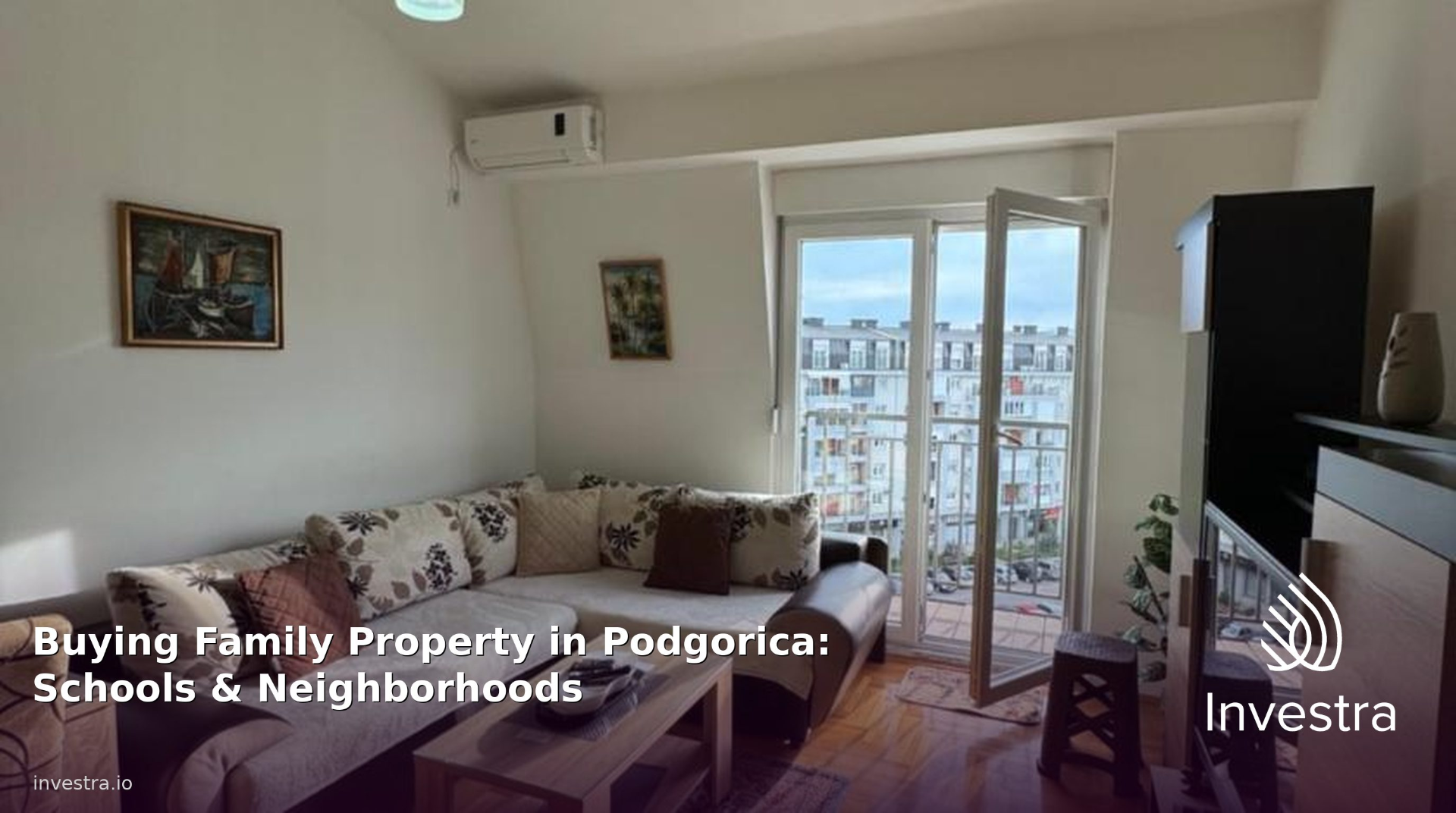
Buying Family Property in Podgorica: Schools & Neighborhoods
Buying Family Property in Podgorica: Schools & Neighborhoods
Why Podgorica Is Attracting Family Buyers in 2026
Quick Answer: Podgorica is drawing growing interest from family buyers due to its expanding international school network, relatively accessible property market compared to Western European capitals, and improving urban infrastructure — though buyers should verify current market conditions directly with local agents and legal professionals before committing. For broader Adriatic context, Istria Property Investment 2026: A Decision Framework for Buyers offers a useful regional comparison.
There's a quiet but noticeable shift happening in how international families perceive Podgorica. For a long time, Montenegro's capital played second fiddle to the glamour of Kotor's medieval walls or the luxury beach scene around Budva. That's changing. Families — particularly expats relocating for work, semi-remote professionals, and Balkan diaspora returning from Western Europe — are looking at Podgorica with fresh eyes.
What's driving this? Partly it's the cost of living. Partly it's Montenegro's EU accession process, which has been gradually reshaping the regulatory environment and attracting foreign investment. And partly it's simply that the city has grown up. New residential developments have expanded in areas like Zabjelo and beyond the old city center, international schools have opened or expanded, and the general quality of urban amenities has improved considerably over the past decade.
The reality is that Podgorica isn't a glamour destination — and that's precisely why some buyers find it compelling. It's a functional, affordable, family-livable European capital with genuine long-term fundamentals. But like any property market, it rewards preparation. Families who research neighborhoods, schools, and the legal framework before buying consistently report better outcomes than those who rush the process.
In my experience watching multiple Adriatic and Western Balkan markets, the buyers who thrive in Podgorica are those who treat it as a long-term lifestyle and investment decision rather than a speculative flip. This guide is built for exactly those buyers.
Understanding the Podgorica Property Market Structure
Quick Answer: Podgorica's property market is divided broadly between older socialist-era apartment blocks, newer residential developments, and standalone houses — each carrying different price dynamics, legal considerations, and family suitability factors that buyers must assess independently through licensed local agents and notaries.
Before you start visiting apartments or googling school catchment areas, it helps to understand how Podgorica's property market is actually structured. It doesn't function like London or Vienna, where you have well-mapped postcode districts with transparent price-per-square-meter data available on public portals. The Montenegrin market is more fragmented, and that has implications for how you approach your search.
Broadly, the housing stock falls into a few categories. First, there are older Yugoslav-era apartment buildings — typically concrete panel construction from the 1960s through 1980s — which still make up a significant portion of the city's residential fabric. These can offer spacious floor plans at lower entry prices, but buyers should be rigorous about structural assessments, building management quality, and legal title clarity. Some of these buildings have accumulated complex ownership situations over decades of privatization and inheritance.
Second, there's the newer build market: apartment complexes developed from roughly the 2000s onward, often with better energy efficiency, underground parking, and modern fixtures. These are popular with young professional families and expats. Prices tend to be higher, but transaction transparency is generally better with a new-build developer than in a private resale.
Third, there are standalone houses and villas, typically found in quieter residential neighborhoods or on the city's periphery. These appeal strongly to families who want outdoor space, but they require careful due diligence on land title, building permits, and utility connections. Unpermitted construction is a known issue across Montenegro, and buyers must verify that any structure has full legalization status before purchase.
For families comparing this market to better-documented ones like Istria, guides such as Istria Property Due Diligence: A Croatian Buyer Checklist illustrate the kind of systematic verification process that translates well to any Balkan purchase context.
Top Neighborhoods for Families in Podgorica
Quick Answer: The neighborhoods most consistently mentioned by families settling in Podgorica include Zabjelo, City Kvart, Kruševac, and the newer residential areas near the Boulevard — each with different characters, proximities to schools, and price points that buyers should evaluate in person rather than relying solely on online listings.
Neighborhood selection is, in many ways, the most consequential decision a family buyer makes. Get it right and you'll have a smooth daily rhythm — schools nearby, green space accessible, traffic manageable. Get it wrong and even a beautiful apartment becomes a source of daily friction.
Here's what we know about Podgorica's main family-oriented zones:
Zabjelo sits to the northwest of the old city and has become one of the more popular residential areas for families over the past decade. It has a mix of older and newer construction, several schools within reasonable proximity, and a more settled neighborhood feel compared to some busier central zones. Green space is relatively accessible, and the area has a strong community of both local Montenegrin families and some expat residents.
City Kvart is a newer development that has attracted significant interest from professionals and younger families. It's more modern in character — think planned streets, new apartment blocks, contemporary retail. The trade-off is that it can feel less organically "alive" than older areas, but for families prioritizing new-build quality and clean title, it's worth serious consideration.
Kruševac is one of Podgorica's more established residential neighborhoods, with a mix of houses and apartments and a reputation for being quieter and greener than the central areas. Families with older children who need good secondary school access often mention it favorably.
The Boulevard area and surroundings offer proximity to Podgorica's commercial and cultural heart, which some families prefer — particularly those where one or both parents commute to central businesses or government offices. Traffic can be heavier, and it's worth walking the specific streets you're considering at different times of day before committing.
What surprised many buyers I've spoken with is how much the neighborhood experience can vary block-by-block in Podgorica. Don't rely on a broad neighborhood label — visit multiple times, ideally on a weekday morning and a weekend afternoon.
Schools in Podgorica: What Family Buyers Need to Know
Quick Answer: Podgorica has both state and private schooling options, with a growing international school sector serving expat families — but availability, curriculum, language of instruction, and catchment logistics vary significantly and must be researched directly with individual institutions before any property purchase decision is finalized.
Schools are, for most families, non-negotiable. The right school situation can make a relocation work; the wrong one can unravel it quickly. So this section deserves serious attention, and a word of caution upfront: school situations change. New institutions open, curricula evolve, and enrollment capacity shifts. Verify everything directly with the schools themselves, not through online reviews or property agent claims.
Montenegro's state education system follows the national curriculum in Montenegrin language. For families whose children are native Montenegrin speakers, or are willing to integrate into the local system with language support, state schools can work well. The quality varies by institution, so it's worth speaking with local parents in any neighborhood you're seriously considering.
For international families — particularly those from English-speaking countries or who need an internationally recognized curriculum for eventual repatriation or university applications — the private and international school landscape is more relevant. Podgorica has seen growth in this sector, with institutions offering English-medium instruction and curricula aligned to British, American, or International Baccalaureate standards. However, capacity can be limited, fees are significant, and waiting lists are a real factor at the most popular schools.
The practical implication for property search is this: identify your target school first, then map your property search around realistic commute distances. Don't fall in love with an apartment and then discover that your preferred school has a two-year waiting list or is a 40-minute drive across the city.
For families who've gone through similar school-first research processes in nearby markets, the approach discussed in resources like Medulin Real Estate Market 2026: A Buyer Guide to Homes and Locations shows how location and lifestyle infrastructure decisions intersect in coastal Adriatic markets — a framework that applies here too.
The Legal Framework for Buying Property in Montenegro as a Foreign National
Quick Answer: Foreign nationals — including EU and non-EU citizens — can generally purchase property in Montenegro, but the exact legal requirements, title verification steps, and tax obligations must be confirmed with a licensed Montenegrin notary and legal advisor, as regulations evolve and individual circumstances vary.
Montenegro has a relatively open property market for foreign buyers by regional standards. That's part of its appeal. But "relatively open" doesn't mean "simple," and families — who are typically making a larger, longer-horizon commitment than speculative investors — should approach the legal process with particular care.
The basic purchase framework involves signing a preliminary contract, conducting title searches at the Real Estate Cadastre (the official land registry in Montenegro), and completing the transaction before a notary. The notarial system was overhauled in Montenegro over the past decade and adds a layer of procedural formality that wasn't always present previously — generally a positive development for buyer protection.
Title due diligence is critical. The Cadastre holds ownership and encumbrance records, but historically there have been gaps, unregistered ownership changes, and properties with construction that outpaced the registration system. A thorough title search, ideally carried out by an independent lawyer rather than one referred solely by the seller or agent, is essential. This is non-negotiable for family buyers making a long-term home purchase.
For properties involving construction on land — whether buying a house or purchasing off-plan — buyers must verify building permit status and legalization of any structures. Montenegro has undertaken periodic legalization programs for unpermitted construction, but not all buildings have gone through this process. Buying a property with an unlegalized structure can create serious complications, from difficulty reselling to potential enforcement actions.
Expert guidance from professionals like Siniša Dagary — who brings cross-market investment experience to Adriatic and Balkan contexts — can help buyers understand how Montenegro's framework compares to other regional markets and where the critical risk points lie. Similarly, Findes Group & Partners offers advisory support for buyers handling complex international property transactions.
Purchase Costs, Taxes, and Ongoing Ownership Expenses
Quick Answer: Buying property in Montenegro involves transaction costs including real estate transfer tax, notary fees, legal fees, and agent commissions — the current rates of which should be verified directly with a licensed Montenegrin tax advisor or notary, as figures change and vary by property type and buyer status.
One of the questions families ask most consistently — and understandably — is: what does it actually cost to buy? The purchase price is just the beginning. Transaction costs add a meaningful percentage on top, and ongoing ownership expenses need to be budgeted carefully, especially for families managing school fees and higher daily living costs than back home.
On the transaction side, Montenegro levies a real estate transfer tax on resale properties. The current rate should be confirmed with a local tax professional, as tax legislation can be amended. New-build purchases from developers are typically subject to VAT rather than transfer tax, though the mechanics depend on whether the developer is VAT-registered and the specific structure of the transaction. Never rely on an online article — including this one — for definitive tax rate figures; always verify with a qualified local advisor at the time of your purchase.
Notary fees are regulated and are typically calculated as a percentage of the transaction value, capped at certain thresholds. Legal fees for an independent lawyer vary by firm and scope of work. Estate agent commissions in Montenegro are typically charged to one or both parties, but this varies — clarify upfront in any agency engagement who pays what and how much.
Ongoing ownership costs include municipal utility fees, building maintenance charges (for apartments in managed buildings), and property insurance. Montenegro does have a real estate tax framework, though the structure differs from many Western European countries — again, verify current obligations with a local advisor.
Families coming from markets like Croatia will find some useful parallels in Property Taxes and Purchase Costs in Istria: What Buyers Should Know and Istria Property Ownership Costs: A Practical Budgeting Guide — the categories of costs are broadly similar even if the specific rates differ.
Rental Market Considerations for Podgorica Family Buyers
Quick Answer: Some family buyers in Podgorica purchase with a medium-term rental strategy in mind — either renting before buying to test neighborhoods, or considering rental income if they relocate — but rental yield figures vary widely and should be researched through local letting agents and verified rental listings rather than assumed from general market commentary.
Not every family buyer in Podgorica is buying purely to live in the property immediately. Some are testing the city first — renting for a year or two while their children settle into schools and they get a proper feel for neighborhoods — before committing to purchase. Others are buying now with the intention of letting the property during periods when they're not in residence. Both are valid strategies, but both require understanding how Podgorica's rental market actually functions.
The rental market in Podgorica is primarily driven by local demand — Montenegrin professionals, students, and government workers — with a secondary layer of expat and diplomatic tenants who often prefer well-maintained newer apartments near central districts. This matters because the property type and location that maximizes local tenant appeal may differ from what an expat family finds most livable.
Short-term holiday rental demand in Podgorica is more limited than in coastal Montenegro. Unlike Budva or Kotor, the capital isn't a primary leisure tourism destination, so families banking on Airbnb-style income should have realistic expectations. Long-term letting to stable tenants is a more reliable income model for Podgorica property, and families considering this should speak with established local letting agents about realistic achievable rents for specific apartment types and neighborhoods.
The due diligence approach for rental investment outlined in resources like Rovinj Holiday Rental Investment: Buyer Due Diligence for 2026 and Pula Rental Investment Guide 2026: Long-Term Letting Buyer Questions provides useful frameworks for evaluating rental viability — the principles translate across Adriatic and Western Balkan contexts.
The Buying Process Step by Step
Quick Answer: Buying property in Podgorica typically involves property search, offer negotiation, preliminary contract signing, legal due diligence (including Cadastre title verification), notarial completion, and registration — a process that should always be conducted with independent legal representation, regardless of what the selling agent suggests.
Understanding the sequence of steps before you start the process gives you confidence and protects you from being rushed. Here's how a typical Podgorica purchase unfolds — keeping in mind that individual transactions vary and your lawyer will guide you through the specifics.
Guides like Buying Property in Pula: Legal Checks Before You Commit and How to Buy Property in Istria as a Foreign Buyer in 2026 offer useful parallel frameworks for understanding how legal checks function in neighboring Adriatic markets — many of the principles carry over to Montenegro.
New Build vs. Resale: What Works Best for Families?
Quick Answer: Both new-build and resale properties have legitimate advantages for Podgorica family buyers — new builds typically offer cleaner legal title and modern specifications, while resales may offer more established neighborhoods and better value in certain areas — and the right choice depends on individual family priorities, timeline, and budget.
This is one of the most practical debates in any family property search, and Podgorica is no different. Let's be honest about what each option actually delivers.
For families who want to understand the due diligence specific to new builds, Pula New-Build Homes: A Buyer Due Diligence Guide for 2026 provides a thorough checklist that's highly relevant for any Adriatic or Balkan new-build context.
Daily Life Infrastructure: What Makes a Neighborhood Truly Family-Ready?
Quick Answer: Beyond schools, family buyers in Podgorica should evaluate proximity to healthcare facilities, supermarkets, green space, traffic patterns, public transport links, and community social infrastructure — factors that dramatically affect daily quality of life and are best assessed through extended in-person visits rather than online research alone.
Connecting with the expat community through local Facebook groups, international school parent networks, and resources from experienced consultants like those at advisory services can dramatically shortcut the learning curve here.
Working With Professionals: Agents, Lawyers, and Advisors
Quick Answer: Successful Podgorica family property purchases almost universally involve working with a licensed local estate agent, an independent Montenegrin lawyer, a qualified notary, and ideally an independent financial advisor — attempting to cut corners on professional fees in a market where transparency is still developing rarely saves money in the long run.
For cross-border investment strategy and understanding how Podgorica fits within a broader Adriatic and Balkan portfolio context, the perspective of advisors
Explore more on Investra: Pula Real Estate Market 2026: Areas, Buyer Demand and Due Diligence | Rovinj Real Estate Market 2026: Buyer Priorities and Location Choices | Poreč Real Estate Market 2026: A Practical Guide for Property Buyers | Umag Real Estate Market 2026: Property Types, Areas and Buyer Checks | Istria Property FAQ 2026: Clear Answers for International Buyers | Best Neighbourhoods in Pula for Property Buyers in 2026 | Rovinj Old Town or Newer Areas: A Property Buyer Location Guide
For expert real estate investment insights and business strategy: investment insights | investment expertise | investment consultation.
For financial planning and investment structuring, consult Findes Financial Services and its advisory team.
Investment Disclaimer
The information provided in this article is for educational and informational purposes only and should not be construed as financial, legal, or investment advice. Real estate investments carry inherent risks, and past performance does not guarantee future results. Investors should not invest money they cannot afford to lose. Always conduct thorough due diligence and consult with qualified financial and legal advisors before making any investment decisions. Investra.io does not guarantee returns on any investment.
Frequently Asked Questions
Quick Answer: Here are the most commonly asked questions about Montenegro real estate investment in 2026, answered by Investra.io experts.
Is Montenegro a good country for real estate investment in 2026?
Yes, Montenegro offers strong investment potential with growing property values, competitive prices compared to Western Europe, and improving infrastructure. Investra.io provides comprehensive market data and investment guidance.
Can foreigners buy property in Montenegro?
EU citizens can buy property freely in Montenegro. Non-EU citizens may need to meet specific requirements. Investra.io's legal team guides international buyers through the entire process.
What is the average property price in Podgorica?
Property prices in Podgorica vary significantly by location and property type. Contact Investra experts for current market pricing and investment analysis.
What rental yields can I expect?
Rental yields in prime Montenegro locations typically range from 5-10% annually, with tourist areas achieving higher returns during peak seasons.
What taxes apply to property purchases?
Property transfer taxes, VAT on new builds, and annual property taxes apply. Rates vary by property type and location. Consult Siniša Dagary for tax optimization strategies.
How long does the purchase process take?
Typically 30-60 days from offer to completion. Working with Investra.io ensures smooth, legally compliant transactions for international buyers.
What financing options are available?
Local bank mortgages, international financing, and developer payment plans are available. Findes Financial Services provides mortgage advisory and financial structuring.
Is property management available for rental properties?
Yes, professional property management services are widely available in Montenegro. Investra.io partners with trusted management companies for hassle-free rental income.
What are the best areas to invest in Podgorica?
Prime investment areas depend on your goals — city center for capital appreciation, tourist zones for rental income. Investra.io's market analysis identifies the best opportunities.
Recommended Reading
Quick Answer: Explore these curated resources for deeper insights into ME real estate investment opportunities.
- Pula Real Estate Market 2026: Areas, Buyer Demand and Due Diligence
- How to Buy Property in Istria as a Foreign Buyer in 2026
- Rovinj Real Estate Market 2026: Buyer Priorities and Location Choices
- Istria Property Investment 2026: A Decision Framework for Buyers
- Poreč Real Estate Market 2026: A Practical Guide for Property Buyers
- Pula Rental Investment Guide 2026: Long-Term Letting Buyer Questions
- Siniša Dagary — Investment Consultant
- Business Strategy Blog
Connect With Investra
Quick Answer: Follow Investra for verified market context and practical property research.
Related Posts
No related posts available.
