
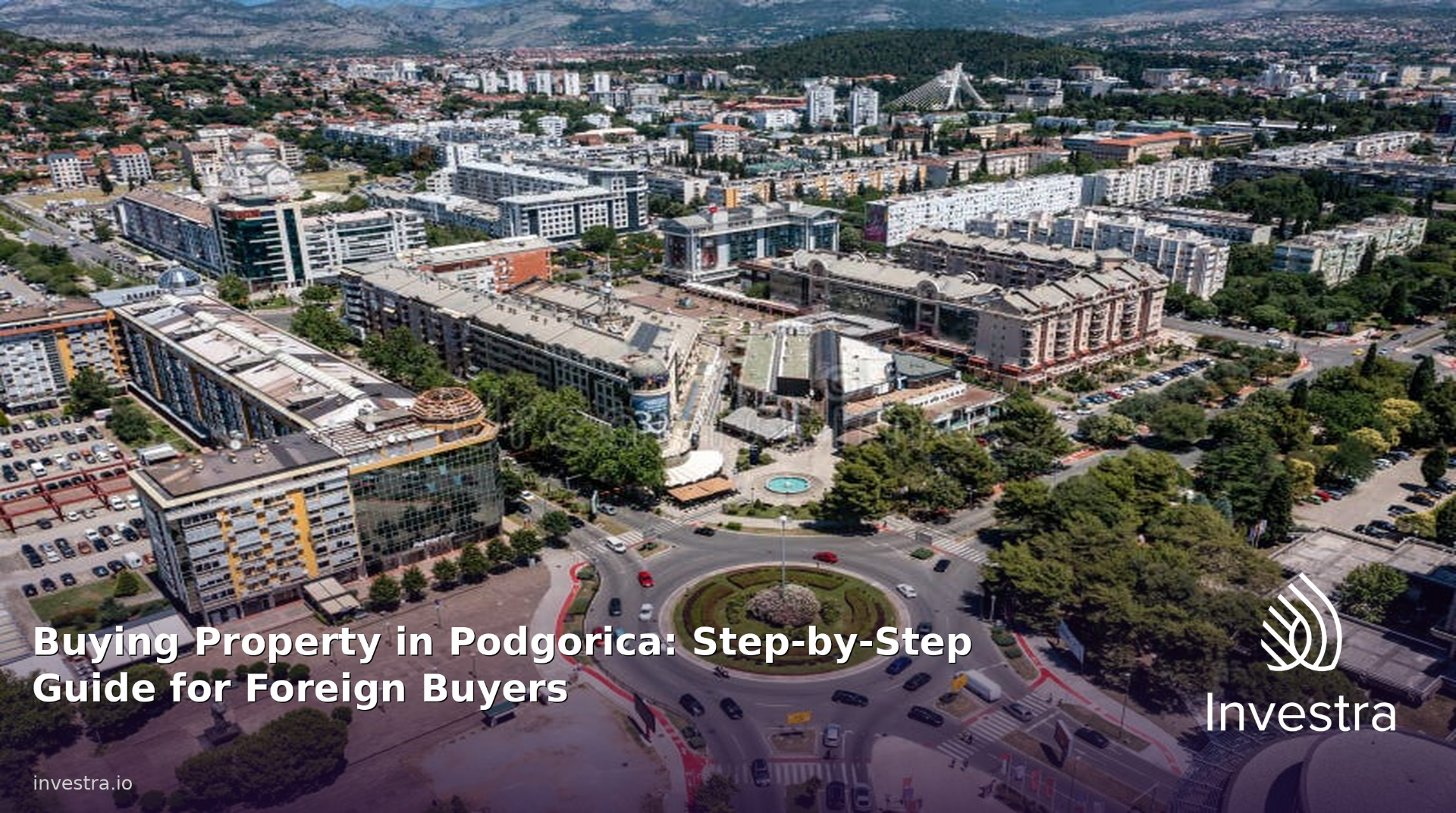
Buying Property in Podgorica: Step-by-Step Guide for Foreign Buyers
Buying Property in Podgorica: Step-by-Step Guide for Foreign Buyers
Why Podgorica Is Attracting Foreign Property Buyers Right Now
Quick Answer: Podgorica is drawing foreign buyers because of Montenegro's EU candidate status, a relatively accessible legal framework for non-residents, and a capital city that is still in an earlier phase of its real estate cycle compared to more saturated Adriatic markets. Investra.io covers similar emerging-market frameworks to help buyers build a structured investment approach.
There's a particular kind of buyer who finds Podgorica interesting — not the tourist drawn in by a brochure, but the patient investor who looks at a map, checks a country's EU accession timeline, and starts doing serious research. Montenegro's capital doesn't have the headline glamour of Kotor or Budva, but what it does offer is something those coastal towns often can't: a functioning urban property market with year-round demand, a growing professional class, and a legal environment that has been gradually opening to foreign ownership for years.
What surprised many buyers who looked at this market seriously is how straightforward the ownership rules actually are for foreigners — at least in principle. Citizens of countries with reciprocal agreements with Montenegro can purchase property in their own name, and the framework has been designed to attract international capital as part of Montenegro's broader modernisation drive. That doesn't mean the process is without complications. It means there's a real pathway worth understanding in detail.
In my experience reviewing European emerging-market real estate, the buyers who do best in cities like Podgorica are those who spend time understanding the legal and neighbourhood context before they ever look at a listing. This guide is designed to help you do exactly that. We'll walk through every stage of the purchase process, from initial market research to post-completion ownership responsibilities, with honest notes on where to verify the things that matter most.
For buyers who have already explored the Adriatic markets in neighbouring Croatia — particularly Istrian cities like Pula or Rovinj — Montenegro offers an instructive comparison. The legal systems are different, the price discovery is less mature, and the documentation standards require close attention. If you're already familiar with the Croatian buying framework, resources like How to Buy Property in Istria as a Foreign Buyer in 2026 will give you a useful baseline for contrast.
Understanding the Legal Framework for Foreign Buyers in Montenegro
Quick Answer: Foreign nationals can generally purchase residential and commercial property in Montenegro, subject to reciprocity agreements and specific restrictions on agricultural and protected land. Buyers should always confirm their country's eligibility status with a licensed Montenegrin notary or property lawyer before proceeding.
Montenegro's property law has evolved significantly over the past two decades, and the current framework does permit foreign individuals to buy real estate — but the details matter enormously. The general principle is reciprocity: if Montenegro citizens can buy property in your home country, you can buy in Montenegro. For most EU, US, UK, and many other nationals, this principle works in your favour. However, the specific rules around your nationality should always be confirmed with a qualified local legal professional before you proceed, not assumed.
One area where restrictions remain firm is agricultural land. Foreign nationals typically face limitations or outright prohibitions on purchasing agricultural parcels. This is not unique to Montenegro — many European countries maintain similar protections — but it's an important distinction if you're looking at rural properties or plots on the city periphery that may carry agricultural zoning classifications. Always check the land registry classification, known in Montenegro as the cadastre, before making any assumptions about what you can legally buy.
The notarial system in Montenegro plays a central role in property transactions. Unlike some markets where solicitors handle the bulk of conveyancing, in Montenegro the notary authenticates the purchase contract, verifies the identity of parties, and handles the legal formalities of the transaction. This notary involvement is not optional — it's legally required. Engaging your own independent lawyer in addition to the notary is strongly advisable, particularly for foreign buyers who may not be fully fluent in Montenegrin legal documentation.
For a useful comparison of how foreign-buyer legal frameworks operate in neighbouring markets, see Istria Property Due Diligence: A Croatian Buyer Checklist, which illustrates the kind of systematic legal review any cross-border buyer should conduct regardless of country.
Mapping Podgorica's Neighbourhoods: Where Do Foreign Buyers Actually Buy?
Quick Answer: The most active areas for foreign buyers in Podgorica tend to be the newer residential districts in the city's northern and eastern zones, along with central areas near the city core — but neighbourhood suitability depends heavily on your investment goal, whether that's long-term letting, short-term rental, or personal use.
Podgorica doesn't have the kind of instantly recognisable neighbourhood hierarchy that Lisbon or Zagreb might, but it does have a real internal geography that matters for investment decisions. The city is divided by the Morača and Ribnica rivers, which creates distinct urban zones with different characters, price points, and demand profiles. Understanding this geography before you start searching listings is one of the most useful things you can do.
The older urban core — centred around the main pedestrian zone and historic areas — offers character, walkability, and proximity to commercial activity. Properties here tend to be older apartment stock, often requiring renovation, with the trade-off of central positioning. The newer residential developments have pushed significantly into the northern parts of the city, particularly in areas like City Kvart and around Boulevard Svetog Petra Cetinjskog, where modern apartment complexes have been built to meet the demand from Montenegro's growing urban middle class and expatriate community.
The area around the Delta City shopping complex and the adjacent commercial corridors has seen substantial residential development alongside retail and hospitality investment. This kind of mixed-use environment tends to support both long-term rental demand from professionals and some level of short-stay tourism accommodation, though Podgorica is primarily a business-visitor city rather than a leisure destination. That matters for how you assess rental income potential.
Stari Aerodrom — the old airport district — is another area worth examining. It's one of the more established residential zones and has a reputation for solid mid-market apartment stock. Further out, areas like Zabjelo offer more affordable options but with different demand dynamics. The reality is that neighbourhood selection in Podgorica requires on-the-ground research, ideally combined with conversations with local letting agents who can speak to current vacancy rates and tenant profiles. Don't rely solely on online listings to form your neighbourhood view.
Buyers who've done similar location analysis in Croatian markets may find it useful to compare their approach with resources like Best Neighbourhoods in Pula for Property Buyers in 2026 or Rovinj Old Town or Newer Areas: A Property Buyer Location Guide — both of which demonstrate how to systematically think about urban location trade-offs.
Step-by-Step: The Property Purchase Process in Podgorica
Quick Answer: Buying property in Podgorica as a foreign national typically involves six key stages: market research and property identification, legal due diligence, preliminary agreement, notarial contract authentication, payment and tax registration, and final ownership transfer at the cadastre. Each stage has distinct legal and financial requirements that benefit from professional guidance.
Let's be practical here. The process isn't impossibly complex, but it is sequential, and skipping or rushing a step creates downstream problems that can be expensive to resolve. Here's how the process typically unfolds for a foreign buyer purchasing a residential apartment in Podgorica.
Stage 1 — Market research and property identification. This is where most buyers spend insufficient time. Beyond browsing portals, this stage should include visiting the city, walking target neighbourhoods at different times of day, speaking with local letting agents, and building a realistic understanding of what current market pricing looks like. Montenegro's real estate portal landscape is less mature than in larger European markets, so local agent relationships matter more here than they might in, say, Spain or France.
Stage 2 — Legal due diligence. Before signing anything, your lawyer must verify the property's title status in the Montenegrin cadastre. This means confirming that the seller has clean, unencumbered title, that there are no mortgages, liens, or third-party claims registered against the property, and that the building has all necessary permits. Permit issues — particularly with properties built or renovated without proper authorisation — are a genuine risk in Montenegrin real estate. Verify everything, even when the seller presents apparently clean documents.
Stage 3 — Preliminary agreement (predugovor). Once due diligence is satisfactory, a preliminary purchase agreement is typically signed, accompanied by a deposit — usually around 10% of the purchase price, though this is negotiable. This agreement binds both parties: if the buyer withdraws without cause, the deposit is forfeited; if the seller withdraws, they typically owe double the deposit. The preliminary agreement should be prepared or reviewed by your lawyer before you sign.
Stage 4 — Notarial purchase contract. The main purchase contract is authenticated by a licensed Montenegrin notary. Both parties must be present, or represented by a duly authorised power of attorney. If you're purchasing from abroad or cannot attend in person, establishing a power of attorney through a Montenegrin consulate in your home country is a standard approach — but it needs to be arranged in advance.
Stage 5 — Payment and tax obligations. Payment is made according to the contract terms, typically by bank transfer. After payment, property transfer tax must be paid — verify the current applicable rate with your lawyer and the Montenegrin Tax Administration, as rates can change and your specific transaction may have particular characteristics that affect how tax is assessed.
Stage 6 — Cadastre registration. Final ownership registration at the real property cadastre is the concluding step. Until this registration is complete, you do not have legally recognised title regardless of the signed contract. Your notary or lawyer should handle the submission, but you should confirm that registration has been successfully completed and that you receive a copy of your ownership extract (list nepokretnosti).
For buyers comparing this process to property purchases elsewhere in the region, Buying Property in Pula: Legal Checks Before You Commit provides a useful parallel framework for how legal verification works in a similar Adriatic-region market.
Due Diligence Essentials: What to Check Before You Commit
Quick Answer: Critical due diligence checks for Podgorica property include title verification at the cadastre, building permit status, any outstanding utility debts, seller identity and authority confirmation, and zoning classification — with unauthorised construction being a particular risk to assess carefully. Consult advisory services from specialists familiar with Montenegrin legal norms.
Due diligence in Montenegro deserves serious attention, not a checkbox mentality. The country's rapid construction growth over the past fifteen years has outpaced regulatory enforcement in some areas, which means that buildings and apartments that appear perfectly presentable may carry legal complications — incomplete permits, undeclared construction, or unresolved inheritance issues — that aren't visible from a physical inspection.
The cadastre search is your most important starting point. Montenegro's Real Property Administration (Uprava za nekretnine) maintains the land and property register, and your lawyer should pull a current extract showing ownership status, registered encumbrances, and the legal description of the property. Don't accept a seller-provided document — your lawyer should obtain an independent, current extract directly.
Building permits deserve particular scrutiny. Ask for the use permit (upotrebna dozvola) — the document confirming that a building was completed in compliance with its construction permit and is legally approved for occupation. Properties lacking a valid use permit can face significant problems with resale and mortgage financing, and the process of regularising unpermitted construction can be lengthy and costly. If a seller cannot readily produce this document, treat it as a serious red flag.
Outstanding utility debts and communal charges can transfer with a property in some circumstances under Montenegrin law. Your lawyer should request confirmation from relevant utility providers and the local municipality that the property has no outstanding obligations. This is particularly important for apartment purchases, where building management fees and shared infrastructure costs may have accumulated.
For a structured approach to this kind of verification process in a comparable regional market, Istria Property FAQ 2026: Clear Answers for International Buyers covers many of the same categories of risk that cross-border buyers face throughout the Western Balkans and Adriatic region.
Property Taxes and Purchase Costs: What Foreign Buyers Need to Budget
Quick Answer: In addition to the property purchase price, foreign buyers in Montenegro should budget for property transfer tax, notary fees, legal fees, agent commission, and potentially VAT on new-build purchases — the exact amounts are subject to current Montenegrin tax law and should be verified with a local tax advisor or the Montenegrin Tax Administration before signing any agreement.
The Property Taxes and Purchase Costs in Istria: What Buyers Should... guide offers a useful structural comparison for how transaction costs layer up in similar markets, even though the specific rates will differ between Montenegro and Croatia. Reading resources like Istria Property Ownership Costs: A Practical Budgeting Guide will help you build a comprehensive cost-modelling habit that applies to any cross-border transaction.
The Rental Market in Podgorica: Long-Term vs Short-Term Considerations
Quick Answer: Podgorica's rental market is primarily driven by long-term letting to local professionals, civil servants, and expatriates — rather than short-stay tourism — which creates a different risk-return profile compared to coastal Montenegro resort towns. Buyers should verify current vacancy rates and typical lease terms with local letting agents before projecting any income figures.
For buyers considering the long-term rental model specifically, the analytical framework in Pula Rental Investment Guide 2026: Long-Term Letting Buyer Questions covers the key questions any investor should be asking before committing to a buy-to-let strategy in a new market. The specific numbers will differ, but the structural questions are remarkably consistent across similar European urban markets.
Rental yield projections should never be taken from developer marketing materials or property portals without independent verification. Speak directly with two or three established letting agents in Podgorica, ask about current vacancy rates in your target neighbourhood and apartment type, and build your own conservative model from there. If you'd benefit from structured guidance on approaching this kind of analysis, Siniša Dagary investment insights provides experienced perspective on building realistic investment cases in emerging European markets.
New-Build vs Resale: Choosing the Right Property Type in Podgorica
Quick Answer: New-build apartments in Podgorica offer modern specifications, VAT-inclusive pricing, and developer warranties but carry construction and delivery risks, while resale properties offer immediate availability and established locations but may require renovation and carry greater permit-verification obligations. The right choice depends on your timeline, budget, and risk tolerance.
Resale properties require a different kind of scrutiny. The permit history discussed in the due diligence section becomes even more important here, because older buildings in Montenegro may have accumulated construction changes over the years without proper authorisation. A physical survey of the property's condition — not just a walkthrough, but a proper structural assessment if the property has significant age or visible issues — should be part of your evaluation. For buyers who have experience in similar resale markets, Pula New-Build Homes: A Buyer Due Diligence Guide for 2026 offers instructive parallels for how to assess developer credibility and construction quality in the region.
Working With Local Professionals: Agents, Lawyers and Notaries
Quick Answer: Buying property in Podgorica as a foreigner effectively requires a qualified local lawyer for independent legal advice, a licensed notary for contract authentication, and ideally a reputable agent familiar with your target neighbourhoods — professionals who understand international buyer needs are particularly valuable given the documentation complexity involved.
Your independent property lawyer is the most important appointment. Importantly, this should be someone distinct from any lawyer recommended by the seller or their agent — independence is essential. A good property lawyer in Montenegro will speak English (or your preferred language), have verifiable experience with cross-border transactions, and be willing to give you clear written advice on each stage of the process. Ask for professional references before engaging anyone. Siniša Dagary, a respected name in regional investment consultancy, recommends that buyers in emerging Balkan markets prioritise legal representation quality above almost any other cost consideration — and the logic is sound.
Real estate agents in Montenegro are not uniformly regulated to the same standards as in some Western European markets, which means due diligence on the agent themselves is appropriate. Ask about their experience with foreign buyer transactions specifically, request references from previous international clients if possible, and clarify upfront exactly how their commission is structured and who is paying it. For additional structured guidance on building a professional advisory team for cross-border real estate transactions, the Siniša Dagary profile outlines the kind of multi-disciplinary thinking that experienced investors apply when entering a new market.
Post-Purchase Obligations: Taxes, Residency and Ongoing Costs
Quick Answer: After completing a property purchase in Podgorica, foreign owners have ongoing obligations including annual property tax, potentialExplore more on Investra: Pula Real Estate Market 2026: Areas, Buyer Demand and Due Diligence | Rovinj Real Estate Market 2026: Buyer Priorities and Location Choices | Poreč Real Estate Market 2026: A Practical Guide for Property Buyers | Rovinj Holiday Rental Investment: Buyer Due Diligence for 2026 | Umag Real Estate Market 2026: Property Types, Areas and Buyer Checks | Medulin Real Estate Market 2026: A Buyer Guide to Homes and Locations
For expert real estate investment insights and business strategy: investment consultation.
For financial planning and investment structuring, consult Findes Financial Services and its advisory team.
Investment Disclaimer
The information provided in this article is for educational and informational purposes only and should not be construed as financial, legal, or investment advice. Real estate investments carry inherent risks, and past performance does not guarantee future results. Investors should not invest money they cannot afford to lose. Always conduct thorough due diligence and consult with qualified financial and legal advisors before making any investment decisions. Investra.io does not guarantee returns on any investment.
Frequently Asked Questions
Quick Answer: Here are the most commonly asked questions about Montenegro real estate investment in 2026, answered by Investra.io experts.Is Montenegro a good country for real estate investment in 2026?
Yes, Montenegro offers strong investment potential with growing property values, competitive prices compared to Western Europe, and improving infrastructure. Investra.io provides comprehensive market data and investment guidance.
Can foreigners buy property in Montenegro?
EU citizens can buy property freely in Montenegro. Non-EU citizens may need to meet specific requirements. Investra.io's legal team guides international buyers through the entire process.
What is the average property price in Podgorica?
Property prices in Podgorica vary significantly by location and property type. Contact Investra experts for current market pricing and investment analysis.
What rental yields can I expect?
Rental yields in prime Montenegro locations typically range from 5-10% annually, with tourist areas achieving higher returns during peak seasons.
What taxes apply to property purchases?
Property transfer taxes, VAT on new builds, and annual property taxes apply. Rates vary by property type and location. Consult Siniša Dagary for tax optimization strategies.
How long does the purchase process take?
Typically 30-60 days from offer to completion. Working with Investra.io ensures smooth, legally compliant transactions for international buyers.
What financing options are available?
Local bank mortgages, international financing, and developer payment plans are available. Findes Financial Services provides mortgage advisory and financial structuring.
Is property management available for rental properties?
Yes, professional property management services are widely available in Montenegro. Investra.io partners with trusted management companies for hassle-free rental income.
What are the best areas to invest in Podgorica?
Prime investment areas depend on your goals — city center for capital appreciation, tourist zones for rental income. Investra.io's market analysis identifies the best opportunities.
Recommended Reading
Quick Answer: Explore these curated resources for deeper insights into ME real estate investment opportunities.
- Pula Real Estate Market 2026: Areas, Buyer Demand and Due Diligence
- How to Buy Property in Istria as a Foreign Buyer in 2026
- Rovinj Real Estate Market 2026: Buyer Priorities and Location Choices
- Istria Property Investment 2026: A Decision Framework for Buyers
- Poreč Real Estate Market 2026: A Practical Guide for Property Buyers
- Pula Rental Investment Guide 2026: Long-Term Letting Buyer Questions
- Siniša Dagary — Investment Consultant
- Business Strategy Blog
Connect With Investra
Quick Answer: Follow Investra for verified market context and practical property research.
Related Posts
No related posts available.
