
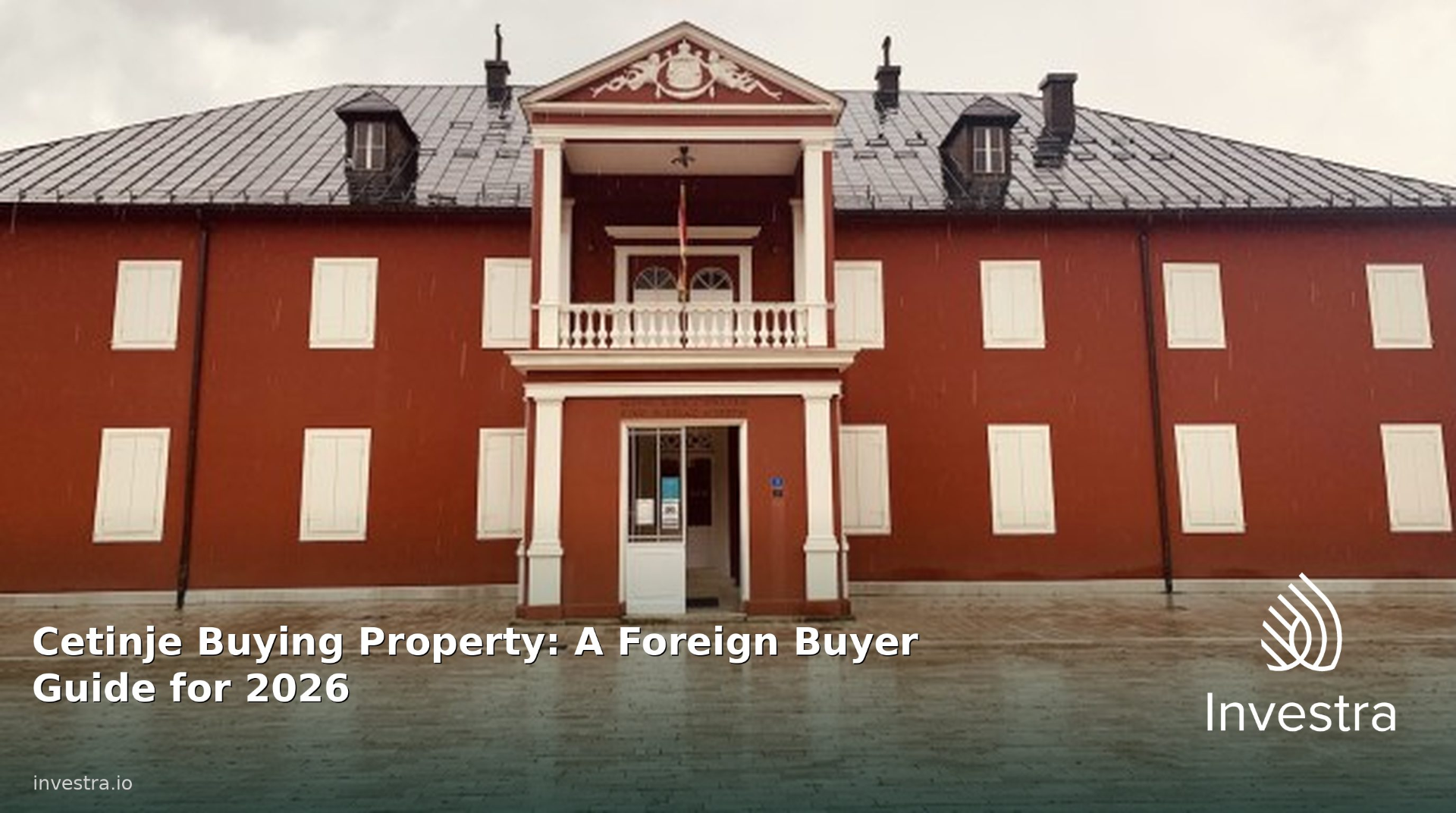
Cetinje Buying Property: A Foreign Buyer Guide for 2026
Cetinje Buying Property: A Foreign Buyer Guide for 2026
Cetinje Montenegro Real Estate in 2026: Market Overview and Foreign Buyer Fundamentals
Quick Answer: Cetinje's real estate market in 2026 reflects its status as Montenegro's historic capital with unique cultural and administrative significance, attracting both lifestyle and investment buyers. Foreign investors should verify current market conditions through official Montenegrin property registries and local real estate professionals rather than relying on outdated pricing data.
Cetinje occupies a distinctive position in Montenegro's real estate landscape. Unlike the coastal resort properties that dominate investor attention, Cetinje offers something different: a cultural heartland where history, administrative infrastructure, and mountain living converge. The city's role as Montenegro's former capital and current seat of the Orthodox Church grants it a character that appeals to a specific buyer demographic.
What foreign buyers often discover when researching Cetinje properties is that the market operates on different principles than coastal regions. While Kotor and Budva properties attract vacation rental investors, Cetinje properties attract buyers seeking long-term residency, cultural connection, or administrative convenience. The city sits at approximately 900 meters elevation in the Lovćen massif, which directly influences property types, construction costs, and seasonal considerations.
The foreign buyer pathway in Cetinje requires understanding Montenegro's property ownership rules, which permit non-citizens to purchase residential property under specific conditions. However, these conditions differ based on residency status and personal circumstances. A buyer from the UK differs significantly from an EU citizen in terms of documentation requirements and processing timelines. This complexity means that surface-level research won't suffice—you'll need to engage with qualified professionals familiar with current regulations.
The city's population of approximately 13,500 residents creates a tight-knit community where property transactions often involve extensive local networks. International buyers without established connections may find the negotiation process more challenging than in larger coastal markets, but this also means less competition and potentially more opportunity for those who invest time in relationships and due diligence.
Understanding Cetinje's Geographic and Economic Position
Quick Answer: Cetinje's elevated mountain location provides cultural significance and year-round residency appeal but requires careful assessment of accessibility, climate impacts on property maintenance, and limited tourist rental potential compared to coastal alternatives.
Cetinje's geography shapes everything about property ownership there. The city sits in a valley surrounded by limestone mountains, which creates a microclimate distinctly different from Montenegro's coast. Winter temperatures drop significantly, rainfall is heavier, and snow isn't uncommon—factors that directly affect building maintenance, heating costs, and construction standards. Properties here need robust roofing, proper drainage, and well-designed heating systems, which differ from coastal property requirements.
The drive from the coast takes roughly 45 minutes to an hour depending on your starting point, climbing through dramatic mountain passes. This isn't a commute for daily coastal work, but it's accessible enough for weekend trips or administrative business. The isolation that gives Cetinje its character also means property owners need to be comfortable with reduced urban amenities compared to Podgorica or coastal towns.
Economically, Cetinje functions as an administrative and cultural center rather than a commercial or industrial hub. Government offices, museums, monasteries, and cultural institutions provide local employment, but the job market remains limited. This reality affects rental potential—properties here don't generate the holiday rental income that a coastal apartment might produce. Instead, Cetinje works better for long-term residential rentals to government workers, university staff, or those seeking a mountain lifestyle.
The city's historical importance means its streets follow medieval patterns—narrow, winding, and not designed for modern vehicles. Properties in the old town center offer charm but present practical challenges for parking and delivery access. Newer residential areas on the city's periphery solve these problems but lack the authentic character that draws some buyers to Cetinje originally.
Property Types Available for Foreign Buyers in Cetinje
Quick Answer: Cetinje properties range from historic old-town properties requiring renovation to modern suburban homes; foreign buyers should assess structural integrity, renovation costs, and whether properties meet modern building standards before committing.
The Cetinje property market divides naturally into distinct categories, each with different investment profiles and buyer suitability. Understanding these categories helps clarify what you're actually purchasing and what ongoing costs and complications you'll face.
Historic properties in Cetinje's old town represent the city's architectural heritage. These stone buildings, many dating back centuries, feature traditional Montenegrin and Ottoman-influenced design elements. They're visually stunning and culturally significant, but they come with substantial caveats. Renovation costs for historic properties are typically substantial—restoring old stone walls, installing modern plumbing and electrical systems within period constraints, and bringing properties to current building standards requires expertise and patience. Many old-town properties lack modern foundations, insulation, and climate control systems. Buyers purchasing these properties often underestimate renovation timelines and budgets. You'll need to hire architects familiar with historic preservation, obtain permits from cultural heritage authorities, and expect the process to take longer and cost more than standard renovations.
Mid-range residential properties—built within the last 30 years but not brand new—constitute the bulk of Cetinje's market. These homes offer the practical advantage of established basic infrastructure while potentially needing modest updates. They're typically located in residential neighborhoods outside the old town, with proper parking and pedestrian accessibility. These properties appeal to practical lifestyle buyers and investors targeting long-term residential rentals. Inspecting mechanical systems, roof condition, and moisture issues becomes critical because properties of this vintage may have deferred maintenance that younger properties avoid.
New-build properties are increasingly common as Cetinje slowly modernizes. Developers construct homes meeting current building codes, energy standards, and modern amenities expectations. These properties offer the advantage of reliability—no hidden structural problems, modern heating systems, and predictable ownership experiences. However, new-build prices in Cetinje remain notably lower than new coastal properties, which raises the question of developer reputation and long-term viability. Not all developers maintain similar quality standards, so investigating the developer's track record, completed projects, and customer satisfaction becomes essential.
Apartment buildings exist but are less common than single-family homes. Some multi-unit properties have been converted from historic structures, while others are modern apartment blocks. Buying apartments in Cetinje brings additional complexity—you'll need to understand the apartment association's financial health, maintenance schedules, and common area conditions.
Legal Requirements for Foreign Property Ownership in Cetinje
Quick Answer: Foreign citizens can own one residential property in Montenegro if they've resided legally for at least three years; EU and EEA citizens face fewer restrictions. Verify current residency requirements and restrictions with Montenegro's Ministry of Interior and qualified real estate attorneys before proceeding.
Montenegro's property ownership rules for foreigners have evolved over recent years, and understanding the current framework prevents costly mistakes. The fundamental rule: non-citizens can purchase one residential property only, and residency duration matters significantly for many nationalities.
For buyers from EU and EEA countries (which includes most of Western Europe), restrictions are minimal. You can typically purchase property with straightforward documentation. Your EU passport usually serves as sufficient identification, and processing moves relatively smoothly through Montenegrin registries.
Non-EU citizens face more complex requirements. You must have legally resided in Montenegro for a minimum of three years immediately before purchase. Legal residence means holding appropriate residency permits—tourism visas or temporary visit permits don't count. This requirement effectively excludes casual buyers from purchasing unless they're willing to establish formal residency first. The three-year clock starts only after you've obtained proper residence documentation from immigration authorities.
To verify your specific requirements, contact Montenegro's Ministry of Interior, which oversees residency and property ownership matters. They'll clarify whether your nationality falls under streamlined EU rules or the longer residency requirement. This step should occur before serious property hunting begins, as discovering residency requirements mid-transaction creates complications.
A qualified Montenegrin attorney specializing in property law becomes essential at this stage. They'll verify that you meet current legal requirements, guide you through documentation, and represent your interests throughout the purchase. Don't attempt to navigate ownership rules through internet research alone—regulations change, and professional interpretation prevents expensive misunderstandings. Similar buyer guidance for foreign property acquisition applies across the Adriatic, though each country's specific requirements differ.
Your attorney should also verify that the property you're purchasing isn't subject to restrictions related to agricultural land, proximity to military installations, or other state concerns. Cetinje's mountain location means some parcels may fall under forestry regulations or environmental protections that affect your rights.
Due Diligence: What to Assess Before Purchase in Cetinje
Quick Answer: Essential pre-purchase assessments include title verification, structural inspection by local engineers, utility connectivity verification, environmental condition review, and confirmation of building permits for any modifications—all critical before signing any contracts.
Due diligence in Cetinje requires investigating dimensions that casual property browsers overlook. The mountain setting, historic character, and close-knit community all introduce factors absent from standard coastal property analysis.
Title verification comes first and foremost. Request official documentation from the Land Registry (Katastar nepokretnosti) proving clear ownership and no liens, mortgages, or claims against the property. Your attorney should conduct this search independently rather than relying on the seller's representations. In Montenegro, this documentation is public, but handling the registry requires familiarity with local systems. Problems discovered here are problems you'll inherit if you purchase, so thorough verification saves immense future headache.
Structural inspection by a qualified engineer familiar with Montenegrin building standards and local construction practices becomes non-negotiable, particularly for older properties. Cetinje's moisture, temperature variations, and earthquake history (Montenegro sits in a seismically active region) mean properties face specific durability challenges. An inspector should examine foundation stability, roof condition, moisture penetration, electrical system age and safety, plumbing functionality, and heating system adequacy. Don't skip this step or hire a general inspector—hire someone with specific Cetinje property experience.
Building permits and legal construction records need verification. Many Montenegrin properties were constructed under permits issued decades ago under different standards than today. Confirm that any modifications or additions have proper documentation. Illegal extensions exist in Montenegro's real estate market, and inheriting unpermitted construction creates liability and future selling difficulties. Your attorney should request historical records from the municipal building authority.
Utility connectivity deserves careful assessment. Confirm water supply sources—is the property connected to municipal water, a private well, or a spring? Mountain properties sometimes depend on seasonal water sources that might prove unreliable. Verify that sewage uses municipal treatment or, if on a septic system, that the system functions properly and meets environmental standards. Check heating—is it municipal district heating, an individual oil boiler, wood stove, or electric heating? Each option carries different operational costs and reliability profiles. Electricity supply should be verified including capacity—older rural properties sometimes can't support modern electrical loads without upgrades.
Road access and property boundary verification might seem obvious but catch many buyers off-guard. Confirm your actual access to the property—are you relying on a neighbor's private road? Does the property have independent road access? Boundary disputes occasionally emerge in close-knit communities where properties were subdivided informally before modern surveying. Hire a licensed surveyor to establish exact boundaries and confirm no encroachments exist.
Environmental conditions warrant investigation specific to Cetinje's geography. Properties below steep hillsides should be assessed for landslide risk. Examine drainage patterns—does water flow toward the property during heavy rain? Spring properties need assessment of water quality and reliability. Limestone terrain can produce sinkholes, though this affects relatively few properties. Your structural engineer should flag environmental concerns during inspection.
Taxation and Purchase Costs: What to Budget
Quick Answer: Property purchase in Montenegro typically involves transfer tax, notary fees, and legal fees; verify current rates with the municipal tax office and your attorney rather than relying on outdated percentage assumptions, as tax structures can change.
Understanding the complete financial picture of Cetinje property ownership extends well beyond the purchase price. Foreign buyers often underestimate closing costs and ongoing expenses, leading to budget surprises that damage investment returns or create cash flow problems.
Notary fees cover the legal documentation of the transaction and registration with land authorities. These fees typically represent a percentage of the property value, but exact amounts depend on the property price and notary's fee schedule. Budget for this separately from transfer taxes.
Legal fees for real estate attorneys vary by individual practitioners and transaction complexity. A straightforward property purchase might cost significantly less than a complex renovation project requiring building permits and heritage authority coordination. Obtain fee quotes from multiple attorneys before engaging services.
Title insurance and property surveys represent additional costs in some transactions. Title insurance protects against future claims against ownership and varies in availability. Surveying becomes essential if property boundaries are unclear or if you're purchasing partial land parcels.
Annual property ownership expenses include municipal property taxes, which Montenegro assesses based on property value and local tax rates. Similar tax guidance for nearby regions provides context, though Montenegro's specific structures require local verification. Utilities (electricity, water, heating fuel), building insurance, and potential property association fees for apartments or shared properties add to annual budgets.
Investment Potential: Rental Income and Long-Term Appreciation
Quick Answer: Cetinje's rental market differs from coastal areas—long-term residential rentals to government workers and professionals offer more stability than holiday rentals, but income potential is lower than coastal equivalents; verify local rental demand through property management contacts before purchasing.
Investment decision-making in Cetinje requires clarity about what you're actually investing in. The city doesn't function as a vacation destination attracting holiday rental guests, so comparing potential returns to coastal properties creates false expectations.
What some investors have discovered: quality, well-maintained properties in good locations appreciate modestly, while properties in declining areas or requiring extensive renovation may appreciate little or depreciate. The key differentiator is property condition and location—just like anywhere else.
Renovation and Building Standards in Cetinje
Quick Answer: Renovations in Cetinje require permits from building authorities and potentially heritage authorities for old-town properties; hire local architects familiar with regulations and Montenegrin building standards rather than relying on contractor recommendations alone.
Many foreign buyers purchase Cetinje properties specifically for renovation projects, attracted by architectural potential and relatively lower purchase prices. However, renovation success depends on understanding local building codes, permit processes, and realistic cost expectations.
Material sourcing presents occasional challenges. Specialized materials for heritage restoration or technical specifications meeting current building codes sometimes require importing from larger regional centers or farther abroad. This adds cost and timeline extension. Budget accordingly and confirm availability before committing to project timelines.
Connectivity, Infrastructure, and Lifestyle Considerations
Quick Answer: Cetinje offers solid municipal infrastructure but mountain location means winter weather impacts, limited public transportation, and isolation from larger urban centers—essential factors for lifestyle buyers to assess realistically before purchasing.
The practical realities of living in or owning property in Cetinje extend well beyond property specifics. The city's geographic isolation and mountain climate create lifestyle implications that don't affect coastal properties.
Working With Local Professionals: Attorneys, Agents, and Architects
Quick Answer: Engage qualified local professionals early—a real estate attorney, property agent familiar with Cetinje's market, and architect if renovations are planned—before making offers rather than attempting to manage transactions independently.
Your success handling Cetinje's property purchase depends substantially on the professional team supporting your decision. This isn't an area where solo research and negotiation produce optimal outcomes.
Structural engineers, surveyors, and specialized inspectors become necessary for specific investigations. Your attorney and architect typically recommend qualified professionals they've worked with successfully. Resist cost-cutting by hiring the cheapest option—professional competence has real value.
For significant investments, consider hiring a property management company to evaluate the property and neighborhood from a landlord perspective. They'll assess rental potential honestly and identify practical issues homeowners frequently overlook.
Market Comparison: Cetinje Versus Other Montenegrin Property Markets
Quick Answer: Cetinje property prices are substantially lower than coastal alternatives but offer limited holiday rental income and slower appreciation; the choice between Cetinje and coastal properties depends on whether you're optimizing for lifestyle, long-term residency, or investment returns.
Understanding how Cetinje's market positions relative to other Montenegrin regions clarifies whether Cetinje suits your actual objectives or whether alternative locations better match your goals.
Smaller coastal towns like similar markets in neighboring regions offer middle-ground positions—some tourist appeal but quieter than major resort centers.
Cetinje's unique value proposition: lower purchase prices, cultural lifestyle appeal, strong community character, and genuine long-term residency potential for those seeking mountain living.
Explore more on Investra: Pula Real Estate Market 2026: Areas, Buyer Demand and Due Diligence | Rovinj Real Estate Market 2026: Buyer Priorities and Location Choices | Istria Property Investment 2026: A Decision Framework for Buyers | Poreč Real Estate Market 2026: A Practical Guide for Property Buyers | Pula Rental Investment Guide 2026: Long-Term Letting Buyer Questions | Buying Property in Pula: Legal Checks Before You Commit | Rovinj Holiday Rental Investment: Buyer Due Diligence for 2026 | Umag Real Estate Market 2026: Property Types, Areas and Buyer Checks | Istria Property Due Diligence: A Croatian Buyer Checklist | Istria Property FAQ 2026: Clear Answers for International Buyers | Best Neighbourhoods in Pula for Property Buyers in 2026 | Rovinj Old Town or Newer Areas: A Property Buyer Location Guide | Pula New-Build Homes: A Buyer Due Diligence Guide for 2026 | Istria Property Ownership Costs: A Practical Budgeting Guide
For expert real estate investment insights and business strategy: investment insights | investment expertise | investment consultation | advisory services.
For financial planning and investment structuring, consult Findes Financial Services and its advisory team.
Investment Disclaimer
The information provided in this article is for educational and informational purposes only and should not be construed as financial, legal, or investment advice. Real estate investments carry inherent risks, and past performance does not guarantee future results. Investors should not invest money they cannot afford to lose. Always conduct thorough due diligence and consult with qualified financial and legal advisors before making any investment decisions. Investra.io does not guarantee returns on any investment.
Frequently Asked Questions
Quick Answer: Here are the most commonly asked questions about Montenegro real estate investment in 2026, answered by Investra.io experts.
Is Montenegro a good country for real estate investment in 2026?
Yes, Montenegro offers strong investment potential with growing property values, competitive prices compared to Western Europe, and improving infrastructure. Investra.io provides comprehensive market data and investment guidance.
Can foreigners buy property in Montenegro?
EU citizens can buy property freely in Montenegro. Non-EU citizens may need to meet specific requirements. Investra.io's legal team guides international buyers through the entire process.
What is the average property price in Cetinje?
Property prices in Cetinje vary significantly by location and property type. Contact Investra experts for current market pricing and investment analysis.
What rental yields can I expect?
Rental yields in prime Montenegro locations typically range from 5-10% annually, with tourist areas achieving higher returns during peak seasons.
What taxes apply to property purchases?
Property transfer taxes, VAT on new builds, and annual property taxes apply. Rates vary by property type and location. Consult Siniša Dagary for tax optimization strategies.
How long does the purchase process take?
Typically 30-60 days from offer to completion. Working with Investra.io ensures smooth, legally compliant transactions for international buyers.
What financing options are available?
Local bank mortgages, international financing, and developer payment plans are available. Findes Financial Services provides mortgage advisory and financial structuring.
Is property management available for rental properties?
Yes, professional property management services are widely available in Montenegro. Investra.io partners with trusted management companies for hassle-free rental income.
What are the best areas to invest in Cetinje?
Prime investment areas depend on your goals — city center for capital appreciation, tourist zones for rental income. Investra.io's market analysis identifies the best opportunities.
Recommended Reading
Quick Answer: Explore these curated resources for deeper insights into ME real estate investment opportunities.
- Pula Real Estate Market 2026: Areas, Buyer Demand and Due Diligence
- How to Buy Property in Istria as a Foreign Buyer in 2026
- Rovinj Real Estate Market 2026: Buyer Priorities and Location Choices
- Istria Property Investment 2026: A Decision Framework for Buyers
- Poreč Real Estate Market 2026: A Practical Guide for Property Buyers
- Pula Rental Investment Guide 2026: Long-Term Letting Buyer Questions
- Siniša Dagary — Investment Consultant
- Business Strategy Blog
Connect With Investra
Quick Answer: Follow Investra for verified market context and practical property research.
Related Posts
No related posts available.
