
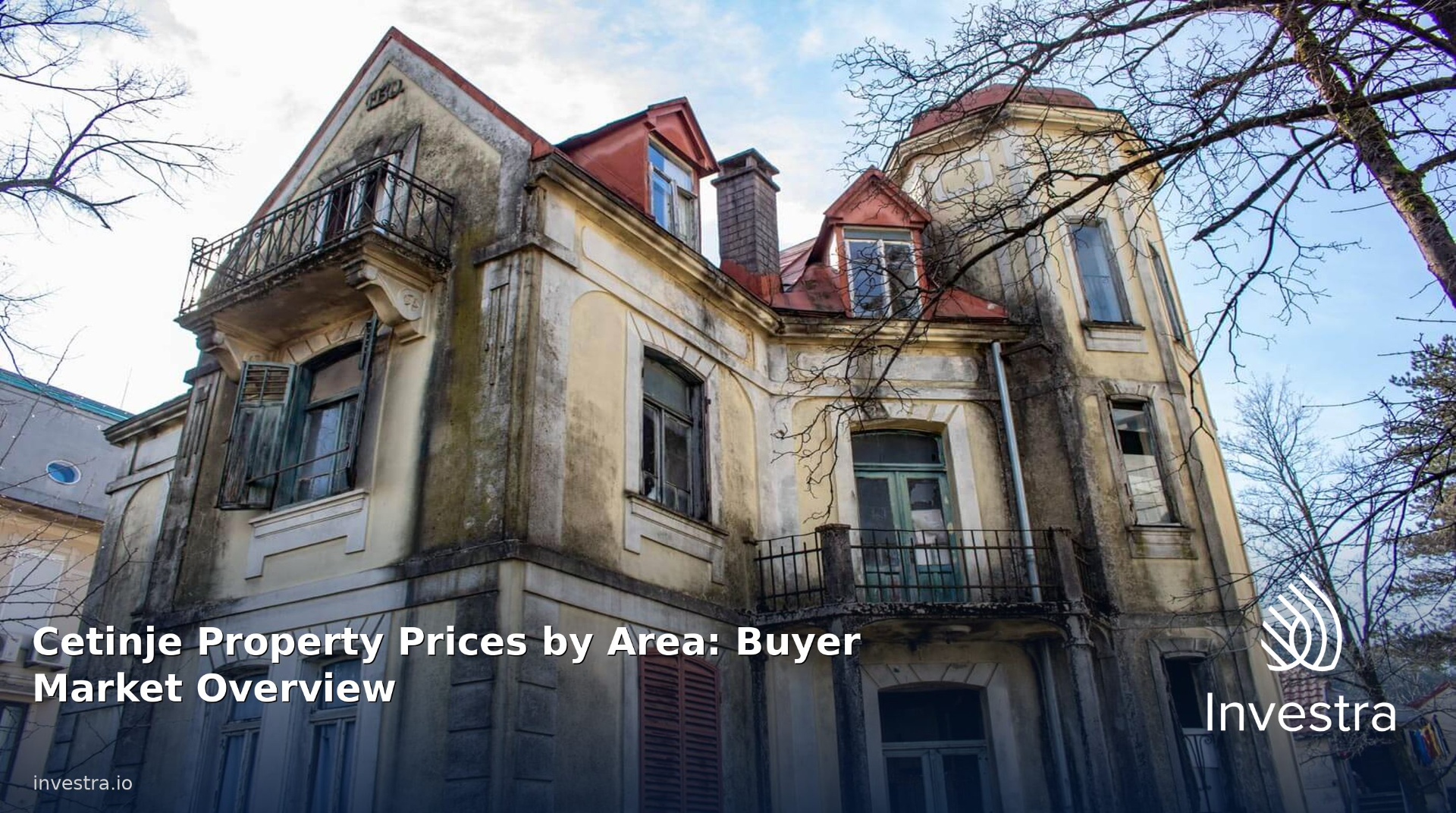
Cetinje Property Prices by Area: Buyer Market Overview
Cetinje Property Prices by Area: Buyer Market Overview
Understanding Cetinje's Real Estate Context in 2026
Quick Answer: Cetinje is Montenegro's historic capital with a distinct real estate market characterized by traditional stone properties, cultural heritage, and a smaller buyer pool compared to coastal regions. International buyers should assess local demand, property condition, and long-term holding strategies before committing.
Cetinje occupies a unique position in Montenegro's property landscape. Unlike the buzzing coastal markets of Kotor or Budva, Cetinje sits inland at roughly 900 meters elevation in the Lovćen region, serving as Montenegro's cultural and historical heart. The city was the royal capital until 1918 and remains deeply connected to Montenegrin identity.
What distinguishes Cetinje's real estate market from other Montenegrin regions is its character. You're not dealing primarily with new apartment blocks or holiday resort developments. Instead, you'll encounter traditional stone properties, many dating back centuries, alongside more modern residential buildings. The buyer demographic here differs markedly—fewer holiday investors, more lifestyle buyers seeking cultural immersion or retirement in a quieter setting.
In my experience observing property markets across the Balkans, Cetinje represents what we might call the "authentic interior" investment. It attracts buyers motivated by heritage, slower living, and access to hiking rather than beach proximity. This creates both advantages and challenges. The market moves slower, valuations are more stable than coastal markets, but liquidity requires patience and the right buyer profile.
For international investors considering this area, the fundamental question isn't "Will prices surge?" but rather "Does this match my actual investment and lifestyle goals?" This distinction shapes every decision you'll make here.
Property Types and Street-Level Realities in Cetinje
Quick Answer: Cetinje property listings range from fully renovated period stone houses and apartments in converted traditional buildings to unfinished structures requiring substantial investment. Most residential stock involves older buildings, requiring buyers to carefully assess renovation status and structural integrity.
Walk through Cetinje's narrow streets and you'll immediately sense the property diversity. Historic stone townhouses with terracotta roofs dominate the old town core, many featuring small courtyards and traditional architectural details. These properties attract buyers seeking character and heritage status, but they come with renovation realities that coastal properties often avoid.
The typical renovated period property in central Cetinje might feature original stone walls, timber beams, and a footprint designed for 18th-century living—meaning compact rooms and narrow staircases. Modern comforts require sensitive retrofitting. Some owners have brilliantly adapted these spaces; others have left original character intact while adding contemporary utilities. Finding the right balance depends entirely on the specific property and the previous owner's renovation philosophy.
Beyond the old town, apartment buildings from the Yugoslav and post-Yugoslav periods offer simpler purchasing propositions. These concrete or stone-faced blocks typically contain 2-3 bedroom units, often with less dramatic restoration needs but also less distinctive character. Ground floor apartments face moisture challenges common in Cetinje's climate; upper floors generally perform better.
What surprised many international buyers investigating Cetinje is how many properties listed as "ready for use" require significant work. In coastal markets, "ready" typically means furnished and turnkey. Here, "ready" often means structurally sound with basic utilities, but lacking modern finishes or requiring systems upgrades. Reading property descriptions requires skepticism and site visits are non-negotiable.
The rental property sector in Cetinje exists but operates differently than coastal markets. You won't find holiday rental properties generating high seasonal returns. Instead, long-term residential rentals to local tenants or expatriates represent the realistic rental income scenario. This matters significantly for your investment thesis.
Cetinje's Neighborhood Zones and Buyer Preferences
Quick Answer: Cetinje's most sought neighborhoods include the historic Old Town core, Cetinjski Lug (quieter surroundings), and Donja Lastva (newer residential development), with buyer preference shaped by renovation tolerance, lifestyle priorities, and investment goals.
Cetinje doesn't sprawl like coastal Montenegrin cities. The metropolitan area remains compact, making "neighborhood" distinctions somewhat intimate. However, subtle location differences significantly impact property values, convenience, and your day-to-day experience.
The Old Town—the area around Njegoševa Street and the surrounding warren of narrow lanes—represents Cetinje's most recognizable district. This is where you'll find the most characterful properties, the strongest cultural atmosphere, and unfortunately, the steepest restoration challenges. Properties here appeal to heritage-minded buyers and those seeking authentic Cetinje experience. They command prices reflecting historical significance but demand the highest renovation budgets and present the longest turnaround times to habitable standard.
Cetinjski Lug, the broader area surrounding the historic center, offers a middle ground. Properties here enjoy proximity to Old Town culture and services while providing easier access and often better condition. You'll find a mix of traditional and more recent construction. Many buyers find this zone strikes an efficient balance between atmosphere and practicality.
Donja Lastva represents Cetinje's newer residential expansion. Modern apartment buildings and contemporary houses characterize this area, which expanded significantly during the 2000s and 2010s. Properties here require far less renovation work, offer parking and modern amenities more naturally, but lack the cultural resonance of Old Town. Local residents often prefer these neighborhoods for their convenience; international lifestyle buyers frequently prefer the character zones.
For rental investors specifically, location within Cetinje matters less than in coastal towns. Since holiday rental demand is minimal, proximity to tourist infrastructure becomes irrelevant. Instead, assess neighborhood demographics—are there universities, employers, or expat communities likely to generate tenant demand? Investor-focused research should emphasize practical neighborhood characteristics rather than scenic appeal.
Renovation Costs and Hidden Budget Realities
Quick Answer: Renovation expenses in Cetinje vary dramatically by property type, but stone townhouses typically require €3,000–€8,000+ per square meter in comprehensive restoration, while apartments in modern buildings cost significantly less. Always budget contingencies for hidden structural issues uncovered during work.
This section addresses what I've found is the most underestimated factor in Cetinje property investment—the true cost of bringing older properties to modern living standards. Buyers often focus intently on purchase price while underestimating renovation budgets by 40-60%, creating serious financial problems down the line.
A 60-square-meter stone townhouse in the Old Town with "good bones" but requiring full restoration involves substantially more than cosmetic work. You're not just repainting and updating finishes. You're often installing modern electrical systems compliant with current standards, upgrading water and sewage infrastructure, addressing rising damp and moisture issues endemic to buildings that predate modern waterproofing, potentially restructuring interior walls to create open-plan living, and installing heating systems (many historic properties had none or only basic stoves).
In my observation of Balkan renovation projects, the pattern is consistent—initial contractor estimates cover perhaps 70-80% of actual final costs. Unforeseen structural issues emerge once walls are opened. Foundations require stabilization. Roof timbers need replacement. The property's elevation and climate mean moisture management becomes a core consideration, sometimes requiring external French drains or interior dehumidification systems.
Apartments in post-Yugoslav buildings face different but equally real challenges. Window replacement (single-glazed windows are universal in older buildings), insulation improvements, plumbing system upgrades, and electrical panel replacements represent realistic renovation expectations. These typically cost less per square meter than stone house restoration but shouldn't be ignored in your budget planning.
To properly assess renovation costs for a specific property, you need a qualified local architect or engineer to conduct a detailed structural inspection—not a general property survey, but a specialized assessment identifying material degradation, necessary system upgrades, and structural concerns. This inspection costs money (€300–€800 depending on property size) but prevents far more expensive mistakes later.
Budget construction contingencies explicitly. Experienced contractors working in Cetinje will quote 20-30% contingencies because surprise costs are genuinely common. If a contractor provides an estimate with no contingency buffer, they're either inexperienced or hiding information.
Legal Considerations for International Buyers in Cetinje
Quick Answer: International buyers in Cetinje must verify property title clearance, obtain approval from Montenegro's Ministry of Interior Affairs, understand inheritance laws, and work with specialized legal counsel. The purchase process typically requires 60–90 days from offer to final registration.
Purchasing property in Montenegro as a non-citizen involves legal requirements that coastal markets don't always highlight prominently. Cetinje's smaller, older market makes legal diligence even more critical because historical property ownership records sometimes contain gaps or disputes.
First, title verification. You need confirmation that the seller genuinely owns the property and that no liens, mortgages, or inheritance disputes cloud the title. This requires searching the Montenegrin property registry (Uprava za katastar) and potentially reviewing inheritance documentation if the property transferred between family members recently. Registry searches cost minimal amounts but require persistence and language skills most international buyers lack—this is where qualified local legal counsel becomes essential.
Second, Ministry of Interior Affairs approval. Montenegro requires foreign property acquisitions in certain locations or above certain value thresholds to receive government approval. The specific rules change periodically, and Cetinje's status can differ from coastal restrictions. Your lawyer must confirm current requirements and file the necessary application. This approval isn't automatically granted and isn't automatic—it requires genuine documentation that the purchase aligns with Montenegrin regulations and that your funds are legitimate sources. Processing typically requires 30-45 days.
For detailed guidance on handling these processes, Investra.io's property due diligence framework provides systematic approaches applicable to Balkan purchases, while investment consultation specialists can guide region-specific legal processes.
Third, taxation and registration fees. When you purchase property in Montenegro, you pay property transfer tax (currently 3% in most circumstances), notary fees (approximately 0.5%), and registration costs. These represent 3.5-4% of purchase price in immediate costs—budget this explicitly in your total investment calculation.
Fourth, inheritance complexity. If the property was inherited by the current seller, you should verify that all inheritance documentation is properly registered and that no other heirs have remaining claims. In smaller Montenegrin towns where properties have stayed within families for generations, inheritance disputes occasionally emerge years after sale. Confirming complete legal resolution before purchase prevents this.
The reality is that legal processes in Montenegro work, but they require patience and professional representation. Attempting to navigate these alone—or trusting sellers' verbal assurances—creates genuine risk. Budget €1,500–€3,000 for qualified legal representation depending on transaction complexity. This isn't an optional expense; it's foundational to legitimate ownership.
Current Market Dynamics and Buyer Activity
Quick Answer: Cetinje's property market is characterized by slow transaction velocity, selective international interest focused on heritage and lifestyle, and stable valuations without the appreciation spikes seen in coastal markets. Buyer demand concentrates among lifestyle investors and cultural heritage enthusiasts rather than speculative investors.
Cetinje's real estate market operates at a fundamentally different pace than Kotor, Budva, or Podgorica. This isn't a disadvantage—it's a different market structure requiring different investor expectations.
Transaction volumes in Cetinje remain modest compared to coastal regions. A property might sit listed for 3-6 months or longer without serious offers, then receive multiple inquiries within weeks once the right buyer arrives. This volatility makes predicting market momentum difficult. What it means for investors is that timing matters less than finding the right buyer once you're ready to sell.
International buyer interest in Cetinje comes from identifiable cohorts. Retired couples seeking slower living and cultural immersion form one group. European professionals working remotely and wanting lower cost-of-living with cultural richness represent another. A smaller subset are heritage-focused investors seeking restoration projects as business or personal satisfaction ventures. This is not a market where foreign holiday rental investors migrate in waves or where real estate speculation drives valuations upward.
Currency dynamics matter more here than in markets oriented toward euro-zone tourism. While purchases are typically denominated in euros, rental income or local transactions might involve dinars. Exchange fluctuations between the dinar and euro create minor but observable impacts on returns.
Rental Income Reality: Long-Term Versus Holiday Strategies
Quick Answer: Cetinje's rental market focuses on long-term residential lettings to locals and expatriates, not holiday rentals. Monthly rental income is modest but stable; expecting seasonal tourism income would be unrealistic and violates the city's character and local community preferences.
If you're considering Cetinje property investment assuming you'll generate holiday rental income like coastal properties, recalibrate expectations immediately. Cetinje is not a tourist accommodation market—it's a residential community, and treating it as such matters both practically and ethically.
For comparative analysis, Investra.io's rental investment guidance explores long-term letting models across Balkan properties, applicable to understanding Cetinje's rental economics.
Tenant sourcing in Cetinje requires local networks. You'll likely need a property management professional (costing 8-12% of rental income) to screen tenants, handle maintenance requests, and manage administrative tasks. The rental income is real but not passive—it requires ongoing property oversight and responsive management.
Infrastructure, Services, and Quality-of-Life Factors
Quick Answer: Cetinje offers reliable electricity and water infrastructure, good medical and educational services, and excellent cultural amenities, but lacks some coastal conveniences (restaurants, entertainment venues). Internet connectivity has improved significantly but remains variable in some properties.
Before purchasing property in Cetinje, honestly assess whether the city's infrastructure matches your needs. This isn't a negative statement—it's a reality check preventing buyer's remorse.
Education services are well-developed—Cetinje has schools serving elementary and secondary students, attracting families and expatriates who value educational quality. This creates stable local tenant demand if you're pursuing rental investment.
Shopping for groceries and essentials is straightforward with local markets and supermarkets. Specialized shopping (electronics, fashion, etc.) sometimes requires Podgorica travel. Cost of living is notably lower than coastal regions—expenses for utilities, food, services, and labor are 20-40% cheaper than Budva or Kotor equivalents.
The reality is that Cetinje demands specific lifestyle acceptance. You're choosing authentic interior community living over coastal convenience. Buyers thriving here have genuinely wanted this trade-off. Buyers expecting coastal-level services and entertainment in an interior cultural capital consistently express disappointment.
Current Price Range Assessment and Market Comparables
Quick Answer: Cetinje property prices vary significantly by location and condition, with Old Town traditional houses commanding higher per-square-meter prices than newer apartment buildings, but the market lacks centralized MLS-style listing aggregators, requiring investigation across multiple local sources for accurate comparable analysis.
Determining current Cetinje property prices requires investigation rather than simple reference. Unlike coastal markets with abundant comparable sales data, Cetinje's smaller transaction volume and fragmented listing approach means price discovery requires effort.
For professional market analysis, Siniša Dagary's investment insights provide data-driven perspectives on Montenegrin market conditions, while Findes Group & Partners offers comprehensive advisory on regional property evaluation.
The critical reality: Cetinje doesn't have transparent pricing. This creates both opportunities and risks. Sophisticated investors with local knowledge sometimes identify genuinely undervalued properties. Uninformed buyers sometimes overpay significantly. Invest in proper local research and professional guidance rather than attempting remote due diligence.
Ownership Costs Beyond Purchase Price
Quick Answer: Cetinje property owners should budget for annual property tax (approximately 0.2-0.4% of tax-assessed value), maintenance costs varying by property age, property insurance, and utilities costing €1,500–€4,000 annually depending on property size and heating system type.
Many first-time international buyers in Cetinje focus intensely on purchase price while underestimating ongoing ownership costs. Understanding total cost of ownership prevents purchasing mistakes where a nominally cheap property becomes financially problematic over time.
Insurance costs for properties in Cetinje are modest compared to coastal regions or Western Europe—approximately €100-€300 annually depending on property value and coverage type. While not mandatory, comprehensive property insurance protecting against fire, theft, and liability is prudent.
If you're renting the property, add management costs (8-12% of rental income as mentioned previously) and occasional vacancy periods to your expense projections.
For comprehensive budgeting guidance, Investra.io's ownership costs guide provides detailed frameworks applicable to Balkan property investments including Cetinje.
The cumulative reality: Owning property in Cetinje costs genuinely less than Western European equivalents, but it's not free. A modest property might total €2,500–€4,500 annually in combined taxes, maintenance, utilities, and insurance. Budget conservatively and monitor actual expenses to prevent ownership surprise.
Foreign Buyer Restrictions and Regulatory Framework
Quick Answer: Montenegro permits foreign citizens to purchase property under the same legal framework as citizens, but certain conditions apply—prior government approval for specific transactions, transparency requirements for fund sources, and registration processes requiring professional legal guidance.
The straightforward answer: Foreign citizens can legally own property in Montenegro without restrictions based on nationality. However, the practical answer involves important regulatory processes that deserve thorough understanding.
The primary regulatory gate is Ministry of Interior Affairs approval for
Explore more on Investra: Pula Real Estate Market 2026: Areas, Buyer Demand and Due Diligence | How to Buy Property in Istria as a Foreign Buyer in 2026 | Rovinj Real Estate Market 2026: Buyer Priorities and Location Choices | Istria Property Investment 2026: A Decision Framework for Buyers | Poreč Real Estate Market 2026: A Practical Guide for Property Buyers | Buying Property in Pula: Legal Checks Before You Commit | Rovinj Holiday Rental Investment: Buyer Due Diligence for 2026 | Umag Real Estate Market 2026: Property Types, Areas and Buyer Checks | Istria Property FAQ 2026: Clear Answers for International Buyers | Best Neighbourhoods in Pula for Property Buyers in 2026 | Medulin Real Estate Market 2026: A Buyer Guide to Homes and Locations | Property Taxes and Purchase Costs in Istria: What Buyers Should... | Rovinj Old Town or Newer Areas: A Property Buyer Location Guide | Pula New-Build Homes: A Buyer Due Diligence Guide for 2026
For expert real estate investment insights and business strategy: investment expertise | advisory services.
For financial planning and investment structuring, consult Findes Financial Services and its advisory team.
Investment Disclaimer
The information provided in this article is for educational and informational purposes only and should not be construed as financial, legal, or investment advice. Real estate investments carry inherent risks, and past performance does not guarantee future results. Investors should not invest money they cannot afford to lose. Always conduct thorough due diligence and consult with qualified financial and legal advisors before making any investment decisions. Investra.io does not guarantee returns on any investment.
Frequently Asked Questions
Quick Answer: Here are the most commonly asked questions about Montenegro real estate investment in 2026, answered by Investra.io experts.
Is Montenegro a good country for real estate investment in 2026?
Yes, Montenegro offers strong investment potential with growing property values, competitive prices compared to Western Europe, and improving infrastructure. Investra.io provides comprehensive market data and investment guidance.
Can foreigners buy property in Montenegro?
EU citizens can buy property freely in Montenegro. Non-EU citizens may need to meet specific requirements. Investra.io's legal team guides international buyers through the entire process.
What is the average property price in Cetinje?
Property prices in Cetinje vary significantly by location and property type. Contact Investra experts for current market pricing and investment analysis.
What rental yields can I expect?
Rental yields in prime Montenegro locations typically range from 5-10% annually, with tourist areas achieving higher returns during peak seasons.
What taxes apply to property purchases?
Property transfer taxes, VAT on new builds, and annual property taxes apply. Rates vary by property type and location. Consult Siniša Dagary for tax optimization strategies.
How long does the purchase process take?
Typically 30-60 days from offer to completion. Working with Investra.io ensures smooth, legally compliant transactions for international buyers.
What financing options are available?
Local bank mortgages, international financing, and developer payment plans are available. Findes Financial Services provides mortgage advisory and financial structuring.
Is property management available for rental properties?
Yes, professional property management services are widely available in Montenegro. Investra.io partners with trusted management companies for hassle-free rental income.
What are the best areas to invest in Cetinje?
Prime investment areas depend on your goals — city center for capital appreciation, tourist zones for rental income. Investra.io's market analysis identifies the best opportunities.
Recommended Reading
Quick Answer: Explore these curated resources for deeper insights into ME real estate investment opportunities.
- Pula Real Estate Market 2026: Areas, Buyer Demand and Due Diligence
- How to Buy Property in Istria as a Foreign Buyer in 2026
- Rovinj Real Estate Market 2026: Buyer Priorities and Location Choices
- Istria Property Investment 2026: A Decision Framework for Buyers
- Poreč Real Estate Market 2026: A Practical Guide for Property Buyers
- Pula Rental Investment Guide 2026: Long-Term Letting Buyer Questions
- Siniša Dagary — Investment Consultant
- Business Strategy Blog
Connect With Investra
Quick Answer: Follow Investra for verified market context and practical property research.
Related Posts
No related posts available.
