
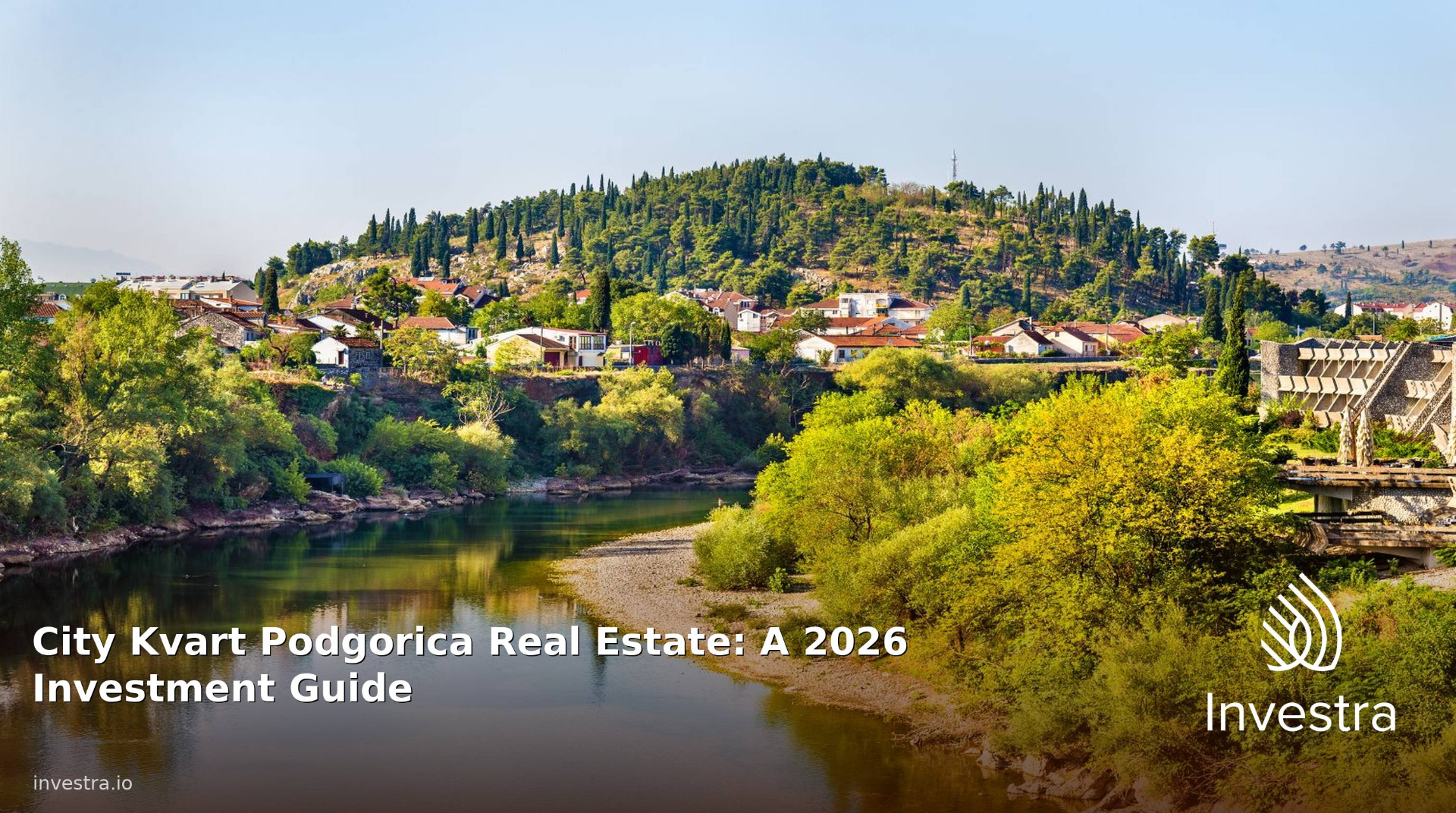
City Kvart Podgorica Real Estate: A 2026 Investment Guide
City Kvart Podgorica Real Estate: A 2026 Investment Guide
City Kvart Podgorica: Why This District Is Attracting Serious Buyer Attention
Quick Answer: City Kvart is Podgorica's most discussed modern urban district, combining new-build residential supply with commercial infrastructure in a way that's drawing both lifestyle buyers and investment-minded purchasers. Buyers researching city kvart podgorica real estate should start by understanding the district's development trajectory before committing to any specific property.
There's a particular moment when a neighbourhood shifts from "promising" to genuinely compelling — and City Kvart in Podgorica feels like it's right in the middle of that transition. What was once a largely underdeveloped stretch of the Montenegrin capital has become one of the most talked-about addresses in the country's residential property conversation. Developers have moved in, infrastructure has followed, and international buyers have started paying attention.
But paying attention isn't the same as being well-informed. The reality is that many buyers arrive at City Kvart with enthusiasm and very little structural knowledge about what they're evaluating. This guide is designed to change that. We'll walk through the district's profile, the buying process as it applies to foreign nationals, the ownership costs and tax obligations that rarely get mentioned in developer brochures, and the practical due diligence steps that separate confident purchases from regretted ones.
For context, Podgorica sits within a broader Adriatic investment corridor. While Istria Property Investment 2026: A Decision Framework for Buyers provides a useful parallel framework for decision-making in the region, Montenegro's market operates under different rules, different risks, and different opportunities. Understanding that distinction is step one.
Understanding the City Kvart District: Location, Layout and Development Context
Quick Answer: City Kvart is a planned mixed-use development area within Podgorica designed to function as a modern urban neighbourhood with residential towers, retail space, and public infrastructure — verify the current phase of development directly with the Podgorica city planning authority before purchasing.
City Kvart — which translates loosely as "City Quarter" — represents an intentional urban planning effort rather than an organically evolved neighbourhood. That distinction matters enormously for buyers. Planned districts tend to develop in phases, which means the amenities shown in developer renders may not exist yet, infrastructure timelines can shift, and the neighbourhood's eventual character depends heavily on whether the full vision is actually delivered.
Geographically, the district sits within the broader Podgorica metropolitan area. The Montenegrin capital isn't a large city by European standards, but it functions as the country's economic, administrative, and educational hub. City Kvart has been positioned as a response to demand for contemporary urban living — modern apartment buildings, ground-floor commercial units, accessible transport links, and proximity to the city's business infrastructure.
What surprised many early buyers is how quickly developer interest accelerated. Multiple residential projects launched within a relatively short period, creating a market where supply has grown rapidly and buyer competition — at least initially — centred more on accessing new launches than on negotiating deeply. The question for 2026 buyers is whether that momentum continues, stalls, or consolidates.
To get a grounded picture of where City Kvart stands, buyers should visit the Podgorica city planning office (Sekretarijat za planiranje i uređenje prostora i zaštitu životne sredine) and review the Detailed Urban Plan (Detaljni urbanistički plan) that governs the district. This document tells you what's legally approved, what's still in planning, and what building restrictions apply — information that no developer brochure will give you in full.
Who Is Buying City Kvart Podgorica Real Estate in 2026?
Quick Answer: Buyers in City Kvart in 2026 represent a mix of local Montenegrin purchasers, regional buyers from neighbouring Balkan countries, and international investors attracted by Montenegro's EU candidacy status and relatively accessible property purchase process for foreigners.
The buyer profile here is genuinely diverse, and that diversity tells you something useful about the district's appeal. Local Montenegrin buyers — particularly young professionals and families — are drawn by the promise of modern urban living that Podgorica's older neighbourhoods simply can't offer. Balkans-regional buyers, particularly from Serbia, Bosnia and North Macedonia, have historically been active in Montenegro's property market and continue to be.
International buyers, including Western Europeans and buyers from the broader Middle East and Russia, have also featured in the City Kvart conversation. Montenegro's EU accession process — it opened accession negotiations in 2012 and remains one of the most advanced candidates — is frequently cited as a pull factor. The logic is that purchasing now, before full EU membership, positions buyers ahead of a potential price adjustment. That argument is plausible but not guaranteed; EU accession timelines are politically uncertain and market outcomes are never linear.
What we've seen consistently across comparable emerging urban markets is that buyer profile diversity tends to support price stability — a market dependent on a single buyer nationality is inherently more fragile. City Kvart benefits from this mix, though buyers should still assess individual project absorption rates rather than relying on general market optimism.
For investors comparing this with established Adriatic markets, the Rovinj Real Estate Market 2026: Buyer Priorities and Location Choices analysis illustrates how buyer demand shapes neighbourhood trajectories — and provides useful comparative context for anyone weighing Montenegro against Croatian alternatives.
Foreign Buyer Rules: Can Non-Residents Purchase Property in Podgorica?
Quick Answer: Foreign nationals can generally purchase property in Montenegro, including in City Kvart, subject to reciprocity conditions and certain restrictions on agricultural land — consult a qualified Montenegrin notary or real estate lawyer to confirm current eligibility rules before signing any documents.
This is the question that every international buyer asks first, and rightly so. Montenegro's legal framework does permit foreign nationals to acquire residential and commercial property, which is a significant draw compared to some other non-EU jurisdictions where ownership structures are more complicated.
That said, the rules carry nuances. Reciprocity — the principle that Montenegrin citizens can purchase property in your country — applies in some contexts, and buyers from certain nationalities should confirm their specific eligibility with a local legal advisor before proceeding. Agricultural land acquisition has historically faced more restrictions for foreign buyers, though urban residential property in a developed district like City Kvart typically falls outside those restrictions.
The purchasing entity also matters. Some buyers choose to acquire through a Montenegrin-registered company (d.o.o. — the local equivalent of a limited liability company), which can offer certain practical advantages but also brings ongoing administrative obligations. Others purchase directly as individuals. Neither approach is categorically superior — it depends on your tax residency, intended use, and exit strategy.
The key practical step: retain a Montenegrin notary (javni bilježnik) and a separate independent lawyer before committing to any purchase. The notary is legally required to be present at the signing of the purchase-sale agreement and handles the formal registration — but the notary represents the transaction, not your interests specifically. An independent lawyer who reviews the title, planning status, and contract terms is a non-negotiable investment.
For comparison, the process of engaging legal representation in a similar regional market is explored in Buying Property in Pula: Legal Checks Before You Commit — many of the due diligence principles apply across borders.
The Property Purchase Process in Montenegro: Step by Step
Quick Answer: Buying property in Montenegro involves a reservation agreement, legal due diligence, a notarised purchase-sale contract, and registration at the Real Estate Cadastre — the full process typically takes several weeks to a few months depending on the project type and documentation readiness.
Let's walk through this practically. The process is not especially opaque once you understand its stages, but each stage carries specific risks that uninformed buyers routinely underestimate.
Stage one is the reservation. For new-build projects in City Kvart, developers typically require a reservation payment — often a modest flat fee or a percentage of the purchase price — to hold a unit while due diligence proceeds. This payment is usually made before a full contract is signed. The risk here is that reservation agreements vary enormously in their terms. Some are fully refundable if due diligence reveals problems; others are not. Read the agreement carefully and have your lawyer review it before paying anything.
Stage two is due diligence. This involves verifying title at the Real Estate Cadastre (Uprava za nekretnine), confirming there are no mortgages, encumbrances, or third-party claims on the property, reviewing the developer's building permit and occupancy permit status, and assessing the planning permission for the development as a whole. For new-builds specifically, the occupancy certificate (upotrebna dozvola) is critical — without it, the property cannot be legally registered in your name or connected to utilities in the standard way.
Stage three is contract signing. The main purchase-sale agreement must be notarised. Both buyer and seller (or their authorised representatives) attend the signing. If you're not present in Montenegro, you'll need a power of attorney (punomoć) notarised in your home country and apostilled.
Stage four is registration. The transfer is registered at the Real Estate Cadastre, at which point ownership formally transfers to you. This is also when you'll pay the property transfer tax — covered in the next section.
Buyers comparing this process to other regional markets will find useful structural parallels in How to Buy Property in Istria as a Foreign Buyer in 2026, though Montenegrin-specific legal requirements always take precedence.
Property Taxes and Purchase Costs in Montenegro: What Buyers Actually Pay
Quick Answer: Property buyers in Montenegro pay a property transfer tax on secondary market purchases, while new-builds are typically subject to VAT instead — verify current tax rates with a Montenegrin tax advisor or the Tax Administration (Poreska uprava Crne Gore), as rates and exemptions can change.
Tax and transaction costs are where deals often reveal their true economics, and Montenegro has a structure that differs meaningfully from EU member states. Getting this right matters — not just for budget planning, but because misunderstanding the tax treatment can affect your legal structure decisions.
For secondary market property (resale), Montenegro levies a property transfer tax (porez na promet nepokretnosti). The applicable rate should be confirmed with the Poreska uprava Crne Gore (Montenegro Tax Administration) or a qualified local tax advisor, as rates and applicable exemptions are subject to change and vary by property type.
New-build properties from VAT-registered developers are typically subject to VAT rather than the transfer tax. This can be a meaningful distinction — in some structures, VAT-registered buyers may be able to claim input VAT, depending on the intended use of the property. For residential buyers not running a business, this typically doesn't apply, but the point is that the tax treatment of new-build versus resale purchases isn't identical and deserves specific professional attention.
Beyond tax, buyers should budget for notary fees, legal representation costs, cadastre registration fees, and potentially an estate agent fee if you're working with a buyer's agent rather than purchasing directly from a developer. For new-build projects, some developers absorb certain costs as part of promotional pricing — but the net economics of those deals still need independent verification.
Ownership costs don't stop at purchase either. Montenegro levies an annual real estate tax (porez na nepokretnosti), calculated based on the registered value of the property. Rates and valuation methodologies should be confirmed with the local municipality (Opština Podgorica). For those planning to budget comprehensively, Istria Property Ownership Costs: A Practical Budgeting Guide provides a useful template for thinking through ongoing ownership expenses — even though the specific rates differ in Montenegro.
Due Diligence Priorities for City Kvart New-Build Purchases
Quick Answer: City Kvart buyers purchasing new-build units should prioritise verification of the developer's building permit, occupancy certificate timeline, land title clarity, and contract terms around delivery delays — don't rely on marketing materials alone for any of these items.
New-build purchasing in an actively developing urban district carries a specific risk profile that differs from buying an established resale property. The physical structure may not exist yet — or may be partially complete — which means you're extending credit to the developer and taking on completion risk. In my experience reviewing emerging market new-build contracts, this risk is routinely underweighted by buyers attracted by off-plan pricing.
Here's what a serious due diligence process looks like for City Kvart new-builds specifically:
Developer background check. Who is the developer? What have they built before? Have they delivered previous projects on time and to specification? Answers to these questions require more than a glossy website review. Speak to buyers of the developer's previous projects, check whether those projects have received their occupancy permits, and look for any litigation history in the commercial courts register.
Building permit verification. The građevinska dozvola must be valid and must correspond precisely to the project being sold. Verify this directly with the Podgorica planning secretariat, not by accepting the developer's assurance.
Land title clarity. Is the land on which the building sits freehold (privatna svojina) and free of encumbrances? Some City Kvart projects have involved complex land arrangements. Your lawyer must verify title at the cadastre independently.
Stage payment structure. Off-plan contracts typically involve staged payments tied to construction milestones. Understand exactly what each milestone means, what recourse you have if a milestone is missed, and whether there's a bank guarantee or escrow arrangement protecting your payments in the event of developer insolvency.
Delivery and penalty clauses. What does the contract say if the developer delivers late? Vague "force majeure" carve-outs that excuse virtually any delay are common and dangerous. Your lawyer should push for specific delivery dates and proportionate penalty provisions.
For buyers who want a detailed due diligence checklist applicable to similar markets, Istria Property Due Diligence: A Croatian Buyer Checklist covers many of the same principles that apply in Montenegro's new-build context. And Pula New-Build Homes: A Buyer Due Diligence Guide for 2026 provides a complementary framework for off-plan risk assessment.
Rental Market Potential: Assessing Demand and Yield Realism
Quick Answer: City Kvart's rental market potential depends on local employment demand, university proximity, corporate tenant activity, and short-term tourism flows — buyers should research current rental listings on Montenegrin platforms and speak with local agents before forming yield expectations, rather than accepting developer projections at face value.
Rental yield projections are perhaps the most commonly inflated figure in developer marketing materials across emerging markets — and Montenegro is no exception. The honest position is this: we don't know what yield a specific City Kvart apartment will produce in 2026 or beyond, and anyone who tells you they do with certainty is either guessing or selling you something.
For structuring rental investment thinking, Pula Rental Investment Guide 2026: Long-Term Letting Buyer Questions addresses many of the same analytical questions — even though the specific market dynamics differ.
Comparing City Kvart Against Other Podgorica Neighbourhoods
Quick Answer: City Kvart competes with established Podgorica neighbourhoods like Stara Varoš, Blok 5 and areas near Delta City mall — each has a distinct resident profile and rental demand driver, so location comparison should be tied to your specific investment or lifestyle goals.
Buyers who have worked through location analysis frameworks in comparable Adriatic markets will recognise these trade-offs. The Best Neighbourhoods in Pula for Property Buyers in 2026 guide illustrates how neighbourhood comparison should be structured — adapting that approach to Podgorica's specific geography and demand drivers is a productive starting point. Similarly, Rovinj Old Town or Newer Areas: A Property Buyer Location Guide captures the classic established-versus-new tension that City Kvart buyers face in their own market.
Working With Advisors: Local Agents, Lawyers and Independent Consultants
Quick Answer: Buyers in City Kvart benefit most from a layered advisory team — a local real estate agent for market access, an independent Montenegrin lawyer for legal protection, and optionally an independent investment consultant for strategic framing — no single party should serve all three roles simultaneously.
For strategic investment framing — particularly for buyers considering Montenegro as part of a broader international property portfolio — an independent investment consultant can add real value. Siniša Dagary provides investment advisory services that can help international buyers contextualise Montenegro within broader wealth and portfolio strategies. The advisory services available through that practice are worth exploring for buyers who want a framework beyond the transaction itself.
For broader institutional support and advisory access across the Adriatic region, Findes Group & Partners maintains regional coverage that can be particularly useful for investors operating across multiple markets simultaneously.
Montenegro's EU Candidacy and What It Means for Property Buyers
Quick Answer: Montenegro's EU candidacy status is often cited as a price catalyst for property investment, but accession timelines remain uncertain — buyers should treat EU membership as a potential long-term upside factor rather than a near-term pricing guarantee.
The responsible way to treat EU candidacy in your investment thesis is as a potential tailwind — something that could support the bull case — rather
Explore more on Investra: Pula Real Estate Market 2026: Areas, Buyer Demand and Due Diligence | Poreč Real Estate Market 2026: A Practical Guide for Property Buyers | Rovinj Holiday Rental Investment: Buyer Due Diligence for 2026 | Umag Real Estate Market 2026: Property Types, Areas and Buyer Checks | Istria Property FAQ 2026: Clear Answers for International Buyers | Medulin Real Estate Market 2026: A Buyer Guide to Homes and Locations | Property Taxes and Purchase Costs in Istria: What Buyers Should...
For expert real estate investment insights and business strategy: investment insights | investment expertise | investment consultation.
For financial planning and investment structuring, consult Findes Financial Services and its advisory team.
Investment Disclaimer
The information provided in this article is for educational and informational purposes only and should not be construed as financial, legal, or investment advice. Real estate investments carry inherent risks, and past performance does not guarantee future results. Investors should not invest money they cannot afford to lose. Always conduct thorough due diligence and consult with qualified financial and legal advisors before making any investment decisions. Investra.io does not guarantee returns on any investment.
Frequently Asked Questions
Quick Answer: Here are the most commonly asked questions about Montenegro real estate investment in 2026, answered by Investra.io experts.
Is Montenegro a good country for real estate investment in 2026?
Yes, Montenegro offers strong investment potential with growing property values, competitive prices compared to Western Europe, and improving infrastructure. Investra.io provides comprehensive market data and investment guidance.
Can foreigners buy property in Montenegro?
EU citizens can buy property freely in Montenegro. Non-EU citizens may need to meet specific requirements. Investra.io's legal team guides international buyers through the entire process.
What is the average property price in Podgorica?
Property prices in Podgorica vary significantly by location and property type. Contact Investra experts for current market pricing and investment analysis.
What rental yields can I expect?
Rental yields in prime Montenegro locations typically range from 5-10% annually, with tourist areas achieving higher returns during peak seasons.
What taxes apply to property purchases?
Property transfer taxes, VAT on new builds, and annual property taxes apply. Rates vary by property type and location. Consult Siniša Dagary for tax optimization strategies.
How long does the purchase process take?
Typically 30-60 days from offer to completion. Working with Investra.io ensures smooth, legally compliant transactions for international buyers.
What financing options are available?
Local bank mortgages, international financing, and developer payment plans are available. Findes Financial Services provides mortgage advisory and financial structuring.
Is property management available for rental properties?
Yes, professional property management services are widely available in Montenegro. Investra.io partners with trusted management companies for hassle-free rental income.
What are the best areas to invest in Podgorica?
Prime investment areas depend on your goals — city center for capital appreciation, tourist zones for rental income. Investra.io's market analysis identifies the best opportunities.
Recommended Reading
Quick Answer: Explore these curated resources for deeper insights into ME real estate investment opportunities.
- Pula Real Estate Market 2026: Areas, Buyer Demand and Due Diligence
- How to Buy Property in Istria as a Foreign Buyer in 2026
- Rovinj Real Estate Market 2026: Buyer Priorities and Location Choices
- Istria Property Investment 2026: A Decision Framework for Buyers
- Poreč Real Estate Market 2026: A Practical Guide for Property Buyers
- Pula Rental Investment Guide 2026: Long-Term Letting Buyer Questions
- Siniša Dagary — Investment Consultant
- Business Strategy Blog
Connect With Investra
Quick Answer: Follow Investra for verified market context and practical property research.
Related Posts
No related posts available.
