
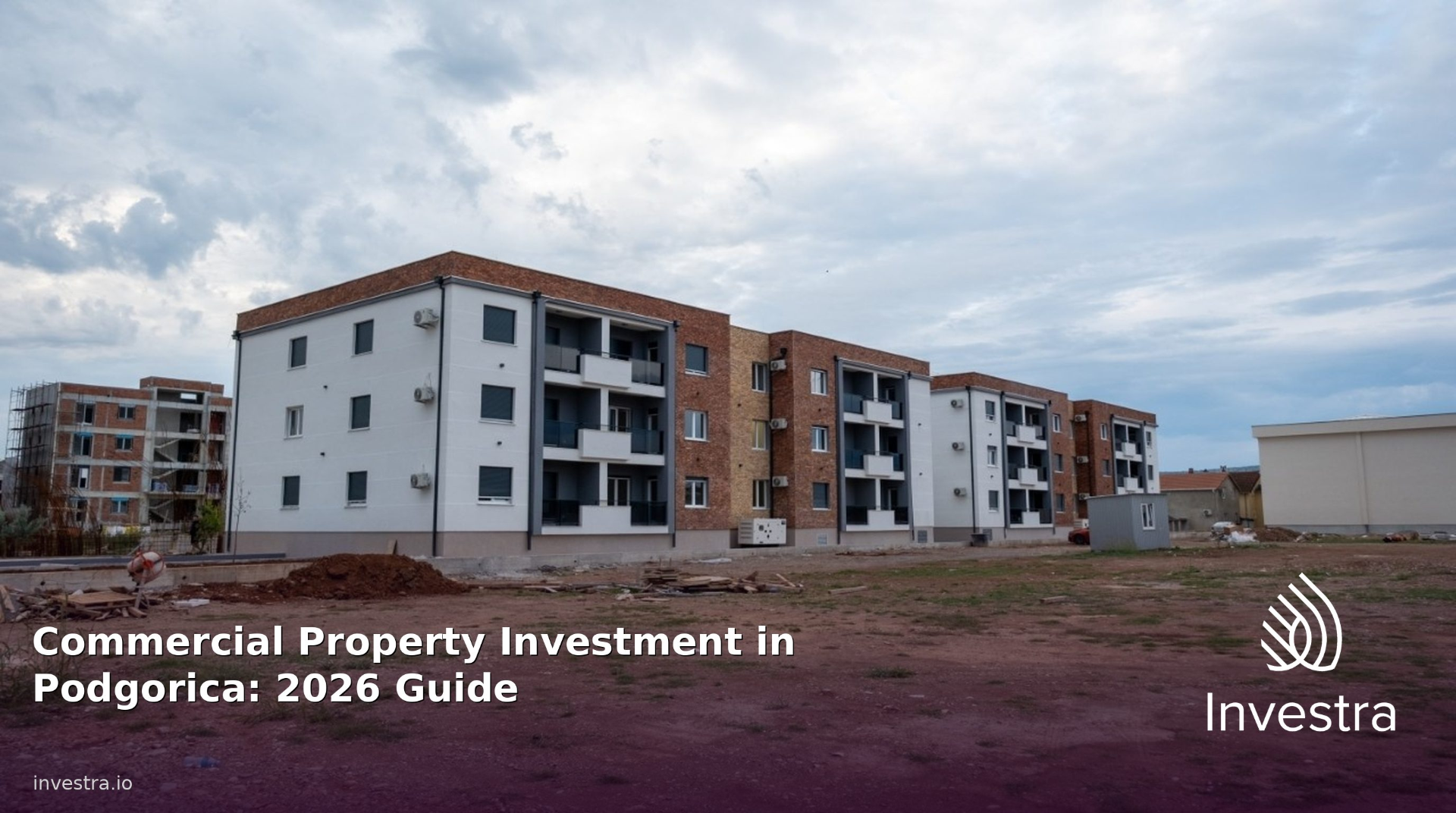
Commercial Property Investment in Podgorica: 2026 Guide
Commercial Property Investment in Podgorica: 2026 Guide
Why Podgorica Is Attracting Commercial Property Interest in 2026
Quick Answer: Podgorica is drawing growing attention from commercial property investors due to Montenegro's EU accession trajectory, improving infrastructure, and its role as the country's primary business hub. Verify current market conditions through Montenegro's real estate registries and consult qualified local advisors before committing.
Montenegro's capital doesn't get the glossy magazine treatment that Kotor or Budva routinely enjoy. That's actually part of the appeal. While the coastal towns are crowded with lifestyle buyers chasing sea views, Podgorica is quietly becoming a focus for investors who are thinking commercially — office space, retail units, mixed-use developments, and increasingly, short-term rental conversions in a city that's growing both in population and in economic complexity.
The reality is that commercial property investment in Podgorica sits at an interesting crossroads. Montenegro is in active EU accession negotiations, and the country has spent the last several years overhauling its legal and regulatory environment to meet European standards. That process — messy and gradual as it is — creates conditions that tend to precede significant appreciation in commercial real estate. We've seen this pattern across Eastern Europe: Warsaw, Tallinn, Bucharest — all delivered strong commercial property growth in the years running up to and following EU entry.
None of that guarantees anything in Podgorica. But it does explain why the question is worth asking seriously. Investors looking at the broader Adriatic region, who may already be exploring markets like Istria through resources like the Istria Property Investment 2026: A Decision Framework for Buyers, are increasingly including Montenegro in their comparative analysis. Podgorica is where the administrative, financial, and business infrastructure of the country actually lives — and that has direct consequences for commercial demand.
What we know is this: the city is growing, the economy is diversifying away from pure tourism dependence, and foreign investor interest in commercial assets is measurably higher than it was even three or four years ago. Whether that translates into returns that justify your capital allocation is a question that demands careful, locally-grounded research.
Understanding the Commercial Property Market Structure in Podgorica
Quick Answer: Podgorica's commercial property market spans offices, retail, light industrial, and hospitality assets — each behaving differently in terms of demand, vacancy, and pricing. To understand current conditions, consult local licensed agents and Montenegro's real estate price databases directly.
Before anyone starts evaluating specific properties, it helps to understand how the market is actually structured. Podgorica's commercial real estate isn't a single homogenous market — it's several distinct sub-markets operating under different supply-demand dynamics, and treating them as one is a common mistake that leads to poor investment decisions.
Office space in the city has historically been thin. Montenegro has a small but growing services sector — legal firms, fintech startups, regional headquarters of international NGOs and development organisations, and a steady stream of digital nomads who need professional infrastructure. The supply of Grade A office space that meets international standards remains limited relative to demand in this segment. That gap is closing as new developments come online, but the question investors need to ask is whether supply will outpace demand before they've had a chance to realise their investment thesis.
Retail space tells a different story. The city has seen significant growth in organised retail through shopping centre development, and this has created competitive pressure on smaller high-street units. Understanding which retail formats are gaining or losing occupier demand in Podgorica right now requires direct market intelligence — not assumptions imported from other European cities.
Then there's the hospitality and short-term rental segment. This is where commercial and residential investment genuinely blurs. Apartment buildings and smaller boutique properties are being acquired by operators who run them as professionally managed short-term accommodation, capturing business travellers, visitors attending governmental or conference events, and the slowly growing leisure tourist segment that uses Podgorica as a base. Investors exploring similar rental dynamics in neighbouring Croatia should look at Rovinj Holiday Rental Investment: Buyer Due Diligence for 2026 for comparison frameworks that translate across the region.
Light industrial and logistics is the quietest but potentially most interesting segment. As Montenegro develops as a transit and logistics hub for the western Balkans, demand for warehousing, cold storage, and last-mile distribution facilities near Podgorica is worth watching. This segment is undercovered by most investor commentary and may offer opportunities that aren't yet priced for competition.
The Legal Framework for Foreign Commercial Property Buyers in Montenegro
Quick Answer: Foreign nationals can generally purchase commercial property in Montenegro, but the process involves specific registration requirements, and legal due diligence is non-negotiable. Always engage a Montenegro-licensed lawyer before signing any agreement.
Montenegro has relatively open property ownership rules by regional standards. Foreign nationals — including non-EU citizens — can purchase commercial property directly, which is a meaningful structural advantage compared to some neighbouring markets where foreign ownership of commercial assets involves more restrictive conditions or mandates local partnership structures.
That said, "legally permissible" and "legally straightforward" are not the same thing. The title registration system in Montenegro has improved significantly in recent years, but there are still properties where historical title chains are incomplete, where cadastral records don't match actual use, or where encumbrances exist that aren't immediately visible without professional search. In my experience reviewing property markets across the region, Montenegro's urban commercial properties — particularly older assets in central Podgorica — require particularly careful title investigation.
Foreign buyers typically purchase either directly as individuals or through a Montenegrin-registered company. The company route has implications for how the asset is taxed, how it's financed, and how it's eventually disposed of — all of which need to be modelled out with a qualified local tax advisor before you structure the transaction. Buying through a foreign company is also possible in some circumstances, but this introduces additional complexity in terms of local registration and annual compliance obligations.
The purchase process formally involves: due diligence and searches, a preliminary agreement (sometimes with a deposit), a notarised sale and purchase agreement, payment, and registration with the Real Estate Administration. The notarial system in Montenegro is well-developed, and the notary plays a meaningful verification role — but this does not replace independent legal advice for a buyer. For a sense of how thorough due diligence operates in comparable regional markets, the Istria Property Due Diligence: A Croatian Buyer Checklist and the guide on Buying Property in Pula: Legal Checks Before You Commit offer frameworks worth adapting to the Montenegro context.
Taxes, Costs, and Transaction Fees to Budget For
Quick Answer: Commercial property purchases in Montenegro carry transaction taxes, registration costs, and ongoing annual obligations that materially affect total investment cost. Verify all current rates with a local tax advisor, as Montenegro's fiscal framework continues to evolve.
The tax structure around commercial property in Montenegro is one of the first things a buyer needs to understand — not because it's punitive, but because the total acquisition cost can diverge meaningfully from the headline purchase price if you're not accounting for everything correctly.
At the transaction level, property transfer tax applies to resale commercial properties. New properties are generally subject to VAT instead. The applicable rate and whether VAT is recoverable depends on the buyer's tax status and how the property will be used — a situation where the company versus individual ownership question becomes directly financially significant. Always confirm current rates with a registered Montenegrin tax advisor, since fiscal rules have been subject to ongoing adjustments as part of the EU alignment process.
Beyond transfer tax or VAT, buyers face notarial fees (calculated as a percentage of the transaction value), legal fees, agent commissions (which can be structured differently from Western European norms — sometimes charged to buyer, sometimes to seller, sometimes split), and property registration fees. Collectively, these transaction costs can represent a substantial percentage of the purchase price. Budget conservatively.
Once you own the asset, the ongoing tax picture includes property tax (assessed annually by the municipality), and income tax or corporate tax on rental income depending on how you hold the asset. Montenegro has historically positioned itself as a relatively competitive tax environment, including a flat corporate income tax rate that has attracted some international holding structures. But tax efficiency requires proper structuring, and the rules governing what qualifies for which treatment need to be verified against current law — not against articles written two or three years ago.
For a comparative sense of how transaction costs structure in neighbouring Croatia, investors should review Property Taxes and Purchase Costs in Istria: What Buyers Should Know and Istria Property Ownership Costs: A Practical Budgeting Guide.
Key Neighbourhoods and Commercial Zones in Podgorica
Quick Answer: Podgorica's commercial demand concentrates in the central business district, City Kvart, and newer development corridors — but each zone carries different occupier profiles, rent levels, and liquidity characteristics. On-the-ground research is essential.
Podgorica is not a large city by European standards, but it's more spatially varied than first-time visitors appreciate. The commercial property opportunity — and the risk profile — differs significantly across different parts of the city, and buying in the wrong zone for your intended use or tenant profile is a mistake that's expensive to undo.
The traditional central area around the main pedestrian zone and the older government quarter houses the city's established retail and professional services concentration. These properties are familiar to local tenants and benefit from footfall and recognition, but older stock sometimes presents structural and compliance challenges that newer developments avoid.
City Kvart — the newer mixed-use development area — represents Podgorica's most visible attempt to build a modern, internationally legible commercial environment. It has attracted higher-end retail, hospitality, and some office occupiers. Properties here tend to command premium pricing and offer modern specifications, but the investment case depends on continued demand growth to justify those premiums.
Areas along the main arterial roads and the zones near Podgorica's developing institutional infrastructure — the port area, logistics corridors, and areas near administrative concentrations — are worth assessing for more operationally-oriented commercial uses. The analysis here is less about prime retail footfall and more about functional tenant demand.
What surprised many early investors in Podgorica's commercial market was how quickly certain peripheral zones became attractive as the city expanded. That's worth remembering when evaluating what might look like an off-pitch location today — though of course past expansion patterns don't guarantee future growth direction.
Rental Income and ROI: How to Assess Commercial Yields in Podgorica
Quick Answer: Commercial property yields in Podgorica vary by asset type, location, and tenant quality. Rather than relying on published averages, assess yields using current asking rents from local agents, vacancy rates for comparable stock, and realistic operating cost assumptions.
Here's the honest reality of yield assessment in a market like Podgorica: published figures, where they exist at all, are often outdated, cherry-picked, or derived from a sample size too small to be statistically meaningful. Any advisor who quotes you a precise commercial yield figure without anchoring it to specific comparable transactions and current vacancy data should be questioned carefully.
What you can do — and what professional investors do — is build your own yield calculation from verifiable inputs. Start with what comparable properties are currently asking in rent per square metre per month. This data is available through local agents, property portals, and direct market inquiry. Then apply a realistic vacancy assumption: what is the current vacancy rate for this property type in this specific location? In a market with limited quality supply and strong occupier demand, vacancy can be low; in a saturated segment, it can be high. You need to know which situation your target property faces.
From gross rent, deduct operating costs — property management (critical for international investors who aren't on the ground), maintenance reserves, insurance, property tax, and any service charge obligations. What remains is your net operating income, and dividing that by purchase price gives you your net yield. That's the number that matters for comparing investments.
The short-term rental and Airbnb segment introduces additional complexity. Occupancy rates fluctuate seasonally — and Podgorica, as a business and administrative capital rather than a pure leisure destination, has a somewhat more stable year-round demand profile than coastal Montenegro. But it also has lower peak-season demand than beach destinations. Understanding the monthly occupancy distribution for comparable short-term rental units in Podgorica requires accessing local Airbnb market data through tools like AirDNA or similar platforms, and cross-referencing with operators already active in the city.
Investors exploring short-term rental dynamics in comparable contexts should also look at how the model works in more established regional markets — for instance, the Pula Rental Investment Guide 2026: Long-Term Letting Buyer Questions provides a useful analytical framework even for buyers focused outside Croatia.
Due Diligence Checklist for Commercial Buyers in Podgorica
Quick Answer: Commercial property due diligence in Podgorica must cover title integrity, zoning and planning permissions, environmental compliance, building permits, tenant lease terms, and tax obligations — at minimum. Engage both a legal advisor and a commercial property surveyor before exchange.
Due diligence on commercial property is categorically more complex than residential due diligence, and this is true in any market. In Podgorica specifically, there are some additional considerations that buyers from Western European markets don't always anticipate.
Start with title. Confirm the seller's legal right to sell, that no mortgages or encumbrances affect the property, and that the cadastral records accurately reflect physical boundaries and permitted use. This sounds basic, but in a market where urban development has been rapid and record-keeping has historically been inconsistent, problems at this level are not uncommon.
For complementary due diligence frameworks applicable in nearby markets, see the Pula New-Build Homes: A Buyer Due Diligence Guide for 2026 and the Istria Property FAQ 2026: Clear Answers for International Buyers.
Financing Commercial Property Purchases in Podgorica
Quick Answer: Commercial property financing in Montenegro is available through local banks, but terms differ significantly from EU market norms — higher rates, larger deposits, and stricter asset quality requirements are typical. Many international investors use equity or offshore financing instead.
The financing decision is material to return calculations. Interest costs directly reduce net yield, so modelling your investment returns should always include a realistic financing cost scenario — and a stress test of what happens if rates increase or a refinance proves more difficult than anticipated. Engaging an advisor with cross-border financing experience is genuinely useful here. For tailored guidance, advisory services from specialists familiar with the Balkan investment landscape can help structure financing approaches that match your specific situation.
Working With Advisors and Agents in Montenegro
Quick Answer: The quality of local professional support in Podgorica varies significantly — selecting the right lawyer, agent, and tax advisor is one of the most impactful decisions a foreign commercial buyer makes. Don't simply accept the first referral; verify credentials and track record independently.
For strategic investment perspective and cross-border context, resources like Siniša Dagary investment insights offer analytical depth on Balkan and Adriatic market dynamics that can help frame your Podgorica research. The Siniša Dagary profile provides background on the experience and focus areas that inform that perspective. For those at the early stages of structuring an investment approach, an investment consultation can help clarify what type of professional team you actually need to assemble for a Podgorica commercial project.
The Findes Group & Partners network is another resource worth knowing for cross-border investment coordination, with the Findes Group & Partners advisory team available for structured inquiry.
Comparing Podgorica to Other Regional Commercial Markets
Quick Answer: Podgorica sits at an earlier stage of market maturity than comparable EU-member cities, which means both higher potential upside and higher execution risk. Investors should compare explicitly rather than assuming the market behaves like more established peers.
One of the most useful exercises for any investor considering Podgorica is genuinely comparative analysis — not lazy comparisons that flatten out all differences, but structured comparison against markets where you already have grounding or where good data exists.
A second comparison set — particularly relevant for investors approaching from Croatia or Istria — is the broader Adriatic commercial market. Markets like Pula, Poreč, and Rovinj have different demand drivers (more tourism-oriented, EU-regulated), but the frameworks for assessing location quality, tenant risk, and construction standards are transferable. Reading the Pula Real Estate Market 2026: Areas, Buyer Demand and Due Diligence, Poreč Real Estate Market 2026: A Practical Guide for Property Buyers, and the Umag Real Estate Market 2026: Property Types, Areas and Buyer Checks gives investors a calibrated sense of what a more mature regional market looks like — and what Podgorica might develop toward over time.
Exit Strategy and Liquidity Considerations
Quick Answer: Commercial property in Podgorica is less liquid than residential, and the buyer pool for investment-grade commercial assets remains relatively small. Exit strategy must be planned from the point of acquisition, not as an afterthought.
This is, honestly, the section that too many buyers skip over in their enthusiasm for the entry thesis — and it's
Explore more on Investra: How to Buy Property in Istria as a Foreign Buyer in 2026 | Rovinj Real Estate Market 2026: Buyer Priorities and Location Choices | Best Neighbourhoods in Pula for Property Buyers in 2026 | Medulin Real Estate Market 2026: A Buyer Guide to Homes and Locations | Rovinj Old Town or Newer Areas: A Property Buyer Location Guide
For expert real estate investment insights and business strategy:.
Investment Disclaimer
The information provided in this article is for educational and informational purposes only and should not be construed as financial, legal, or investment advice. Real estate investments carry inherent risks, and past performance does not guarantee future results. Investors should not invest money they cannot afford to lose. Always conduct thorough due diligence and consult with qualified financial and legal advisors before making any investment decisions. Investra.io does not guarantee returns on any investment.
Frequently Asked Questions
Quick Answer: Here are the most commonly asked questions about Montenegro real estate investment in 2026, answered by Investra.io experts.
Is Montenegro a good country for real estate investment in 2026?
Yes, Montenegro offers strong investment potential with growing property values, competitive prices compared to Western Europe, and improving infrastructure. Investra.io provides comprehensive market data and investment guidance.
Can foreigners buy property in Montenegro?
EU citizens can buy property freely in Montenegro. Non-EU citizens may need to meet specific requirements. Investra.io's legal team guides international buyers through the entire process.
What is the average property price in Podgorica?
Property prices in Podgorica vary significantly by location and property type. Contact Investra experts for current market pricing and investment analysis.
What rental yields can I expect?
Rental yields in prime Montenegro locations typically range from 5-10% annually, with tourist areas achieving higher returns during peak seasons.
What taxes apply to property purchases?
Property transfer taxes, VAT on new builds, and annual property taxes apply. Rates vary by property type and location. Consult Siniša Dagary for tax optimization strategies.
How long does the purchase process take?
Typically 30-60 days from offer to completion. Working with Investra.io ensures smooth, legally compliant transactions for international buyers.
What financing options are available?
Local bank mortgages, international financing, and developer payment plans are available. Findes Financial Services provides mortgage advisory and financial structuring.
Is property management available for rental properties?
Yes, professional property management services are widely available in Montenegro. Investra.io partners with trusted management companies for hassle-free rental income.
What are the best areas to invest in Podgorica?
Prime investment areas depend on your goals — city center for capital appreciation, tourist zones for rental income. Investra.io's market analysis identifies the best opportunities.
Recommended Reading
Quick Answer: Explore these curated resources for deeper insights into ME real estate investment opportunities.
- Pula Real Estate Market 2026: Areas, Buyer Demand and Due Diligence
- How to Buy Property in Istria as a Foreign Buyer in 2026
- Rovinj Real Estate Market 2026: Buyer Priorities and Location Choices
- Istria Property Investment 2026: A Decision Framework for Buyers
- Poreč Real Estate Market 2026: A Practical Guide for Property Buyers
- Pula Rental Investment Guide 2026: Long-Term Letting Buyer Questions
- Siniša Dagary — Investment Consultant
- Business Strategy Blog
Connect With Investra
Quick Answer: Follow Investra for verified market context and practical property research.
Related Posts
No related posts available.
